

How to Decide Which Content Marketing Tasks to Delegate to ChatGPT
A practical decision framework for content marketers: based on 2026 adoption data, this article identifies which tasks ChatGPT handles well, which it consistently fails at, and how to allocate human versus AI effort by task complexity and consequence of error.
The hard part of using ChatGPT for content marketing is no longer getting people to try it. In one 2026 content marketing survey, 97% of programs said they use AI, and 74% said they use it for content ideation and briefs.[1] The harder number is quieter: only 19% of marketers in Averi’s 2026 benchmarks said they track AI-specific KPIs.[2]
That gap explains why so many AI conversations feel productive in the meeting and expensive by Friday. The team has adopted the tool, but not the allocation logic. A writer saves an hour on a draft, then an editor spends two hours untangling a claim. A strategist gets 30 title ideas, then has to explain why all of them sound like a webinar from 2019. A manager sees faster output, but no one can say whether the AI-assisted work improved rankings, conversions, pipeline quality, or brand trust.
The useful question is not whether ChatGPT is good or bad at content marketing. It is which part of the work you are asking it to carry. Some tasks are safe to delegate because the inputs are structured, the output is short, and mistakes are easy to catch. Some tasks are worth doing with ChatGPT because speed helps, but the judgment still belongs to a human. Some tasks should stay human-owned because a fluent mistake can become a brand, legal, SEO, or trust problem.
The Delegation Question Is Really Two Questions
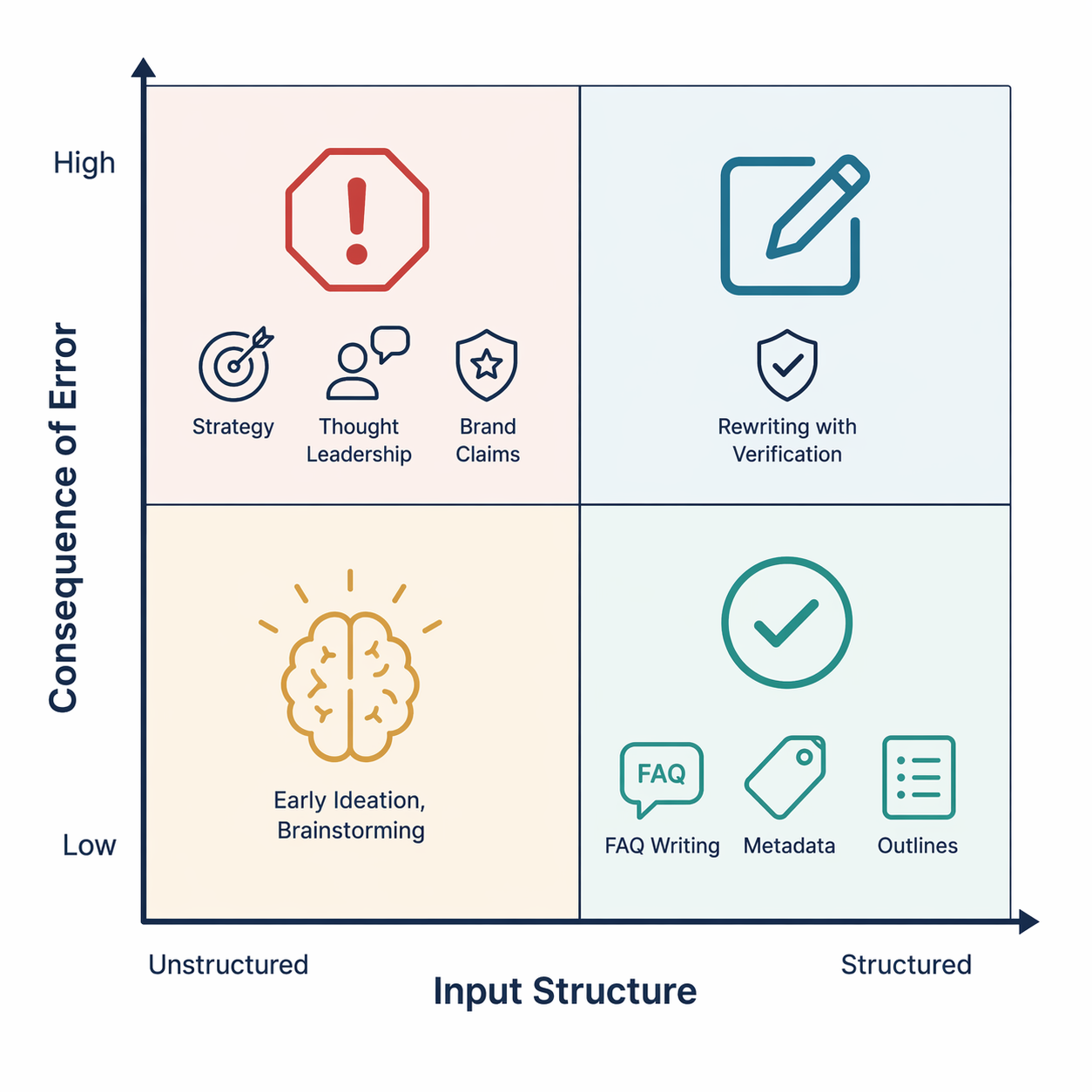
Before assigning a task to ChatGPT, look at two things: how structured the task is, and how much damage a wrong answer can do.
Structure is about how clearly the machine can be constrained. A structured input gives ChatGPT boundaries: a transcript, a product page, a keyword list, a sales call summary, a finished article, a style rule, a list of competitors, or a table of facts. An unstructured input asks it to invent too much: “write our point of view,” “find the strategic angle,” “make us sound differentiated,” or “explain what the market is missing.”
Consequence of error is about what happens when the output is wrong, generic, misleading, or off-brand. A weak meta description is annoying. A fabricated benchmark in a thought leadership article is a credibility problem. A bland FAQ can be edited in minutes. A misframed product claim may need legal review, customer-success cleanup, and a tense Slack thread with leadership.
Those two questions produce a more useful framework than “AI can write” or “AI cannot write.”
| Task Profile | Typical Content Tasks | Best Allocation |
|---|---|---|
| Structured input, low consequence of error | Metadata, title variations, FAQ drafts, transcript cleanup, summaries, content repurposing | Delegate to ChatGPT, then spot-check |
| Structured input, higher consequence of error | Rewrites of expert material, source synthesis, product-page refreshes, email variants, SEO updates | Collaborate with ChatGPT, with human verification |
| Unstructured input, low consequence of error | Early ideation, angle exploration, brainstorming, rough outline options | Use ChatGPT as a sparring partner, not a decider |
| Unstructured input, high consequence of error | Strategy, thought leadership, brand claims, original research interpretation, final editorial judgment | Keep human-owned |
This sits close to the automate, edit, and skip framework: automate the bounded work, edit the work where AI creates useful speed, and skip AI delegation when the task depends on context the model cannot own.
Tasks You Can Usually Delegate
The safest ChatGPT tasks in content marketing have a visible source of truth. The model is not deciding what matters; it is compressing, reshaping, formatting, or multiplying material a human has already selected.
Metadata and Title Variations
Meta titles, meta descriptions, social post variants, newsletter subject lines, and headline options are good delegation candidates because they are short, easy to compare, and easy to reject. The editor can see quickly whether the output overpromises, misses the keyword, or flattens the angle.
This does not mean ChatGPT should choose the final title. It means it can produce a larger set of usable candidates than most people want to write from scratch on a deadline. The human still decides which version fits the search intent, brand tolerance, and actual article.
FAQ Drafting
FAQ sections are one of the cleaner uses of ChatGPT because the format is constrained: question, answer, question, answer. Averi’s 2026 benchmarks reported that FAQ sections were cited by LLMs at three times the rate of non-FAQ content, a useful signal even if the data comes from a vendor with a stake in AI content workflows.[2]
The practical version is not “ask ChatGPT what people ask.” A stronger workflow is to feed it search queries, sales-call objections, customer-success notes, and the article draft, then ask for questions that are directly answerable from those materials. The editor deletes anything speculative, combines duplicates, and checks whether each answer says something concrete.
Outlines From Existing Research
ChatGPT is useful for outline drafting when the research set is already assembled. Give it competitor headings, keyword notes, interview excerpts, product constraints, and the intended reader. Ask for possible structures, not a final strategy. The output is most useful when it exposes ordering options: what belongs early, what can be collapsed, what is missing, and where the article might become repetitive.
This is also where the 74% ideation-and-brief usage figure makes sense. Marketers are not wrong to use AI at the front of the process; the mistake is letting the first plausible outline become the editorial decision.[1]
Transcript Extraction and Summaries
Sales calls, webinars, SME interviews, podcast transcripts, and internal workshops often contain the raw material content teams need but cannot quickly use. ChatGPT can pull out objections, repeated phrases, pain points, examples, claims, definitions, and possible article sections. This is not original research analysis yet; it is extraction.
The guardrail is simple: require traceability. If a summary says customers are confused about implementation time, the editor should be able to find the transcript lines that support it. If the transcript does not support it, the sentence does not survive.
Repurposing Finished Content
Turning a webinar into a LinkedIn post, a guide into an email, or a long article into a short summary is usually safer than asking ChatGPT to create the original asset. The source material already carries the argument. The model helps change length, format, or channel.
This is still editorial work. The person reviewing the output needs to check whether the repurposed version preserved the claim accurately or quietly made it broader, punchier, and less true.
Tasks That Work Better as Human-AI Collaboration
The middle zone is where ChatGPT often saves real time but cannot be trusted to finish the job. These tasks have enough structure to make the model useful, but enough consequence that a human has to verify, interpret, and decide.
Rewriting and Editing Existing Drafts
ChatGPT can tighten a long paragraph, make a dense explanation easier to scan, or turn rough notes into a readable first pass. That is valuable, especially when the alternative is a senior editor doing mechanical cleanup before they can even reach the real issue.
The risk is that fluency hides loss. A rewrite can remove nuance, soften a necessary caveat, make a claim sound more certain than the source allows, or replace a specific voice with competent sameness. Portent identifies generic tone, hallucinated information, and the inability to generate new information as important limitations in ChatGPT content workflows.[3] Poetica Marketing also flags factual reliability, generic output, and keyword-placement issues as recurring concerns.[4]
The review question is not “does this read well?” It is “did the rewrite preserve the thing that made the paragraph worth publishing?”
Email Variants
Email is a strong collaboration case because teams often need variants: subject lines, preview text, segmentation angles, nurture copy, and follow-up versions. Francesca Tabor’s roundup cites an aggregate 13.4% click-through-rate improvement for AI-assisted email campaigns, which is promising but should be read as a collaboration benchmark, not proof that unreviewed AI emails outperform human work.[5]
The allocation is straightforward: let ChatGPT generate options, then have the marketer choose based on audience stage, offer quality, list fatigue, and promise accuracy. AI can write ten ways to frame the CTA. It cannot know which promise your sales team can actually defend.
SEO Refreshes and On-Page Adjustments
ChatGPT can help identify missing subtopics, draft internal-link suggestions, rewrite stale introductions, and generate FAQ candidates for an existing page. Averi reported that content with statistics saw 28% to 40% higher AI visibility, and that internal linking density of 15 or more links correlated with number-one ranking in its benchmarks.[2] Those are useful prompts for editorial review, not mechanical rules to apply everywhere.
This is where SEO nuance matters. A model can suggest adding a keyword. A human has to decide whether the query belongs on the page, whether the page satisfies the intent, whether the added section bloats the article, and whether a statistic is actually relevant. Poetica Marketing’s warning that ChatGPT can struggle with exact keyword placement is less about one formatting error and more about this larger problem: SEO is not just including terms; it is deciding what the page deserves to rank for.[4]
Tasks Humans Should Own
The human-only category is not a defense of creativity as magic. It is an accountability decision. Some work depends on original evidence, strategic tradeoffs, brand risk, and judgment under uncertainty. ChatGPT can support that work, but it should not own it.
Creative Strategy
Strategy decides what the company will say, what it will ignore, which audience it is willing to disappoint, and which tradeoffs are worth making. Those decisions require market context, business priorities, politics, constraints, and taste. ChatGPT can summarize inputs or pressure-test a positioning draft, but it cannot be accountable for the choice.
A strategy document generated from generic prompts tends to sound reasonable because it averages familiar patterns. That is exactly why it is dangerous. Differentiation usually lives in the uncomfortable part: the specific customer you serve better, the claim competitors avoid, the operational proof you can show, or the belief your leadership is willing to stand behind.
Thought Leadership and Original Insight
Thought leadership has to originate something: a useful distinction, a new interpretation, a field observation, a counterintuitive lesson, proprietary data, or a sharper way to frame a problem. Portent’s point that ChatGPT cannot generate new information is the operational boundary here.[3]
The model can help turn an expert’s rough idea into a cleaner draft. It can ask questions, find gaps, or produce alternate structures. But if the expert insight is not already present somewhere in the input, ChatGPT will usually fill the space with consensus language. Consensus language is not thought leadership; it is the material an editor cuts while muttering at the screen.
Brand Claims and Sensitive Product Messaging
Any claim about being first, best, fastest, most secure, easiest, compliant, trusted, proven, or guaranteed needs human ownership. The issue is not that ChatGPT cannot produce polished language. It can. The issue is that polished language often raises the liability of a claim faster than it raises the evidence behind it.
This is also where consumer trust becomes part of the allocation decision. Bynder’s 2025 study found that 52% of consumers were less engaged with content they suspected was AI-generated, and 57% wanted AI-generated content labeled.[6] That does not mean every AI-assisted sentence is a trust problem. It does mean that brand-sensitive, consumer-facing work needs a higher review standard, especially when the content sounds machine-made or overproduced.
For a deeper look at that risk, the trust question belongs with AI-generated marketing and the trust gap, not buried as a footnote after the campaign has already shipped.
Original Research Interpretation
ChatGPT can help clean survey responses, group open-ended answers, summarize interview notes, and format charts into plain-language descriptions. It should not be the final interpreter of original research.
Research interpretation requires deciding what the data can and cannot support. It requires separating adoption from effectiveness, attitude from behavior, correlation from causation, and one notable case from a general pattern. Those distinctions are not decoration. They are the difference between a credible report and a confident asset that quietly overclaims.
Final Editorial Judgment
The final editor is responsible for what gets published. That responsibility includes factual accuracy, source fit, brand voice, argument quality, search intent, reader usefulness, and the decision to cut material that is fluent but unnecessary.
ChatGPT can help prepare the draft for review. It can flag repetition, suggest missing sections, simplify a paragraph, or generate a checklist. It cannot sign off on whether the piece should exist, whether it is saying the right thing, or whether the brand should stand behind it.
Why Human Editing Changes the Outcome
The strongest argument for human-AI collaboration is not sentiment. It is performance. Digital Applied’s 2026 workflow summary reported a 73% bounce-rate reduction for AI-assisted content with human editing, while unedited AI content showed no improvement.[7] That distinction is the whole operating model in one sentence.
Human editing is not a light polish at the end. It is where the content gets its accountability back. The editor checks the source, narrows the claim, removes the generic setup, restores the expert’s point, changes the order, cuts the section that only exists because the model expected it, and asks whether the answer actually helps the reader do the work.
That is also why “we use AI” is not an operating metric. A team can use ChatGPT heavily and still publish better work if it delegates bounded tasks and protects judgment-heavy ones. Another team can use the same tool and create a pile of plausible drafts that senior people have to rescue.
The same pattern shows up in AI visibility discussions. LocaliQ analysis cited by WordStream found that 50% of AI referral traffic came from 5% of content, a sign that original, high-value assets may carry disproportionate visibility.[8] That finding should not be generalized into a universal law, but it does fit the practical observation: the content most worth finding is rarely the content a model can invent from a blank prompt.
A Practical Allocation Rule for Content Teams
A team does not need a 40-page AI policy to make better delegation decisions. It needs a shared rule that shows up in briefs, production meetings, and edit notes.
- Delegate when the input is structured, the output is short or formulaic, and errors are easy to catch.
- Collaborate when ChatGPT can create speed, options, or cleaner first drafts, but a human must verify meaning, evidence, and fit.
- Keep humans in control when the task depends on original insight, strategic consequence, factual authority, brand trust, or final editorial judgment.
In practice, that means ChatGPT can draft FAQ candidates, summarize transcripts, generate title options, reshape finished material, and produce rough outlines from supplied research. It can assist with email variants, SEO refreshes, expert rewrites, and source synthesis when review time is planned into the workflow. It should not own the strategy, the point of view, the research interpretation, the brand claim, or the final publish decision.
If the team needs a broader production system around those choices, the next step is a workflow layer like the AI content marketing workflow, where task allocation, review ownership, and measurement sit in the same process instead of living in separate conversations.
The 97% adoption number says AI is already inside the content operation.[1] The 19% KPI-tracking number says many teams still do not know what it is doing there.[2] Until that measurement catches up, the safest discipline is allocation: give ChatGPT the bounded work, use it to accelerate reviewable work, and keep humans accountable for the work where being wrong costs more than being slow.
References
- 7 Content Marketing Trends Shaping 2026 [New Data], Siege Media.
- State of AI in Marketing (2026): 7 Trends Reshaping the Industry, Averi.
- 5 Best Ways to Use ChatGPT for Content Marketing, Portent.
- 3 Pros and Cons of ChatGPT In Content Marketing, Poetica Marketing.
- Top Chat GPT Use Cases for Marketing & Advertising, Francesca Tabor, December 5, 2025.
- Bynder 2025 study, Bynder, 2025.
- Digital Applied 2026 summary, Digital Applied, 2026.
- LocaliQ analysis cited by WordStream, WordStream.

Comments
Join the discussion with an anonymous comment.