

Google's AI Spam Policy: An Audit Checklist for SEO Practitioners
A practical audit checklist based on Google's May 2026 spam policy amendment, helping you identify which GEO and content tactics carry enforcement risk and what specific changes to make in Q3 2026.
Google’s spam policies now include “attempting to manipulate generative AI responses in Google Search” inside the definition of spam.[1] That sentence is the useful starting point for a Q3 2026 audit. It does not require a new panic deck, a new taxonomy of “AI spam,” or a vendor’s private theory of how AI Mode citations are scored. It requires pulling your GEO, content, link, and technical experiments into the same spam-policy review you should already be running.
The operational read is simple: if a tactic exists mainly to steer AI Overviews or AI Mode into quoting, ranking, or recommending you in a way that would look manipulative under Google’s existing spam categories, it belongs in the audit queue. If it improves usefulness, crawlable clarity, source quality, or page organization for users and Google Search generally, it probably belongs in the normal SEO workstream.
That distinction matters because Google’s own AI optimization guidance is blunt about several popular “AI visibility” add-ons. Google says llms.txt files, content chunking, AI-specific rewriting, inauthentic mentions, and special schema markup are not necessary for Google Search generative AI features.[2] Some of those are merely busywork. Some are warning labels with invoices attached.
Why This Audit Belongs On The Q3 List
Google framed the May 15 policy language as a clarification, not as a brand-new violation category.[1] That is still a meaningful clarification. It tells practitioners that AI search manipulation can be treated through the same spam framework as scaled content abuse, cloaking, link spam, site reputation abuse, doorway abuse, scraping, and thin affiliate behavior.
The timing also makes this hard to file under “watch later.” Google’s June 2026 spam update began on June 24, 40 days after the May 15 policy clarification.[3] That does not prove the update targeted any specific GEO tactic, and Google has not published the signal-level enforcement recipe. But it is enough of a cadence signal to justify auditing now rather than waiting for a traffic graph to explain the problem for you.
The March 2026 spam update had already shown how quickly spam systems can move, with coverage describing it as completed in under 20 hours.[4] A fast rollout and a later AI-search clarification do not create a clean cause-and-effect chain. They do, however, make one thing practical: remediation debt is more expensive than preventive review.
There is also a recovery problem. Google’s spam policy documentation says that when an algorithmic spam demotion is lifted, recovery may take “a period of months,” and there is no manual reconsideration route for algorithmic actions.[1] That is the part that gets lost when a GEO experiment is pitched as harmless. Someone eventually has to explain why the cleanup is slow.
Run The Audit By Spam Category, Not By Tool Name
Do not start by asking whether a tactic is “GEO,” “AEO,” “LLMO,” or whatever label procurement approved this quarter. Start with the old categories. The label on the tactic is less important than the behavior it creates.
| Audit category | Risk signal | What to check | Default action |
|---|---|---|---|
| Scaled content abuse | Large volumes of AI-generated or lightly edited pages built mainly to capture AI citations | Page clusters, templates, generation prompts, indexation rules, quality review records | Consolidate, rewrite, noindex, or remove pages that do not add independent value |
| Inauthentic mentions | Self-serving recommendations, fake neutrality, or engineered third-party-looking mentions | Best lists, comparison pages, contributor posts, partner content, review language | Disclose relationships, remove fake neutrality, replace claims with verifiable evidence |
| Cloaking or AI-specific variants | Different content for Googlebot, AI crawlers, users, or AI retrieval layers | Rendering rules, edge logic, user-agent handling, hidden blocks, alternate templates | Serve the same substantive content to users and Google systems |
| Link or reputation abuse | Borrowed authority, paid placement, or third-party publishing used mainly to influence AI answers | Sponsored posts, parasite pages, link placements, author bylines, affiliate arrangements | Remove or qualify manipulative placements and document legitimate editorial control |
| Doorway-style answer pages | Many near-duplicate pages targeting small query variants for citation coverage | Programmatic pages, location/query permutations, internal search pages, answer hubs | Merge into stronger resources or remove low-value variants |
| Scraping | Republished summaries, copied rankings, or derivative pages without added value | Source overlap, rewrite workflows, syndicated material, AI summarization pipelines | Replace with original analysis, obtain rights, or remove |
| Thin affiliate content | Pages that mainly route users to offers while pretending to be independent recommendations | Affiliate templates, review criteria, testing evidence, monetized comparison pages | Add real evaluation, clarify monetization, or remove pages that cannot stand on their own |
This is where a lot of AI-search cleanup gets simpler. You are not trying to prove that Google has named your exact tactic. You are asking whether the tactic would survive being described plainly to a client, an editor, and the spam policy page. If the honest description sounds like “we made this so AI systems would mention us more often,” keep digging.
Scaled AI Content Built For Citation Volume
Google’s scaled content abuse policy already names “generative AI tools or other similar tools” as one way scaled abuse can be produced.[1] The issue is not whether AI touched the draft. The issue is whether the site is publishing large volumes of low-value pages to manipulate search rankings or, now, generative AI responses in Google Search.
Audit the content library for clusters that were created after someone mapped AI Overview prompts, People Also Ask patterns, or “best answer” opportunities and then generated a page for each variation. Pay attention to pages that have no original reporting, no tested product experience, no meaningful expert review, and no reason to exist outside citation capture.
- Pull URL groups created by the same template, prompt, brief, or automation workflow.
- Sample pages for repeated paragraphs, generic conclusions, invented completeness, and weak sourcing.
- Check whether each page answers a distinct user need or only targets a distinct query phrasing.
- Look for pages that cite sources without adding interpretation, testing, or decision support.
- Separate pages that can be improved from pages that should be consolidated or removed.
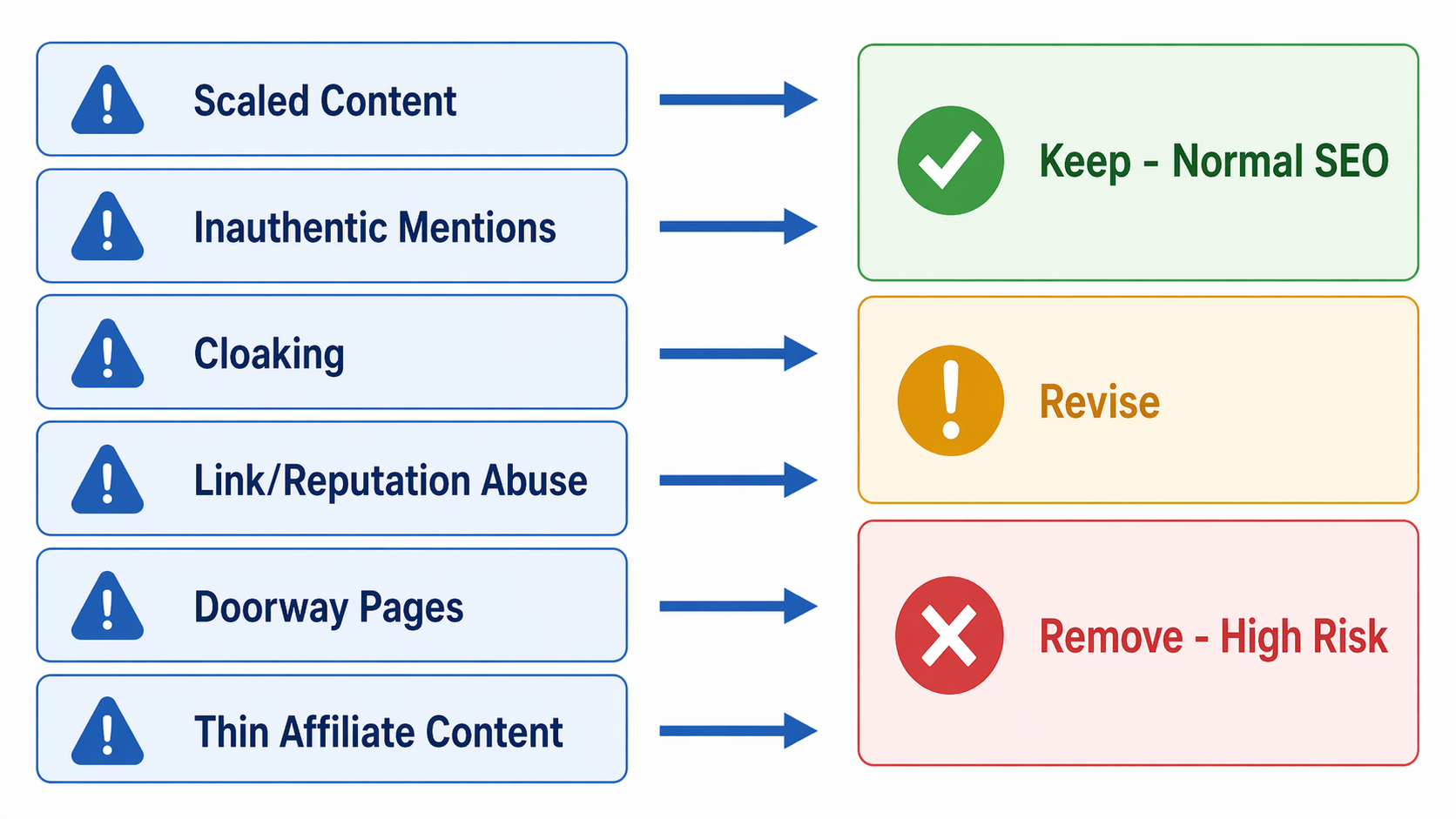
A practical cleanup usually has three buckets. Keep pages with clear utility and real editorial review. Revise pages where the topic is valid but the execution is generic. Remove or noindex pages that were manufactured only to create more entry points for AI citation.
Inauthentic Mentions And Self-Promotional Best Lists
Inauthentic mentions deserve special attention because they are easy to sell internally as “brand seeding.” They also leave a messy footprint: fake editorial neutrality, undisclosed relationships, brand-owned comparison pages ranking the brand first, and third-party-looking content that exists mainly to feed recommendation systems.
Ahrefs found that 67.6% of “best X software” SERPs in its study featured a list where the company ranked itself number one.[5] The same research reported that 28% of ChatGPT’s most-cited pages had zero organic visibility.[5] That second number is about ChatGPT, not Google AI Overviews, so it should not be treated as a Google enforcement finding. It is still a useful reminder that AI recommendation surfaces can reward pages that would not necessarily pass a traditional organic visibility sniff test.
For this audit, the question is not “do comparison pages work?” Comparison pages can be useful. The question is whether the page is pretending to be independent while being engineered to make an AI answer repeat your preferred ranking.
- Check whether owned or affiliated properties present the brand as an independent top recommendation.
- Review disclosures on partner, contributor, affiliate, and sponsored recommendation pages.
- Verify that ranking criteria are real, visible, and applied consistently to competitors and the brand.
- Remove claims that cannot be supported outside the page itself.
- Replace fake neutrality with explicit product positioning, transparent comparisons, or first-party evidence.
Microsoft’s research on AI recommendation poisoning gives a more adversarial version of the same problem. It documented more than 50 unique prompts from 31 companies across 14 industries that embedded memory manipulation through “Summarize with AI” buttons.[6] That is Microsoft’s security research, not a Google statement about ranking systems. Still, it shows why platforms are unlikely to treat AI-answer manipulation as a cute growth hack indefinitely.
Cloaking, Hidden Blocks, And AI-Only Variants
Cloaking is one of the easiest areas to audit because the principle has not changed: do not show Google something materially different from what users get.[1] AI search has simply created more places for teams to get clever with variants.
Review any implementation that detects crawlers, AI user agents, referrers, regions, logged-out states, or rendering conditions. The goal is not to ban personalization or technical optimization. The goal is to catch cases where the site serves a cleaner, more citation-friendly, more claim-heavy, or more keyword-loaded version to systems than to users.
- Compare rendered HTML for Googlebot, normal users, and any AI-specific crawler handling your team has configured.
- Look for hidden summaries, injected Q&A blocks, or invisible entity lists meant only for machine extraction.
- Check edge workers, CDN rules, server-side rendering logic, and experimentation platforms.
- Remove AI-only copy variants unless the same substantive information is available to users.
Google’s AI optimization guide also undercuts the excuse for much of this work. It says AI-specific rewriting is not necessary for Google Search generative AI features.[2] If the page needs clearer structure, improve the page. Do not maintain a second, machine-facing version and hope nobody later has to explain it.
Link Spam And Site Reputation Abuse Wearing A GEO Badge
The link and reputation-abuse review should include any campaign where the stated purpose was to get your brand mentioned on pages likely to be used by AI systems. That includes digital PR, affiliate placements, paid contributor posts, “top tools” pages, hosted microsites, and third-party pages published under someone else’s domain authority.
Not every mention campaign is spam. A real review, a properly disclosed sponsorship, a legitimate partner integration page, or a newsworthy mention can be part of normal marketing. The risk rises when the page’s editorial purpose is weak and the placement exists mainly to transfer authority, shape recommendation text, or manufacture consensus.
- Inventory paid, affiliate, sponsored, partner, and contributor placements from the last 12 months.
- Tag placements that use ranking language such as “best,” “top,” “recommended,” or “number one.”
- Check whether links and commercial relationships are disclosed and qualified appropriately.
- Remove placements where you would not be comfortable saying the commercial arrangement out loud.
- Keep earned coverage and editorially controlled pages that can stand without the AI citation rationale.
This is also a good place to coordinate with whoever owns affiliate, partnerships, and PR. Spam risk rarely respects org charts. The SEO team may be the one watching Search Console, but the footprint often comes from campaigns approved somewhere else.
Doorway-Style Answer Pages
Doorway risk shows up when teams build many pages that lead users to essentially the same destination while targeting tiny variations in AI-search phrasing. In older SEO audits, these might be city pages, industry pages, or query permutations. In GEO audits, they often look like answer pages tuned to the ways AI Overviews might summarize a topic.
The audit should group pages by intent, not just by folder. If 40 pages answer the same decision with slightly different framing, the site probably needs one stronger resource, not 40 thin candidates for extraction. A user should be able to tell why each page exists without seeing the keyword map.
- Cluster pages by user decision, product category, location, and query template.
- Identify pages that funnel to the same conversion path without adding distinct help.
- Merge overlapping answer pages into fewer, more complete resources.
- Redirect or remove variants that exist only for query coverage.
If you need legitimate structure guidance for AI Overview eligibility, keep it on the safe side: clear headings, direct answers, accessible source material, and pages that satisfy real intent. For more on that side of the work, see how to structure content for AI Overview citations.
Scraping And Derivative Summaries
Scraping risk has become easier to hide behind AI rewriting. A page can look original sentence by sentence and still be derivative in substance: copied selection criteria, copied rankings, copied source lists, copied examples, or summaries that add no new evaluation.
Audit any workflow that begins with competitor pages, SERP exports, AI-generated summaries of existing articles, or scraped review data. The question is whether the final page contributes something the source material does not: original testing, clearer synthesis, expert interpretation, proprietary data, user research, or a better decision framework.
- Review source documents used in AI-assisted briefs and drafts.
- Check whether rewritten pages preserve another site’s structure, conclusions, or ranking order.
- Replace synthetic summaries with original evaluation where the topic matters commercially.
- Remove pages that cannot be made useful without copying someone else’s work pattern.
Thin Affiliate Pages That Want To Be AI Recommendations
Thin affiliate content becomes more fragile when it is dressed up for AI answers. A product roundup with affiliate links, generic pros and cons, manufacturer claims, and no evidence of hands-on evaluation was already a quality problem. If the page is also engineered to make AI Mode recommend the monetized option, it becomes a cleaner audit target.
The fix is not to delete every affiliate page. The fix is to make the page earn its recommendation. Show how products were selected, what was tested, where the product is a poor fit, how prices or availability affect the recommendation, and what commercial relationship exists. If that work is not worth doing, the page probably was not worth publishing.
Stop The Add-Ons Google Already Said You Do Not Need
Google’s AI optimization guide is useful because it narrows the cleanup. It tells teams not to spend time on several AI-specific tactics that have been sold as mandatory for visibility in generative AI features.[2] That does not mean every implementation of these tactics is spam. It means they should not be defended as necessary Google AI optimization when Google says otherwise.
| Tactic | Audit read | What to do instead |
|---|---|---|
| llms.txt files | Not needed for Google Search AI visibility according to Google’s guide | Prioritize crawlable, indexable, useful pages and standard robots controls |
| Content chunking for AI systems | Not necessary as a special Google AI tactic | Use clear page structure because it helps users and normal search understanding |
| AI-specific rewriting | Risky when it creates machine-facing variants or claim-heavy alternate copy | Improve the public page itself |
| Inauthentic mentions | Explicitly unnecessary and aligned with spam-risk behavior | Earn or disclose mentions; remove fake independence |
| Special schema markup for AI features | Not required as a special AI visibility mechanism | Use supported structured data only when it accurately represents visible page content |
There is still plenty to keep. Good SEO does not become suspicious because AI Overviews exist. Clean information architecture, strong source pages, original evidence, helpful comparison logic, descriptive headings, accessible content, and accurate structured data are still sensible. The difference is that they can be explained without pretending to hack an answer engine.
If your team needs to separate legitimate workflow changes from policy risk, use what GEO actually changes in your SEO workflow as the workflow layer and this audit as the compliance layer. They should not be the same document.
How To Decide: Keep, Revise, Remove
For each tactic or URL group, assign one of three outcomes. Do it in writing. The documentation matters because memory gets very selective after an algorithmic hit.
- Keep: the page or tactic serves users, uses transparent sourcing or relationships, and would make sense even if AI Overviews did not exist.
- Revise: the topic or campaign is legitimate, but the execution includes exaggerated claims, weak disclosure, duplicated structure, thin evidence, or AI-specific formatting theater.
- Remove: the asset exists mainly to manipulate AI citations, manufacture recommendations, scale low-value answers, cloak content, borrow reputation, or monetize without independent value.
The revise bucket is where most real work lands. A self-promotional “best” list might become a transparent comparison page. A bloated answer cluster might become one strong guide. A thin affiliate page might become a real evaluation with disclosures and limits. A machine-facing summary block might become visible, useful page content or disappear.
The remove bucket should not require a philosophical debate. If the asset’s only defensible purpose is “AI systems might cite this,” it is carrying more risk than value. That is especially true when the asset involves fake independence, hidden variants, mass generation, or borrowed authority.
Handle Industry Evidence Carefully
There is useful evidence around AI-answer manipulation, but it needs careful labeling. Ahrefs’ self-promotional list research is a strong illustration of how recommendation content can become distorted, but its ChatGPT citation findings are not the same as Google AI enforcement data.[5] Microsoft’s recommendation-poisoning research shows a real attack surface, but it is not a list of Google spam signals.[6]
BBC Future reported Lily Ray’s observation that Google may be quietly removing companies from AI answers when self-promotion is suspected, and the article said Google declined to comment on that point.[7] Treat that as an industry observation reported by the BBC, not as a confirmed Google enforcement disclosure.
That conservative reading is not weakness. It is how you avoid replacing one bad habit with another. The audit does not need secret signal claims to be useful. Google has already given enough policy language to review the tactics.
The Q3 2026 Working File
Build one working file for the audit. Keep it boring. Boring is good here.
| Field | What to record |
|---|---|
| URL or tactic | The affected page, template, campaign, placement, or technical rule |
| Owner | SEO, content, PR, affiliate, product marketing, engineering, agency, or partner |
| Spam category | The closest existing Google spam-policy category |
| AI-search behavior | How the tactic attempts to influence AI Overviews, AI Mode, or generative responses |
| Evidence | Examples, screenshots, rendered HTML, source files, contracts, prompts, briefs, or placement records |
| Decision | Keep, revise, remove, noindex, consolidate, disclose, or redirect |
| Date changed | When the remediation went live |
| Monitoring note | Queries, pages, traffic segments, and AI citation observations to watch |
Do not overfit the file to AI Overviews visibility alone. Track normal organic performance, indexation, crawl behavior, conversions, and content quality changes too. If the cleanup improves the site only by making it less embarrassing to explain, that is still a win.
For teams still building a citation-first approach, the safe version is not “get mentioned anywhere an AI might look.” It is to create pages and evidence worth citing, then make them accessible and clear. That strategy sits much closer to citation-first SEO for Google AI Overviews than to the manufactured-consensus playbook.
The action point for Q3 is narrow: remove or revise tactics that only exist to manipulate AI citation surfaces, keep normal SEO practices that improve usefulness and crawlable clarity, document what changed, and assume that recovery from an algorithmic spam hit may take months rather than a support ticket.[1]
References
- Spam Policies for Google Web Search — Google Search Central
- Google's Guide to Optimizing for Generative AI Features — Google Search Central
- Google June 2026 Spam Update — Digital Applied
- Google Spam Update March 2026 — SEO Kreativ
- Ahrefs: Do Self-Promotional 'Best' Lists Boost ChatGPT Visibility? — Ahrefs
- Microsoft Security Blog: Manipulating AI Memory for Profit — Microsoft Security Blog
- BBC Future: Google's AI is being manipulated — BBC Future

Comments
Join the discussion with an anonymous comment.