
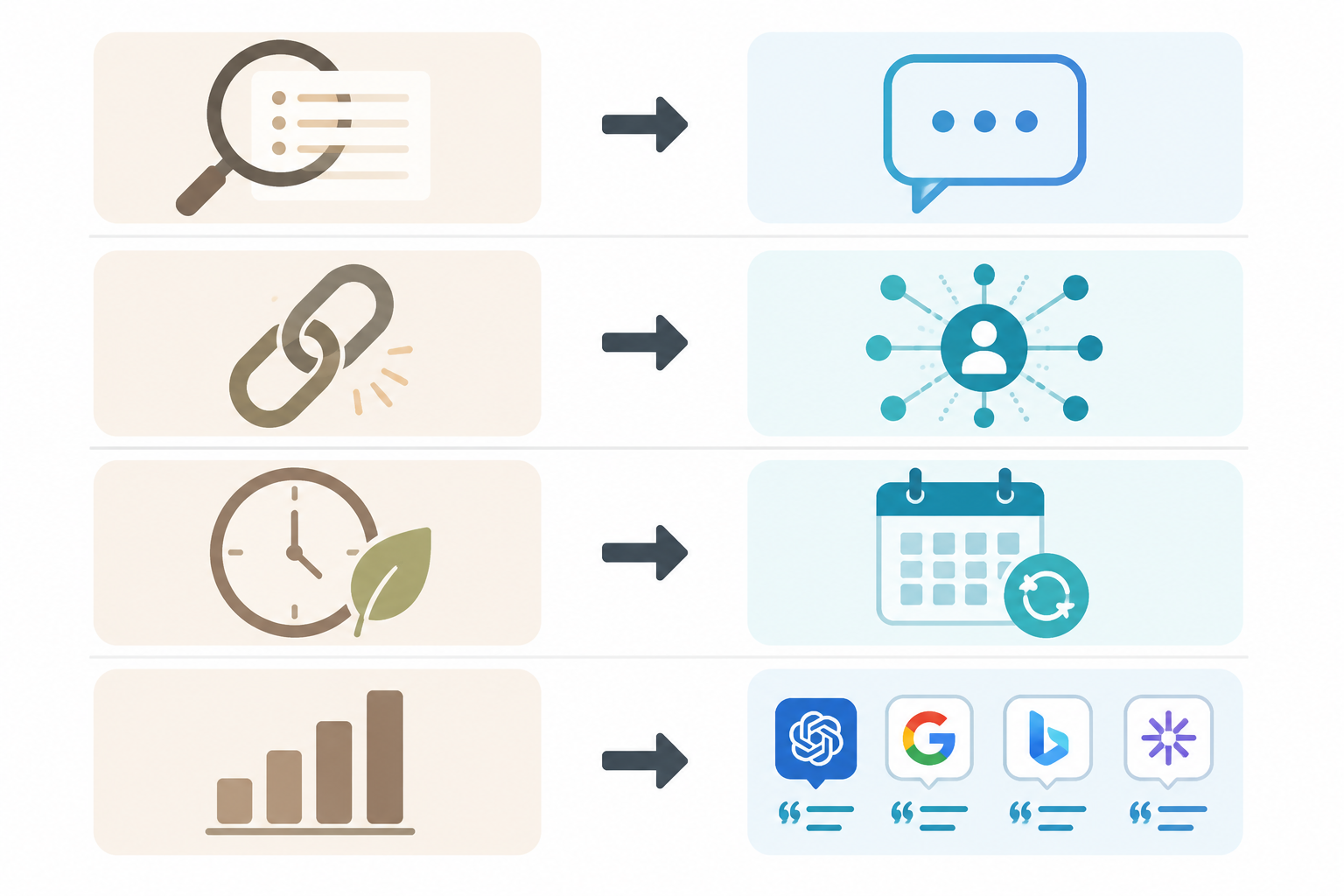
What GEO Actually Changes in Your SEO Workflow
This article breaks down the four concrete workflow changes—from prompt-based keyword research to multi-platform citation tracking—that GEO demands from SEO practitioners, with supporting data from 2025–2026 research.
The practical problem with GEO vs SEO for marketers is not whether classic SEO still matters. It does. The problem is that the old workflow was built around Google results pages, keyword demand, backlinks, publishing queues, and rank movement. AI search adds another surface where the same page can be ignored, cited, summarized, or used as supporting evidence without ever behaving like a normal blue-link result.
That changes the work. Not all of it, and not overnight. Technical hygiene, intent mapping, helpful content, internal linking, and measurement discipline still belong on the calendar. But if the team stops there, it misses four operating shifts that are already visible in 2025–2026 research: prompts instead of keywords alone, entity authority instead of link building alone, shorter freshness cycles instead of loose evergreen maintenance, and citation tracking instead of rank tracking alone.
| Classic SEO workflow | GEO workflow addition | What changes on Monday |
|---|---|---|
| Keyword research | Prompt mapping | Research longer, conversational inputs and map them to answerable content blocks |
| Link building | Entity authority | Track branded mentions, citations, and structured signals alongside backlinks |
| Evergreen publishing | 90-day freshness cadence | Refresh high-value pages before AI citation decay becomes visible |
| Rank tracking | Multi-platform citation tracking | Measure whether ChatGPT, Gemini, Copilot, Perplexity, and AI Overviews cite or omit you |
The Unit of Research Moves From Keywords to Prompts
A keyword sheet can still tell you what people search. It is less reliable at telling you what people ask an AI system to synthesize. That distinction matters because AI inputs are longer and more conversational than conventional search queries. One 2026 analysis reports that Google queries average 3–4 words, ChatGPT search averages 5.48 words, Google AI Mode averages 7.22 words, and direct ChatGPT prompts average 23 words, drawing on Nectiv, ExposureNinja, and Semrush data as summarized by iFactory.[1]
The planning consequence is simple: a content brief built only around “best CRM for agencies” is thinner than the AI-search demand around it. The prompt-shaped version may include constraints, comparisons, user profile, budget, implementation anxiety, migration risk, integrations, and a request for a recommendation. Those are not just long-tail keywords. They are answer specifications.
Prompt mapping starts by keeping the keyword, then expanding the research object around the jobs a user gives the model. For a commercial investigation page, the map should capture:
- The short keyword or topic cluster the SEO program already tracks
- The likely prompt formats: compare, recommend, diagnose, explain, shortlist, calculate, summarize
- The constraints users add: company size, budget, risk tolerance, industry, current tool, timeline
- The evidence an AI answer would need: statistics, product limits, pricing logic, examples, definitions, quotes, caveats
- The page sections that directly answer those prompts without requiring the model to infer too much
This is where GEO starts to affect the brief, not just the optimization pass. A traditional brief might include primary keyword, secondary keywords, search intent, SERP competitors, outline, internal links, and metadata notes. A GEO-ready brief adds prompt families and answer blocks. The page does not need to stuff in awkward question strings. It does need to be easy for a model to retrieve, parse, and cite when the user asks a detailed question.
For example, a hypothetical brief for “marketing attribution software” should not stop at “best marketing attribution tools.” It should also map prompts such as “recommend attribution software for a B2B SaaS team with HubSpot and a six-month sales cycle” or “explain when first-touch attribution is misleading for paid search reporting.” The exact prompts will vary by audience, but the planning habit is the same: collect the modifiers that change the answer.
How to Add Prompt Mapping Without Rebuilding Research
The lightweight version fits into the existing research step. Start with the keyword set. For each priority topic, add a column for “AI prompt pattern” and another for “answer requirement.” The prompt pattern names the task: comparison, recommendation, troubleshooting, planning, definition, or evaluation. The answer requirement names the content asset needed to satisfy it: table, short definition, step sequence, pro/con comparison, dated statistic, quoted expert view, or source-backed claim.
| Keyword target | Prompt pattern | Answer requirement |
|---|---|---|
| GEO vs SEO for marketers | Explain what changes in my workflow | Side-by-side workflow table and operating changes |
| AI content measurement | Show which KPIs change when AI tools are involved | Measurement framework and citation-style KPIs |
| AI marketing strategy roadmap | Plan implementation over 90 days | Phased schedule with ownership and review points |
The point is not to predict every possible prompt. It is to stop pretending that a two-word keyword and a 23-word prompt create the same content requirements. The keyword can name the market. The prompt often names the decision.
Authority Looks Less Like a Link Graph and More Like Entity Evidence
Backlinks do not become irrelevant in GEO. They are still part of the web’s authority infrastructure, and they still matter for organic visibility. But AI visibility appears to reward a broader entity footprint. In iFactory’s secondary analysis of Ahrefs data, branded web mentions correlated with AI Overview visibility at 0.664, while backlinks correlated at 0.218, a roughly 3:1 gap.[1]
That number should not be treated as a universal law. It is correlation, not causation, and it is reported through a secondary source rather than directly from the original Ahrefs post. Still, it is strong enough to challenge a budget line. If the only off-page plan is “get more links,” the plan may be underinvesting in the signals that help AI systems identify who the brand is, what it is known for, and where it is referenced.
Entity authority is the least useful when it becomes a vague brand aura. In a working SEO operation, it needs to be translated into evidence the team can track:
- Unlinked branded mentions on relevant third-party sites
- Citations in industry explainers, reports, podcasts, webinars, and comparison pages
- Consistent organization, product, author, and expert profiles across owned properties
- Schema that clarifies entities, relationships, authorship, FAQs, products, and services
- Pages that state claims clearly enough for a model to attribute them without rewriting the source beyond recognition
This does not mean every SEO lead needs to become a PR department. It does mean the link-building queue should be audited. A guest post that creates a weak backlink from an irrelevant site may be less useful than a credible mention in a topical resource that names the company, product, category, and point of view. The measurement habit shifts from “did we get a link?” to “did the web gain more consistent evidence about this entity?”
Structured data belongs here, but with a caveat. Dietz Group reports that FAQPage schema provides a 3.7x citation lift, while listicle formats achieve a 25% citation rate compared with 11% for narrative blog posts.[2] Those are vendor-published figures, so they are better treated as directional test inputs than as guaranteed performance promises. If a team already has FAQ sections, comparison tables, and list-based buying guides, schema cleanup is a reasonable experiment. It should not become the whole GEO strategy.
Freshness Becomes a Citation Maintenance Problem
SEO teams already know that some pages age faster than others. GEO tightens the refresh window because AI systems appear to favor newer cited material in many answer contexts. Dietz Group, citing 2026 GEO statistics, reports that 50% of content cited in AI answers is less than 13 weeks old.[2]
That does not mean every evergreen article needs a full rewrite every quarter. It does mean “last updated two years ago” is a larger liability when the page competes to be cited inside an AI answer. The practical cadence is a 90-day review for pages that serve volatile decisions: software comparisons, pricing explainers, regulatory topics, statistics pages, market maps, tool roundups, and strategy articles that reference current platform behavior.
A 90-day GEO refresh is narrower than a rewrite. The editor checks whether the claim set is still current, whether the page has a visible last-reviewed date, whether statistics need replacement, whether examples still reflect the market, whether structured data still matches the page, and whether the page answers the prompt families now appearing in AI results. For teams already running refresh queues, this is a prioritization change more than a new department.
If the team needs a broader implementation rhythm, the 90-day cadence maps naturally to phased planning: choose the pages, update evidence and structure, then measure citation movement. Signal & Convert’s 90-day AI marketing strategy roadmap is a useful companion if the issue is not knowing what GEO is, but getting the work into a quarter without creating a parallel operating system.
Citation Tracking Is Not Rank Tracking With a New Label
The most uncomfortable data point for a search team may be this one: Dietz Group reports, citing Analyze AI 2025 data, that 89% of ChatGPT citations come from pages ranking below position 20 in Google.[2] If that finding holds across more categories, traditional rank tracking gives an incomplete view of AI visibility. A page can be commercially invisible in Google’s top results and still become a source in a ChatGPT answer. The reverse can also happen.
This is the workflow shift that most teams underestimate. It is tempting to add one “AI visibility” column to the dashboard and move on. That will not be enough because AI platforms do not cite the web in the same way. ChatGPT, Gemini, Copilot, Perplexity, and Google AI Overviews may return different source sets for similar prompts, and visibility in one surface should not be treated as a proxy for visibility in another.
A workable citation-tracking routine starts small. Pick the prompt families tied to revenue or strategic authority. Run them on a fixed schedule across the platforms that matter to the audience. Record whether the brand appears, whether the page is cited, which competitors are cited, which source type wins, and whether the answer uses current or stale information. Over time, the team can calculate citation frequency, share of cited sources, and gaps by platform.
| Metric | What it tells you | Why rank alone misses it |
|---|---|---|
| Citation frequency | How often your domain is used as a source for tracked prompts | A page may be cited even if it does not rank on page one |
| Share of cited sources | How often you appear compared with competitors and publishers | SERP position does not show model preference |
| Platform coverage | Which AI systems cite you, ignore you, or cite competitors | Each platform can produce a different source set |
| Answer accuracy | Whether the model describes your product, category, or point of view correctly | A rank report cannot detect misrepresentation |
| Source freshness | Whether cited pages are current enough to remain useful | Ranking pages may carry outdated claims |
This also changes reporting conversations. A page that holds position five but earns no citations for priority prompts has a different problem than a page that ranks poorly but appears repeatedly in AI answers. The former may need clearer extractable evidence, better structure, stronger entity signals, or fresher claims. The latter may deserve more traditional SEO support because AI citation is revealing source value that the SERP has not rewarded yet.
For teams rebuilding dashboards around this problem, the measurement discussion overlaps with the broader AI marketing KPI gap. The related Signal & Convert guide on how to measure AI content marketing is useful because GEO measurement is not just another traffic report. It has to account for visibility, attribution, citation quality, and downstream behavior.
Content Structure Still Matters, but It Is Supporting Work
Once the larger workflow shifts are in place, the familiar on-page mechanics become more specific. AI systems need content they can parse and attribute. Secondary reporting on Princeton GEO research says that citing sources produced a 40% lift, adding statistics produced a 37% lift, and including quotations produced a 30% lift in AI citation rates over unoptimized content.[3] Because this is reported second-hand through Digital Applied rather than independently reviewed here from the original 2023 paper, it should guide testing rather than be treated as a universal benchmark.
The operational takeaway is not to decorate every paragraph with numbers and quotes. It is to make important claims easier to verify. A page that says “AI search is changing content measurement” is less citable than a page that states what changed, gives a dated source, distinguishes survey evidence from platform behavior, and names the boundary of the claim. The same editorial discipline that improves trust for readers also gives retrieval systems cleaner material to work with.
A GEO editing pass should therefore ask different questions than a standard SEO polish:
- Can a model identify the page’s main entity, category, author, and date context?
- Are key claims supported by citations, examples, or clearly labeled analysis?
- Does the page answer prompt-shaped questions directly enough to be extracted?
- Are comparison tables, lists, FAQs, and definitions used where they genuinely improve comprehension?
- Does the structured data match the visible content instead of describing a page that no longer exists?
This is also where tool decisions should stay subordinate to workflow decisions. A platform can help with monitoring, briefs, schema, or governance, but it cannot decide which prompts matter, which claims deserve evidence, or which pages need quarterly review. If the team is still choosing how much process to formalize before buying more software, Signal & Convert’s piece on AI marketing leaders versus tool collectors frames the decision usefully.
How This Fits Into a Weekly SEO Routine
The cleanest GEO rollout is not a separate initiative with its own mythology. It is a set of additions to the operating rhythm the team already uses.
| Workflow moment | Keep doing | Add for GEO |
|---|---|---|
| Research | Keyword volume, intent, SERP review, competitor pages | Prompt families, user constraints, answer requirements |
| Briefing | Outline, internal links, target queries, technical notes | Extractable answer blocks, source needs, entity references |
| Production | Clear structure, expertise, examples, conversion path | Citable claims, statistics where useful, direct answers to prompt patterns |
| Publishing | Indexability, metadata, schema, internal links | Entity consistency, visible dates, structured FAQ or list elements where appropriate |
| Refresh | Traffic decay, rank drops, conversion updates | 90-day review for AI-sensitive pages and citation freshness |
| Measurement | Rank, impressions, clicks, conversions, assisted revenue | Citation frequency, platform coverage, source share, answer accuracy |
A small team can start with one topic cluster. Choose a cluster that already has business value, not a random blog category. Map the prompts. Update the highest-value page. Add or clean up structured data where it matches the content. Refresh old claims. Run the same prompt set across the AI platforms the audience likely uses. Record citations and competitor appearances. Then repeat the cycle with a second cluster once the team knows how long the work actually takes.
That last point matters because GEO can become another vague mandate if it never meets the calendar. The work has to displace something or sharpen something. It may reduce low-value link outreach. It may change how briefs are written. It may move more editor time into refreshes and source verification. It may add a monthly citation-tracking review next to the rank report. Those are real tradeoffs, which is why “just write helpful content” is not a sufficient plan.
What Not to Overclaim
The current evidence supports workflow changes, not certainty. The branded-mention and backlink comparison is correlational and secondarily reported. The schema and format lifts are vendor-published and should be tested before they are forecast. The Princeton-derived mechanics are also cited here through secondary reporting. AI citation behavior is still changing as platforms update retrieval systems, answer formats, and source policies.
That is not a reason to wait. It is a reason to keep the SEO foundation and modify the workflow where the evidence points: research prompts, build entity evidence, refresh important pages on a tighter cadence, and measure citations across platforms. For Q3 2026, that is the defensible middle ground between pretending nothing changed and throwing out a search discipline that still does a lot of useful work.
References
- GEO vs. SEO: A Higher Ed Marketer’s Guide to What’s Actually Different and What Isn’t, iFactory
- X Things You Need to Know Before Generative Engine Optimization, Dietz Group, June 2026
- GEO Guide: Generative Engine Optimization 2026, Digital Applied

Comments
Join the discussion with an anonymous comment.