
What a Citation-First SEO Strategy Looks Like for Google AI Overviews
Google's AI Overviews have structurally decoupled citations from traditional rankings. This article provides a tactical, data-grounded framework for shifting from position optimization to a citation-first approach — focusing on extractability, topical breadth, and freshness across sub-query SERPs.
The practical problem with a Google AI Overviews SEO strategy in 2026 is not that rankings stopped mattering. It is that rankings stopped explaining enough of the citation layer to run the same workflow with a new dashboard label.
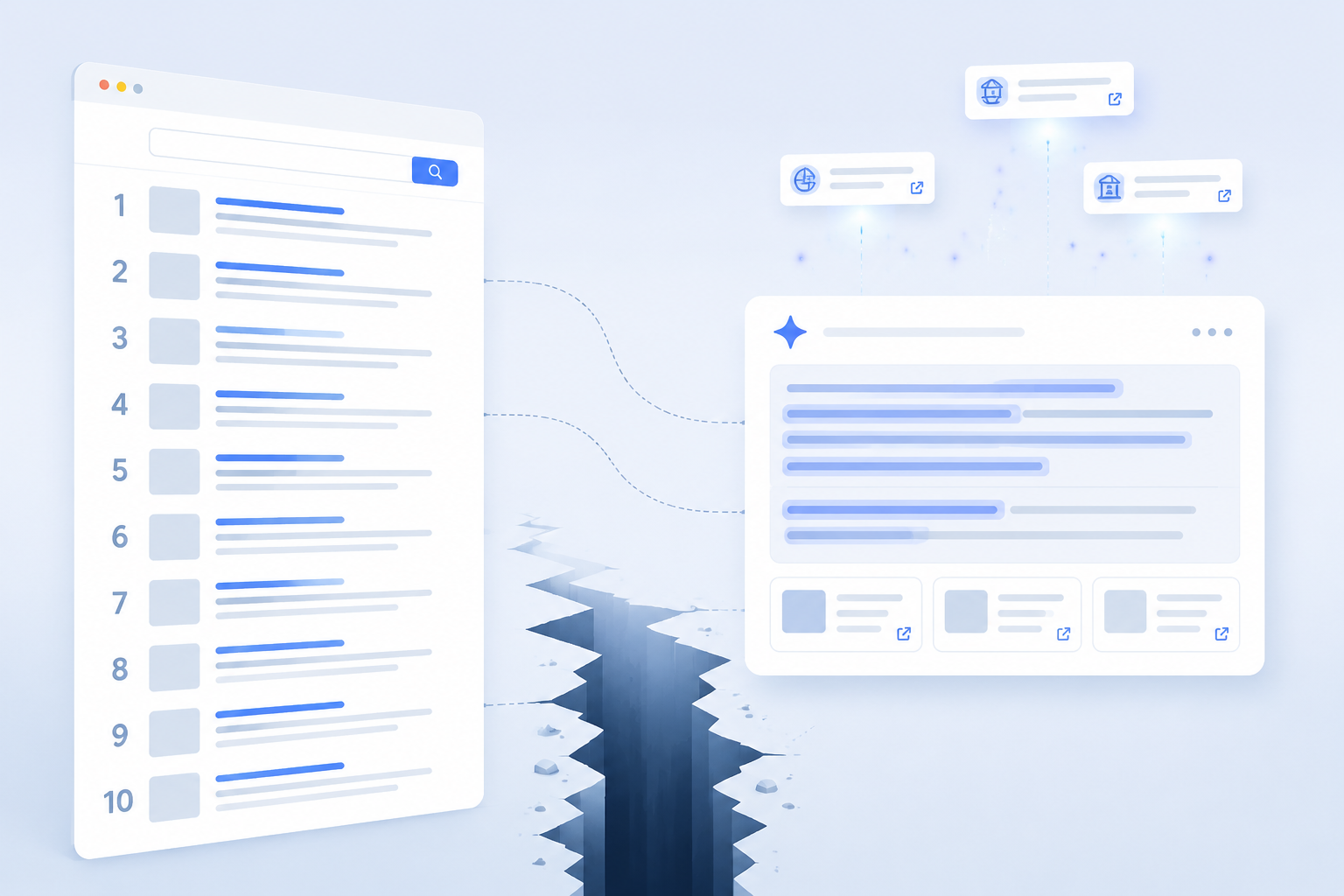
The cleanest evidence is the Ahrefs 863,000-keyword dataset: only 38% of pages cited in AI Overviews also ranked in the top 10 organic results, down from 76% seven months earlier. In other words, a page can hold position one and still be skipped, while a page outside the first page can be pulled into the overview.[1]
That one shift changes the work. The old question was mostly, “What do we need to improve to move this URL from position eight to position three?” The citation-first question is messier: “Which pages, passages, and supporting cluster assets make us eligible to be extracted across the sub-queries Google uses to assemble the answer?”
That does not make technical SEO, authority, or rank tracking optional. It does make them incomplete. If your quarterly plan still treats AI Overview visibility as a byproduct of top-10 ranking, you are leaving the actual citation mechanism mostly unmanaged.
What changed in the workflow
Before AI Overviews became a material surface, an SEO team could usually prioritize from a familiar stack: query demand, current position, URL quality, link equity, conversion value, and content gap. That stack still belongs in the room. It just no longer tells you whether Google can lift a useful answer from the page, whether the page appears across the sub-results that feed the overview, or whether the content is fresh enough to survive the next refresh cycle.
| Old position-first workflow | Citation-first addition |
|---|---|
| Track the ranking URL for the head keyword. | Track which URLs are cited, skipped, and repeated across related AI Overview queries. |
| Optimize the page title, intent match, internal links, and content coverage. | Add extractable answer passages that resolve complete sub-questions without losing context. |
| Build a content brief around one primary keyword and supporting terms. | Build the brief around the head query, fan-out sub-queries, and cluster assets that can support citation eligibility. |
| Refresh when rankings decay or competitors overtake the page. | Refresh when cited passages age, source claims become stale, or the cluster stops matching current sub-query behavior. |
| Report rankings, clicks, impressions, and conversions. | Report citations, citation share by topic, cited URL type, passage freshness, and assisted organic outcomes. |
Traffic loss is part of the context, but it is not the operating model. Ahrefs has reported a 34.5% CTR drop, while Seer Interactive has reported a 61% decline on informational queries; the wider Seer figure is tied to a more affected query set, not a universal search result condition.[1][2] Useful, yes. Sufficient to brief writers next Monday, no.
The mechanism to plan around: query fan-out
The important mechanical detail is query fan-out. Google describes AI search systems that decompose a user query into multiple related searches, then use those searches to gather supporting information for the generated answer. Current industry analysis commonly frames that behavior as roughly 4–10 sub-queries feeding the overview.[3][4]
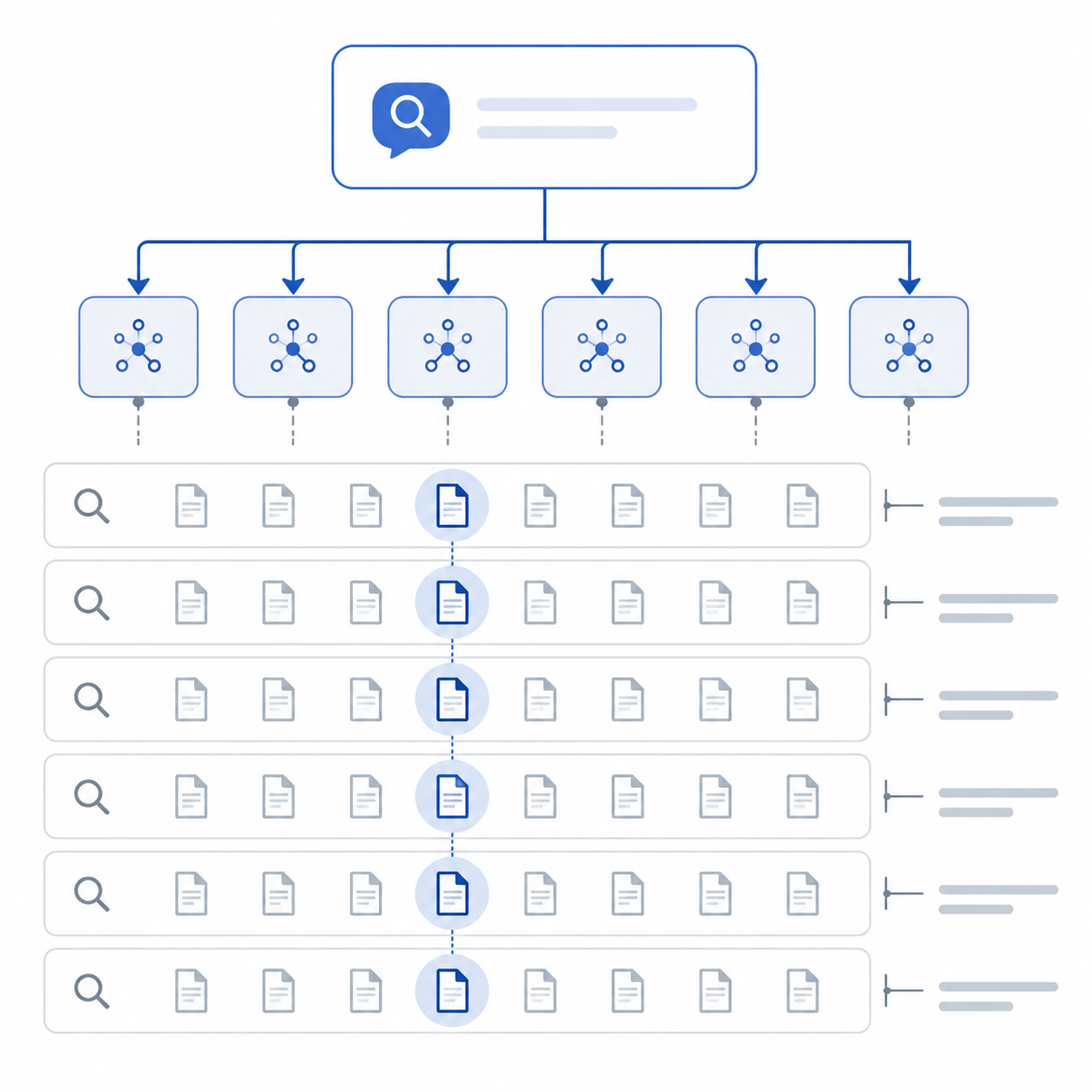
That explains why the top result for the exact head term can be passed over. The overview is not only looking at the one SERP your rank tracker shows. It is assembling an answer from adjacent result sets: definitions, comparisons, steps, risks, tools, examples, pricing constraints, troubleshooting issues, and entity-specific follow-ups.
For a B2B SaaS query, the head term might be “customer onboarding software.” The fan-out paths may include implementation steps, integration requirements, time-to-value metrics, security review questions, customer success ownership, onboarding checklist templates, and alternatives by company size. This is a hypothetical example, but it shows the planning issue: a single ranking page may not cover enough of the answer space to be repeatedly useful.
The job is not to stuff one giant page with every adjacent phrase. The job is to make sure your site has credible, internally connected assets that can appear across those sub-SERPs. A strong page can win one extraction. A strong cluster gives Google more chances to encounter the same brand, same entity, and same answer quality from different angles.
If your team already uses topic clusters, this is where the work gets more specific. The cluster is no longer just a crawl path and topical authority signal. It is a citation surface. The hub page should answer the broad decision query. Supporting pages should handle the durable sub-questions. Internal links should make the relationship obvious to users and systems, not merely distribute PageRank.
For teams formalizing this across AI search surfaces, the broader GEO and AEO operating model belongs in a separate playbook; the practical overlap is that AI systems reward pages that can be retrieved, understood, and quoted cleanly. A useful starting point is the internal guide on GEO and AEO for ChatGPT discovery, especially if your team needs one vocabulary for Google AI Overviews, assistants, and answer engines.
Build the brief around sub-query coverage, not just keyword inclusion
A citation-first brief starts with the target query, then immediately breaks it into the likely fan-out paths. This is not the same as dumping a keyword export into the appendix. The useful version separates sub-questions by the job they perform in the answer.
- Definition paths: what the thing is, how it works, and which entities or concepts must be clarified.
- Comparison paths: alternatives, trade-offs, category boundaries, and “X vs. Y” decisions.
- Implementation paths: steps, owners, timing, dependencies, and operational constraints.
- Risk paths: limitations, failure modes, compliance issues, and cases where the advice does not apply.
- Evidence paths: benchmarks, examples, research findings, and documented outcomes.
Those buckets should not become artificial sections by default. They are planning inputs. Some deserve their own page. Some deserve a passage inside the hub. Some are only worth a FAQ entry or a comparison table. The decision depends on search demand, business value, existing authority, and whether the sub-question is substantial enough to earn citation on its own.
For a refresh queue, this means you should stop sorting only by “high impressions, low CTR” or “ranking positions four through ten.” Add a citation gap view: important queries where competitors are cited and you are not; queries where you rank but are not cited; and topics where your cluster has one strong page but no supporting assets across the likely fan-out paths.
Keyword clustering can still help, but the prompt or workflow needs to ask for sub-query jobs, not just semantic similarity. The internal AI keyword clustering prompt template is most useful here when it is adapted to label clusters by answer role: definition, comparison, implementation, risk, evidence, and decision support.
Make passages extractable without making the page thin
Citation eligibility often comes down to whether a system can lift a passage without mangling it. Seer Interactive and Amsive research points to an ideal extraction passage length of 134–167 words: long enough to answer one sub-question completely, short enough to be quoted or summarized cleanly.[5]
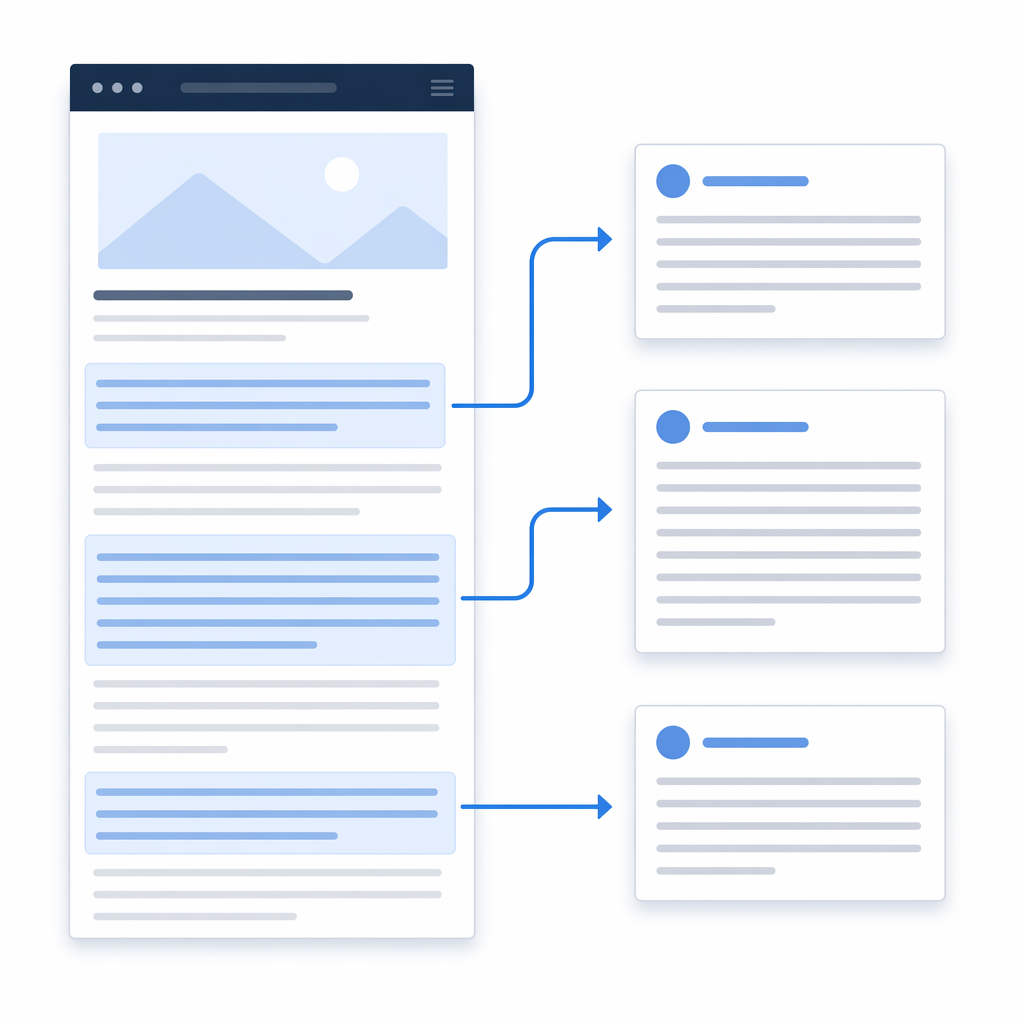
This is one of the few findings concrete enough to put directly into a content brief. It does not mean every paragraph should be 150 words. It means the page should contain deliberate answer blocks that can stand on their own.
- One passage should answer one complete sub-question, not introduce three partial ideas.
- The passage should include the subject, condition, and consequence without relying on the previous paragraph for basic context.
- The heading above it should name the question or decision clearly enough to be understood out of sequence.
- The surrounding page should provide depth, examples, caveats, and related links so the extract does not sit inside a shallow answer farm.
The depth point matters. In the same Ahrefs research summarized by SEOproFY, pages above 20,000 characters averaged about 10.18 citations each, while pages under 500 characters averaged 2.39 citations.[1] That does not prove that adding words causes citations. It does suggest that pages with enough room to cover sub-questions, evidence, and context create more citation opportunities than pages that only answer the head term at brochure depth.
A workable page pattern looks like this: an early direct answer, followed by sections that each resolve a real sub-question, supported by tables where comparison is the task, examples where implementation is the task, and caveats where the answer has boundaries. The extractable passage is not a decorative summary box. It is the cleanest version of the answer the page has earned the right to give.
What to change in the content brief
The brief should identify which passages must be self-contained before drafting starts. For each priority sub-question, specify the intended answer, the evidence available, the likely caveat, and whether the passage belongs in the hub page or a supporting asset.
| Brief field | Citation-first instruction |
|---|---|
| Primary query | State the head query and the business reason it matters. |
| Fan-out sub-queries | List the sub-questions the page or cluster must cover, grouped by answer role. |
| Extractable passages | Identify the passages that should answer one sub-question completely in roughly 134–167 words. |
| Evidence requirements | Name which claims need data, dates, cases, or source attribution. |
| Cluster links | Specify which supporting pages should be linked and what role each link plays. |
| Refresh trigger | Define what would make the passage stale: date-sensitive data, product change, policy update, or competitor movement. |
Freshness is now a maintenance cost, not a launch detail
Semrush found that roughly 50% of AI-cited content is less than 13 weeks old.[6] That number should make SEO managers uncomfortable in a productive way. It points toward a citation environment where old-but-ranking assets may still perform in classic organic results while becoming less competitive as AI Overview sources.
Freshness does not mean changing the publish date and calling it a refresh. For AI Overview work, the maintenance question is passage-level: are the quoted claims still current, are the examples still representative, are the linked supporting assets still live, and has Google’s generated answer started emphasizing a different sub-question?
A quarterly calendar is a reasonable starting point for high-value AI Overview targets because it maps closely enough to the 13-week freshness signal without pretending every URL deserves weekly attention. For lower-value evergreen pages, refreshes can stay event-driven. For pages tied to regulation, platform features, pricing, or fast-moving benchmarks, the refresh trigger should be stricter.
Google’s own AI search guidance was updated on June 15, 2026, which is current enough to use but not stable enough to treat as permanent doctrine.[3] The operating habit should be simple: keep the content accurate for users, make the answer blocks easy to extract, and review whether the cluster still matches the way the AI Overview frames the topic.
The same maintenance burden is part of a broader content advantage in AI-heavy search: assets that are deep, updated, and specific age better than generic pages that were only built to catch a keyword variation. That overlap is covered more fully in the durable advantages for content marketers in an AI-saturated era.
How to measure this without inventing fake certainty
AI Overview measurement is still uneven. That is not a reason to avoid reporting it; it is a reason to label the dashboard honestly. Track what you can observe, separate it from inferred impact, and do not let vendor metrics collapse into one magic “AI visibility” score.
- Citation presence: whether your domain or URL appears in the AI Overview for tracked queries.
- Citation share: how often you appear compared with recurring competitors across a topic set.
- Cited asset type: hub page, supporting article, comparison page, documentation, tool page, or data page.
- Passage freshness: age of the cited passage and date of the last substantive update.
- Ranking-citation mismatch: URLs that rank but are not cited, and URLs that are cited despite weaker traditional rankings.
- Business follow-through: assisted clicks, branded demand, conversions, or paid search interaction where attribution allows it.
The commercial upside claims need careful handling. Seer Interactive data reported by Contently found that brands cited in AI Overviews earned 35% more organic clicks and 91% more paid clicks than uncited brands on the same queries.[7] That is a relative advantage against uncited brands in the same query environment. It is not proof that citation produces a 35% net traffic increase versus the pre-AI Overview baseline.
The same caution applies to AI referral visitor value. Claims that AI referral visitors are worth 3x to 4.4x more come primarily from Semrush’s proprietary study, so they should be useful inputs for hypothesis-building, not universal conversion assumptions.[6] If your executive dashboard needs a revenue view, tie AI Overview exposure to your own assisted conversion, branded search, and pipeline data instead of importing someone else’s multiplier.
Coverage caveats that should change how you prioritize
AI Overview coverage estimates vary because tools count different query sets. Digital Applied has reported a 48% query-coverage figure, while Semrush has described stabilization around 15–16%; the difference comes from broad versus volume-weighted tracking and whether AI Mode queries are counted separately.[6] Treat coverage as a monitored surface, not a fixed market constant.
Market variation matters too. Much of the available research is concentrated in English-language US and UK markets, while reported AI Overview behavior differs elsewhere, including 37.2% coverage in Indonesia versus 20.5% in the US.[6] A global SEO team should not copy a US citation model into every locale without checking local SERPs, language behavior, and content availability.
For most teams, this means prioritization should start where three conditions overlap: AI Overviews appear often enough to matter, the topic has business value, and your site can credibly cover the fan-out paths better than the current cited sources. If one of those conditions is missing, the work may still be good SEO, but it is not necessarily the best AI Overview project for this quarter.
A citation-first operating model for Q3 2026
The workflow does not need a new department name. It needs a few changes to the way research, briefs, production, refreshes, and reporting already happen.
- Select priority query sets where AI Overviews appear, the topic affects revenue or audience growth, and the current citation set is visible enough to study.
- Map the likely fan-out sub-queries and group them by answer role: definition, comparison, implementation, risk, evidence, and decision support.
- Audit whether your current pages appear across those sub-SERPs, not only whether one URL ranks for the head keyword.
- Decide which sub-questions belong in the hub page and which require supporting assets, then connect them with deliberate internal links.
- Write self-contained answer passages for the highest-value sub-questions, using evidence where the claim needs support and caveats where the answer has limits.
- Refresh cited and citation-eligible passages on a quarterly or trigger-based schedule, depending on how quickly the topic changes.
- Report citation presence, citation share, ranking-citation mismatches, passage freshness, and business follow-through separately.
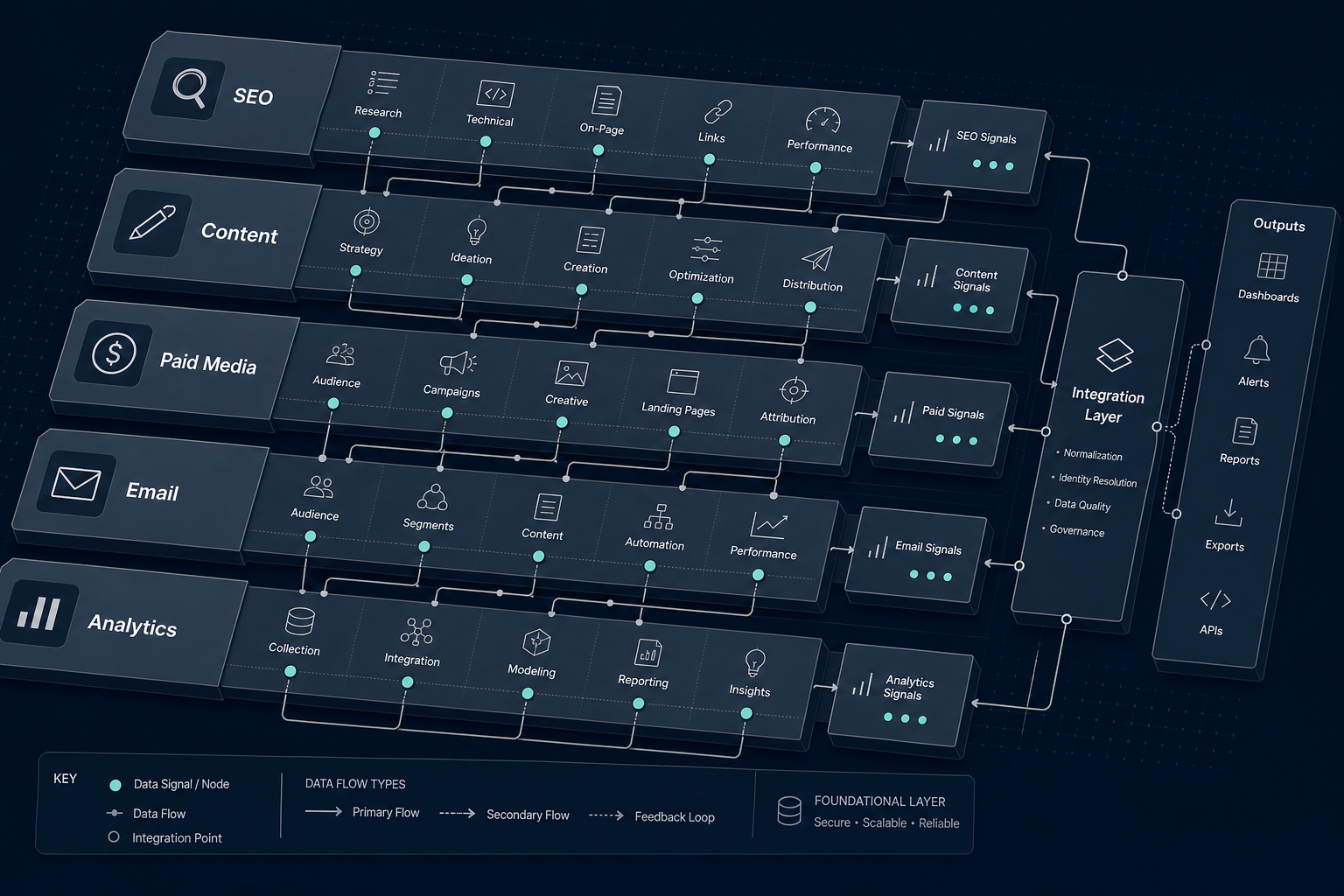
This is also where SEO needs to stay connected to broader AI marketing work without letting it blur into abstraction. If your organization is still sorting out how AI changes search, content, paid media, analytics, and customer experience together, the function-level view in AI in digital marketing for 2026 can help keep the SEO work from being treated as an isolated experiment.
The sober version is enough: technical health, authority, and rankings still matter. The competitive edge in Q3 2026 is building pages and clusters that can be repeatedly extracted, freshly maintained, and surfaced across the sub-query paths Google uses to assemble AI Overviews.
References
- Google AI Overviews: Statistics and Trends in 2026 — SEOproFY
- AI Overview Traffic Impact: New Data on Search, Paid, and Brand Visibility — Contently, April 27, 2026
- AI optimization guide — Google Search Central
- Succeeding in AI Search — Google Search Central, May 2025
- Seer Interactive / Amsive AI Overview extraction passage research — Seer Interactive / Amsive
- We Studied the Impact of AI Search on SEO Traffic — Semrush
- AI Overview Traffic Impact: New Data on Search, Paid, and Brand Visibility — Contently, April 27, 2026

Comments
Join the discussion with an anonymous comment.