
How to Structure Content for AI Overview Citations
Getting cited in AI Overviews requires more than ranking well. This guide covers the passage-level structure, vertical position, and schema tactics that determine whether Google's AI extracts your content—backed by citation studies and real-world data.
Last reviewed: July 5, 2026.
A page can rank on page one and still be useless to Google’s AI Overview citation layer. That mismatch usually does not mean the article is bad. It means the answer Google wants to cite is trapped in the wrong part of the page, wrapped in too much setup, or written so it only makes sense after a human has read the paragraphs around it.
The practical question is not “how do we make this article higher quality?” It is “where is the extractable answer, and can it stand alone?” If the answer starts after a long intro, a definition, a brand story, and three throat-clearing paragraphs, the page may satisfy a reader who scrolls. It gives an AI system very little clean material to lift.
For teams working on how to get cited in AI Overviews, the fastest wins usually come from restructuring passages already on the page: move the answer higher, make each section answer-first, and add schema only where the visible content already works as a self-contained citation surface.
The Citation Problem Starts With Page Position
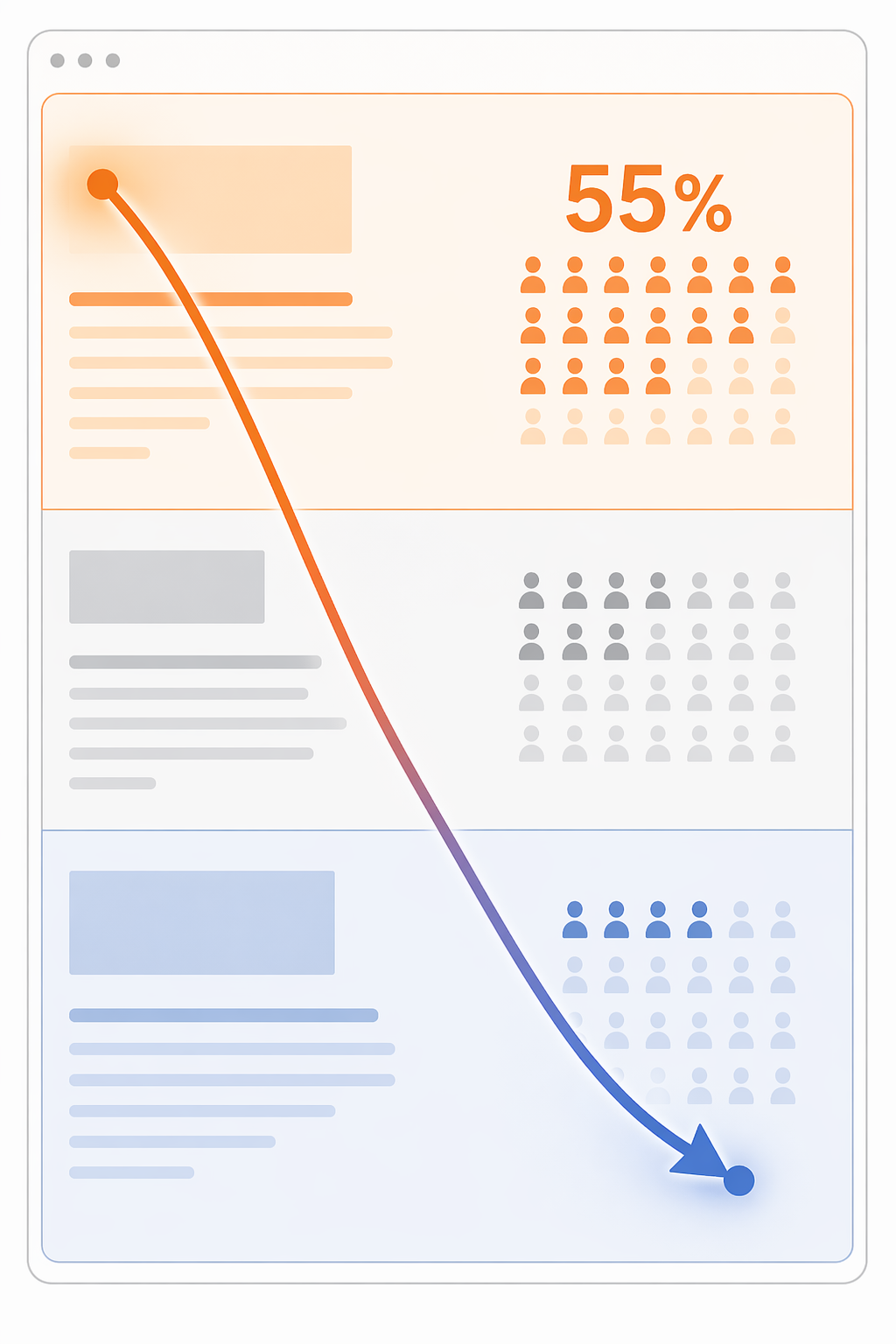
CXL’s study of 100 Google AI Overview citations found that 55% came from the top 30% of the cited page, while only 21% came from the bottom 40%.[1] That is a small sample, so it should not be treated as a universal law. But it is large enough to turn one common editorial habit into a visible problem: burying the usable answer is not just a style preference. It changes what Google is most likely to retrieve.
Kevin Indig’s larger analysis gives the pattern more weight. In a study of 1.2 million search results and 18,012 ChatGPT citations, 44.2% of citations came from the first 30% of the document, and buried answers saw an estimated 2.5x reduction in retrieval probability.[2] This is not the same system as Google AI Overviews, so the findings should not be merged as if they measure one product. The useful point is that two different AI citation environments show the same downward slope.
That slope should change how you edit an existing article. The first 30% of the page is not a place to warm up. It is where the highest-value, most directly citable answer should appear.
Move the Answer Before the Page Explains Itself
The first edit is mechanical: find the answer a searcher came for and move it above the long context. If the page targets a comparison query, the comparison result belongs near the top. If it targets a “how to” query, the actual process belongs before the theory. If it targets a definition-plus-decision query, the definition and decision criteria should appear before the history of the topic.
A traditional SEO article often opens like this:
- Intro that validates the problem
- Broad definition
- Why the topic matters
- Industry trend or general context
- The actual answer
That structure can still read smoothly, but it asks Google to keep looking. For AI Overview extraction, the better opening sequence is usually:
- Direct answer to the query
- Short condition or caveat
- Compact supporting explanation
- Evidence, examples, or selection criteria
- Deeper background only after the citation-ready material
This does not mean every article should start with a bland encyclopedia answer. It means the first screen should contain a passage that can survive being removed from the article. A human reader can still get nuance after that. Google needs a usable unit before it has to parse the whole page.
| Common Existing Structure | AI Overview-Friendly Rewrite |
|---|---|
| “In recent years, AI Overviews have changed how searchers interact with results. Brands now need to think beyond rankings and adapt their content strategies.” | “To get cited in AI Overviews, place a direct, standalone answer in the first 30% of the page, structure each major section as an extractable passage, and use FAQPage schema only for visible Q&A content that answers real follow-up questions.” |
| “Before choosing a project management tool, it helps to understand why workflow design matters.” | “For small teams, the best project management tool is usually the one that makes ownership, due dates, and dependencies visible without forcing every task into a complex approval workflow.” |
| “Cloud migration is a major step for modern companies, and planning ahead can reduce disruption.” | “A cloud migration plan should first identify which applications move, which dependencies must stay connected, who owns rollback decisions, and what downtime is acceptable for each system.” |
The rewritten versions are not guaranteed citations. They are better citation candidates because they answer first, carry their own context, and do not depend on a preceding setup paragraph.
Design Each Important Section as a Standalone Passage
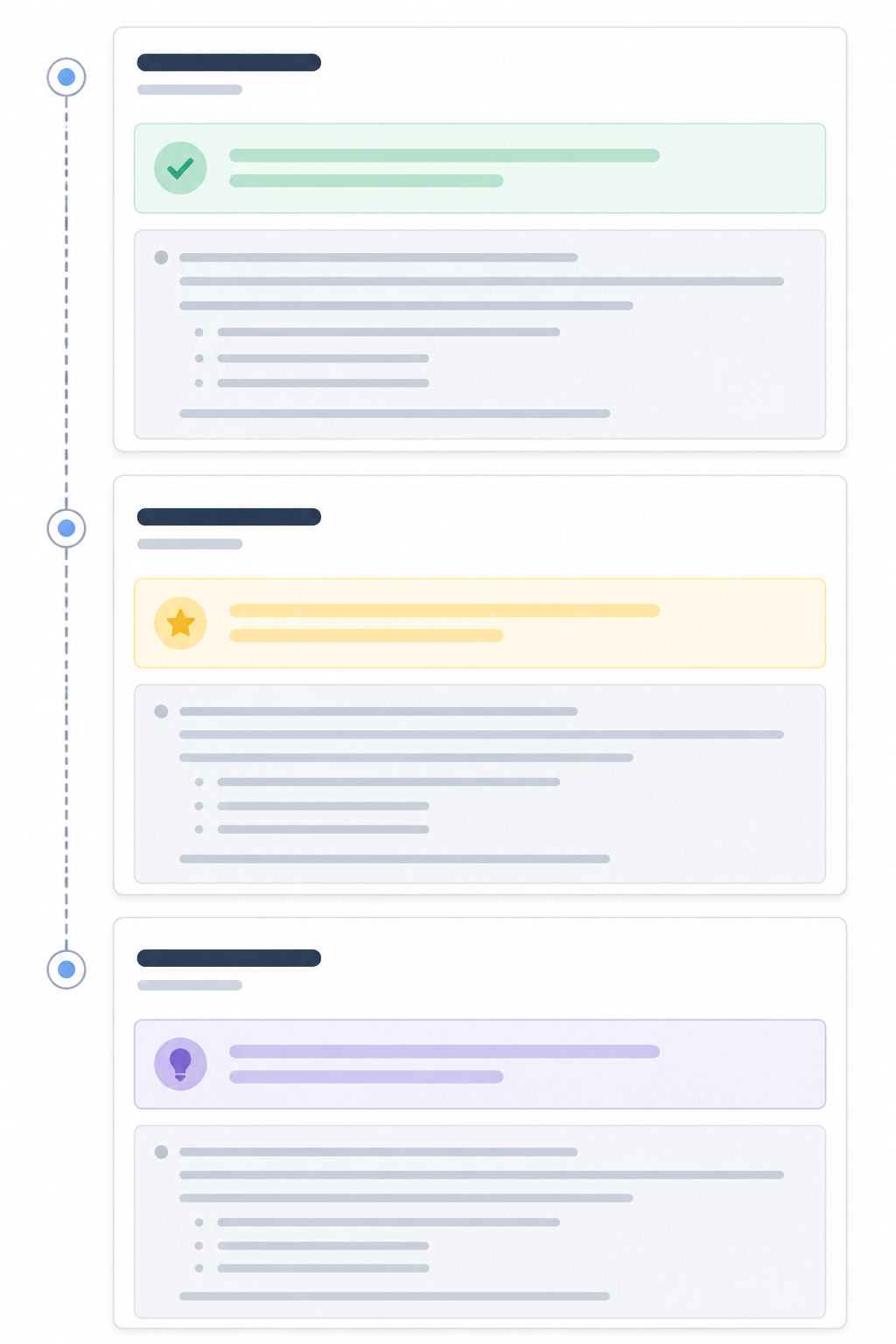
The most useful section pattern is simple: open each important H2 or H3 with a 45–75 word direct answer, then add the facts, conditions, examples, and exceptions that make the answer trustworthy. That opening passage should name the subject, answer the implied question, and include enough context that it still makes sense if Google extracts it without the rest of the article.
Google’s own developer guidance has pointed toward chunk-level retrieval with fact-rich, concise passages that can stand alone.[3] Strapi’s discussion of AI Overview extraction uses roughly 800 tokens as a practical chunk-size reference.[4] Treat that number as an editing target, not a physics constant. The safer rule is to keep one extractable idea inside a compact unit instead of spreading it across a 1,500-word section with several turns.
A workable section unit looks like this:
- Heading: names the exact sub-question or decision.
- Opening answer: 45–75 words that directly answer that sub-question.
- Support: evidence, criteria, examples, or constraints that explain when the answer applies.
- Boundary: one short clarification if the answer is easy to overgeneralize.
For example, a section titled “How long should an AI Overview citation passage be?” should not begin with a paragraph about the evolution of AI search. It should answer the question immediately: “An AI Overview citation passage should usually be short enough to work as one extractable unit, with a direct answer in the first 45–75 words and supporting detail kept close by.” Then the section can explain token windows, caveats, and examples.
This is where many already-ranking pages fail. The answer exists, but it is split across the heading, a setup paragraph, a bullet list, and a later caveat. A human can assemble it. A citation system may choose a competitor whose paragraph already did the assembly.
Do Not Make Every Section the Same Size
Answer-first does not mean every section needs the same template. Some sections only need a direct answer and a short list. Others need evidence and nuance. The point is not visual uniformity; it is extractability. If a section covers a minor supporting question, keep it short. Save the longer passage design for the sections that match likely AI Overview sub-answers.
Use Featured Snippet Discipline as the Starting Skill Set
SE Ranking found that 61.79% of AI Overview sources overlap with featured snippet winners.[5] That does not mean winning a featured snippet causes an AI Overview citation. It does mean the same editorial habits are useful: direct answers, clean definitions, compact lists, comparison tables, and headings that match the way people ask the question.
If you already optimize for snippets, do not throw that workflow away. Tighten it. A snippet block often answers one query cleanly; an AI Overview-ready page needs several such blocks placed where Google can find them. The opening section should answer the main query. The next few sections should answer the natural follow-ups without forcing the reader through a long narrative bridge.
| Query Type | Best Extractable Format | Editing Note |
|---|---|---|
| Definition | One direct paragraph followed by conditions or examples | Avoid opening with history unless the query asks for it. |
| Process | Short ordered list followed by expanded steps | Put the full sequence before detailed commentary. |
| Comparison | Compact table plus a direct recommendation paragraph | State when each option wins. |
| Troubleshooting | Cause-and-fix list | Keep symptoms, causes, and actions close together. |
| Best option | Answer paragraph plus selection criteria | Name the deciding factors before reviewing alternatives. |
The main difference is placement. A featured snippet answer buried halfway down a page may still win if the snippet system identifies it. The citation-position studies suggest AI citation systems are less forgiving. Put the best snippet-style block where it has the strongest retrieval odds.
FAQPage Schema Helps When the FAQ Is Already Worth Citing
Frase reports, citing industry research, that pages with FAQPage schema are 30–40% more likely to be cited in AI-generated answers.[6] Keep the attribution straight: this is a secondary-source figure, not a direct Google disclosure. It is useful enough to act on, but not strong enough to justify turning every article into a pile of fake questions.
FAQ blocks can work because they create independent citation surfaces. A clear question and a concise answer already resemble the unit an AI system wants to extract. Schema adds machine-readable reinforcement to content that is visible on the page.
Add FAQPage schema when the questions are genuine follow-ups to the main query, the answers are visible to users, and each answer can stand alone. Do not add it to duplicate section headings, stuff variations of the same question, or hide thin answers at the bottom because someone said “AI likes FAQs.” Schema can multiply a clean structure. It does not rescue a weak one.
A good FAQ answer is usually shorter than a full section opener, but it follows the same rule: answer first, then qualify. If the question is “Can a page get cited in AI Overviews without ranking first?” the answer should not begin with “It depends on many factors.” It should say the narrow supported version: “Yes, an AI Overview can cite sources that are not the top organic result, but ranking visibility, authority, and passage relevance still influence which pages are eligible.”
A Practical Rewrite Flow for Existing Pages
Start with the page you already have. Do not begin by adding more words. Most pages that rank but do not get cited need less setup and cleaner extraction points, not another generic section about why the topic matters.
- Identify the exact AI Overview answer you want the page to be cited for.
- Find where that answer currently appears on the page.
- Move the clearest version of that answer into the first 30% of the article.
- Rewrite the first major section so it starts with a 45–75 word standalone answer.
- Break oversized sections into smaller H2 or H3 units, each focused on one extractable idea.
- Convert process, comparison, and selection content into lists or tables where that format makes the answer clearer.
- Add FAQPage schema only for visible, useful Q&A blocks that answer real follow-up questions.
- Remove or shorten introductions that delay the answer without adding necessary context.
The most revealing audit question is: “If Google extracted only this paragraph, would it still be accurate?” If the answer is no, the passage needs more context inside the same unit. If the answer is yes but the paragraph appears halfway down the page, the passage needs a better position.
What to Shorten First
Cut slow openings before you cut useful support. The weakest material is usually the paragraph that says the topic is important, the paragraph that repeats the title in softer language, or the paragraph that describes a trend without helping answer the query. Keep the caveats that protect accuracy. Remove the warm-up that delays retrieval.
What to Move Up
Move up the direct recommendation, the concise definition, the process overview, the comparison table, or the criteria list. If a reader would screenshot that section to explain the topic to a colleague, it probably belongs earlier. If a section only proves that the subject is complicated, it can wait.
What to Leave as Background
Brand authority, backlinks, topical depth, and search intent still matter as baseline conditions. A clean passage on an untrusted or irrelevant page is not suddenly entitled to a citation. But once a page is already competitive, the editing work shifts from proving the page deserves to rank to making sure the right passage is eligible to be extracted.
For the broader strategic shift behind that distinction, see What a Citation-First SEO Strategy Looks Like for Google AI Overviews. The work here is narrower: take an existing page and make its best answers easier to cite.
The Final Pre-Publish Check
Before republishing, scan the page like an extraction system, not like a loyal reader. The page should not require patience before it becomes useful.
- The main query receives a direct answer in the first 30% of the page.
- Each high-value H2 or H3 opens with a standalone 45–75 word answer.
- Long sections are split around distinct sub-questions, not arbitrary word counts.
- Lists and tables are used where they make extraction cleaner, not as decoration.
- FAQPage schema is applied only to visible, non-duplicative Q&A content.
- Caveats stay close to the answer they qualify.
- The article removes slow setup that pushes the best citation unit too far down the page.
None of this guarantees an AI Overview citation. Google’s AI Overview behavior changes quickly, and citation selection still depends on query type, source mix, authority signals, and competing pages. But a page that surfaces direct, standalone, schema-supported answers early gives Google more usable citation units than a page that hides the answer inside a traditional long-form SEO narrative.
References
- Where Google AI Overviews Cite From: A 100-Page Study, CXL.
- Analysis of 1.2M search results and 18,012 ChatGPT citations, Kevin Indig.
- Google Developers Blog guidance on chunk-level retrieval, Google Developers Blog, May 2025.
- AI Overview extraction chunk size reference, Strapi.
- AI Overview sources and featured snippet overlap data, SE Ranking.
- FAQPage schema citation likelihood research, Frase.

Comments
Join the discussion with an anonymous comment.