
Why AI-Based Marketing Stalls at 6% Adoption — and the Data-First Roadmap to Fix It
For marketing managers and ops leads under pressure to deliver AI results: a diagnostic and phased roadmap built on the real structural blockers — fragmented data, ownership disputes, and poor martech integration — not more tools.
The Headline Gap: 80% Pressure, 6% Embedding
If you are a marketing manager or ops lead in a mid-market company, you have likely received the directive by now: "We need to be using AI." The pressure is real and it is coming from every direction — the C-suite, the board, competitors, and the vendor ecosystem. According to Supermetrics' 2026 Marketing Data Report, which surveyed 435 marketers globally, 80% of marketers report feeling pressure to adopt AI into their workflows. The mandate is clear. The execution, however, is not.
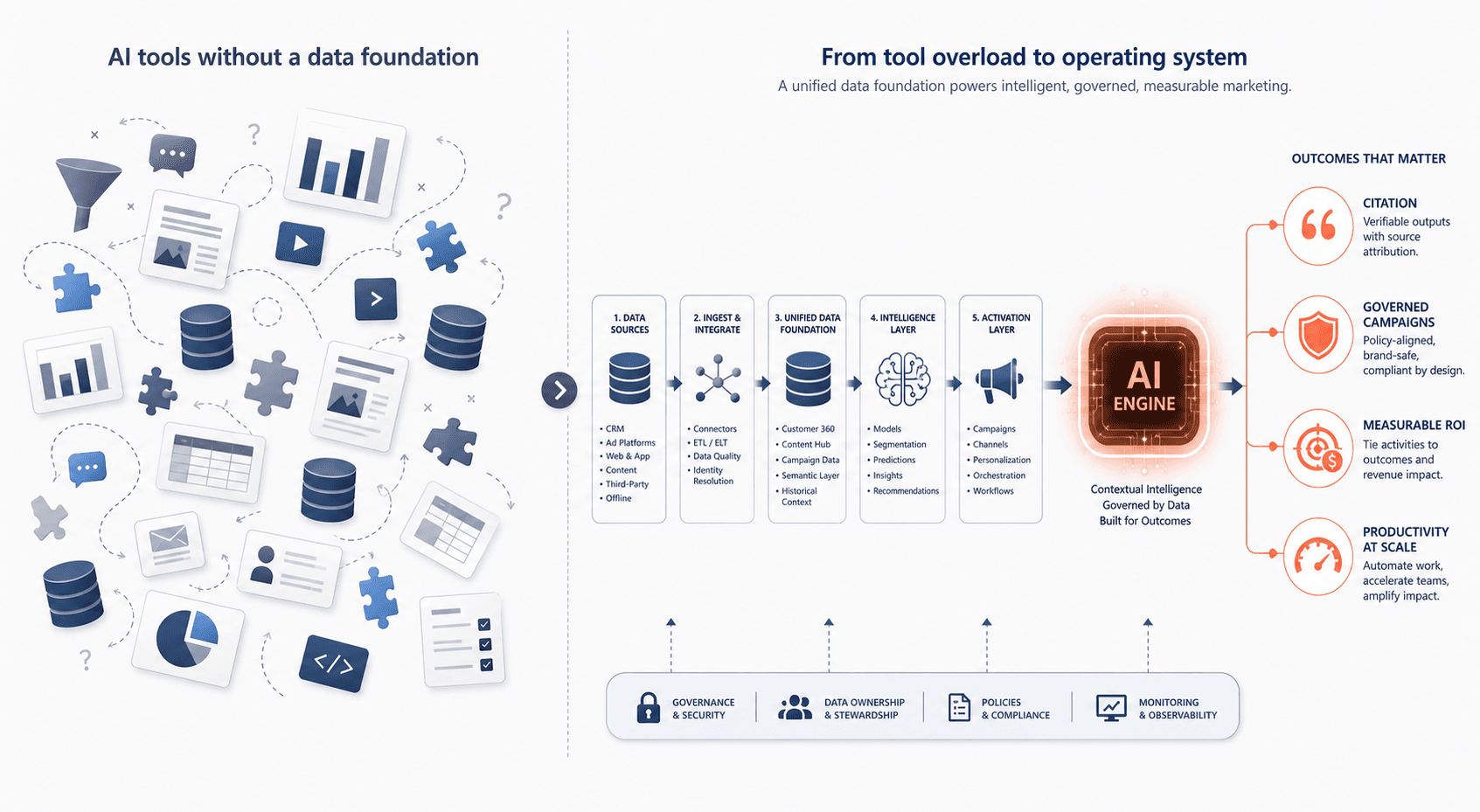
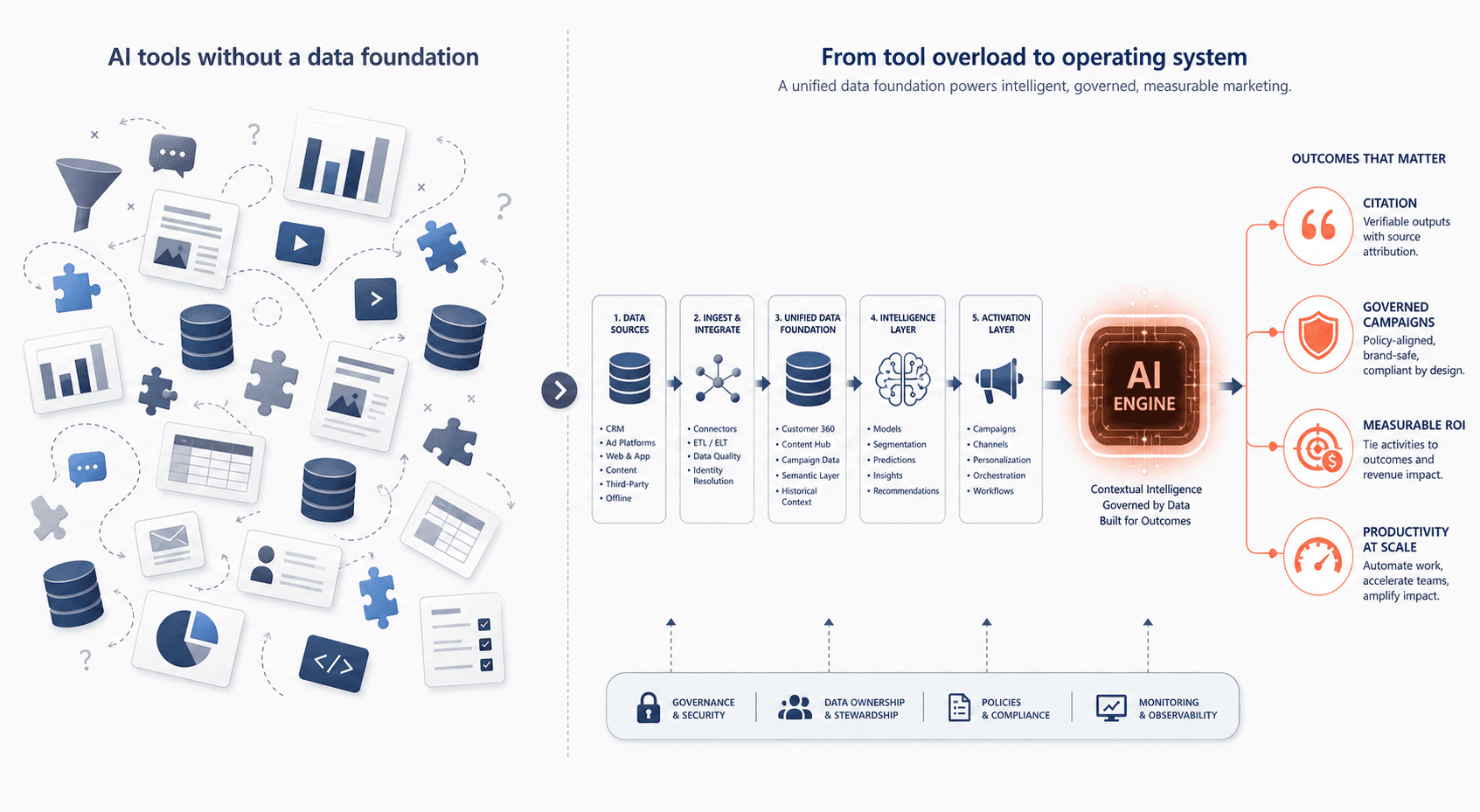
The same report reveals a stark disconnect: only 6% of marketers have fully embedded AI into their daily operations. That is not a slow adoption curve — it is a structural bottleneck. The remaining 94% are stuck in pilot phases, running isolated experiments, or purchasing tools that never integrate into a coherent system. The problem is not a lack of motivation or budget. It is that most teams are trying to build an AI-powered marketing engine on a foundation of fragmented, siloed, and unowned data.
This article is not another list of AI tools or a generic call to "start small." It is a diagnostic and a phased roadmap for marketing managers and ops leads who have the mandate but lack the foundation. The core thesis is straightforward: the biggest barrier to AI-based marketing ROI is not tooling or talent — it is that most marketing teams do not control their own data strategy, and without that control, no amount of AI spend will produce reliable results.
Why AI Adoption Stalls: Three Structural Blockers
The gap between the 80% who feel pressure and the 6% who have embedded AI is not caused by a single factor. The research points to three interconnected structural blockers that, together, create a ceiling that most teams cannot break through on their own.
Blocker 1: Fragmented Data and Poor Martech Integration
AI models are only as good as the data they consume. When your customer journey data lives in a CRM, your campaign performance data lives in an ad platform, and your content engagement data lives in an analytics tool — and none of them talk to each other — your AI has no coherent picture to work with. According to aggregated benchmarks from Digital Applied, 60% of failed AI marketing initiatives cite poor martech integration as the primary challenge. This is not a minor operational inconvenience; it is the single largest cause of AI project failure in marketing.
IBM's 2026 analysis of enterprise AI adoption reinforces this finding, identifying data quality and readiness as the largest barrier to scaling AI. Companies often operate with fragmented, siloed data environments that developed over decades. When you layer AI on top of that fragmentation, you do not get automation — you get automated garbage.
Blocker 2: Data Strategy Ownership Disputes
Even when the data exists, the question of who controls it often remains unresolved. The Supermetrics report found that 52% of marketing teams do not control their own data strategy. Decisions about which data to collect, how to structure it, which tools to integrate, and who has access are made by IT, finance, or external agencies. This creates a fundamental dependency: marketing cannot move faster on AI than the teams that control its data allow it to.
This is not a technical problem — it is an organizational and political one. Marketing teams that cannot define their own data architecture cannot build AI applications that serve their specific goals. They end up using whatever data is available, which is rarely the data they actually need.
Blocker 3: Unclear Success Criteria
The third blocker is measurement. The Supermetrics report states that 40% of marketers struggle to prove ROI across channels. When you cannot measure the impact of your existing campaigns reliably, adding AI into the mix does not clarify the picture — it obscures it further. Teams end up reporting vanity metrics (content volume, tool usage) instead of business outcomes (pipeline influence, cost per acquisition, data activation rate), because those are the numbers they can access.
| Structural Blocker | Supporting Data | Implication for AI Adoption |
|---|---|---|
| Fragmented data & poor martech integration | 60% of failed AI initiatives cite this as primary cause (Digital Applied) | AI models cannot produce reliable outputs without a unified data layer |
| Data strategy ownership disputes | 52% of marketing teams don't control their own data strategy (Supermetrics) | Marketing cannot build AI applications that serve its goals without data autonomy |
| Unclear success criteria | 40% struggle to prove ROI across channels (Supermetrics) | Without clear measurement, AI investments cannot be justified or optimized |
The Data-Readiness Diagnostic: A 9-Question Self-Assessment
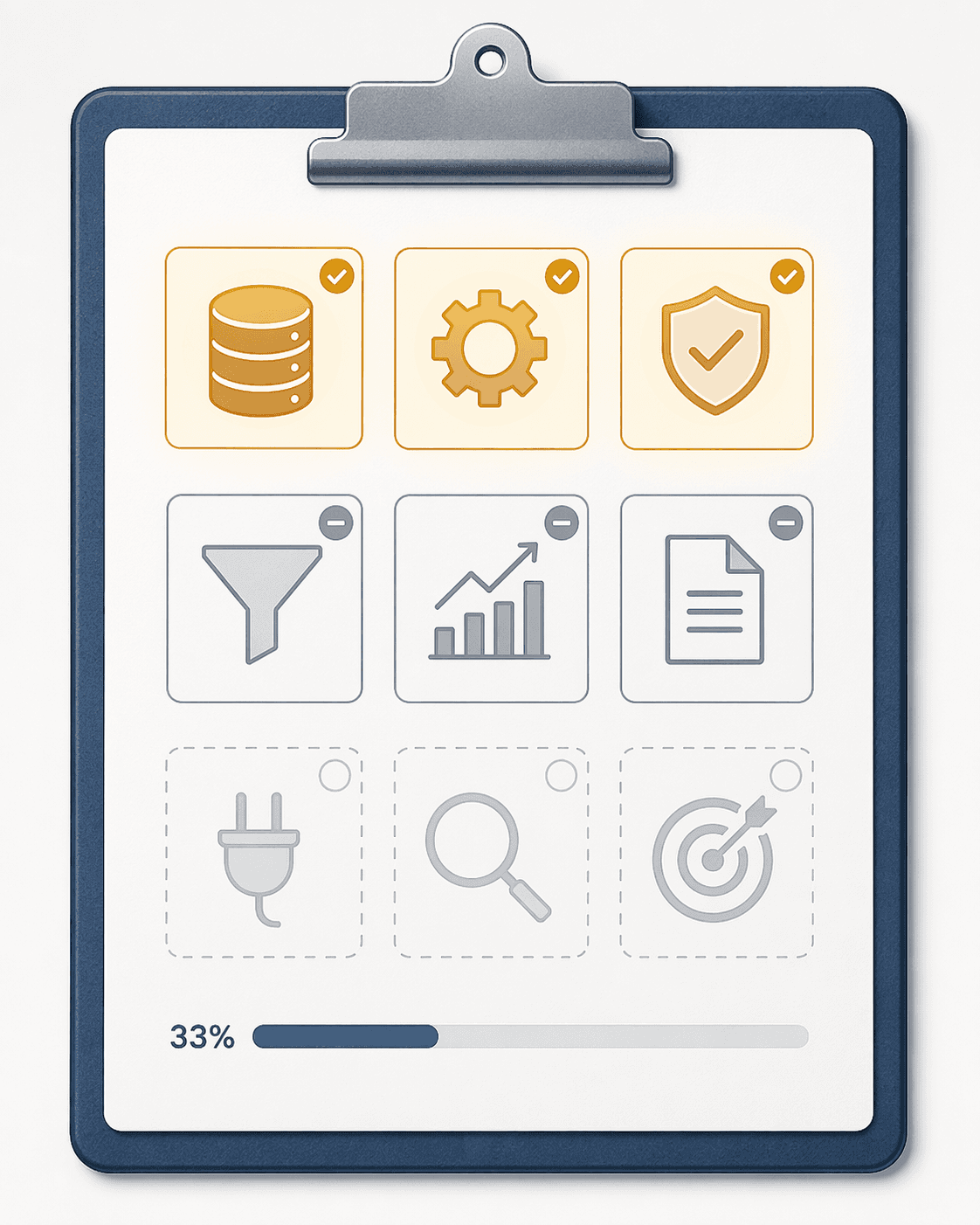
Before you can build a roadmap, you need to know where you are starting from. The Supermetrics report includes a 9-question AI readiness self-assessment designed to surface the specific gaps in your data foundation, ownership model, and integration maturity. This is not a generic "are you ready for AI?" quiz. Each question targets one of the structural blockers identified above.
Run this assessment with your team. Be honest about the answers — the goal is diagnosis, not a passing score.
- Do we have a single source of truth for our marketing data, or is it spread across disconnected platforms? (Tests data fragmentation)
- Can we trace a lead from first touch to closed deal across all our tools without manual work? (Tests martech integration)
- Who decides which data we collect, how we structure it, and which tools we integrate? (Tests data ownership)
- Can our marketing team add a new data source or tool without IT approval taking more than two weeks? (Tests operational autonomy)
- Do we have documented definitions for key metrics (CPA, ROAS, MQL, pipeline influence) that all teams agree on? (Tests measurement clarity)
- Can we generate a cross-channel performance report in under an hour? (Tests data accessibility)
- Do we have a documented AI strategy that goes beyond "use AI for content generation"? (Tests strategic clarity)
- Have we identified which specific marketing tasks would benefit most from AI, based on data, not intuition? (Tests use-case prioritization)
- Do we have a human-in-the-loop review process for AI-generated outputs that touch customers? (Tests governance readiness)
The Phased Roadmap: From Data Foundation to Scale
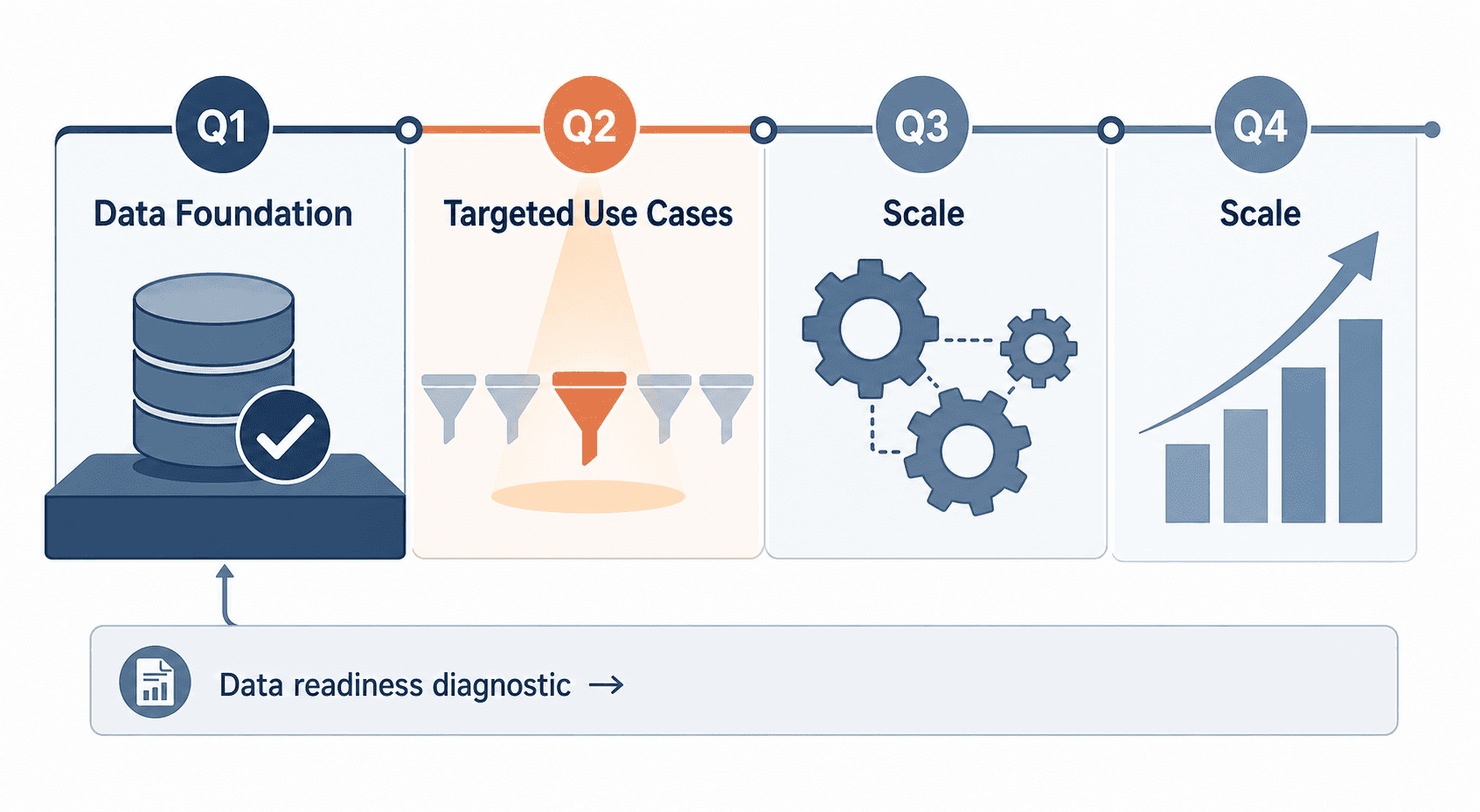
Once you have your diagnostic results, the path forward becomes clearer. The following four-phase roadmap is designed to be executed over three to four quarters. It prioritizes foundation over speed, because every attempt to skip the foundation phase will result in wasted tool spend and stalled initiatives.
| Phase | Timeline | Goal | Key Action | Success Signal |
|---|---|---|---|---|
| 1. Data Foundation | Q1 (Weeks 1-12) | Establish a unified, owned data layer | Connect and clean your core data sources (CRM, ad platforms, analytics). Document metric definitions. Establish marketing ownership of data strategy. | You can generate a cross-channel report in under 30 minutes without manual data pulling. |
| 2. Targeted Use Cases | Q2 (Weeks 13-24) | Prove value with one high-impact, low-complexity AI application | Pick one use case where clean data already exists (e.g., AI-assisted ad copy testing, predictive lead scoring). Run a controlled pilot with human oversight. | You can measure a specific improvement (e.g., 15% higher CTR on AI-assisted copy vs. control) with statistical confidence. |
| 3. Expand & Integrate | Q3 (Weeks 25-36) | Scale to additional use cases and deepen integration | Add 2-3 more AI applications. Build automated data pipelines. Implement human-in-the-loop governance for all customer-facing outputs. | AI-assisted campaigns consistently meet or exceed baseline performance. Data refresh is automated. |
| 4. Optimize & Embed | Q4 (Weeks 37-48) | Move from pilot to embedded operations | Integrate AI into daily workflows. Establish ongoing measurement and optimization cadence. Document learnings and failure modes. | AI is part of standard operating procedure, not a special project. Team can articulate what AI does and does not do well. |
For the Q1 Data Foundation phase, you will need a practical framework for selecting and connecting your analytics tools. Our guide to building an AI marketing analytics stack provides a step-by-step approach for mid-market teams that need to connect CRM, ad platforms, and analytics tools into a single, queryable layer. That article covers the specific tool selection criteria and integration patterns that make the data foundation phase achievable.
Budget Benchmarks: What Mid-Market Teams Are Actually Spending
Understanding what peer teams are spending on AI tools provides useful context, but it can also be misleading if you do not account for the foundation costs. According to Digital Applied's aggregated benchmarks, the median mid-market marketing team spent $3,400 per month on AI tools in Q1 2026, up from $1,200 per month in Q1 2025. That is a 183% year-over-year increase in tool spend.
The risk here is obvious: teams are spending nearly three times more on AI tools than they were a year ago, but the majority have not addressed the data foundation that makes those tools useful. If your data is fragmented and your martech stack is not integrated, that $3,400/month is buying you expensive experiments, not operational leverage.
How to Measure What Matters: ROI as Signal, Not Truth
The measurement challenge is real: 40% of marketers struggle to prove ROI across channels, according to the Supermetrics report. But the problem is not that ROI is impossible to calculate — it is that teams are trying to calculate it too early, with the wrong metrics, using fragmented data.
In the first two quarters of AI adoption, ROI is a directional signal, not a precise truth. The real question is not "did this AI tool deliver a 3x ROAS?" but "is our data foundation improving?" If your data is becoming more connected, more accessible, and more reliable, the ROI will follow. If you are chasing ROI numbers without fixing the foundation, you are measuring noise.
For the first two quarters, focus on these proxy metrics instead of trying to calculate a precise ROI figure:
- Data activation rate: The percentage of your marketing data that is connected, clean, and queryable. Supermetrics found that only 33% of marketers say they can activate their data effectively. Moving from 20% to 50% is a meaningful win.
- Time saved per campaign cycle: How many hours does your team save on reporting, data pulling, and manual analysis per campaign? This is a direct productivity metric that does not require complex attribution modeling.
- Number of integrated data sources: A simple count of how many of your core platforms (CRM, ad platforms, analytics, email) are connected through automated pipelines. Each new integration increases the potential value of your AI layer.
- Pilot success rate: What percentage of your AI pilots meet their stated success criteria? If you are running three pilots and two fail due to data quality issues, that is diagnostic information, not failure.
For a deeper treatment of the ROI measurement challenge — including why most teams are measuring the wrong things and how to build a measurement framework that works — read our AI for Sales and Marketing ROI Reality Check. That article covers the specific measurement pitfalls and provides a framework for calculating ROI that accounts for the foundation-building phase.
What the Top 6% Do Differently (and Why It's Not Just Workflow)
The 6% of marketers who have fully embedded AI did not get there by buying better tools or hiring more data scientists. They got there by addressing the structural blockers first. The research points to three consistent patterns among these teams:
- They own their data strategy. The 52% stat cuts both ways: the teams that succeed are the ones that have taken control of their data architecture, either by building internal capability or by establishing clear ownership agreements with IT.
- They integrate martech before adding AI tools. The 60% failure rate from poor integration is a warning, but it is also a roadmap. Teams that invest in connecting their existing tools before adding AI layers see dramatically higher success rates.
- They combine AI with human oversight. Digital Applied's data shows that teams combining AI with human oversight see 2.4x better campaign performance than teams using full automation. The top 6% do not replace humans with AI — they build workflows where AI handles the repetitive, data-intensive work and humans handle the strategic, creative, and judgment-based decisions.
These patterns are consistent with what we found in our analysis of why most companies using AI for marketing do not see real ROI. That article, which uses McKinsey data and examines specific brand examples, goes deeper into the behavioral patterns that distinguish the top performers. Read the full analysis here for a complementary perspective on what the 6% do differently once the structural blockers are addressed.
The path from 80% pressure to 6% embedding is not a technology problem. It is a data foundation, ownership, and integration problem. The teams that solve those three blockers first will be the ones that actually see ROI from AI-based marketing. The teams that skip the foundation and go straight to tool purchases will continue to wonder why their AI experiments never scale.


Comments
Join the discussion with an anonymous comment.