

Why chip stock volatility matters for AI marketing tools
Semiconductor stock volatility directly affects AI marketing tool economics through inference costs, hyperscaler capex, and memory pricing. Here's how sales leaders can interpret these signals and time their procurement decisions in Q3 2026.
The June 2026 semiconductor selloff is not, by itself, a reason to rewrite a sales-tech budget. Stock prices do not flow straight into the renewal quote for an AI SDR platform or a conversation intelligence product. Contracts, vendor competition, cloud commitments, and private margins all sit between Wall Street and the invoice.
But the size of the move makes it hard to ignore. Semiconductor companies lost about $1.4 trillion in market value in a single session in June 2026, with Nvidia alone losing more than $300 billion; the SOXX semiconductor ETF fell 10% that day.[1] For sales and marketing leaders, the useful question is narrower than the market headline: does chip stock volatility affect AI marketing economics in ways that can show up as usage limits, higher overages, slower vendor rollout, or tougher renewal terms in Q3 2026?
The answer is not that a chip crash automatically raises SaaS prices. The supported answer is that chip volatility is a signal to inspect three cost paths that matter to AI marketing tools: inference costs, hyperscaler capacity plans, and memory pricing. Those paths do not affect every vendor equally, and that is exactly why procurement teams should ask more precise questions before they buy or renew.
The part of AI cost that marketing buyers actually touch
Most sales teams are not paying directly to train foundation models. They are paying vendors whose products call models repeatedly: drafting outbound emails, scoring accounts, summarizing calls, generating follow-up tasks, enriching records, matching intent signals, or running chat-style prospecting workflows. That is inference.
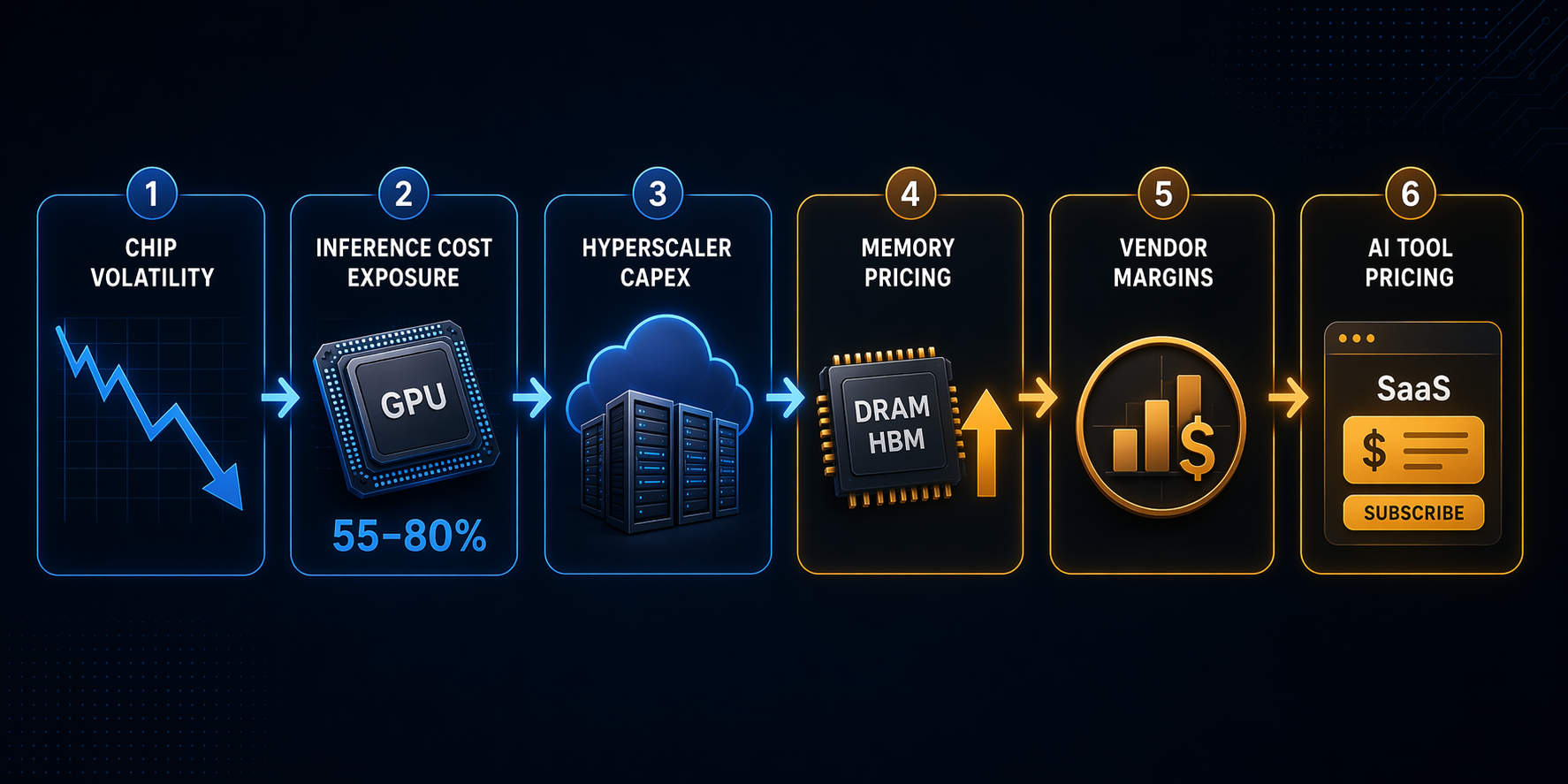
That distinction matters because inference accounts for an estimated 55% to 80% of enterprise AI GPU spend, according to Spheron’s April 2026 inference cost benchmarks.[2] If a vendor’s product depends on high-volume inference, the vendor’s economics are exposed less to the one-time drama of model training and more to the daily cost of serving responses at scale.
This is where the invoice risk begins. A sales team may see a stable per-seat subscription, but the vendor sees variable compute underneath it. Every automated email variant, account research request, call transcript summary, and chatbot exchange consumes inference. If customer usage rises faster than the vendor priced into the contract, somebody absorbs that gap. Sometimes the vendor eats it to win share. Sometimes the customer sees tighter fair-use language, lower included credits, degraded model access, add-on packages, or overage fees.
The hardware choice also matters. Spheron’s benchmark put cost per million tokens at $1.90 on H100 GPUs and $3.18 on B200 GPUs, based on GPU cloud spot and on-demand pricing as of April 2026.[2] That does not mean every AI marketing vendor pays those exact numbers. Enterprise contracts are opaque, workloads differ, and vendors may optimize aggressively. It does mean that two tools with similar user-facing features can carry very different compute costs depending on where and how inference runs.
A lightweight enrichment tool that calls a model occasionally sits in a different risk category from a real-time AI SDR that researches accounts, writes messages, handles replies, updates CRM fields, and learns from engagement patterns throughout the day. The second product can still be worth buying. It just deserves a different pricing conversation.
Capex deceleration is a capacity signal, not a prophecy
The next transmission path runs through hyperscalers. AI software vendors usually do not own the entire infrastructure stack behind their products. They depend on cloud providers, GPU clouds, model providers, reserved capacity, and sometimes spot or on-demand compute. When the companies financing the largest data center buildouts slow their growth plans, the downstream effect is not guaranteed, but it is relevant.
UBS forecast hyperscaler capex growth dropping from 76% in 2026 to 25% in 2027 and 6% in 2028, according to Reuters reporting in July 2026.[3] Separately, Pimco data cited by American Century Investments put hyperscaler capex at 94% of operating cash flow across 2026 and 2027.[4] Those figures do not say compute will suddenly disappear. They do suggest that the industry’s ability to keep adding capacity at the prior pace is being questioned.
For a sales leader, the issue is not whether Microsoft, Google, or AWS misses a forecast. The issue is what kind of vendor you are buying from. A vendor with long-term reserved compute, well-managed model routing, and credible gross-margin discipline has more room to keep customer pricing stable. A vendor relying heavily on expensive on-demand capacity may have less room, especially if usage accelerates after a generous pilot.
This is why pilot economics can be misleading. A 60-day trial may run beautifully when a vendor is subsidizing usage, limiting high-cost features, or operating before the customer’s full sales team is active. The renewal problem arrives later, after reps have built the workflow into their day and managers have built reporting assumptions around it.
Memory pricing is the less glamorous cost pressure
GPU headlines get the attention, but inference servers are not made of GPUs alone. Memory is part of the cost base, and the AI buildout has pulled high-bandwidth memory and conventional DRAM into the same supply conversation.
Deloitte’s 2026 Semiconductor Outlook reported that consumer DRAM prices rose fourfold between September and November 2025 as HBM production consumed fabrication capacity, and it projected additional price spikes of 50% through mid-2026.[5] That is not a direct quote for an AI sales tool invoice. It is a cost-input shock in the infrastructure that supports inference-heavy software.
Memory pressure matters most for tools that need fast, repeated processing at scale: call recording and summarization, live meeting assistance, real-time chat agents, automated account research, and prospecting systems that generate many variants per contact. In those cases, the vendor’s margin depends on both model efficiency and infrastructure procurement. If memory costs rise while customers increase usage, the vendor has to find savings somewhere else or change commercial terms.
There is also a location constraint to watch, though it should be kept in proportion. Reuters reported in July 2026 that New York imposed the first U.S. moratorium on large data center construction.[6] A single-state moratorium does not prove national capacity scarcity. It does, however, reinforce a vendor-selection point: teams should care whether a provider has durable compute access or is exposed to constrained regional buildouts and spot-market pricing.
Why modest pricing surprises hurt more in 2026
If marketing budgets were expanding comfortably, some compute pass-through would be irritating but manageable. That is not the budget environment most teams are working in.
Gartner’s 2026 CMO Spend Survey found marketing budgets at 7.8% of company revenue, effectively flat, based on 401 respondents from companies with more than $1 billion in revenue in North America and Europe.[7] The same survey found that AI-ready marketing organizations allocate 21.3% of their budget to AI, compared with a survey average of 15.3%, and that only 30% of marketing organizations have mature AI readiness.[7]
That gap matters. A team with mature AI operations is more likely to track usage, assign ownership, define approval thresholds, and retire underperforming tools. A team that is still experimenting may discover cost exposure only after adoption spreads across SDRs, account executives, customer marketing, and RevOps.
Spencer Stuart’s 2026 CMO research adds another constraint: 56% of CMOs said they already had insufficient budget for their 2026 strategy.[8] In that context, an AI vendor changing included usage, enforcing overages, or moving advanced capabilities into a higher tier is not a small administrative issue. It can force a mid-year tradeoff between pipeline tooling, media spend, events, headcount, or data quality work.
| Upstream signal | What it can affect downstream | What sales leaders should verify |
|---|---|---|
| Inference is 55% to 80% of enterprise AI GPU spend | Usage caps, per-credit pricing, fair-use enforcement, model access tiers | Which features drive token or compute consumption, and how usage changes price |
| H100 and B200 benchmark token costs differ | Vendor gross margin and willingness to subsidize high-volume workflows | Whether the vendor optimizes model routing and discloses compute-heavy features |
| Hyperscaler capex growth is forecast to decelerate | Capacity planning, reserved compute access, slower rollout of expensive features | Whether pricing assumes reserved capacity or on-demand/spot exposure |
| DRAM and HBM pricing remain pressured | Infrastructure cost base for inference servers | Whether real-time and high-volume features carry separate limits |
| Marketing budgets are flat and many CMOs feel underfunded | Lower tolerance for surprise renewals and overages | Whether contract terms protect the approved budget through the term |
Where this shows up in AI marketing tools
The practical exposure is uneven. Some AI features are mostly workflow packaging around occasional model calls. Others are compute-intensive products wearing a familiar SaaS buying motion.
AI SDR platforms are a clear example. Their value often depends on repeated account research, message generation, reply handling, personalization, and CRM updates. If the platform is genuinely doing that work in real time or near real time, usage can expand with every rep, segment, and sequence. The risk is not just a higher base subscription; it is the possibility that the most valuable behavior is also the behavior most likely to trigger metering.
Conversation intelligence has a different pattern. It may process large volumes of audio, transcripts, summaries, coaching notes, and deal-risk signals. A vendor can offer a clean per-seat price and still have internal costs tied to meeting volume, recording length, transcription, summarization depth, and analytics frequency. Procurement should not assume that “unlimited calls” means unlimited AI processing forever.
Data enrichment and intent tools can sit anywhere on the spectrum. A simple record-cleaning feature may not carry much compute exposure. A system that generates account narratives, recommends buying-committee maps, monitors signals, and updates messaging daily has a different cost profile. The buyer’s job is to separate the feature label from the inference pattern underneath it.
The Q3 2026 procurement posture
Chip stock volatility should not push a team into panic-buying, and it should not freeze AI investment. It should change the questions asked before a workflow becomes hard to unwind.
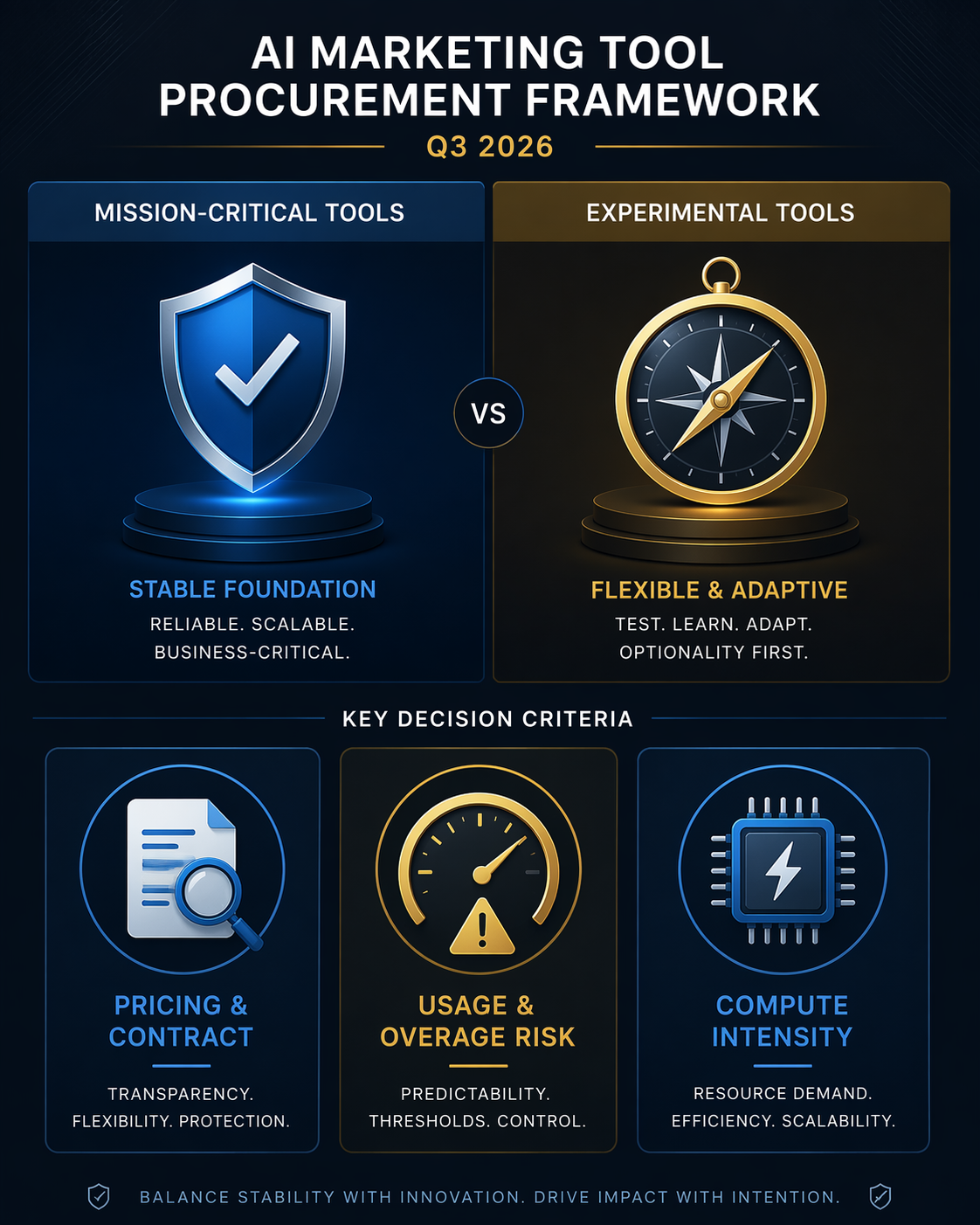
Start by sorting AI tools into two groups: mission-critical and experimental. Mission-critical tools are already attached to pipeline creation, forecast inspection, rep productivity, routing, or customer follow-up. Experimental tools are still proving adoption, data quality, or revenue impact. The first group deserves contract protection. The second group deserves shorter commitments and strict usage boundaries.
- Ask which features are compute-intensive, not just which features are “AI-powered.”
- Ask whether included usage is measured by seats, credits, records, conversations, tokens, minutes, workflows, or another internal unit.
- Ask what happens when usage exceeds the contracted amount: throttling, overage billing, forced tier upgrade, or reduced access.
- Ask whether pricing is fixed for the full term or can change if infrastructure, model, or fair-use policies change.
- Ask whether the vendor depends on reserved compute, cloud partner commitments, spot capacity, or third-party model APIs for the features you use most.
The answers do not need to reveal the vendor’s entire cost structure. They do need to be specific enough for the buyer to model adoption. A vague assurance that pricing is “scalable” is not the same as a clause that caps overages, preserves included usage, or guarantees notice before fair-use terms change.
Renewals need different questions than pilots
For renewals, the uncomfortable question is whether the first-year price reflected the real cost of full adoption. If usage has grown, ask for a usage export before negotiation starts. Look for the features driving cost: automated research, long-form generation, live assistant use, transcript volume, or high-frequency enrichment. Then negotiate around the actual driver rather than the broad seat count.
For new purchases, the risk is committing too broadly before the usage pattern is visible. A narrower initial deployment can be more useful than a discounted enterprise-wide rollout if it exposes how pricing behaves under real workflows. The goal is not to slow down every purchase. It is to avoid discovering the metering model after the sales team has already standardized on the tool.
Contract language matters more than vendor optimism
The most useful protections are plain. Lock pricing for the term. Define included usage. Require notice before material changes to fair-use policies. Cap overages or require written approval before they accrue. Preserve access to the features that justified the purchase. Tie expansion pricing to known units rather than leaving it to a future custom quote.
This is especially important for tools whose value depends on heavy real-time inference. If the product is always listening, summarizing, generating, researching, or responding, it deserves more scrutiny than a feature that occasionally drafts copy. Real-time usefulness can be real business value; it is also where infrastructure exposure is hardest to ignore.
There is one caveat that should stay attached to the whole discussion: no source directly proves that chip stock moves cause AI marketing tool price hikes. The connection is an analytical framework built from observable cost pressures, infrastructure forecasts, and marketing budget constraints. That makes chip volatility a negotiation and timing signal, not a deterministic price forecast.
In Q3 2026, the safer posture is neither AI enthusiasm nor AI avoidance. It is exposure management: protect the tools that now carry pipeline work, keep experiments bounded, and make vendors explain how usage, compute, and contract terms interact before the renewal surprise lands on the revenue team’s budget.
References
- June 2026 semiconductor selloff analysis, Intellectia, June 2026.
- Inference cost benchmarks, Spheron, April 2026.
- UBS hyperscaler capex growth forecast, Reuters, July 2026.
- Hyperscaler capex and operating cash flow analysis, American Century Investments, 2026.
- 2026 Semiconductor Outlook, Deloitte, 2026.
- New York data center construction moratorium report, Reuters, July 2026.
- 2026 CMO Spend Survey, Gartner, 2026.
- 2026 CMO research, Spencer Stuart, 2026.



Comments
Join the discussion with an anonymous comment.