

How Alphabet's Record AI Capex Impacts Your Marketing Tools
Alphabet's $175–190B AI infrastructure investment in 2026 powers new tools like AI Max and Pomelli but also cannibalizes paid search via AI Overviews. This article explains the paradox and how to adjust your strategy for H2 2026.
The phrase alphabet ai capex cuts impact on marketing tools starts from the wrong premise. As of Q3 2026, Alphabet is not cutting AI capex. It is pushing AI infrastructure spending to record levels: roughly $175–190 billion for 2026, nearly double the $91.4 billion reported for 2025 and well above the roughly $115 billion analysts had expected before the spending reset became clear.[1][2]
That correction matters, but it does not answer the question a marketing lead actually has to answer before the next budget meeting. If Google is spending almost twice as much on AI infrastructure, why might paid search feel less predictable, not more? Why can the same quarter produce better AI-native campaign tools and worse confidence in the click path that has carried Google Ads reporting for years?
The answer is not that Google’s tools are getting weaker. It is that Alphabet’s AI spend is improving the machine while also changing the behavior the machine is supposed to monetize. Infrastructure funds more automation, more generated creative, more agentic commerce, and more AI-native ad surfaces. It also funds search experiences that answer more questions before a user reaches an advertiser’s site.
Record Capex Does Not Land Evenly Inside a Campaign
Alphabet’s infrastructure spending is not an abstract finance line if you run Google Ads. More compute makes heavier AI products possible: larger models, faster auction-time decisions, richer creative generation, more automated campaign construction, and more commercial experiences inside Google-owned surfaces. The issue is timing. Alphabet can invest against a multi-year infrastructure curve; most advertisers are judged on the next 30, 60, or 90 days of CPA, ROAS, pipeline, or store revenue.
That creates a practical mismatch. Google can be right that AI-native ads are the next operating system for marketing and still leave individual advertisers absorbing volatility while search behavior changes underneath them. A stronger ad platform does not automatically mean a cleaner funnel, more clicks, or more observable conversions in the same reporting window.
This is the part that gets lost when infrastructure announcements are treated as a direct gift to advertisers. The spend expands Google’s product options. It does not guarantee that your account has enough clean conversion volume, CRM feedback, or attribution coverage to benefit from those options immediately.
What the Spending Is Enabling
The clearest marketing-side evidence showed up in Google’s 2026 product push. AI Max for Shopping was presented with a vendor-reported 27% increase in conversions at the same CPA. Pomelli was positioned as a creative suite that can generate five times more ad variations. Conversational Discovery ads and Universal Commerce Protocol point toward a broader shift: ads and checkout moving closer to AI-assisted exploration rather than a familiar search result followed by a website visit.[3][4]
| AI-funded shift | What changes for marketers | What not to assume |
|---|---|---|
| AI Max and automated campaign expansion | More auction-time decisions move into Google’s optimization layer. | A vendor-reported lift is not a guarantee for every account or category. |
| Pomelli and AI creative generation | Creative testing becomes less constrained by production capacity. | More variations do not solve weak positioning, poor offer quality, or bad measurement. |
| Conversational Discovery ads | Google can place ads inside more exploratory, assistant-like sessions. | Those sessions may not behave like old keyword-triggered search visits. |
| Universal Commerce Protocol | Checkout can move closer to YouTube and other Google surfaces. | A completed transaction inside a platform can complicate channel comparison if measurement is not designed for it. |
These are not cosmetic updates. They are the kind of products that need serious infrastructure behind them. For a deeper look at the infrastructure-to-tool chain, including the role of custom AI chips, see How Google’s Custom AI Chips Are Changing the Tools You Use. The short version for campaign operators is simple: Google is building toward a world where more of the ad process happens inside AI systems before a user ever clicks through to your site.
That can be useful. It can reduce manual campaign assembly. It can speed up creative testing. It can find combinations a human buyer would not have built. It can also make the platform’s own reporting layer more central at exactly the moment independent click-based validation becomes harder.
The Funnel Is Being Rebuilt While the Tools Improve
The uncomfortable metric is paid CTR when AI Overviews appear. In a Seer Interactive analysis cited by Search Influence, queries with AI Overviews present had a paid CTR of 6.34%, compared with 19.70% on queries without AI Overviews. That is a 67.8% relative decline, based on a study set of 25.1 million organic impressions and 1.1 million paid impressions.[5]
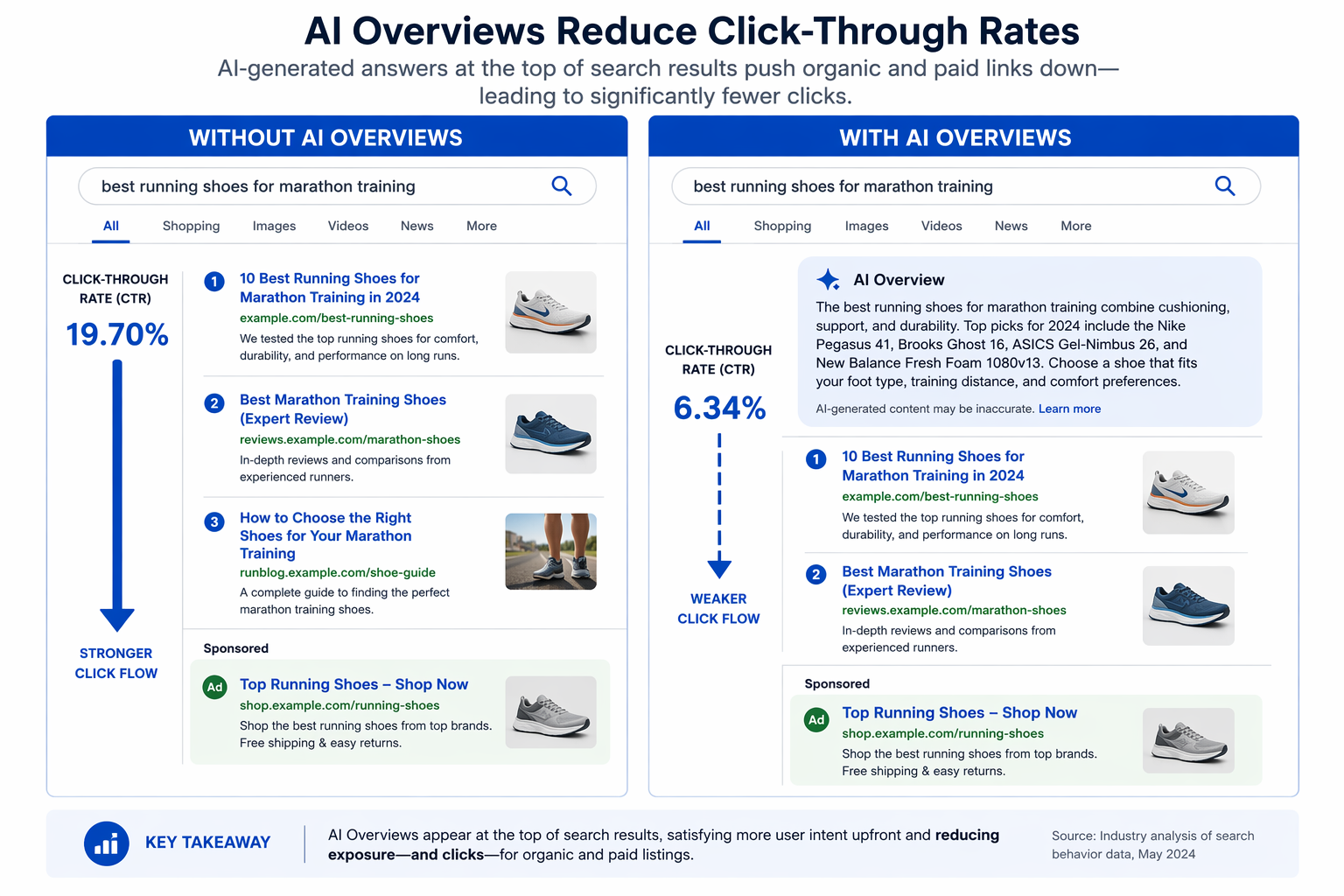
That does not prove every advertiser will lose two-thirds of paid search traffic when AI Overviews appear. Query mix, ad position, vertical, brand demand, and intent all matter. But it makes the paradox visible in one metric. The AI experience that makes Google Search more useful for some users can reduce the need to click an ad, especially when the answer, comparison, or next step is handled directly on the results page.
This is not only an organic SEO problem wearing a PPC hat. Paid search has always depended on an exchange: the user expresses intent, Google sells access to that intent, and the advertiser gets a visit it can measure. AI Overviews weaken the middle of that exchange when the user’s need is satisfied before the visit. AI Mode pushes the change further by creating a more conversational surface where ads can exist, but not necessarily in the same layout, cadence, or measurement pattern as classic search ads. For tactical implications inside campaigns, see AI Mode Ads Are Already in Your Google Ads — Here’s How to Adapt.
The broader zero-click pattern adds pressure. Search Engine Land’s practitioner analysis frames AI Overviews as part of a PPC environment where fewer users need to leave Google to complete early-stage research.[6] That is a different problem from a bad ad. A bad ad can be rewritten. A shrinking click path changes how much behavior is available for the advertiser to observe.
Automation Still Needs Enough Clean Conversions
The other half of the squeeze is signal volume. Search Engine Land’s 2026 analysis of Google Ads automation notes that automated bidding systems generally need roughly 30–50 conversions per month to recognize patterns reliably.[7] That threshold is not new in spirit; machine learning has always needed enough feedback to separate pattern from noise. What is changing is the difficulty of feeding that feedback when more discovery and comparison happen without a site visit.
Agency-cited benchmark material makes the operating concern harder to dismiss, even if it should not be treated as universal market law. Simaia cites a WordStream study of more than 15,000 accounts in which 29% of Google Ads accounts recorded zero conversions over a 90-day period. The same article cites BrightBid benchmarks putting the average Google Ads conversion rate across all industries at 4.40%, with B2B at 1.42%.[8]
Those numbers are not a diagnosis for any one account. They are a warning about the median operating environment many advertisers are trying to automate from. If an account already struggles to produce enough meaningful conversion events, a decline in qualified paid clicks can push it further below the learning threshold. At that point, adding a more advanced Google tool may not solve the core problem. The account may simply be asking a better machine to learn from thinner evidence.
This is where the infrastructure story meets the weekly campaign review. Google can release more capable bidding, targeting, and creative systems. But if the account imports only shallow form fills, loses visibility into offline sales stages, or treats every lead as equal, the automation optimizes toward the wrong proxy faster. More compute does not rescue bad labels.
Why Google Has Every Incentive to Move Fast
There is a strategic reason the shift is so aggressive. Google Search and other advertising revenue reached $60.4 billion in Q1 2026, up 19% year over year, with management pointing to AI Overviews as one of the drivers.[9] That is the tension: Google must protect and extend the ad business while users are being trained to expect AI-composed answers, not blue-link navigation.
So the company is not choosing between AI experiences and ads. It is trying to make ads native to AI experiences before the old search layout loses too much behavioral relevance. That is rational for Alphabet. It may even be necessary. It still means advertisers are being asked to fund the transition through budgets that are measured against old funnel assumptions.
This is why the “capex cuts” framing is misleading for marketers. The risk in H2 2026 is not that Google suddenly stops investing in AI and leaves its ad tools stagnant. The more immediate risk is the opposite: Google invests so heavily that AI-native surfaces scale faster than advertiser measurement systems can adapt.
What Should Change in H2 2026 Planning
Do not increase Google spend simply because Alphabet is increasing AI capex. That is not a media plan; it is a sympathy trade. The useful question is narrower: where does your account show observed marginal return from Google’s newer AI surfaces, and where is spend being pushed into a funnel with weaker click and conversion visibility?
- Separate tests of AI-native tools from assumptions about paid search recovery. AI Max, conversational placements, and commerce integrations deserve controlled tests, but they should not be used to excuse declining search query economics elsewhere.
- Watch paid CTR and conversion volume by query group where AI Overviews are likely to appear. Aggregate account-level CPA can hide the specific inventory where the funnel is compressing.
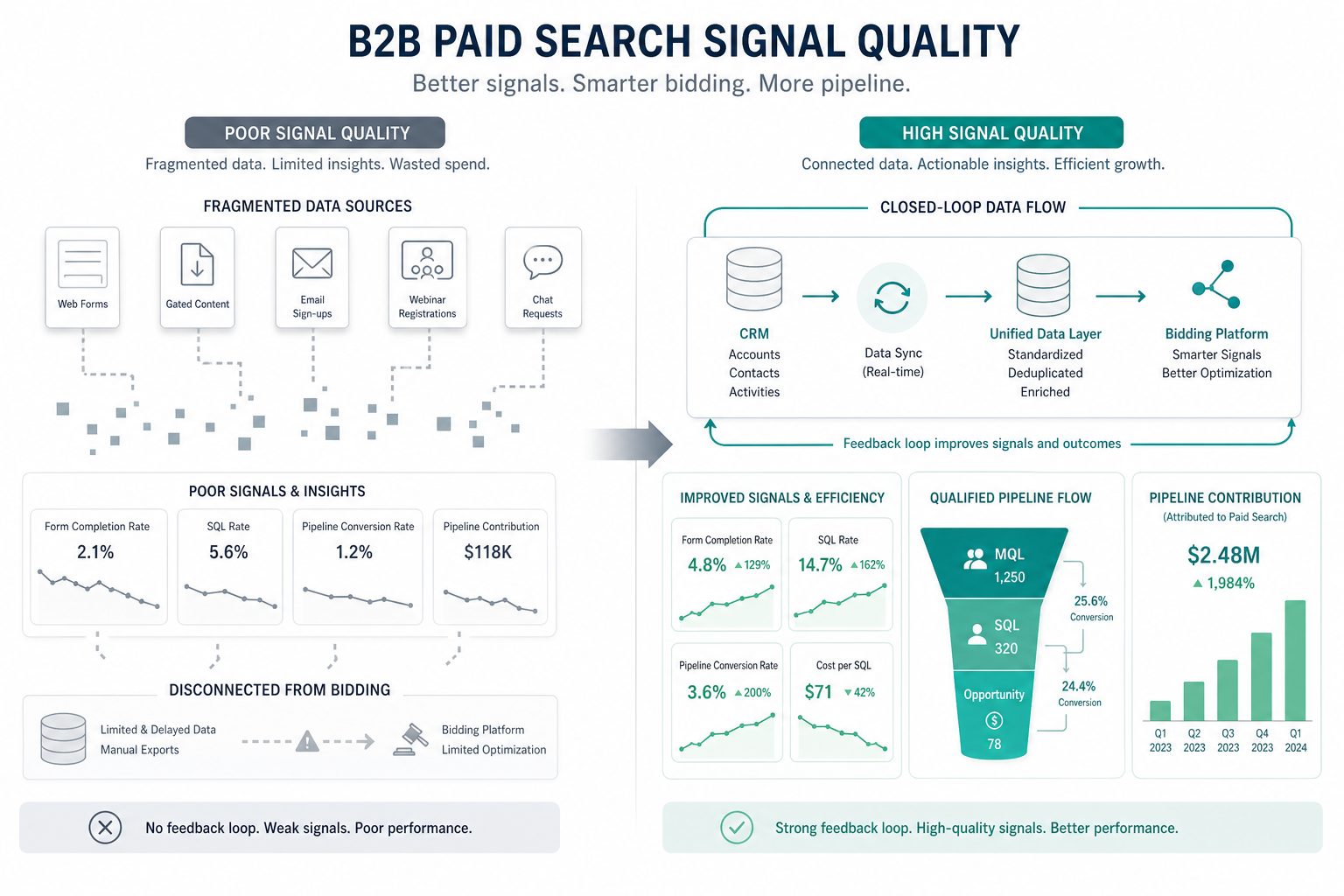
- Raise the quality of conversion imports before widening automation. Offline conversion imports and CRM-stage feedback are now more valuable than another round of audience tinkering when the account is starved for clean signals.
- Keep vendor-reported gains in their proper category. A reported 27% conversion lift at the same CPA is worth testing; it is not a forecast for your account.
- Judge budget by marginal return, not by Alphabet’s confidence. Google’s capex plan tells you where the platform is going, not what your next dollar will return.
The most important operational move is improving the data Google receives. Search Engine Land’s 2026 signal hierarchy places offline conversion imports from CRM data at the top of the leverage stack, above audience lists and keyword targeting.[7] That should change the priority list for many teams. Before adding another campaign type, fix the handoff from lead to qualified opportunity, opportunity to sale, and sale to revenue value.
For ecommerce, that may mean passing better transaction values, margin-aware conversion data, or repeat-purchase signals where available. For B2B, it often means importing lifecycle stages rather than optimizing to every form submission. For local and service businesses, it can mean closing the loop between call outcomes, booked appointments, and actual revenue. The point is not to feed Google more data for its own sake. It is to stop asking automation to optimize toward the easiest event to count.
Budget planning should also separate Google’s AI tool tests from Google-dependent attribution. If discovery increasingly happens inside AI Overviews, AI Mode, YouTube, and other assisted surfaces, last-click reporting will understate some influence and overstate whatever still produces the final measurable click. That does not mean abandoning Google Ads. It means refusing to let one platform define both the media exposure and the measurement story.
For a broader budget view, How Alphabet’s $185B AI Investment Reshapes Marketing Budgets goes deeper on allocation. The immediate campaign takeaway is to create room for channel evidence outside Google-owned click paths: direct demand capture, lifecycle email, partner traffic, community, creator distribution, and AI discovery work that does not depend on a paid search click to prove it exists.
That is also where GEO and AEO work becomes less theoretical. If answer engines and AI summaries mediate more discovery, the job is not only to rank in a conventional results page. It is to make brand facts, product evidence, comparisons, and expert content easier for AI systems and human evaluators to retrieve and trust. For SEO-side workflow changes, see What GEO Actually Changes in Your SEO Workflow; for non-Google discovery, see Winning Discovery Inside ChatGPT: A Practical GEO and AEO Playbook.
The Practical Read
Alphabet’s AI capex is a real product signal. It makes stronger marketing tools more likely, and some advertisers will benefit from that quickly. AI Max, Pomelli, conversational ads, and commerce integrations are not vaporware in the strategic sense; they are evidence that Google is rebuilding the marketing stack around AI-native behavior.
But the same investment accelerates the search behavior that makes old paid-search measurement less reliable. AI Overviews can reduce paid CTR. AI Mode can change where ads appear and how users move. Fewer site visits can make conversion thresholds harder to reach. Weak CRM imports can turn advanced automation into faster optimization against weak proxies.
So the H2 2026 answer is not to cut Google reflexively, and it is not to reward Google’s capex with automatic budget expansion. Test the new tools. Tighten the signals. Diversify discovery and attribution. Then let marginal return, not Alphabet’s infrastructure confidence, decide how much budget Google earns.
References
- AI Capex 2026: The $690B Infrastructure Sprint — Futurum Group
- Alphabet says capital spending in 2026 could double — Reuters, Feb. 4, 2026
- Google Just Changed Everything (Again): Our Takeaways from Google Marketing Live 2026 — Making Science
- Google Marketing Live: How Google Is Building an AI-Native Marketing Ecosystem — CMSWire
- How Will AI Search Affect Paid Ads in 2026? — Search Influence
- How Google AI Overviews are changing the PPC game — Search Engine Land, 2026
- In Google Ads automation, everything is a signal in 2026 — Search Engine Land, 2026
- Google Ads Conversion Rates Dropping in 2026? How AI Search Cannibalization May Be the Hidden Culprit — Simaia
- Alphabet Can Outgrow Everything Else, But Can It Outgrow Ads? — AdExchanger

Comments
Join the discussion with an anonymous comment.