

AI Mode Ads Are Already in Your Google Ads — Here's How to Adapt
Google AI Mode ads are new placements within existing campaigns, not a separate campaign type. This article explains what changes for paid search in Q3 2026 and how to adjust campaign settings, creative asset libraries, and landing pages for conversational intent.
If you are looking for a new “AI Mode campaign” button in Google Ads, that is already the wrong starting point. The practical Google AI Mode ads implications in Q3 2026 are less about launching a new campaign type and more about understanding where Google can now extend campaigns you already run.
Google’s own documentation treats ads in AI experiences as inventory that can be served through existing Google Ads activity, including Performance Max and Search campaigns using AI-powered features, rather than as a standalone campaign build.[1] That distinction matters because it changes the work on Monday morning: eligibility, assets, conversion data, and landing-page fit become the levers. A separate AI Mode media plan does not.
Campaign Type, Placement, and Format Are Not the Same Thing
The cleanest way to avoid bad decisions is to separate three layers that often get collapsed in AI search discussions.
| Layer | What it means in practice | What you can do |
|---|---|---|
| Campaign type | The campaign architecture you create and fund, such as Performance Max, Search with broad match, or AI Max for Search. | Choose structure, budgets, conversion goals, feeds, and asset coverage. |
| Placement | The surface where an eligible ad can appear, including AI Mode when Google determines the auction and context fit. | You currently should not plan around a separate AI Mode targeting or exclusion workflow. |
| Format | The way the ad is rendered in the AI experience, including conversational and shopping-oriented formats Google has announced or tested. | Prepare assets and landing pages for assembly, comparison, and qualification. |
That middle row is the uncomfortable one. A placement can affect performance without giving the account manager a clean placement switch, clean placement report, or clean placement-specific story for the next budget meeting. That is not a reason to ignore AI Mode. It is a reason to stop describing it like a normal campaign expansion.
For most accounts, the first audit is basic: which Performance Max campaigns are live, which Search campaigns rely on broad match, and whether AI Max for Search is enabled or being tested. If you need a deeper refresh on the automation layer behind PMax, the Performance Max AI features guide is the more useful companion than a generic AI search explainer.
What Is Live Enough to Matter, and What Is Still Testing
Google announced new AI ad experiences at Google Marketing Live on May 20, 2026, including formats built for conversational discovery, highlighted answers, AI-powered shopping, and lead-oriented business agents.[2] Search Engine Land’s coverage framed the same shift plainly: ads are being adapted for conversations, not only for the click-and-landing-page pattern search managers have optimized around for years.[3]
Those announcements should influence asset planning now, but they should not be treated as four fully controllable ad products sitting in every account. The safer interpretation is that Google is showing the direction of the inventory: more answers assembled in-session, more product and business data pulled into the response, and more qualification happening before a user reaches your site.
Digital Applied’s independent analysis adds urgency, but it should be handled as directional rather than Google-confirmed. The firm reported 75 million daily AI Mode users, more than 100 million monthly users, more than 1 billion monthly queries, ads appearing in 25.5% of AI results, and 816 active experiment IDs related to AI Mode monetization.[4] Those figures are not a replacement for your account data. They are a warning that the surface is moving faster than the reporting comfort level.
The Measurement Story Gets Worse Before It Gets Cleaner
The hardest internal conversation will not be whether AI Mode exists. It will be why a campaign changed after Google expanded conversational inventory and the reporting view still does not isolate AI Mode performance in the tidy way a director wants.
AI Overviews data is useful here, but only as a proxy. Seer Interactive’s 25.1 million-impression study found paid CTR on queries that triggered AI Overviews fell 68%, from 19.70% to 6.34%, between June 2024 and September 2025.[5] That does not prove AI Mode ads will behave the same way. AI Overviews and AI Mode are different surfaces, with different user actions and ad mechanics.
Still, the pattern is hard to ignore: when Google answers more of the question before the click, fewer casual clicks may survive. Digital Applied separately reported a 93% zero-click rate for AI Mode, again as an independent estimate rather than an audited Google benchmark.[4] The planning implication is not “AI Mode will destroy paid search.” It is that click volume, CTR, and assisted conversion narratives may become less stable if the user arrives after a longer AI-mediated exchange.
That means Q3 reporting needs cleaner language. Do not promise an AI Mode line item if the platform does not provide one. Do separate branded and nonbranded movement, watch broad match query themes, compare landing-page engagement by campaign type, and annotate major AI Max or PMax changes. If leadership wants a firm AI Mode CPA, the honest answer may be that the account can show blended campaign impact, not isolated placement economics.
The Account Audit Starts With Eligibility, Not Ideology
Before rewriting creative or building new pages, map the campaigns Google can already use. The audit does not need to become a deck. It needs to answer a few operational questions.
- Which Performance Max campaigns are active, and do they have complete product feeds, audience signals, final URL settings, and asset groups?
- Which Search campaigns use broad match, and are they tied to conversion goals that still reflect business value?
- Where is AI Max for Search enabled, planned, or blocked by internal policy?
- Which campaigns rely on thin creative inputs, outdated landing pages, or weak offline conversion imports?
- Which performance shifts would be hardest to explain if AI inventory expanded inside the campaign tomorrow?
This is where automation-friendly account structure earns its keep. If conversion goals are noisy, product data is incomplete, or landing pages do not match the kinds of exploratory questions AI Mode invites, the system has more freedom than the advertiser has confidence. For AI Max specifically, the AI Max campaign feature breakdown is worth reviewing before treating it as just another Search setting.
Creative Now Means the Inputs Gemini Can Assemble
The old reflex is to respond to a new search format with more headlines. That is too narrow for AI Mode. In conversational ad surfaces, creative is increasingly the structured material Google can select, combine, and adapt per query: product titles, images, descriptions, ratings, reviews, price, promotions, policies, differentiators, and claims that are specific enough to be useful outside their original ad unit.

Search Engine Land reported that Google is testing multiple conversational ad variants per query, with Gemini assembling creative from advertiser-provided assets and structured product data.[6] The important part is not that machines can remix copy. The important part is that weak inputs become weak combinations at scale.
A useful asset library for AI Mode does not look like a folder of generic brand lines. It looks closer to a well-maintained product and proof database. Each major offer should have clean product names, current pricing or promotion information where applicable, multiple image types, short benefit statements, comparison points, objections answered in plain language, review snippets if the account can use them, and landing-page destinations that support the same claims.
The difference shows up in the query. A user asking for “best patio furniture for a small balcony that can stay outside in rain” does not need the same assembled message as a user comparing two named outdoor dining sets. In a traditional Search account, the manager might have tried to split that precision across keywords and ad groups. In an AI-assembled environment, the cleaner play is to give the system durable components: weather-resistance language, dimensions, materials, care instructions, review proof, shipping terms, and the page that can finish the decision.
That does not mean surrendering brand standards. It means translating them into modular claims the system can use without inventing connective tissue. If a claim needs legal approval, put the approved version in the asset library. If a promotion expires, remove it from the feed. If review language is only valid for one product line, do not let it float as a general proof point.
What to Fix First in the Asset Library
- Remove stale promotions, outdated prices, unsupported claims, and duplicate product descriptions.
- Add images that show use cases, scale, product details, and variants instead of relying only on default product shots.
- Write short claim modules for comparison, qualification, objections, and next steps.
- Connect reviews, ratings, and proof points to the specific products or services they support.
- Align each asset group with landing pages that can substantiate the assembled message.
This is also where creative and data operations stop being separate teams. A campaign manager can optimize asset coverage only if merchandising, lifecycle, legal, and analytics teams keep the underlying inputs usable. For broader data hygiene work behind AI targeting, see the data infrastructure guide for AI targeting.
Landing Pages Need to Catch Up With Conversational Intent
AI Mode users may not arrive with the same mental state as someone who typed a transactional keyword, skimmed three ads, and clicked the most relevant headline. Yotpo describes AI Mode behavior as more exploratory and open-ended than traditional search, while NWS Digital similarly emphasizes that AI search changes paid search by shaping intent before the site visit.[7][8]
That has a landing-page consequence. Pages built only for bottom-funnel confirmation may underperform when the visitor has been comparing, qualifying, and narrowing through an AI exchange. They may arrive more educated, but not necessarily ready for a cart, demo form, or quote request without one more layer of reassurance.
The page should answer the questions the AI conversation likely raised. For ecommerce, that often means comparison tables, fit guidance, shipping and return clarity, review summaries, care instructions, bundles, and variant explanations. For lead generation, it may mean who the service is for, who it is not for, pricing ranges if available, implementation steps, proof by segment, and a lower-friction next step for users who are qualified but not ready to speak with sales.
This is not a call to turn every landing page into a blog post. It is a call to stop sending conversationally qualified traffic to pages that assume the user already chose the category, trusts the brand, understands the tradeoffs, and only needs a button. If the ad experience helped the user compare options, the landing page has to finish that comparison instead of pretending it never happened.
| If the AI exchange shaped this question | The landing page should make this easy |
|---|---|
| Is this product right for my situation? | Show use cases, limitations, sizing, compatibility, or eligibility criteria. |
| How does this compare with alternatives? | Provide comparison points without forcing the user to reconstruct them from marketing copy. |
| Can I trust this claim? | Put reviews, proof, certifications, policies, and claim support near the decision point. |
| What happens next? | Explain checkout, consultation, onboarding, delivery, implementation, or support steps. |
Common Thread Co’s recap of Google Marketing Live noted that Google’s Dan Taylor said traditional search ads are being adapted rather than replaced.[9] That is a useful constraint. The landing page still has to convert. The difference is that it may now receive a visitor who has already had the first conversation somewhere else.
Conversion Signals Become the Guardrail
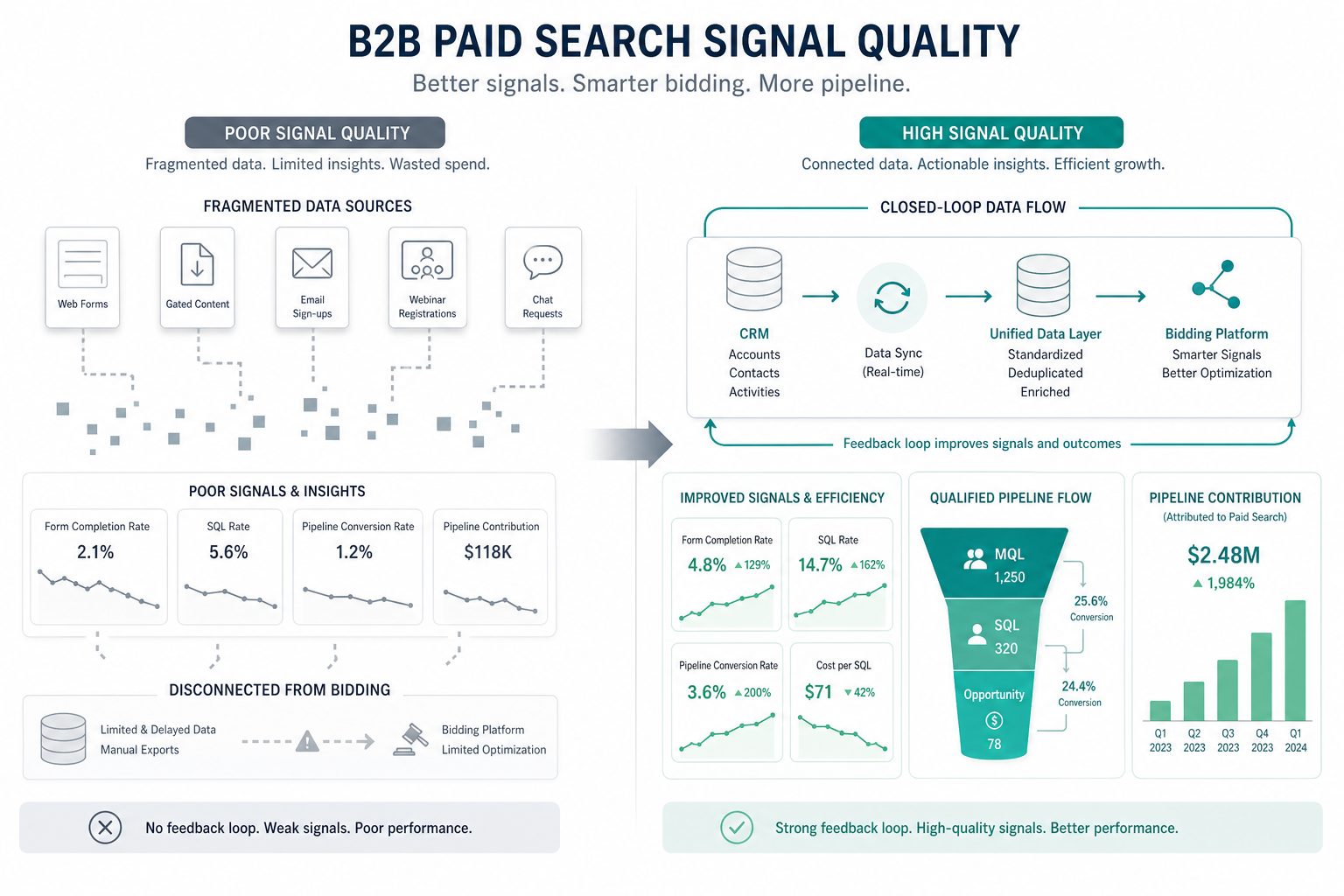
When placement control is limited, conversion quality matters more. Performance Max, broad match, and AI Max all depend on the system understanding which outcomes are worth finding more of. If the account optimizes equally toward newsletter signups, low-quality lead forms, store visits with weak value, and closed revenue, AI Mode expansion will not fix the signal problem. It may magnify it.
The Q3 version of measurement work is not glamorous: import offline conversions, distinguish qualified from unqualified leads, pass values where the business can defend them, remove duplicate events, and annotate conversion goal changes. For ecommerce, product margin, returns, new-customer value, and promotion periods should be visible enough that campaign performance does not get judged only on blended revenue.
This also changes how tests should be framed. A campaign exposed to more AI inventory may show lower CTR, different CPC behavior, or fewer site sessions without automatically becoming worse. The question is whether the surviving traffic carries stronger intent, better lead quality, or higher downstream value. That requires CRM and analytics discipline before it requires another round of bid tweaks.
A Practical Q3 2026 Workflow
The adaptation work is not evenly weighted. Eligibility and reporting expectations can be checked quickly. Assets, feeds, and landing pages deserve most of the time because they are where advertisers still have leverage.
- Map eligible campaigns: list active Performance Max campaigns, broad match Search campaigns, and AI Max tests; note budgets, goals, feeds, and final URL behavior.
- Reset reporting expectations: document that AI Mode performance may not be separable in standard reporting, then define the blended indicators the team will monitor.
- Clean conversion inputs: prioritize value-based goals, offline conversion imports, lead qualification, deduplication, and conversion annotations.
- Rebuild creative inputs: treat feeds, images, reviews, promotions, descriptions, policies, and approved claim modules as the creative system.
- Revise landing pages: add comparison, qualification, proof, and next-step content for users arriving from exploratory AI interactions.
- Create a change log: record campaign setting changes, major asset updates, landing-page releases, and tracking fixes so performance shifts have a timeline.
The workflow is deliberately unglamorous because the platform change is asymmetric. Google can test conversational ad surfaces quickly. The advertiser’s near-term response is slower and more operational: better inputs, better destinations, better signals, and more careful performance narratives.
What to Stop Doing
Stop building phantom AI Mode campaign plans. There is no useful reason to organize Q3 work around a campaign type you cannot launch as a distinct object.
Stop treating AI Overviews benchmarks as AI Mode benchmarks. They are adjacent evidence, not a measurement substitute. The Seer CTR decline is a serious warning about changed click behavior, but it does not give an AI Mode conversion-rate forecast.[5]
Stop judging creative readiness by headline count. If Gemini is assembling ads from structured assets, the quality of the feed and supporting proof points matters as much as the copy variations sitting in the ad platform.
Stop sending every exploratory query path to the same thin transactional page. AI-mediated users may need fewer generic claims and more specific help deciding whether the offer fits their use case.
The Real Implication for Paid Search Teams
AI Mode ads are not just another Google Ads feature update because they sit across budget confidence, measurement narratives, creative operations, and landing-page strategy. The account manager may not get a clean AI Mode report, but she will still be asked why Performance Max changed, why broad match behaved differently, and whether the new traffic is worth funding.
The practical posture for Q3 2026 is simple enough to act on: do not create a campaign that does not exist. Make the campaigns Google already uses eligible, well-fed, well-measured, and matched to the kind of conversational intent AI Mode is training users to bring.
References
- About ads in AI experiences, Google Ads Help.
- Google Marketing Live: New AI-powered ads and commerce experiences, Google, May 20, 2026.
- Google’s latest AI ad push shows ads are becoming conversations, not clicks, Search Engine Land.
- Google AI Mode: 75M Users, Ads in AI Results 2026, Digital Applied.
- How Google AI Overviews Are Reshaping Paid Search Performance, Signal & Convert.
- Google tests new conversational ad formats in AI Mode and Search, Search Engine Land.
- Google AI Mode vs. Traditional Search, Yotpo.
- Google Ads AI: How AI Mode and AI Overviews Are Changing Paid Search, NWS Digital.
- Google Marketing Live 2026: AI Advertising Updates, Common Thread Co.
Comments
Join the discussion with an anonymous comment.