

How Google AI Overviews Are Reshaping Paid Search Performance
Google's AI Overviews have triggered a 68% decline in paid CTR on affected queries and accelerated CPC inflation. This article explains the data behind the shift and offers five tactical adjustments — from intent-layer restructuring to placement-sensitive bidding — that performance marketers can apply to protect ROI.
The uncomfortable part of Google AI advertising in 2026 is not that the search results page looks different. It is that paid search accounts are now being judged against benchmarks built for a SERP that no longer exists on a meaningful share of queries.
The cleanest evidence is still the Seer Interactive dataset: 25.1 million organic impressions and 1.1 million paid impressions across 42 organizations. On queries that triggered AI Overviews, paid CTR fell from 19.7% in June 2024 to 6.34% in September 2025, a 68% decline. The drop was not smooth, either; Seer’s data showed a particularly sharp July 2025 collapse, with paid CTR moving from roughly 11% to roughly 3% in a single month.[1]
That is the number that explains why an account can look stable in impression volume and still feel broken in the P&L. The search happened. The ad was eligible. The auction ran. But the user’s first real answer may have been the AI Overview, not the ad.
The scale is now large enough that this cannot be treated as a weird edge case. Conductor’s Q1 2026 data put AI Overviews on 25.5% of searches, while Digital Applied reported that ads appeared in 25.5% of those AI Overviews, with the important caveat that prevalence varies by query category, geography, date, and methodology.[2] Adthena’s category-level data makes the concentration even clearer: 79% of finance queries with five or more words triggered AI Overviews, as did 84% of retail comparison searches.[3]
Those are exactly the query shapes many paid search teams used to prize: longer, richer, more specific, and closer to comparison or decision-making behavior. When those queries start producing fewer paid clicks, the old comfort metrics become dangerous. Impression share can still tell you whether you were present in an auction. It does not tell you whether the user’s attention was consumed before the ad had a fair chance.
The placement problem behind the CTR decline
AI Overviews do not create one uniform paid search problem. They create a placement problem. An ad above the AI Overview, an ad embedded around the AI Overview experience, and an ad below the AI Overview are not competing for the same kind of attention.
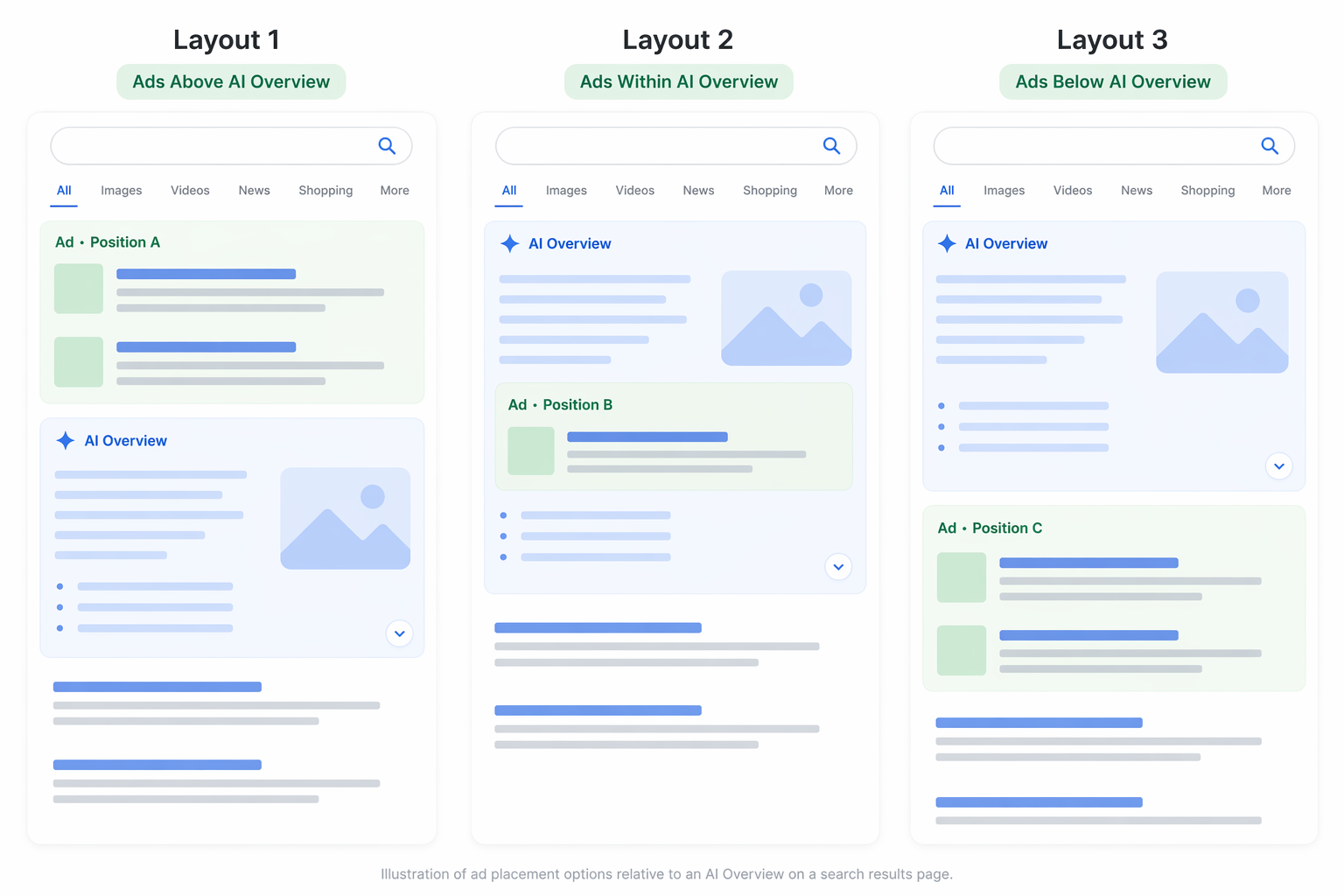
When the ad appears above the AI Overview, it still has first-screen visibility, but it is often operating before the user has absorbed the AI-generated summary. That placement can still work for transactional queries where the user already knows what they want. It is less reliable when the query is exploratory and the user is clearly asking Google to synthesize the market before choosing a vendor, product, or next action.
When ads appear within or immediately around the AI Overview experience, the user has already been framed by Google’s answer. That can help if the ad is tightly aligned with the next step the summary implies. It can hurt if the ad repeats generic category language the user just got for free. The ad is no longer introducing the problem; it is trying to win the next click after Google has done part of the education.
When ads sit below the AI Overview, the bar is higher. The user has to read, scan, or at least move past the AI answer before getting to the paid result. Some of those users will be more qualified because they have used the summary to narrow their intent. Others will never arrive. Treating all three layouts as the same paid search inventory is how budgets quietly drift into weaker click yield.
Intent is getting compressed, but not in a way you can automate blindly
The working explanation many practitioners are using is intent compression. The user asks a broad or comparative question, gets a summarized answer from the AI Overview, and then clicks only when there is a stronger reason to act. What used to spread across several searches, several sessions, and a retargeting window can collapse into one search session.
That should be treated as an operating hypothesis, not a universal law. The available evidence does not support a precise claim that every multi-day journey has collapsed into a single session. But the observed mechanics are plausible: AI Overviews are more common on longer and comparison-heavy queries, and paid CTR has weakened on AI-Overview-triggering searches at the same time.[1][3]
The practical consequence is that mid-funnel paid search can become harder to read. A query that used to signal research may now contain a user who has already consumed a summary, compared options, and is deciding whether one result deserves the click. A query that used to be cheap upper-funnel coverage may start behaving like expensive pre-purchase inventory, especially if spend concentrates on the fewer users who still click.
This is where broad advice about “using AI in ads” becomes too vague to be useful. The account problem is more specific: the same keyword can now sit behind different SERP layouts, different degrees of AI pre-education, and different click probabilities. If the campaign structure still assumes that keyword category alone equals intent, it will miss the change that matters.
Restructure campaigns by intent layer, not just keyword theme
Intent-layer restructuring is the adjustment most likely to change performance next week, but it is also the one most likely to be damaged by lazy implementation. The goal is not to create a neat folder system called informational, commercial, and transactional. The goal is to stop letting queries with different AI Overview exposure, click behavior, and conversion proximity share the same budget logic.
| Intent layer | What to look for in query data | How the campaign logic changes |
|---|---|---|
| Informational | Question-led searches where the user is seeking explanation, definitions, comparisons, or process guidance | Use tighter budgets, softer conversion expectations, and stronger audience or remarketing logic before scaling |
| Commercial evaluation | Queries comparing vendors, product types, prices, features, reviews, or alternatives | Separate from pure research terms; test more aggressive bids only where post-click behavior supports it |
| Transactional | Queries with clear purchase, quote, demo, booking, or near-term action language | Protect coverage, but watch CPC inflation and conversion value rather than assuming higher bids are always justified |
The important move is separating evaluation behavior from general information behavior. Before AI Overviews became this visible, many accounts could afford to group those queries together because mid-funnel clicks were relatively abundant and remarketing could pick up the slack. Now, if AI Overviews absorb a larger share of informational clicks, the remaining clicks from that layer may be too sparse or too expensive to subsidize with the same assumptions.
A practical rebuild starts with the search terms report, not the campaign naming convention. Pull queries that have lost CTR disproportionately while maintaining impressions. Tag them by apparent intent. Then compare conversion rate, cost per conversion, average CPC, and assisted value where available. If informational queries are losing clicks without producing later value, they should not sit in the same budget pool as bottom-funnel queries just because they share a root keyword.
Commercial evaluation deserves its own treatment because AI Overviews appear heavily on comparison-oriented searches. Retail comparison searches were one of the categories where Adthena found especially high AI Overview triggering, at 84%.[3] That does not mean comparison queries are dead. It means the ad has to be evaluated as a next-step option after the user has seen Google’s synthesis. The landing page, offer, and ad copy need to justify why the click is still worth making.
Transactional terms should not simply inherit all the budget saved from informational cuts. CPC pressure can intensify when spend concentrates into fewer high-intent clicks. If Google Search spend is growing faster than click volume, as Q1 2025 data indicated with 9% year-over-year spend growth against 4% click growth, the auction is already telling advertisers that clicks are becoming more expensive.[4]
The better question is not “Which layer gets more budget?” It is “Which layer still produces profitable marginal clicks under the new SERP?” For some accounts, that will mean cutting broad educational coverage. For others, especially brands that can monetize longer consideration cycles or have strong first-party nurturing, informational coverage may still be useful. It just needs to be priced like a weaker click source unless the data proves otherwise.
Bid by placement sensitivity, not average position nostalgia
Average position is long gone, but some account habits never really left. Many teams still behave as if higher visibility on the page has a stable relationship with click probability. AI Overviews make that assumption weaker because the ad’s relationship to the answer block matters as much as its presence on the page.
Placement-sensitive bidding starts with isolating query groups where AI Overviews are likely to appear and where CTR has diverged from the account baseline. The exact visibility controls available inside Google Ads are imperfect, so the work is partly diagnostic: compare affected query clusters against similar non-affected clusters, monitor CTR deltas over time, and avoid letting automated bidding chase volume that no longer carries the same probability of conversion.
Above-AI placements can justify stronger bids when the query is already action-oriented. If someone searches with a clear purchase, booking, quote, or demo modifier, the ad can still intercept demand before the summary changes the path. But if the query is broad and explanatory, paying aggressively for the first ad slot may mean buying attention before the user has decided what category, feature, or vendor criteria matter.
Ads around the AI Overview require a different test. These users may be more informed by the time they see or process the ad. Bid tests should be tied to landing-page behavior, not CTR alone. If CTR is lower but conversion rate or average order value improves, the placement may still work. If CTR falls and post-click engagement weakens, the ad is probably paying for leftovers after the AI Overview satisfied the user’s need.
Below-AI placements should be treated with the most skepticism on educational queries. They may still capture determined users, but they are also exposed to the highest attention tax. Before defending bids there, look at whether the query group produces meaningful conversion value after the CTR decline. If not, budget caps and lower targets are not timid; they are the account admitting that the inventory has changed.
This is also where automation needs adult supervision. Smart Bidding can optimize toward the conversion signals it sees, but it does not automatically understand that a CTR drop on a specific query class may reflect a SERP layout shift rather than weaker ad relevance. Teams evaluating tools for this work should care less about generic AI features and more about whether the stack can expose query-level movement cleanly; that is the more useful lens for choosing an AI PPC management tool stack.
Feed quality and structured data become economic levers
Feed quality used to be easy to treat as housekeeping: important, but rarely the exciting part of paid search strategy. AI Overviews make that view harder to defend. When the user has already received a synthesized answer, weak product data, thin business information, vague landing pages, and mismatched assets leave the ad with less room to recover.
The Seer finding that cited brands saw a 91% higher paid CTR than uncited brands is especially important here.[1] It does not prove that being cited causes the higher CTR. Stronger brands may be more likely to be cited and more likely to earn the click for other reasons. But for an advertiser managing the account, the distinction does not make asset quality optional. If brand presence inside the AI-influenced SERP is associated with stronger paid CTR, messy feeds and unclear entity signals become performance risks, not just SEO chores.
For ecommerce, that means product titles, availability, pricing, variants, GTINs where applicable, ratings, shipping information, and promotional attributes need to be accurate enough that the ad can survive comparison. For lead generation, it means the landing page must state the service, geography, proof points, pricing cues where possible, and next action without forcing the visitor to reconstruct the offer from generic copy.
Structured data will not magically buy back lost CTR. It can, however, reduce ambiguity. The more the SERP summarizes options before the click, the more valuable it becomes for Google and the user to understand exactly what the business sells, where it operates, what inventory exists, and which page answers which intent. That is a structural advantage because it improves the odds that the ad, feed, landing page, and query are describing the same thing.
Creative has to add what the AI Overview cannot
Once the AI Overview has explained the category, generic ad copy loses even more force. “Trusted provider,” “best solution,” and “learn more” were never especially useful, but they become weaker when the user has just received a summarized answer that already covers the basics.
Creative should pick up where the AI answer stops. That can mean pricing clarity, inventory specificity, implementation speed, comparison proof, local availability, warranty terms, financing, integrations, or a sharper reason to choose one brand now. The right differentiator depends on the query layer. A commercial comparison query may need proof and contrast. A transactional query may need friction removal. A returning visitor may need an offer or a reminder of a specific product line.
This is not a call to stuff every responsive search ad with every possible claim. It is a call to stop using one ad-message set for users who have been pre-educated by the SERP and users who have not. If an AI Overview has already answered “what is this?” the ad should not spend its limited attention answering the same question again.
First-party audiences matter more when retargeting pools thin out
If fewer users click during the research stage, fewer users enter remarketing pools from paid search. That is one of the quieter budget problems created by AI Overviews. The account does not just lose the first click; it may lose the later audience path that used to make the first click defensible.
First-party audience data becomes a defensive layer because it gives the account something sturdier than the open SERP to optimize around. Customer lists, qualified lead stages, high-value purchaser segments, newsletter or demo-request audiences, and CRM-derived value signals can help bidding systems distinguish between cheap traffic and useful demand.
The implementation should be conservative. Poor audience hygiene can make automation more confident in the wrong direction. Uploading broad lists of unqualified contacts, stale leads, or low-value buyers will not solve an AI Overview problem. It will just give the system more noisy signals. The useful audience work is narrower: define the users who actually create margin, pass those signals back cleanly, and use them to judge whether compressed journeys are producing profitable customers.
The reporting change: CTR and query intent move to the center
Impression share is not useless, but it is no longer enough to explain paid search performance on AI-Overview-heavy queries. It answers a presence question. The account now needs to answer an attention question.
At minimum, reporting should separate query groups by likely AI Overview exposure, intent layer, CTR movement, CPC movement, conversion rate, and conversion value. The point is not to create a perfect AI Overview detection system inside Google Ads. The point is to stop blending affected and unaffected queries until the account average hides the problem.
- Track CTR by query cluster, not only by campaign or ad group.
- Flag queries where impressions hold but paid clicks deteriorate.
- Compare informational, commercial evaluation, and transactional terms separately.
- Watch CPC and conversion value together so high-intent bidding does not become margin leakage.
- Document SERP observations for the highest-spend query groups, especially where AI Overviews are visible.
This is also the right place to keep Google’s own AI advertising claims in their lane. Platform-reported uplift claims, including AI Max-style conversion lift narratives, may be worth testing in controlled account experiments. They should not be used to explain away independent CTR evidence from AI-Overview-triggering queries. For a deeper treatment of that gap, see Google AI Advertising: Real Results vs. the Marketing Claims.
The same caution applies to automation. Automated bidding may still be useful, and in many accounts it will remain necessary. But if the human layer does not restructure intent, isolate query behavior, and clean up value signals, automation will optimize inside a muddled system. The more practical debate is covered in AI PPC Automation: A Reality Check on Where It Delivers and Where It Fails, but the short version here is simple: automation cannot rescue a campaign architecture that no longer matches the SERP.
Legacy benchmarks are now the risky choice
The Seer data runs through September 2025, and AI Overview behavior has continued to evolve since then. That means the exact CTR figures should not be treated as a permanent constant. But dismissing them because the SERP has changed further would be backwards. They are still the clearest independent account-level warning that paid search economics changed when AI Overviews became a serious part of the results page.
For performance marketers, the response is not to abandon Google search. It is to stop managing affected inventory as if the old auction environment still holds. Campaigns need intent-layer separation. Bids need to reflect placement sensitivity and post-click value. Feeds, structured data, and landing pages need to remove ambiguity. Creative needs to say something the AI Overview did not already say. Reporting needs to put CTR movement and query-level intent where impression share used to sit.
Google’s platform-reported AI uplift claims belong in a separate testing conversation. The operating problem inside paid search accounts is already visible: AI Overviews have changed where attention goes, which clicks remain, and how expensive those clicks can become. Profitability now depends on rebuilding the account around that reality rather than defending last quarter’s benchmarks.
References
- 4 strategic paid search pivots to survive Google’s AI Overviews — Search Engine Land.
- AI Search & SEO Statistics 2026: Definitive Collection — Digital Applied.
- Adthena AI Overview analysis — Search Engine Land.
- Google Search spend and click growth Q1 2025 — Search Engine Land.
Comments
Join the discussion with an anonymous comment.