

Why AI Data Center Costs Are Reshaping Marketing Budgets
The $5.2 trillion AI infrastructure buildout isn't an abstract tech macro trend — it flows directly into marketing budgets through inference pricing, hyperscaler capex pass-through, and a structural cost visibility gap. This article traces the causal chain so marketing leaders can plan more accurately and justify budget decisions.
The awkward moment in the 2026 marketing budget meeting is no longer whether the team is “using AI.” It is whether anyone can forecast what that use will cost once it moves from scattered pilots into daily production. A content team adds AI-assisted drafting. Demand gen tests automated landing page variants. Sales enablement asks for summarization inside the CRM. The platform renewal arrives with an AI bundle, the experimentation tool adds usage-based credits, and the finance partner quite reasonably asks which line item produced which marketing outcome.
That is where AI data center infrastructure for marketing stops being a distant technology story. Bessemer Venture Partners estimates that $5.2 trillion in AI infrastructure investment will be needed globally by 2030, alongside a 165% increase in power demand and 190 GW of announced hyperscale capacity.[1] Those numbers are too large to be useful on their own. They matter to marketing because the cost of serving AI outputs has to land somewhere: in API bills, platform margins, enterprise subscription tiers, AI add-ons, credit systems, or delayed vendor price increases.
The chain is not perfectly linear. A hyperscaler does not spend on data centers in January and force every martech vendor to raise prices in February. Some vendors absorb costs for a while. Some negotiate better compute rates. Some subsidize AI features to win enterprise share. But the direction of pressure is clear enough for budget planning: AI features are compute-intensive, inference happens every time users ask for outputs, and marketing teams are often increasing usage before they have a durable cost model.
The cost chain marketers actually need to understand
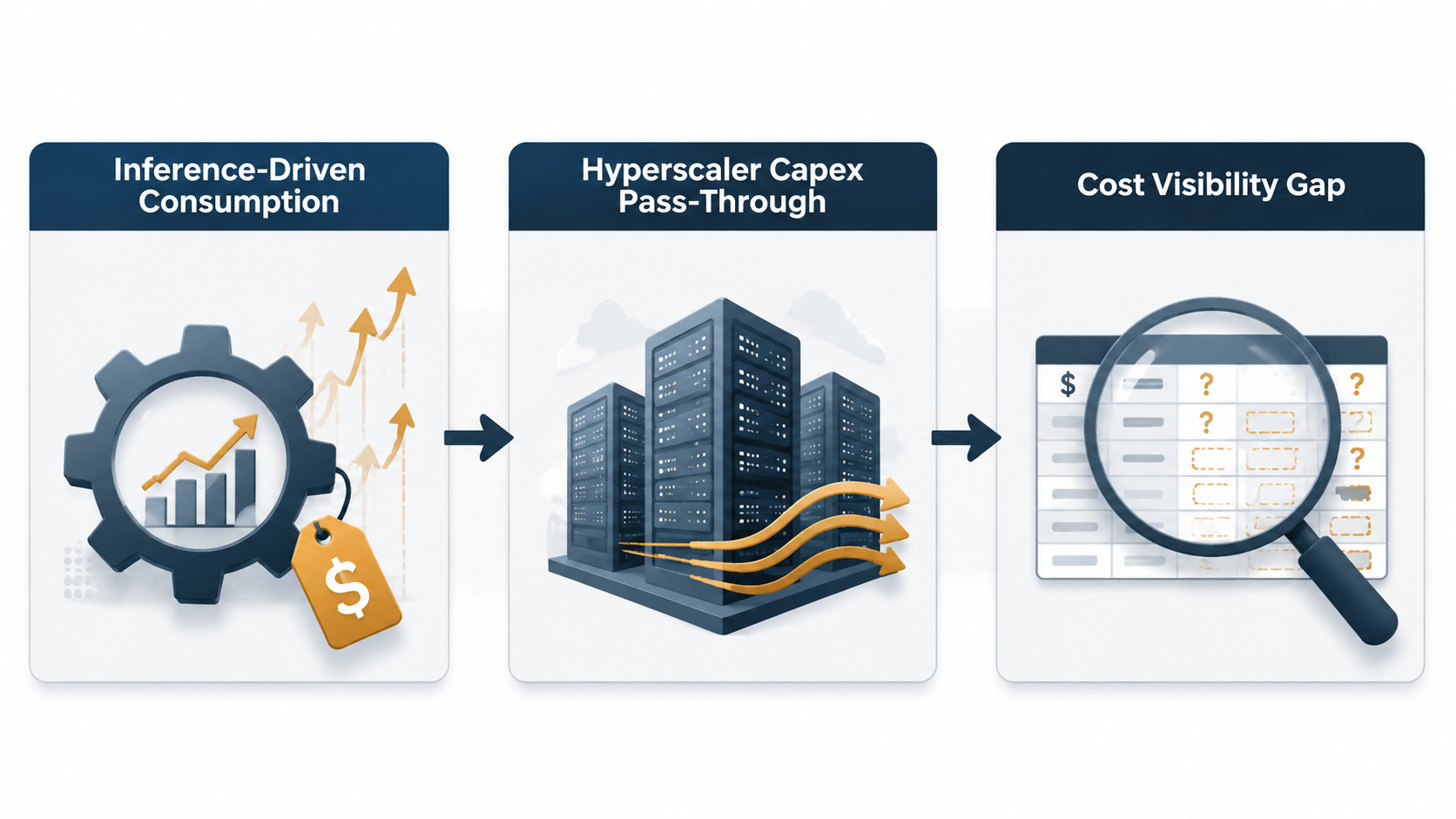
The useful version of the infrastructure story has three links. First, inference turns normal marketing activity into metered consumption. Second, hyperscaler capital spending creates cost pressure for the vendors building on top of cloud infrastructure. Third, most marketing teams lack the visibility to connect AI spending to useful outputs, so the spend becomes hard to defend even when some of the work is genuinely valuable.
| Cost mechanism | What changes for marketing | Budget question to ask |
|---|---|---|
| Inference-driven consumption pricing | Every prompt, generation, classification, enrichment, or automated workflow can create incremental compute cost. | Which AI actions are frequent enough to change the bill? |
| Hyperscaler capex pass-through | Vendors face higher infrastructure commitments and may recover them through tiers, credits, add-ons, or renewals. | Which platform prices depend on AI usage, even if the invoice still looks like SaaS? |
| Cost visibility gap | Teams adopt AI faster than they measure cost per useful output. | Which AI spend can be tied to production volume, quality, conversion, or cycle-time gains? |
This framing is more useful than asking whether AI is “expensive” or “worth it.” Some AI use is cheap and sensible. Some is expensive because it calls a powerful model repeatedly for low-value work. Some is hard to judge because it is bundled inside a platform renewal. The budget risk comes from treating all of those as one category.
Inference is where marketing behavior shows up on the bill
Training gets the headlines because it is visibly expensive: large model runs, specialized chips, long development cycles, and technical teams measuring progress at model scale. For most marketing departments, however, the recurring budget exposure is inference. Inference is the cost of using a model after it has been trained: generating ad variants, classifying leads, summarizing calls, rewriting nurture emails, producing product descriptions, tagging creative, or evaluating content against a brand rubric.
VKTR’s review of the AI cost crisis cites training costs rising 2.4x per year, but it also points to the bigger operating issue: inference averages 60% to 90% of AI compute spend at scale.[3] That distinction matters for marketing operations because inference is not a one-time innovation investment. It is what happens when a useful workflow becomes popular.
A pilot might involve a strategist asking for ten campaign concepts. A production workflow might ask an AI system to generate, score, localize, and route thousands of content elements across segments. The second workflow may be better operationally, but it is also closer to a meter than a subscription. The cost moves with frequency, model choice, prompt size, context length, output length, automation loops, retries, and quality-control steps.
This is why generic per-seat thinking breaks down. A team can buy the same AI-enabled tool and produce very different costs depending on whether users ask occasional questions or build automated workflows that call a model every time a lead changes stage. In scaling-stage AI B2B companies, inference averages 23% of total product costs, a figure VKTR attributes to SaaStr data.[3] That is a vendor-side number, not a marketing-department invoice line. Still, it explains why AI-heavy software economics can feel less predictable than older SaaS margins.
Marketing has more control over inference than it has over data center construction. The team can decide which tasks deserve a frontier model, which can use a smaller model, which can be cached, which can be batched, and which should not be automated at all. A high-volume classification task does not need the same model as a sensitive executive thought-leadership draft. A personalization workflow that runs on every contact in the database needs a different cost review than a brainstorm assistant used by five campaign managers.
This is also where tool comparisons need to become operational rather than tribal. The useful question is not which model sounds smarter in a demo. It is which model or platform tier performs the job well enough at the volume the workflow will actually create. That is the practical layer behind a ChatGPT vs. Claude comparison for content marketing teams: task routing, not brand preference.
Hyperscaler capex does not become your invoice directly, but it changes vendor economics
The second link in the chain is capital intensity. Avid Solutions, summarizing data center growth projections, points to roughly $400 billion in hyperscaler AI capex in 2026.[2] That figure includes the cloud and infrastructure layer many AI vendors depend on, even when the marketing buyer never sees the underlying provider.
For marketing teams, the important point is not that every vendor will pass through cost in the same way. They will not. The pressure can appear as higher enterprise renewals, fewer unlimited-use features, separate AI credits, usage thresholds, premium tiers for better models, or lower discount flexibility. A vendor may also keep list prices stable while narrowing what is included in the base package.
That makes AI pricing harder to compare across the martech stack. One platform may charge per seat and hide model use inside a plan. Another may sell credits. Another may meter API calls. Another may bundle AI into an enterprise edition and make the cost visible only during procurement. A spreadsheet that treats all four as normal SaaS subscriptions will miss the variable cost buried underneath.
The supply side can tighten in other ways too. Power availability, local permitting, and data center policy constraints can affect where capacity is built and how quickly it comes online. That does not mean a local moratorium automatically raises a marketing team’s software bill, but it is part of the environment vendors operate in. For the supply-side version of that issue, see how AI data center moratoriums can affect the marketing tech stack.
The visibility gap is now a budget risk
The third link is the one marketing leaders can least afford to dismiss: most organizations are not forecasting AI infrastructure costs well. MarTech reports that 80% of enterprises miss AI infrastructure forecasts by more than 25%. The same analysis cites 84% of companies reporting margin erosion from AI infrastructure, with 26% seeing an impact of 16% or more.[4]
Those are enterprise-level figures, not a clean benchmark for a marketing department’s software budget. But they are a warning about the planning pattern. Teams approve AI use, usage expands, infrastructure economics remain abstract, and the actual cost shows up later in a place that is difficult to attribute. By the time finance asks for justification, the organization may know the vendor, the renewal date, and the total increase, but not the cost per useful marketing output.
The most damaging gap is not ignorance of model architecture. It is the absence of a shared unit of value. If AI-assisted content production increases output, the budget owner still needs to know whether that output improved speed, quality, revenue contribution, conversion rate, rep productivity, or simply the volume of material waiting for review. If a generative workflow saves copywriting time but creates more editing, legal review, and brand QA, the cost moved rather than disappeared.
ClickMinded’s 2026 AI marketing statistics report that only 14% of organizations track AI content performance against human content as a KPI.[7] That is not proof that AI content underperforms. It is proof that many teams cannot yet say, in a disciplined way, whether AI-assisted production is creating better marketing outcomes, cheaper comparable outcomes, or just more measurable activity.
The fix starts before procurement. A renewal conversation should not ask only, “Do we need the AI package?” It should ask what the package will be used for, how often it will run, which model or tier it uses, what limits trigger overages, whether unused credits expire, what reporting is available, and which business metric will justify expansion. The finance conversation improves when marketing can separate experimentation cost, production cost, and speculative platform bundling.
Adoption is moving faster than operating discipline
The timing matters because AI has already moved past novelty for many marketing teams. Spencer Stuart reports that 84% of marketing leaders are piloting or scaling AI, while none in its survey reported full transformation.[5] That is a familiar middle state: enough adoption to create real spend, not enough maturity to make the spend easy to forecast.
Headcount expectations make the budget story even more complicated. In the same Spencer Stuart work, 69% of marketing leaders said headcount had remained steady, while 36% expected AI-driven headcount reductions over the next 12 to 24 months.[5] PwC frames the leadership choice as whether marketing in the AI era will matter more or cost less.[6] In practice, many departments are still carrying both sides of the transition: existing teams, new AI tools, enablement time, governance work, and uncertain productivity gains.
That is why “AI will save money” is too blunt for budget planning. A tool can reduce production time in one workflow while increasing spend in another. A content assistant can help a lean team move faster, while an always-on personalization engine may add meaningful variable cost. An AI research tool may be easy to justify for strategy work, while automated generation at scale needs tighter controls because volume can run ahead of value.
The better operating question is cost per outcome. If a team cannot yet answer that, it can at least narrow the unit: cost per approved asset, cost per tested variant, cost per qualified account enriched, cost per sales-ready summary, cost per localized page, or cost per usable campaign concept. The specific unit matters less than the discipline of not treating all AI activity as a single productivity cloud. The same logic applies in any ChatGPT ROI reality check for marketing: the output has to be useful enough to carry its cost.
What marketing can control
Marketing leaders cannot control global power demand, GPU supply, data center construction, or hyperscaler capital budgets. They can control how casually AI usage enters the operating model. The practical work is less glamorous than transformation language, but it is what makes adoption defensible.
- Separate AI experimentation from production usage so pilots do not quietly become permanent variable costs.
- Map high-volume workflows before approving AI automation, especially enrichment, classification, generation, scoring, and personalization.
- Require vendors to explain AI pricing units, usage limits, model tiers, overage rules, credit expiration, and reporting granularity.
- Route tasks by value and complexity instead of defaulting every workflow to the most expensive available model.
- Track at least one cost-per-output or cost-per-outcome measure before expanding AI use across a team.
For a smaller team, this may be as simple as choosing fewer tools and being clear about which job each one does. A practical small business AI marketing stack should not recreate enterprise sprawl at a smaller budget. For a larger team, the same principle becomes governance: workflow owners, usage reviews, procurement language, and reporting that connects AI activity to marketing outcomes.
The most useful procurement questions are specific enough to make vague AI pricing uncomfortable. Which features call a third-party model? Can usage be exported by team, workflow, or campaign? Are AI credits pooled across departments? What happens when volume doubles? Can lower-cost models handle routine tasks? Does the vendor provide logs detailed enough to identify waste? If the answer is “AI is included,” the follow-up is “included up to what limit, measured how?”
The budget question changes
The $5.2 trillion infrastructure buildout is not a reason for marketing teams to slow down useful AI adoption. It is a reason to stop treating AI as a generic software feature. The cost chain is now close enough to the marketing budget to require a clearer operating model: inference creates recurring consumption, hyperscaler capex shapes vendor economics, and weak measurement turns both into budget volatility.
A marketing team does not need to solve the economics of global AI infrastructure. It does need to know which AI usage is producing measurable marketing output at a cost it can forecast.
References
- Roadmap: The AI data center stack, BVP Atlas
- 13 Data Center Growth Projections That Will Shape 2026-2030, Avid Solutions
- Inside the AI Cost Crisis: Why Inference Is Draining Enterprise Budgets, VKTR
- Why AI is the most unpredictable cost in the martech stack, MarTech
- The AI Reckoning: Why Marketers Think 2026 Is a Make-or-Break Year, Spencer Stuart
- Marketing in the AI era: To matter more or cost less?, PwC
- AI Marketing Statistics 2026 by Adoption, ROI, Use Case, and Risk, ClickMinded

Comments
Join the discussion with an anonymous comment.