

The Real ROI of ChatGPT in Marketing: A Data Reality Check
Marketers overwhelmed by ChatGPT hype need a data-backed reality check. This article synthesizes 2026 research to separate where ChatGPT drives measurable ROI—content velocity, personalization lift, time savings—from areas where the evidence is thin, including direct conversion attribution and creative differentiation.
The budget question around chat gpt for marketing is no longer whether teams are using it. They are. The harder question is which business result moved because of it, and whether that movement is strong enough to defend the spend.
That distinction matters in 2026 because adoption, budget commitment, and ROI proof are being discussed as if they are the same thing. HubSpot reports that 84% of marketers use AI tools daily, while CMI reports that 88% of marketers use ChatGPT at least three times per week.[1][2] Gartner says 91% of CMOs now classify AI as mission-critical infrastructure, with AI accounting for 31% of total MarTech budgets.[3] IDC projects AI marketing spending above $35 billion in 2026, up from $26.99 billion in 2025.[4]
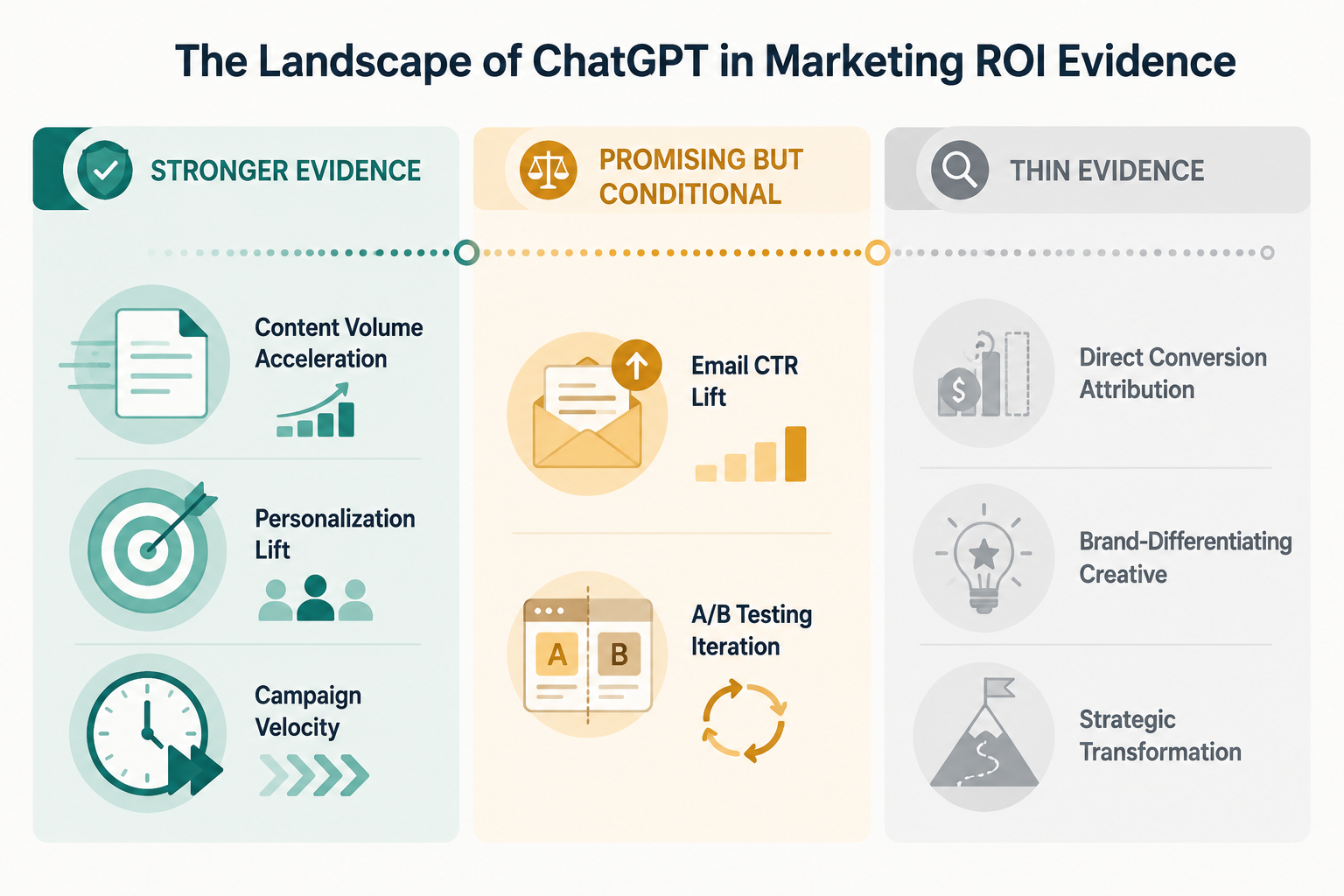
Those numbers justify taking ChatGPT seriously. They do not prove that ChatGPT is creating proportional revenue lift. The most useful 2026 read is narrower: ChatGPT has measurable value where it removes production drag, helps teams personalize faster, and compresses campaign iteration cycles. The evidence is much thinner when the claim shifts to direct conversion attribution, strategic transformation, or brand-differentiating creative.
Adoption Is Not the Same as Marketing ROI
The cleanest tension in the data comes from OpenAI’s own usage segmentation. In January 2026, only 6.1% of all ChatGPT use cases involved marketing copywriting, although that share had nearly doubled from the 3.4% to 3.7% range reported in July 2025.[5] That is not a small finding. It means ChatGPT can be culturally dominant inside marketing teams while still representing a relatively narrow slice of total ChatGPT behavior.
The practical reading is not that marketers are exaggerating usage. It is that “we use ChatGPT constantly” and “ChatGPT is driving marketing ROI” are different statements. A content manager may use it to draft subject-line variants, summarize interview notes, reformat briefs, outline landing pages, and repurpose webinar transcripts. Those are real workflow improvements. They are also upstream from the metrics finance usually asks about: pipeline, CAC, conversion rate, retention, and revenue.
This is where many AI budget conversations become sloppy. Daily use becomes adoption proof. Adoption proof becomes impact language. Impact language becomes a revenue claim. The missing step is measurement design: what exactly changed, compared with what baseline, and how much of the change can be isolated to ChatGPT rather than to list quality, offer strength, media spend, sales follow-up, or seasonality?
That gap is not unique to ChatGPT. It is the same implementation problem discussed in The AI Marketing Implementation Gap: high adoption can coexist with weak outcome capture when workflows, ownership, and measurement do not change alongside the tool.
| Claim about ChatGPT in marketing | What the current evidence supports | How to treat it in a budget case |
|---|---|---|
| Teams are using it heavily | Strongly supported by marketer AI and ChatGPT adoption data | Use as adoption context, not ROI proof |
| It saves marketer time | Supported by hours-saved productivity data across AI-assisted work | Translate into capacity, cost avoidance, or cycle-time reduction |
| It improves personalization and campaign velocity | Promising, especially in email and variant generation, but methodology should be checked before overclaiming | Pilot against a control group and define the conversion event before launch |
| It directly increases revenue | Not well isolated in the available ChatGPT-specific evidence | Require attribution design before funding as a growth engine |
| It creates distinctive brand strategy or creative | Thinly supported; most evidence points to assistance, not differentiation | Keep human strategy, editorial judgment, and review in the workflow |
The Strongest ROI Case Is Productivity
The most defensible ChatGPT ROI argument starts with time, not revenue. Asana’s Work Innovation Lab reports that marketing teams save 12.4 hours per employee per week through AI-assisted work, translating to about $31,200 in annualized value per marketer.[6] The study covers AI-assisted work broadly, so it should not be read as a ChatGPT-only number. But it maps closely to the way many marketing teams actually use ChatGPT: faster drafts, faster summaries, faster first-pass variations, faster repackaging of existing material.
This is a useful finance conversation because it can be converted into operating language. If a team of ten marketers saves even a meaningful fraction of that time, the result may show up as fewer agency hours, shorter campaign lead times, more landing-page tests shipped, more sales enablement requests handled, or less weekend work before launch. Those are measurable changes, even if they do not immediately appear as a clean revenue line.
The mistake is to treat saved time as automatic growth. Time savings become ROI only when the reclaimed capacity is redeployed or when it avoids a cost the organization would otherwise incur. A content lead who uses ChatGPT to cut first-draft time from a long afternoon to a shorter review cycle has created capacity. Whether that capacity becomes revenue depends on what happens next: more experiments, faster campaign launch, better sales support, or simply the same output with less burnout.
For a defensible business case, productivity measurement should sit close to the workflow. Track brief-to-draft time, revision rounds, campaign assembly time, stakeholder wait time, and agency spend avoided. Do not start by asking ChatGPT to prove pipeline. Start by asking whether a measurable step in the production system became faster or cheaper.
Where the savings usually appear
- Turning raw inputs into usable first drafts: webinar transcripts, interview notes, sales-call summaries, survey responses, and product documentation.
- Producing controlled variants: subject lines, ad copy options, nurture email versions, CTA language, meta descriptions, and social posts.
- Reducing coordination drag: summarizing stakeholder feedback, creating launch checklists, translating a brief into channel-specific tasks, and drafting internal explanations.
- Extending existing assets: repurposing long-form content into newsletter sections, landing-page modules, enablement snippets, and campaign briefs.
Those uses are not glamorous, but they are where the ROI argument is cleanest. They remove labor from repeatable steps. They reduce waiting. They give managers something more concrete than “the team feels more efficient.”
Personalization Looks Promising, With a Methodology Asterisk
The strongest performance-oriented use case is personalization, especially in email. Forrester’s CX Index 2026 reports that AI-personalized email sequences achieved a 19.3% click-through rate versus a 6.1% industry average across a sample of 2,900 brands.[7] That is large enough to deserve attention. It is also a number to verify against the original Forrester methodology before it becomes the headline in a board deck.
The reason for caution is not that the finding is implausible. AI-assisted personalization can improve speed and relevance when the underlying data is good. ChatGPT can help generate segment-specific copy, adapt offers by customer stage, and turn a single campaign concept into multiple versions without making the team rebuild every asset from scratch. The question is whether the measured lift came from the language model, the segmentation logic, cleaner customer data, better timing, a stronger offer, or all of them together.
That distinction changes how a marketing manager should run the pilot. A fair test does not compare “AI campaign” against “old campaign” after multiple things have changed. It compares AI-assisted copy or personalization workflow against a clear control, using the same audience rules, similar timing, and the same conversion definition. Otherwise the test may prove that better segmentation works, not that ChatGPT created the lift.
This is where ChatGPT can be legitimately valuable without being the whole engine. It can lower the cost of variant creation. It can help a team produce more segment-level messages than manual copywriting would allow. It can shorten the distance between insight and execution. Those are real advantages, but they depend on the surrounding marketing system: data quality, approval speed, testing discipline, and human review.
The 5.2x ROI Benchmark Is About Mature AI, Not ChatGPT Alone
The most tempting number in the 2026 AI marketing conversation is McKinsey Global Institute’s finding that mature AI adopters average 5.2x ROI versus non-AI peers, up from 3.7x in prior benchmarks.[8] It is a serious benchmark, and it belongs in the conversation. It just does not prove that adding ChatGPT to a marketing team produces 5.2x returns.
The benchmark describes companies using AI across at least three marketing functions for more than 18 months.[8] That is a different operating model from a team giving employees access to ChatGPT and encouraging them to write faster. Mature AI adoption usually includes process redesign, data integration, governance, testing infrastructure, and management accountability. ChatGPT may be one layer in that stack, but the ROI belongs to the system.
This distinction is central to Where AI Marketing ROI Is Real in 2026 — and Where It Isn't. Broad AI maturity can create stronger economics than isolated tool usage. Treating the broad benchmark as ChatGPT-specific proof makes the business case look stronger in the short term and weaker under scrutiny.
A better use of the McKinsey number is comparative. If leadership wants ChatGPT to become more than a productivity assistant, the company needs the conditions associated with mature AI adoption: connected data, defined use cases, workflow ownership, measurement discipline, and a governance model that keeps speed from turning into brand or compliance risk.
Where the Evidence Gets Thin
Direct conversion attribution is the first weak spot. ChatGPT can contribute to copy, targeting hypotheses, landing-page variants, sales emails, ad concepts, and nurture logic. But once a campaign is live, the conversion event is usually influenced by audience quality, channel economics, brand awareness, offer strength, timing, website experience, sales response, and competitive conditions. Unless the test isolates the ChatGPT-assisted element, the conversion claim is not clean.
Creative differentiation is the second weak spot. ChatGPT is useful for generating options, stress-testing angles, summarizing customer language, and moving through unglamorous drafting work. That is not the same as producing a distinctive brand position. In many teams, the model’s default output still needs a strategist or editor to remove generic claims, sharpen tradeoffs, and decide what the brand will not say.
Strategic transformation is the third. Prompt libraries and use-case guides can help teams get started, and OpenAI’s own marketing use-case resources are useful as enablement material. But templates do not establish strategic ROI. A prompt can standardize a task; it cannot decide whether the task deserves budget, whether the campaign should exist, or whether the market position is credible.
For teams looking beyond aggregate benchmarks, Five Real Patterns from 119 AI Marketing Case Studies is a better next stop than another list of generic prompts. Case patterns are not perfect proof either, but they are closer to the operational level where AI either changes work or does not.
What a Defensible ChatGPT Business Case Looks Like
A credible business case for ChatGPT in marketing should separate three questions: how often the team uses it, which workflow steps changed, and which business outcomes can be tied to those workflow changes. Collapsing those questions into one ROI slide is how a useful tool becomes an overfunded promise.
| Investment claim | Evidence to collect | Reasonable decision |
|---|---|---|
| ChatGPT saves the team time | Hours saved by task, cycle-time reduction, agency spend avoided, revision rounds reduced | Fund as a productivity layer if savings exceed tool, training, and review costs |
| ChatGPT improves campaign output | Number of variants shipped, campaign launch speed, test volume, approval bottlenecks | Fund where additional volume leads to better testing or faster market response |
| ChatGPT improves personalization | Controlled tests by segment, CTR and conversion by audience, same offer and timing where possible | Fund pilots with clear controls and a predefined success metric |
| ChatGPT increases revenue | Incremental lift with attribution design, holdout groups, downstream conversion tracking | Do not make a strategic growth claim until the contribution is isolated |
| ChatGPT improves brand strategy | Qualitative review, message consistency, competitive distinctiveness, customer resonance | Use as support for strategists and editors, not as a substitute for them |
The review layer matters because ChatGPT’s productivity benefit can create a quality-control problem. More drafts, more variants, and more personalized messages mean more material entering the approval system. Without ownership rules, the team simply moves the bottleneck from creation to review.
That is where governance becomes part of the ROI equation rather than a legal afterthought. The team needs to know which uses are safe for self-serve drafting, which require subject-matter review, which require legal or compliance review, and which should not use customer or proprietary data at all. The practical governance model in The Four-Layer AI Governance Framework for Marketing Teams is relevant here because workflow control is what keeps time savings from being canceled out by rework.
The 2026 Decision: Fund the Layer, Not the Myth
ChatGPT deserves budget when the use case is specific: faster content production, faster campaign assembly, lower cost of variants, better support for personalization, and reduced coordination drag. Those are not minor benefits. In many marketing organizations, they are exactly where capacity is constrained.
It deserves more scrutiny when the claim becomes broader: revenue transformation, direct conversion lift, superior creative strategy, or durable brand differentiation. The current evidence does not rule those outcomes out. It just does not isolate ChatGPT’s contribution strongly enough to treat them as proven.
The defensible position in Q3 2026 is to evaluate ChatGPT as a tactical efficiency and personalization layer inside a larger marketing system. Fund it where workflow metrics improve. Expand it where controlled tests show lift. Demand different evidence before calling it a strategic growth engine.
References
- State of Marketing 2026, HubSpot, Jan 2026, link
- CMI 2026 Survey, Content Marketing Institute, 2026, link
- CMO Survey 2026, Gartner, 2026, link
- AI Marketing Spending Projection, IDC, Mar 2026, link
- OpenAI Internal Usage Segmentation, OpenAI, Jan 2026, link
- Work Innovation Lab, Asana, Jan 2026, link
- CX Index 2026, Forrester, 2026, link
- Global Institute AI ROI Benchmark, McKinsey Global Institute, Feb 2026, link

Comments
Join the discussion with an anonymous comment.