

How AI data center moratoriums will impact your marketing tech stack
AI data center moratoriums at state and federal levels are restricting compute supply, which will drive up costs for cloud-dependent AI marketing tools. This article explains the policy chain, the data on rising SaaS and AI pricing, and actionable steps marketers can take now to protect budgets and vendor access.
The immediate marketing impact of AI data center moratorium policy will not arrive as a headline about substations or zoning boards. It will arrive in renewal paperwork: an AI assistant that used to be included now sits behind an enterprise tier, a content tool introduces generation credits, a CRM vendor adds a capacity clause, or procurement asks why the same workflow suddenly needs a larger cloud budget.
That does not mean every data center moratorium automatically becomes a price increase in every AI marketing tool next month. The chain has several links: cloud inventory, GPU availability, model efficiency, vendor margins, and whether a provider can shift work to another region. But the chain is now strong enough to belong in Q3 2026 budget planning. AI features were already getting more expensive before the latest policy wave. Moratoriums add one more constraint to the compute supply those features depend on.
Why This Stopped Being a Local Zoning Story
New York made the issue much harder for buyers to ignore. On July 14, 2026, the state issued an executive order halting hyperscale data center facilities using 50 megawatts or more of power for up to one year, making it the first U.S. state to impose that kind of moratorium on large-scale data center development.[1]
At the federal level, the Sanders-Ocasio-Cortez AI Data Center Moratorium Act would halt construction of data centers using 20 megawatts or more until comprehensive AI safety legislation passes.[2] State activity is broader than one executive order: current trackers identify 14 states with active data center moratorium bills, while local governments have enacted more than 100 restrictions.[3][4]
The political pressure is not imaginary. Gallup found in March 2026 that 71% of Americans oppose AI data center construction in their area, the highest opposition it has measured for any energy infrastructure project.[5] Data Center Watch has reported $64 billion in data center projects blocked or delayed by local opposition.[6] In New York, residential electricity prices were up roughly 68% since 2019, with AI data center demand cited as a significant driver in CNBC’s coverage of the executive order.[1]
For marketing teams, the point is not to adjudicate the entire energy debate. The point is that compute expansion is becoming politically harder at the same time AI has become embedded in campaign operations, creative production, analytics, ad optimization, and sales handoff.
The Policy-to-Stack Chain
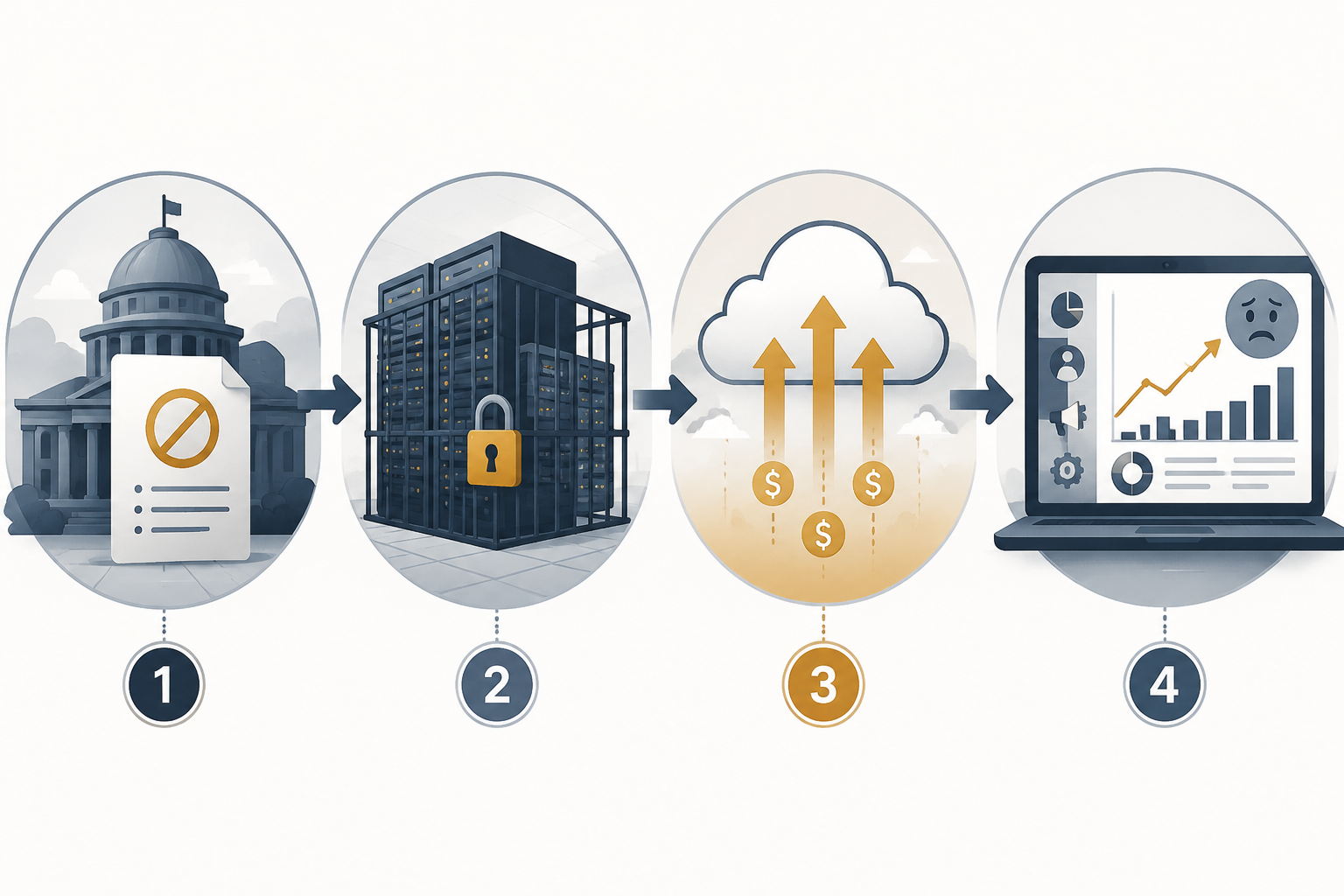
The cleanest way to understand the marketing impact of AI data center moratorium policy is as a sequence, not a direct switch.
| Link in the chain | What changes | How marketers feel it |
|---|---|---|
| Policy restriction | New data center construction becomes slower, blocked, conditional, or more expensive to permit. | Vendors become more cautious about promising unlimited AI capacity. |
| Compute supply | Cloud and GPU capacity becomes more strategically valuable, even if not uniformly scarce everywhere. | AI-heavy workflows face usage caps, queueing, throttling, or tier restrictions. |
| Vendor pricing | Software companies repackage AI features around credits, premium seats, enterprise plans, or consumption. | Renewals include new AI line items instead of simple seat expansion. |
| Marketing operations | Teams that built campaigns and reporting around AI features have less flexibility at renewal time. | Procurement asks for usage justification after the workflow is already live. |
This is not proof that New York’s July order has already repriced a marketing automation platform. It has not been long enough to observe that. The federal bill has not passed. Some state proposals may fail, as Maine’s vetoed proposal shows. And providers can respond with efficiency gains, regional substitution, better scheduling, or margin compression.
Still, constraints do not need to be universal to matter in a renewal cycle. If a vendor’s AI roadmap depends on predictable access to high-volume inference, and that access becomes more expensive or less certain, the vendor has only a few commercial options: charge more, narrow what is included, meter usage, reserve the best capabilities for larger contracts, or quietly reduce what “unlimited” means.
Capacity Risk Is Rising While Demand Keeps Expanding
The pressure on compute is not only regulatory. Data center energy demand is projected to nearly double from 80 gigawatts to 150 gigawatts by 2028.[7] That projection helps explain why state and local governments are reacting in the first place: these projects are not small commercial tenants asking for ordinary utility connections.
For a marketing team, this matters because most AI tools do not expose their infrastructure dependency clearly. A campaign assistant, ad creative generator, predictive scoring feature, chatbot builder, and meeting-summary tool may all feel like different software categories. Underneath, they compete for cloud compute, model access, storage, and inference capacity. The contract rarely says it that plainly.
AI Pricing Was Already Moving Before Moratoriums
The strongest reason to take the moratorium risk seriously is that AI pricing pressure is already visible. Gartner reported SaaS cost increases of 10% to 20% in 2025, while the Zylo 2026 SaaS Management Index found that 78% of IT leaders experienced unexpected charges tied to AI consumption features in the past year.[8]
AI features are also being priced above ordinary software expansion. Industry analysis puts AI feature premiums at 49% to 63% above list prices.[9] Separately, reporting on AI pricing shifts describes companies moving away from low-priced unlimited plans toward $200-plus monthly enterprise tiers and usage-based pricing, with compute costs cited as a driver.[10]
That pricing behavior shows up in familiar places. A tool that once sold seats now sells seats plus AI credits. A content platform that once promised unlimited drafts now distinguishes between standard generation, premium model access, and team-level usage pools. A CRM or marketing cloud may include basic AI summaries while reserving predictive, generative, or autonomous features for higher tiers. The language changes from “included” to “fair use,” “capacity,” “credits,” “tokens,” or “eligible enterprise plans.”
The cost structure behind that shift is not theoretical. Nvidia’s vice president of applied deep learning stated that compute costs have already surpassed people costs in some enterprise budgets.[11] That does not describe every marketing vendor’s P&L, but it does describe the environment in which AI-native and AI-heavy SaaS providers are making pricing decisions.
Where the Marketing Stack Is Most Exposed
The exposure is not equal across the stack. A billing platform with one AI help widget does not carry the same risk as a content operations workflow that generates briefs, drafts, variants, translations, summaries, and campaign assets every day. The budget question is not “Does this vendor mention AI?” It is “How much of our actual work now depends on metered AI consumption?”
| Tool area | Likely exposure | Contract signal to inspect |
|---|---|---|
| AI content creation and localization | High if teams generate large volumes of drafts, variants, briefs, or translations. | Generation credits, model access tiers, fair-use clauses, output limits. |
| Marketing automation and CRM intelligence | Medium to high if scoring, summaries, routing, and recommendations are operational dependencies. | AI add-ons, premium intelligence packages, seat eligibility, capacity language. |
| Paid media automation | Medium if creative generation, audience modeling, or optimization relies on vendor-side AI. | Bundled AI fees, campaign-volume thresholds, optimization feature gates. |
| Analytics and reporting assistants | Medium if natural-language querying or automated insights replace manual reporting work. | Query limits, premium analytics tiers, data-processing charges. |
| Chatbots and conversational experiences | High if customer or sales interactions generate large volumes of AI responses. | Conversation-based pricing, token or message limits, escalation charges. |
The operational risk is highest where the team has already removed the old process. If writers no longer keep reusable launch templates because the AI tool produces the first pass, if SDR handoff depends on automated summaries, or if campaign reporting depends on a natural-language analytics layer, the vendor has leverage. The problem is not that the tool uses AI. The problem is that the replacement workflow has no cheap fallback.
Adoption Raises the Stakes, Trust Limits the Upside
Marketing teams are already dependent enough for pricing changes to matter. Surveys cited in the research brief put daily AI tool use among marketers in the 84% to 91% range, depending on the source and sample.[12] That is adoption, not proof of effectiveness. It does mean that AI is no longer a side experiment in many teams’ operating model.
At the same time, customer trust is not moving in the same direction. Qualtrics found that comfort with brands using AI fell from 57% to 46% in one year.[13] That creates an awkward budget reality: marketers may pay more for AI-enabled production while customers become less forgiving of sloppy, over-automated, or poorly disclosed AI experiences.
What to Ask Before the Next Renewal
Procurement does not need a final answer on national data center policy to ask better questions. The useful move is to separate vendor enthusiasm from pricing mechanics. If a product roadmap depends on AI, the renewal should explain how that AI is priced, capped, and protected from surprise charges.
- Which AI features are included in the base subscription, and which are billed separately?
- Are usage limits measured by seats, credits, tokens, messages, generations, conversations, queries, or data volume?
- What happens when the team exceeds the limit: throttling, overage fees, forced tier upgrade, or degraded access?
- Can the vendor change AI usage allowances during the contract term, or only at renewal?
- Does the quoted price assume access to a specific model, model class, or service level?
- Will the vendor provide historical usage reports before renewal, not after the new quote is issued?
The answer to those questions matters more than the AI feature demo. A beautiful workflow with an undefined usage meter is not a workflow; it is a future budget exception.
Build the Budget Model Around Dependencies, Not Logos
Start with the work, then map the tools. A logo-by-logo audit misses the point because the most expensive AI dependency may sit inside a platform the company already considers “core.” The safer Q3 exercise is a workflow inventory.
| Workflow question | Why it matters |
|---|---|
| Would this workflow stop, slow down, or merely become less convenient if the AI feature disappeared? | This separates operational dependency from nice-to-have automation. |
| How many times per week does the team trigger the AI feature? | Frequency reveals whether a low visible price could become a high consumption charge. |
| Who owns the fallback process? | If nobody owns it, the vendor has more leverage at renewal. |
| Can output quality be maintained with a cheaper model, manual template, or alternate vendor? | Substitution options reduce exposure to premium-tier pricing. |
| Does the AI feature affect customer-facing experiences? | Customer-facing AI carries trust and brand risk, not only cost risk. |
This audit usually changes the conversation. A team may discover that the flashy generative landing-page tool is optional, while the quiet CRM summarization feature has become essential to sales follow-up. Or the reverse may be true: the team may be paying for a premium AI bundle because it sounded strategic, while actual usage is concentrated in two low-value tasks that could be handled by templates.
Model Three Renewal Scenarios
For the next 12 to 18 months, a single renewal forecast is too thin. Build three scenarios for AI-heavy tools: a flat base case, a moderate premium case, and a high-friction case where the vendor adds usage caps or pushes advanced AI into a higher tier. The point is not to predict the exact number. The point is to keep leadership from treating the first surprise quote as the first time anyone could have known.
- Base case: current contract terms continue, with ordinary SaaS inflation.
- Moderate case: AI features receive separate pricing, modest usage caps, or a premium add-on.
- High-friction case: the vendor moves critical AI features into an enterprise tier, reduces included usage, or charges overages for core workflows.
The high-friction case should not assume disaster. It should assume a normal vendor response to expensive infrastructure: fewer unlimited promises, clearer consumption meters, and more packaging around premium AI access.
Keep Alternatives Alive Before You Need Them
Alternatives do not have to be perfect to be useful. A manual workflow, a cheaper model, an exportable prompt library, a second approved vendor, or a non-AI reporting process can all reduce renewal pressure. The worst time to build those alternatives is after the vendor has already said the feature your team depends on now requires a higher tier.
This is especially important for workflows that cross team boundaries. If marketing operations uses AI to clean campaign data before sales sees it, or demand generation uses AI summaries to route high-intent accounts, the fallback process cannot live only in one person’s notes. It needs an owner, a documented trigger, and a decision about what quality level is acceptable during a temporary downgrade.
The Procurement Posture for Q3 2026
A defensible posture is measured, not alarmist. Moratoriums have not yet directly repriced the marketing stack in a way that can be isolated from ordinary SaaS inflation, AI packaging strategy, or vendor margin choices. But they strengthen an already visible cost trend: AI features are moving from cheap add-ons toward metered, premium, and capacity-sensitive products.
- Map every tool that depends heavily on generative AI, predictive AI, conversational AI, or AI consumption features.
- Audit contracts for usage caps, fair-use language, AI add-on clauses, renewal rights, and unilateral pricing-change language.
- Ask vendors how AI pricing is calculated and what infrastructure assumptions could change that pricing.
- Preserve alternatives for mission-critical workflows before a renewal forces the issue.
- Separate nice-to-have AI from operational dependencies so cuts do not break campaign execution or sales handoff.
- Build 12- to 18-month budget scenarios that allow for higher AI feature premiums, usage-based charges, or tier migration.
The practical conclusion is simple enough for a renewal meeting: do not blame every AI price increase on data center moratoriums, and do not ignore moratoriums because the impact is still indirect. If compute expansion becomes harder, the vendors selling compute-intensive AI will protect margin and capacity somehow. Marketing teams should decide now which AI workflows are worth paying more for, which need a fallback, and which were never important enough to become dependencies.
References
- New York executive order coverage, CNBC, July 14, 2026
- AI Data Center Moratorium Act press release, Sanders Senate office, March 2026
- State-level data center moratorium tracking, Rockefeller Institute, June 2026
- Local data center moratoriums coverage, Route Fifty, June 2026
- Public opposition poll on AI data center construction, Gallup, March 2026
- Blocked and delayed data center projects analysis, Data Center Watch
- Data center energy demand projection, Bloom Energy
- 2026 SaaS Management Index, Zylo
- AI pricing analysis, Josh Bersin, May 2026
- AI pricing shift analysis, ProInsights360
- Compute costs surpassing people costs coverage, Forbes, April 2026
- Marketer AI adoption survey findings, HubSpot; Content Marketing Institute; Gartner; SQ Magazine
- Consumer comfort with brands using AI, Qualtrics
Comments
Join the discussion with an anonymous comment.