
Prompt Library for Paid Social Ads: Platform-Specific Templates for Meta, LinkedIn, and TikTok
This prompt library delivers ready-to-use AI templates for Meta, LinkedIn, and TikTok that encode each platform's character limits, hook strategies, and audience psychology — helping paid media managers generate ad copy that outperforms generic prompts.
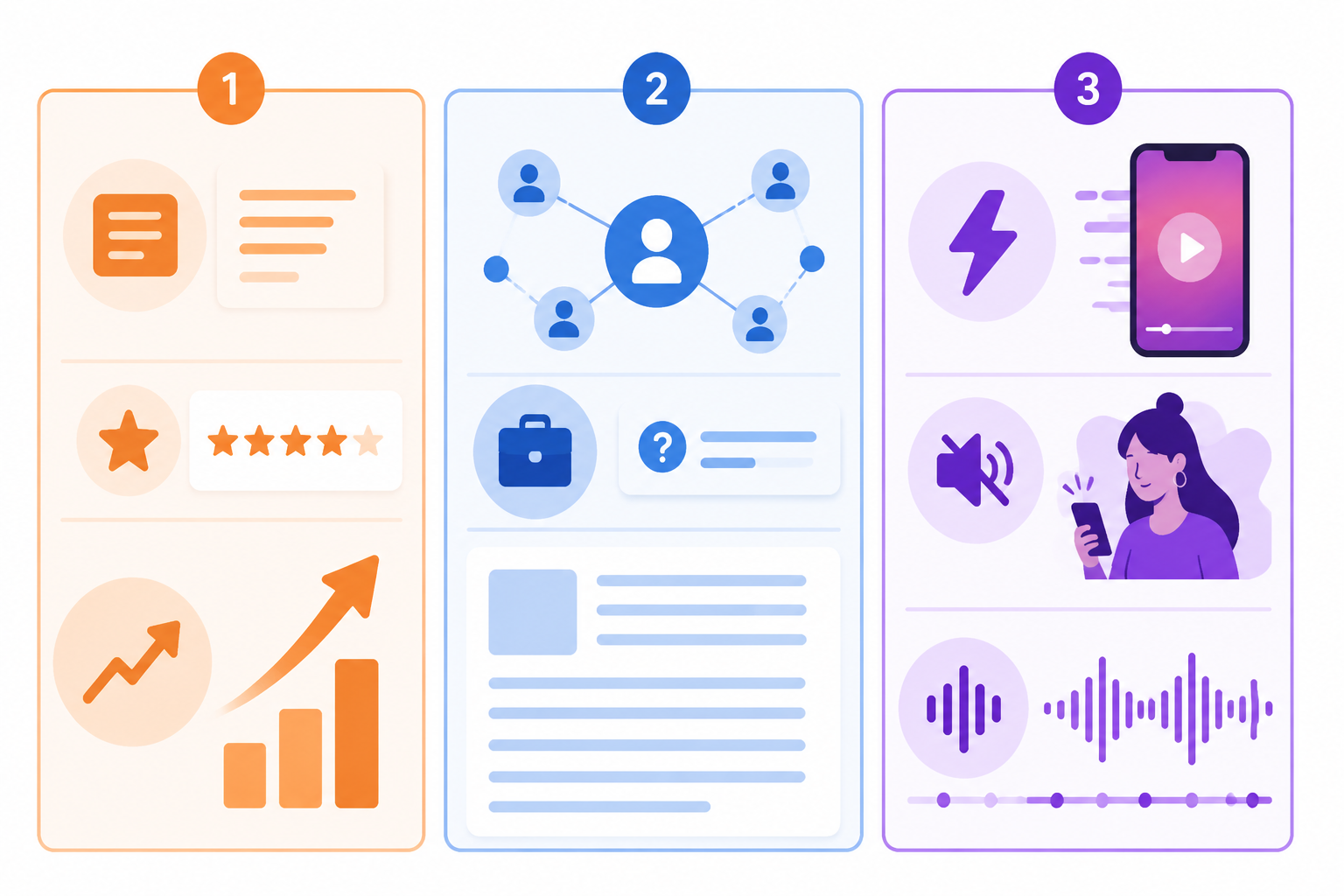
The fastest way to waste an AI copy session is still this prompt: “Write me a high-converting paid social ad.” It gives you copy that sounds like it could run anywhere, which usually means it is ready for nowhere. Meta wants tight primary text and fast benefit recognition. LinkedIn needs a professional reason to care before the offer earns attention. TikTok needs a hook that works before the viewer has decided whether to keep watching.
A useful prompt library for paid social ads does not start with clever wording. It starts by making the model respect the channel before it writes: placement, audience state, hook style, character limits, proof type, brand voice, and output format. That is the difference between receiving twenty generic options and receiving ten variations you can actually put into a test grid.
| Platform | Prompt Should Prioritize | What Usually Breaks Generic AI Copy |
|---|---|---|
| Meta | Short benefit-led primary text, social proof, fast offer clarity, variant volume for testing | Too much setup, soft hooks, copy that ignores the recommended 125-character primary text target |
| Professional problem framing, buyer role, sponsor credibility, business outcome | Consumer-style urgency, vague thought-leadership language, weak connection between role and pain | |
| TikTok | First-two-seconds hook, video beats, text-on-screen cues, sound-off comprehension | Static ad copy disguised as a video script, late product reveal, captions that do not carry the idea |
Meta gets the most evidence-backed treatment here because the available source set is strongest for Facebook and Instagram copy. Ryze AI cites Meta-linked research that Facebook ad costs have increased 89% since 2020 while average CTR has dropped to 0.9%, and it also reports higher conversion rates for benefit-focused and social-proof-based Facebook ads; those figures are useful pressure signals, though the original Meta-sourced study should be traced before treating them as independently verified benchmarks.[1]
The Prompt Structure That Survives Platform Reality
Most bad ad prompts fail before the copy starts. They skip the inputs a media buyer would never skip in a launch doc: who the ad is for, what they already believe, where the ad appears, what claim can be made, what proof is allowed, what tone is on-brand, and what format the output needs to fit.
The cleanest shared structure is CARE: Context, Ask, Rules, Examples. Nielsen Norman Group uses CARE as a practical prompting structure because it separates background, task, constraints, and model guidance instead of stuffing everything into one vague request.[2] For paid social, that structure becomes operational rather than academic.
| CARE Element | Paid Social Translation | What To Include |
|---|---|---|
| Context | The situation the ad enters | Platform, placement, audience segment, funnel stage, offer, landing page angle, existing objections |
| Ask | The asset you need | Primary text, headline, description, hook options, video script beats, CTA variants |
| Rules | The constraints that prevent rework | Character targets, prohibited claims, tone, proof requirements, compliance notes, formatting |
| Examples | The voice and quality bar | Approved brand examples, winning past ads, phrases to use, phrases to avoid |
The extra instruction worth adding is a reasoning step before generation. Do not ask the model to reveal a long chain of thought. Ask it to reason through the audience’s likely motivation, objection, and trigger before writing, then provide a short rationale with each variation. Digital Applied reports a 28% CTR improvement on ad headlines from chain-of-thought prompting versus direct generation, and a 3.2x conversion lift for structured prompts over generic prompts across internal testing with 300 marketing teams.[3] Those are not clean public benchmarks; sample mix, spend level, attribution window, and baseline copy quality all matter. They are still a good reason to test structured prompts against the lazy default.
Reusable paid social prompt shell

Context:
You are writing paid social ads for [platform] and [placement].
Audience: [specific segment, role, awareness level, pain point].
Offer: [product, promotion, lead magnet, demo, trial, purchase offer].
Landing page angle: [main promise, proof, CTA].
Audience state: They currently believe [belief], hesitate because [objection], and are most likely to act if [trigger].

Ask:
Create [number] ad variations for [objective]. Include [asset types needed].

Rules:
Follow [platform-specific character limits or targets].
Use [tone]. Avoid [claims, phrases, compliance risks].
Each variation must lead with [hook type] and include [proof type or credibility cue].
Do not use generic phrases such as [list].

Examples:
Use these brand voice examples as reference:
1. [approved example]
2. [approved example]
3. [approved example]
4. [approved example]
5. [approved example]

Output format:
Return a table with columns: Variation, Audience Insight, Hook Angle, Primary Text or Script, Headline, CTA, Proof Used, Why This Might Work.
The five-example detail is not cosmetic. Digital Applied reports 90%+ voice consistency when five brand voice examples are included in a prompt, while fewer than three examples produced inconsistent tone in its internal testing.[3] Again, treat that as vendor-reported evidence, not a universal rule. In day-to-day production, it matches what usually happens: one example gives the model permission, five examples give it boundaries.
Meta Prompts: Short Primary Text, Clear Benefit, Proof Fast
Meta is where generic AI copy often looks almost acceptable until it hits the preview. The sentence is a little too long. The hook arrives after the feed has already moved. The proof sounds like a landing page paragraph. For Facebook and Instagram, the prompt should force compression before persuasion.
Use 125 characters as the working target for primary text when you want tight feed-ready copy, then request longer alternates only when the placement and creative justify it. Ryze AI’s Facebook-specific prompt guidance also emphasizes benefit-led messaging, social proof, and the BAB framework; it cites 31% higher conversion rates for benefit-focused Facebook ads versus feature-focused ads and 34% higher conversion rates for Facebook ads with social proof versus generic benefit claims.[1]
Meta prompt: benefit-led static or image ad

Context:
You are writing Meta ad copy for Facebook and Instagram feed placements.
Audience: [segment] who are aware of [problem] but have not yet chosen [solution category].
Offer: [offer].
Landing page promise: [promise].
Main objection: [objection].
Proof available: [review count, customer type, case result, testimonial, press mention, or other approved proof].

Ask:
Generate 12 Meta ad copy variations for A/B testing.

Rules:
Keep primary text at or under 125 characters where possible.
Make the benefit clear in the first line.
Use one proof cue in each variation.
Avoid hype, unverifiable claims, and vague phrases like “game-changing,” “revolutionary,” and “unlock your potential.”
Write for a casual but credible feed environment.

Before writing:
Briefly identify the audience trigger, likely objection, and strongest proof angle.

Output format:
Return a table with columns: Variation, Trigger, Primary Text, Headline, Description, CTA, Proof Cue, Test Hypothesis.
Customize the trigger before the model writes. A cold prospect who is problem-aware needs a different first line from a retargeting audience that already visited the pricing page. If you leave that blank, the model will usually split the difference and hand you copy that is too broad for both.
Meta prompt: BAB framework for problem-aware audiences

Context:
You are writing Facebook and Instagram ads using the Before-After-Bridge structure.
Audience before state: [current frustration, cost, delay, or missed opportunity].
Desired after state: [specific improved outcome].
Bridge: [product or offer] helps by [mechanism].
Offer: [offer].
Proof: [approved proof].

Ask:
Create 8 Meta ad variations using BAB.

Rules:
Primary text target: 125 characters or fewer for the main version.
Headline target: short, benefit-led, no more than one idea.
Each variation must include a clear before state and after state without sounding dramatic or fear-based.
Use proof only if it is provided above.

Output format:
Return a table with: Before Angle, After Angle, Primary Text, Headline, CTA, Notes for Designer.
The “Notes for Designer” column is not busywork. It catches mismatches early: a copy variation about speed needs a creative concept that shows reduced steps, not a generic product screenshot. If your team is also using Meta’s automation layer, keep the prompt inputs aligned with the settings covered in Meta AI Advertising in 2026 and the Advantage+ creative enhancement decision matrix. Prompting and platform automation should not be making separate creative bets.
Meta prompt: retargeting ad with objection handling

Context:
You are writing Meta retargeting ads for people who [visited page, watched video, added to cart, opened lead form, or engaged].
They already know: [brand/product awareness].
They have not converted because they may worry about: [price, time, trust, complexity, fit, switching cost].
Offer or next step: [demo, trial, checkout, consultation, download].
Approved proof: [testimonial, rating, guarantee, customer logo, case result].

Ask:
Generate 10 retargeting ad variations.

Rules:
Do not reintroduce the product like the audience is cold.
Lead with the objection or missed value.
Keep copy concise enough for feed scanning.
Use one credibility cue per variation.
Avoid pressure tactics unless explicitly approved.

Output format:
Return a table with: Objection Addressed, Primary Text, Headline, CTA, Proof Cue, Best Placement Fit.
For Meta testing, ask for variation by angle, not just wording. Five versions of the same benefit line are not five meaningful tests. A better first batch might split into speed, cost, social proof, simplicity, and risk reversal, with two executions under each angle. That gives the buyer something to learn when results come back.
LinkedIn Prompts: Start With the Professional Problem
LinkedIn copy fails differently. The obvious bad version sounds like a consumer ad in a suit: “Ready to transform your workflow?” The quieter bad version sounds like a white paper abstract with no reason to click. A LinkedIn prompt has to tell the model who is speaking, who is being addressed, and what business problem makes the interruption legitimate.
The sponsor matters more here than it does in many Meta placements. A claim from an unknown vendor lands differently from a claim backed by a recognized company, category expert, or customer proof. Platform-specific prompt guidance from Branded Agency separates LinkedIn from consumer social by emphasizing professional context, role relevance, and B2B problem framing rather than entertainment-first hooks.[4]
LinkedIn prompt: sponsored content for lead generation

Context:
You are writing LinkedIn Sponsored Content for [company name].
Sponsor credibility: [why this company has permission to speak on this issue].
Audience: [job titles, seniority, industry, company size].
Business problem: [specific operational, financial, strategic, or compliance problem].
Offer: [report, webinar, demo, consultation, benchmark, guide].
Landing page promise: [what the user gets after clicking].
Proof available: [customer segment, research, benchmark, case study, executive quote].

Ask:
Generate 8 LinkedIn ad variations for lead generation.

Rules:
Open with a professional problem, not a sales slogan.
Make the audience role visible in the copy.
Use a credible, calm tone.
Avoid consumer-style urgency, exaggerated transformation claims, and vague productivity language.
Include the sponsor's credibility naturally when it strengthens the ad.

Before writing:
Identify the business pain, the buyer's likely internal pressure, and the proof that makes the offer credible.

Output format:
Return a table with: Audience Role, Problem Hook, Intro Text, Headline, CTA, Credibility Cue, Test Hypothesis.
The variable to protect is the audience role. “Marketing leaders” is usually too loose. A VP of Demand Gen trying to lower pipeline acquisition cost and a Content Director trying to increase qualified organic traffic may both sit inside marketing, but they will not respond to the same problem hook. If the prompt does not separate them, the copy will blur them back together.
LinkedIn prompt: executive pain-point angle

Context:
You are writing LinkedIn ads for senior decision-makers.
Audience: [executive role or committee].
Strategic pressure: [board-level, revenue, cost, risk, retention, or efficiency pressure].
Current workaround: [manual process, disconnected tools, agency dependency, spreadsheet reporting, legacy system].
Offer: [demo, assessment, executive briefing, calculator, benchmark report].
Sponsor credibility: [category experience, customer base, proprietary data, expert authorship].

Ask:
Create 6 executive-level LinkedIn ad variations.

Rules:
Do not over-explain the category.
Do not use casual slang.
Connect the pain to a business consequence.
Keep each variation specific enough that an unqualified audience would self-select out.

Output format:
Return: Hook, Intro Text, Headline, CTA, Business Consequence, Why This Audience Might Care.
That last column is useful because LinkedIn can attract polite but low-intent clicks when the copy is too broadly educational. The model should tell you why the person would care before you spend money proving that they do not.
LinkedIn prompt: thought leadership ad that still has a job to do

Context:
You are promoting a thought leadership asset on LinkedIn.
Asset: [report, article, research, webinar, opinion piece].
Audience: [role, industry, maturity level].
Point of view: [specific argument or finding].
Why now: [market shift, regulation, budget pressure, technology change, competitive pressure].
Desired action: [read, download, register, follow, book].

Ask:
Generate 7 LinkedIn ad variations that make the asset worth stopping for.

Rules:
Lead with the tension or decision the audience is facing.
Do not summarize the asset generically.
Make the sponsor credible but not self-congratulatory.
Avoid empty phrases like “in today’s fast-paced landscape.”

Output format:
Return a table with: Tension, Intro Text, Headline, CTA, Sponsor Role, Best For Funnel Stage.
LinkedIn prompts should also ask for disqualification. A good ad can make the wrong buyer less interested. That is not a copy failure; it is often a media efficiency gain. When the offer is expensive, complex, or sales-assisted, broad curiosity is not the goal.
TikTok Prompts: Write Video Beats, Not Just Copy
TikTok is the thinnest evidence area in this source set, so these prompts should be treated as current best-practice production prompts rather than benchmark-proven formulas. The strongest guidance is still operational: the first two seconds need to earn the next three, the concept needs visual motion, and the message has to survive sound-off viewing through text-on-screen cues.[4]
The common mistake is asking for “TikTok ad copy” and getting a caption with a few hashtags. That is not a TikTok creative. Ask for beats: opening visual, spoken line, on-screen text, product moment, proof moment, CTA, and edit notes.
TikTok prompt: hook-first short-form video ad

Context:
You are writing TikTok ad concepts for [product/offer].
Audience: [segment] who currently feel [pain, desire, skepticism, habit].
Creative format: [founder talking head, UGC-style demo, problem/solution, creator review, screen recording, before/after, listicle].
Offer: [offer].
Proof available: [review, result, customer quote, demo, comparison, social proof].
Brand voice: [casual, expert, playful, direct, skeptical, warm].

Ask:
Create 10 TikTok video ad concepts.

Rules:
The first 2 seconds must contain a strong hook.
Include text-on-screen for sound-off viewing.
Write in visual beats, not paragraphs.
Show the product or outcome early unless the concept requires a brief setup.
Avoid polished corporate language.
Do not invent proof.

Before writing:
Identify the scroll-stopping tension, the visual proof moment, and the reason the viewer keeps watching.

Output format:
Return a table with: Concept, First 2 Seconds, On-Screen Text, Voiceover, Visual Beat, Proof Moment, CTA, Editing Note.
The editing note is where the prompt becomes useful to the person producing the asset. “Cut from messy desk to finished dashboard” is more actionable than “show transformation.” “Start with the failed attempt before the product appears” gives the editor a sequence, not a mood.
TikTok prompt: creator-style problem/solution script

Context:
You are scripting a TikTok creator-style ad.
Creator persona: [customer, expert, founder, skeptic, operator, parent, student, team lead].
Audience problem: [specific problem].
Old way: [what they currently do].
New way: [how the product changes the process].
Product moment: [what must be shown on screen].
Offer: [offer].
Compliance limits: [claims to avoid].

Ask:
Write 5 short TikTok scripts with distinct hooks.

Rules:
Open with a natural spoken line that sounds like it belongs in-feed.
Include on-screen text for every major beat.
Keep the script paced for short-form viewing.
Make the product moment visible before the CTA.
Do not use fake creator enthusiasm or unverifiable claims.

Output format:
For each script, return: Hook Line, On-Screen Text, Beat-by-Beat Script, Product Shot, CTA, Caption Option.
For paid teams, the useful split is usually hook testing before full concept testing. Ask the model for twenty first-two-second hooks around the same product moment, then pick the few that create genuinely different openings: contradiction, confession, mistake, speed demo, comparison, or social proof. Do not shoot ten versions that all begin with “Here’s how to…” unless that is the thing you are deliberately testing.
TikTok prompt: hook bank for paid testing

Context:
You are creating TikTok hook options for a paid ad test.
Audience: [segment].
Product: [product].
Core problem: [problem].
Desired outcome: [outcome].
Proof or demo moment: [what can be shown].
Tone boundaries: [what is on-brand and off-brand].

Ask:
Generate 25 first-two-second hooks grouped by hook type.

Rules:
Each hook must be speakable in one breath.
Each hook must pair with a visual action or on-screen text.
Avoid clickbait that the product cannot satisfy.
Include at least 5 hooks that address skepticism directly.

Output format:
Return a table with: Hook Type, Spoken Hook, On-Screen Text, Opening Visual, Viewer Curiosity, Risk to Watch.
Objective Changes the Prompt, But Platform Still Comes First
Campaign objective matters, but it should not erase platform behavior. A lead-generation ad on LinkedIn still needs professional relevance. A conversion ad on TikTok still needs a video hook. A retargeting ad on Meta still has to fit the feed without sounding like a landing page follow-up email.
| Objective | Meta Prompt Adjustment | LinkedIn Prompt Adjustment | TikTok Prompt Adjustment |
|---|---|---|---|
| Awareness | Test broad benefit and social-proof angles | Lead with category tension or market shift | Prioritize thumb-stop hooks and memorable visuals |
| Lead generation | Clarify offer value quickly and reduce form hesitation | Name the role, business problem, and asset credibility | Make the payoff obvious before asking for the click |
| Conversion | Compress offer, proof, and CTA into testable feed copy | Connect action to business consequence or buying trigger | Show the product moment and proof before the CTA |
| Retargeting | Address known objections and skipped decision points | Reference the next logical evaluation step | Use reminder, comparison, or objection-handling scripts |
If your workflow problem is bigger than prompts, fix that first. A library will not help much if briefs arrive without audience notes, offers change after copy approval, or brand review happens after assets are built. The broader governed workflow issues are covered in the AI creative advertising playbook and the AI advertising bottleneck framework. A prompt library is a production system, not a substitute for one.
How To Test the Library Without Fooling Yourself
Do not test “AI copy” against “human copy” as if those are stable categories. Test a structured platform-specific prompt against your current generic prompt or current manual first draft process. Keep the same offer, audience, budget logic, and landing page. Otherwise the prompt gets blamed or credited for everything around it.
- Save the exact prompt version with each test so winners can be reproduced.
- Label variants by angle, not just by copy number.
- Separate hook tests from offer tests when budget allows.
- Review outputs for claim risk, tone drift, and platform fit before upload.
- Refresh character limits, placement specs, and policy notes at least quarterly.
The maintenance step is where most prompt libraries decay. A prompt that worked when Meta placements were configured one way, or when a TikTok creative format was fresh, can become a rework machine three months later. EverWorker’s prompt library guidance is commercially tied to workflow tooling, but its governance point is still sound: prompts need ownership, versioning, and review if a team is going to reuse them beyond one enthusiastic week.[5]
Last reviewed: Q3 2026. Platform-specific prompts are not magic performance levers. They are a better starting system: fewer unusable drafts, clearer test hypotheses, and copy that respects the channel before budget is spent finding out whether the market agrees.
References
- ChatGPT Prompts for Facebook Ads: 15 Copy Templates — Ryze AI, 2026
- CAREful Prompts — Nielsen Norman Group
- Prompt Engineering for Marketing: 20 Copy Templates — Digital Applied
- High-Converting Ad Copy Prompt in 2026 — Branded Agency, 2026
- How to Build an AI Marketing Prompt Library Your Team Will Actually Use — EverWorker

Comments
Join the discussion with an anonymous comment.