

What Machine Learning in Digital Marketing Actually Delivers on ROI
This article provides a sourced, honest assessment of machine learning ROI in digital marketing, presenting 2026 benchmark data and real brand case studies that show conversion lifts of 14–31% and CAC reductions up to 57%—alongside the organizational factors that separate top-quartile returns from stalled pilots.
A defensible ROI case for machine learning in digital marketing should not start with the best case study in the deck. It should start with the range a finance team can challenge without collapsing the whole argument. The useful answer in 2026 is that ML can produce measurable gains in conversion, acquisition efficiency, personalization, and campaign operations, but the payback window is often longer than the sales narrative suggests and the spread between strong and weak returns is mostly operational.
The headline benchmarks are encouraging. AI-driven campaigns are reported to generate 18.3% higher conversion rates on average, AI-powered lead scoring and predictive targeting are associated with a 57.3% reduction in customer acquisition costs, and marketing automation ROI is reported at 544% over three years.[1] Those numbers are strong enough to justify a serious budget conversation. They are not strong enough to justify treating machine learning as an automatic margin improvement line.
The ROI Benchmarks Worth Taking Into the Budget Meeting
The most useful way to frame machine learning in digital marketing is to separate performance upside from implementation drag. A conversion lift and a break-even timeline answer different questions. A CAC reduction and a scaling rate answer different questions. Put them in the same memo, and the investment case becomes more believable.
| Planning Question | 2026 Benchmark | How to Use It |
|---|---|---|
| Can ML improve campaign conversion? | AI-driven campaigns generate 18.3% higher conversion rates on average. | Use as a directional conversion benchmark, not a guaranteed lift for every channel. |
| Can ML reduce acquisition cost? | AI-powered lead scoring and predictive targeting are associated with a 57.3% CAC reduction. | Use when the planned use case directly changes targeting, scoring, or prioritization. |
| Can automation pay back over time? | Marketing automation ROI is reported at 544% over three years. | Use for multi-year investment modeling, with assumptions separated from near-term payback. |
| How long before payback? | AI marketing projects average 14.2 months to break even, down from 22.7 months in 2023. | Use to resist unrealistic quarterly payback expectations. |
| How often do pilots become operating systems? | Only 27% of enterprises successfully scale AI marketing beyond pilot stages. | Use as the warning label on any pilot-first proposal. |
| Does executive planning matter? | Companies with board-approved AI roadmaps report 31% higher marketing ROI. | Use to justify governance and prioritization work, not just tooling spend. |
| Does workflow redesign matter? | Companies adding AI without process redesign achieve 12.8% ROI, compared with 34.6% for those with redesigned workflows. | Use as the core argument for funding process work alongside software. |
| What blocks adoption? | 61% cite fragmented data infrastructure as the primary barrier. | Use to put data cleanup into the ROI model rather than treating it as an IT side project. |
| What blocks execution? | 54% cite insufficient talent as a barrier. | Use to include training, analytics support, and operating ownership in the budget. |
There is also a larger macro story. McKinsey’s 2026 estimate projects generative AI could add $4.1 trillion to $6.2 trillion annually, with marketing and sales accounting for $1.4 trillion.[1] That figure is useful context, but it is too broad to carry a department-level business case. A growth lead does not get a budget approved because the global economy has upside. The budget survives because the team can explain which decisions ML will improve, which costs will fall, which workflows will change, and when the investment is expected to break even.
What the Conversion and CAC Numbers Actually Mean
An 18.3% conversion lift sounds clean until it reaches the planning model. If the lift comes from better audience selection, it may reduce wasted spend. If it comes from personalization after the click, it may raise conversion without changing media cost. If it comes from smarter lifecycle messaging, it may affect retention or reactivation more than new customer acquisition. Each version belongs in a different row of the forecast.
The same caution applies to the 57.3% CAC reduction attributed to AI-powered lead scoring and predictive targeting.[1] That is not a general statement that every machine learning tool cuts acquisition cost by more than half. It is a use-case-specific result tied to scoring and targeting. A team buying a content generation tool, a send-time optimization feature, or a product recommendation engine should not borrow that CAC number unless the planned deployment actually changes who gets targeted, when, and with what spend.
This is where many ROI decks get loose. They take a valid result from one operating motion and apply it to another. Machine learning in digital marketing is not one intervention. Predictive lead scoring, next-best-action recommendations, dynamic creative selection, churn modeling, bid optimization, and lifecycle personalization all use data to improve decisions, but they do not move the same KPI with the same speed.
For a leadership conversation, the safer structure is simple: tie each expected return to a specific decision that will change. If ML changes lead priority, model sales acceptance, conversion rate, and CAC. If it changes email timing and content, model engagement, conversion, unsubscribe risk, and incremental revenue. If it changes media allocation, model spend efficiency and learning-period volatility. The technology matters, but the decision being automated or improved matters more.
The Break-Even Window Is Not a Footnote
The 14.2-month average break-even timeline is one of the most important numbers in the benchmark set.[1] It changes the tone of the investment case. A project can be attractive and still fail a six-month payback demand. A platform can improve performance and still create a temporary margin drag while data, workflows, integrations, and measurement catch up.
The improvement from 22.7 months in 2023 to 14.2 months in 2026 suggests that organizations are getting faster at turning AI marketing projects into economic returns.[1] It does not mean the average project now pays back inside one quarter. For most teams, that distinction is the difference between a credible investment memo and a promise that later has to be walked back.
A realistic model should therefore separate early operating indicators from financial payback. In the first few months, the team may be able to show cleaner segmentation, higher model coverage, improved campaign velocity, better lead routing, or early conversion movement. Those are useful milestones. They are not the same as full payback after software cost, implementation time, analytics labor, training, and process redesign.
This is also why a three-year marketing automation ROI figure of 544% should be handled carefully.[1] Multi-year return can be compelling, especially when automation compounds across campaigns and customer journeys. But three-year ROI does not answer whether the first-year budget hit is acceptable. Finance will usually ask both questions, and the second one is where weak ML proposals tend to get exposed.
Brand Cases Show What Is Possible, Not What Is Typical
The brand examples are worth studying because they show machine learning affecting real campaign metrics. They should not be treated as baseline forecasts. Most published case studies come from a platform’s customer ecosystem, which means they are useful for understanding mechanisms and possible outcomes, but weaker as evidence of average market performance.
Pizza Hut reported a 31% conversion lift using machine learning-driven personalization in Braze.[3] That is a concrete result, and it is directionally consistent with the broader benchmark that AI-driven campaigns can lift conversion. The right takeaway is not that a restaurant, retailer, SaaS company, and marketplace should all expect 31%. The takeaway is that personalization can move revenue metrics when customer data, messaging logic, and execution channels are already close enough to act on the model output.
Ticketek’s Braze case is more dramatic: the company reported a 250% lift in conversion rates using ML.[4] A result that large deserves attention, but it also needs containment. It says a specific company, in a specific customer engagement environment, achieved a large conversion gain. It does not make 250% a responsible planning assumption for a new ML budget.
8fit reported 3.75X higher conversions using predictive ML without hiring data scientists.[5] That point matters for a practical reason: some teams can get value from embedded predictive capabilities rather than building a full in-house modeling function. But embedded capability still depends on data quality, campaign volume, integration discipline, and someone owning the decision rules around the model.
Walgreens is also cited as achieving a 276% CTR increase via ML, but the available brief traces that figure through an aggregator and notes that original attribution should be verified.[1] That makes it usable as a directional example with a caveat, not as a centerpiece claim. Click-through rate is also not ROI by itself. A CTR increase matters commercially only if it improves downstream conversion, revenue, retention, or cost efficiency.
The Scaling Gap Is the Budget Risk
The most uncomfortable benchmark is not a weak performance number. It is the scaling number: only 27% of enterprises successfully scale AI marketing beyond pilot stages.[1] That is the statistic that should sit next to every optimistic conversion chart. It says many organizations can produce a promising test, but far fewer can turn the test into a repeatable operating capability.
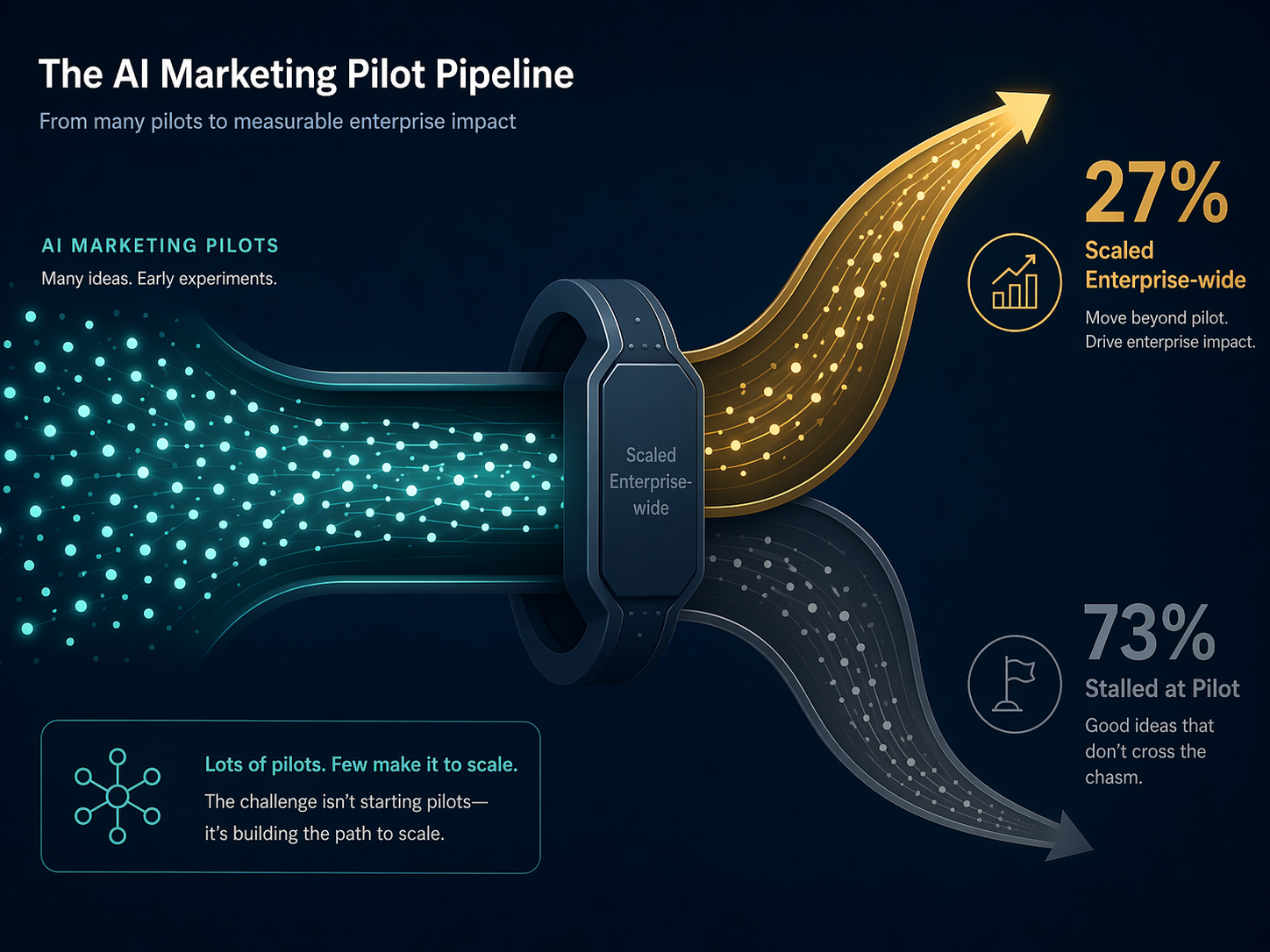
Pilots are usually protected from the mess of the full organization. They run on narrower data sets, fewer stakeholders, cleaner use cases, and friendlier measurement windows. Scaling is different. It asks whether the CRM, CDP, ad platforms, ecommerce systems, consent logic, creative process, analytics team, and campaign calendar can absorb model-driven decisions without adding more friction than value.
That is why the scaling gap deserves more weight than another tool comparison. A vendor demo can show a model making a better recommendation. The operating question is whether the organization can use that recommendation in time, in the right channel, with compliant data, and with measurement that separates incremental lift from normal campaign noise.
For readers who want to go deeper into this failure pattern, the companion piece on strong pilot returns and weak scaling is the natural next read.
Why Process Redesign Changes the ROI Range
The clearest readiness signal in the benchmark set is the process redesign split. Companies that add AI without process redesign achieve 12.8% ROI, while companies that redesign workflows achieve 34.6%.[1] That gap is too large to treat process work as implementation detail. It is part of the return mechanism.
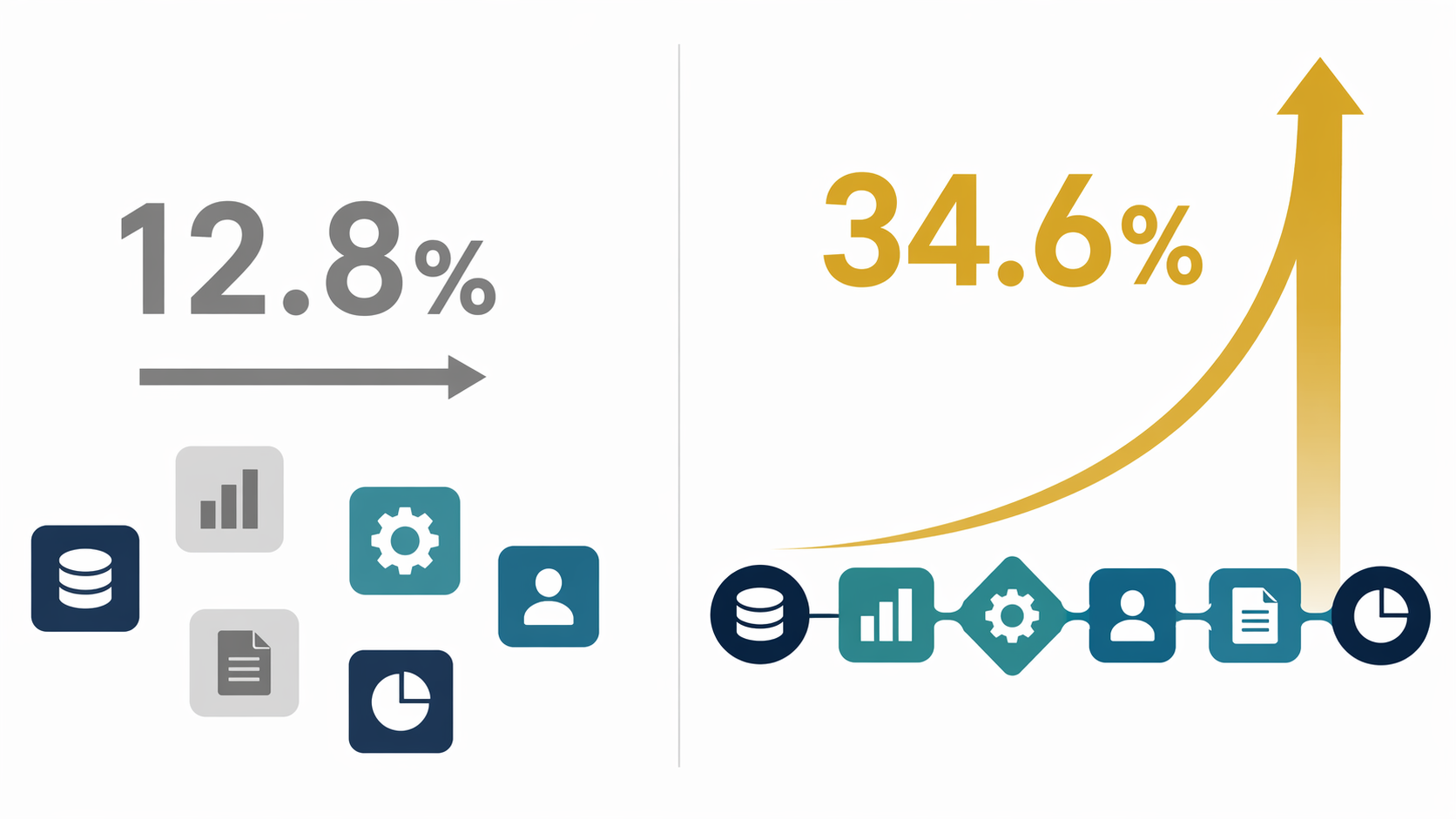
In practical terms, process redesign decides whether ML output changes behavior. A predictive score that arrives after sales has already worked the lead is reporting, not optimization. A churn model that produces a segment no lifecycle manager owns is analysis, not retention. A personalization engine that requires creative variants the team cannot produce becomes shelfware with a better dashboard.
The process question should be asked before procurement, not after launch. Who reviews the model recommendation? Which campaign step changes? What happens when the model disagrees with a manager’s instinct? How quickly can creative, offer, audience, or budget decisions be changed? Who is accountable if the model improves clicks but lowers qualified pipeline?
None of this requires turning marketers into machine-learning engineers. It does require treating ML as an operating change. The teams that get more value are usually not the ones with the most dramatic model language. They are the ones that shorten the distance between prediction and action.
Data Fragmentation Is Not a Technical Excuse
The 61% data-fragmentation barrier is the number that explains why competent marketing teams still struggle with machine learning.[1] ML systems need usable signals: customer behavior, transaction history, campaign exposure, consent status, product usage, sales outcomes, and support interactions. If those signals sit in disconnected systems with inconsistent identifiers, the model may be technically impressive and commercially underfed.
Fragmented data also weakens measurement. If the acquisition platform, CRM, ecommerce system, and retention tool disagree on customer identity or conversion status, the team cannot confidently say whether ML improved ROI. It can only say one dashboard moved. That may be enough for a pilot celebration, but it is not enough for a renewal, expansion, or board review.
This is where the ROI model needs a line item many decks avoid: data readiness. Identity resolution, event tracking, consent management, taxonomy cleanup, and integration work may not look like marketing performance spend, but they determine whether performance spend can learn. If the budget only covers the visible tool, the organization may be buying a model that cannot see enough of the customer journey to matter.
Board-Level Roadmaps Are Boring Until They Improve Returns
Companies with board-approved AI roadmaps report 31% higher marketing ROI.[2] That finding is easy to misread. A board roadmap does not magically make a model better. More likely, it forces prioritization: which use cases matter, which data investments get funded, which risks need governance, and which teams are accountable for adoption.
Without that alignment, marketing ML projects often compete with each other. One team buys a personalization tool, another experiments with lead scoring, another tests generative content, and another asks analytics to build a churn model. Each pilot may be rational on its own. Together they can create duplicate integrations, inconsistent measurement, unclear ownership, and a portfolio of half-supported experiments.
A roadmap is not a ceremonial document if it makes tradeoffs explicit. It should identify the few use cases where ML can affect revenue or cost, name the data dependencies, set governance rules, and define how success will be measured. For teams still shaping that operating plan, a 90-day AI marketing strategy roadmap is a better next step than another feature shortlist.
Talent Constraints Show Up as Slower Payback
The 54% talent-barrier figure should not be read only as a shortage of data scientists.[1] In marketing, the more common gap is operating talent: people who can translate a model output into campaign logic, understand enough analytics to challenge a misleading readout, and coordinate the handoff between marketing ops, data, creative, sales, and finance.
A team can buy embedded ML and still need new skills. Someone has to decide whether a predictive segment is large enough to target. Someone has to know when holdout testing is required. Someone has to spot when a model is optimizing for a shallow metric. Someone has to explain why an early lift did not translate into pipeline or margin.
This is also where vendor-commissioned ROI studies should be handled with care. Forrester TEI studies, Salesforce-commissioned research, and platform case studies can provide useful evidence, especially around implementation patterns and customer outcomes. They should not be weighted the same as independent benchmarks, and their assumptions should be separated from the company’s own baseline.
A Board-Safe ROI Position
A responsible business case for machine learning in digital marketing can be positive without being inflated. The evidence supports measurable conversion gains, meaningful CAC improvement in the right targeting and scoring use cases, and attractive multi-year automation returns. It also supports a longer break-even window than many teams want to promise and a serious risk that pilots stall before they become operating capabilities.
The most defensible forecast is a range, not a single heroic number. The low end should assume limited process change, fragmented data, partial adoption, and slower measurement. The high end should be reserved for use cases with connected data, clear ownership, redesigned workflows, governance, and enough campaign volume for the system to learn and prove incremental lift.
That framing also helps with budget allocation. The investment is not only the platform subscription. It is the combination of software, integration, data cleanup, operating redesign, training, analytics support, and measurement discipline. For a broader view of where this spend belongs relative to other AI investments, see the guide to AI sales and marketing budget allocation in 2026.
Tool selection still matters, but it should come after the operating case. A role-by-role AI marketing tool guide is useful once the team knows which decisions it is trying to improve. Buying the tool first and discovering the workflow later is how promising pilots become renewal problems.
The cleanest leadership position is this: expect measurable lifts, do not promise instant payback, treat vendor case studies as directional, and make readiness part of the ROI model. Machine learning can justify digital marketing spend when it is funded as an operating capability, not when it is presented as a shortcut around the work that makes the model useful.
References
- AI marketing ROI statistics aggregator citing Nielsen/IAB, HubSpot/MIT, Gartner, Deloitte, Accenture, McKinsey, and Walgreens figures — AMRA & ELMA
- AI statistics page citing BCG 2026 board-approved AI roadmap benchmark — Itransition
- Pizza Hut Case Study — Braze
- Ticketek Case Study — Braze
- 8fit Case Study: Predictive — Braze

Comments
Join the discussion with an anonymous comment.