
Anthropic Copyright Settlement: What Marketers Need to Know Now
The $1.5 billion Anthropic copyright settlement and the Supreme Court's refusal to extend copyright to purely AI-generated content create two concrete legal exposures for marketing teams using generative AI. This guide explains what those exposures are and the specific workflow changes they demand to protect your content and reduce liability.
The Monday-morning question is not whether your team should stop using Claude, ChatGPT, Gemini, Jasper, Copy.ai, or whatever else has already made its way into the content calendar. The question is narrower and more useful: if someone challenges an AI-assisted campaign six months from now, can you show where the risk was checked, who edited the output, and why the final asset is yours to publish?
That is the practical edge of the Anthropic copyright lawsuit implications for AI marketing. And yes, for search clarity: this is Anthropic the AI company, not “anthropic” in the human-centered design sense.
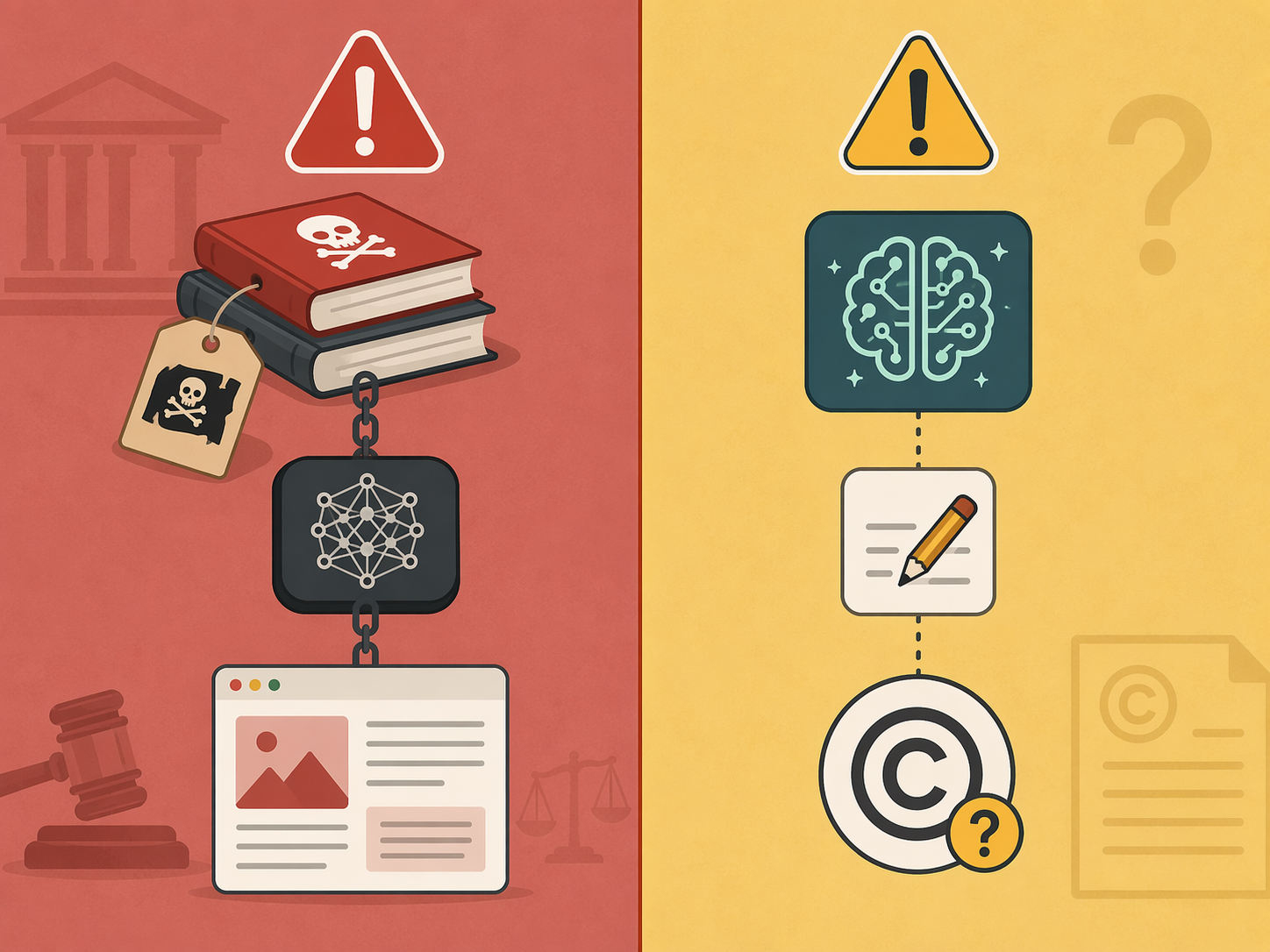
Two exposures now deserve a place in the marketing operations checklist. First, infringement risk tied to training-data provenance: the tool may generate useful output, but the source material used to build or support that tool can still matter. Second, weak copyright protection for minimally edited AI output: if a team publishes something that is essentially machine-generated, it may not be able to stop a competitor from copying it.
The headline number is hard to miss. Anthropic agreed to pay $1.5 billion to settle authors’ copyright claims, with reporting describing the deal as covering roughly 500,000 works at about $3,000 per book, though final amounts depend on claims, fees, and court approval.[1] But the number is not the most useful part for a marketing team. The useful part is what the case separated.
The Case Did Not Say What Many Teams Think It Said
Bartz v. Anthropic is easy to flatten into the wrong takeaway: AI training was fair use, so the risk is over. That is not what happened.
In June 2025, Anthropic won a key ruling that its use of books to train large language models was fair use.[2] That part matters, especially for vendors defending the act of training itself. But the same dispute also turned on Anthropic’s alleged creation of a “central library” of pirated books, including works from Books3. Authors Alliance described the split plainly: Anthropic won on fair use for training its LLMs and lost on building a central library of pirated books.[3]
For marketers, that distinction changes the operating question. The question is not only “Can an AI model be trained in a transformative way?” It is also “What source material did the vendor rely on, and what assurances do we have when this tool becomes part of our production system?”
The settlement covered the central-library claim, not a blanket admission that every use of AI training data is unlawful.[3] As of July 2026, the settlement is also still subject to court approval, and the court has raised questions about adequacy and notice procedures.[1] That uncertainty matters, but it does not make the operational lesson disappear. Provenance has become expensive enough that it belongs in procurement and workflow records, not in a forgotten Slack thread from the tool-selection phase.
This is where ordinary marketing teams can get caught between vendor messaging and legal reality. A vendor may be right that its model output is useful, fast, and often better than a blank page. That does not answer whether the vendor can defend the datasets behind the system, whether its terms protect your company, or whether your team has evidence that the final campaign asset involved meaningful human judgment.
The Other Exposure Is Ownership, Not Infringement
The second issue is quieter, which is why it is easier for a content team to miss. In March 2026, the Supreme Court declined to take Thaler v. Perlmutter, leaving in place the Copyright Office’s position that human authorship is a bedrock requirement of copyright.[4] Forbes framed the marketing consequence sharply: businesses may think their AI content is protected, while the law may treat purely AI-generated content as outside copyright protection.[4]
That is not the same as being sued. It is a different kind of exposure. If your team publishes a landing page hero, email sequence, product description set, or ad concept that came straight from a model with only light cleanup, you may have trouble claiming exclusive rights in that output. The uncomfortable scenario is not a copyright owner sending a demand letter. It is a competitor copying what worked and your team having little to enforce.
This is especially relevant for high-volume work. A team that uses AI to create dozens of paid social variants, hundreds of product blurbs, or repeated nurture emails may be increasing output while weakening the paper trail that proves human authorship. If review means “someone glanced at it before scheduling,” that record will not help much later.
Global teams have an added problem. Bird & Bird’s marketing-focused analysis notes that German courts have found even detailed prompts of about 1,700 characters insufficient for copyright, and that the UK’s computer-generated works regime may be repealed.[5] The practical point is not that every country will land in the same place. It is that prompt effort alone may not carry the protection story, and multinational campaigns may face uneven protection from market to market.
What Changes In The Workflow
The answer is not “send everything to legal.” Legal should set the risk posture and contract requirements. Marketing still has to run the day-to-day system, and the system needs to be light enough that people actually use it when a launch date is close.
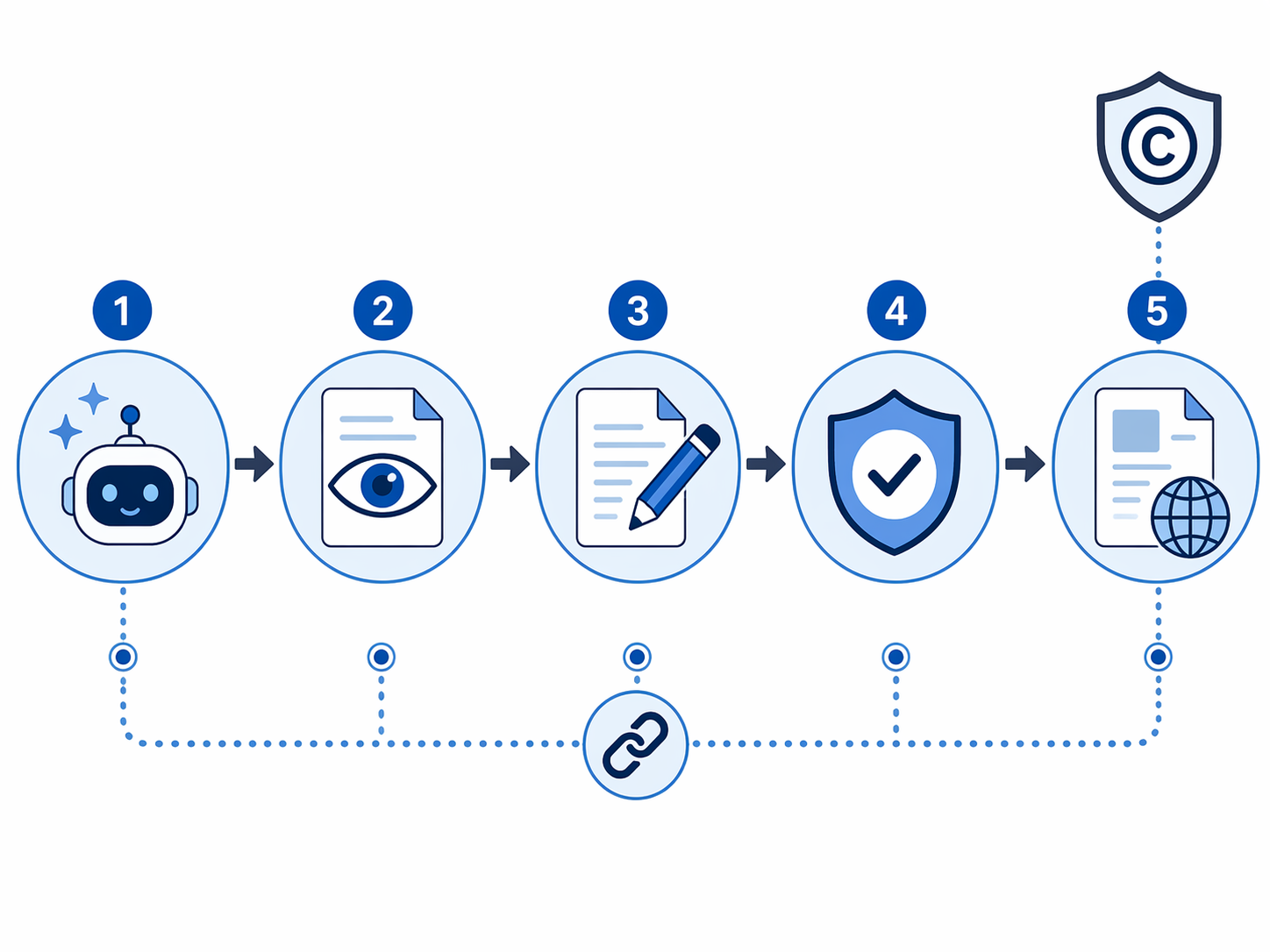
A defensible workflow starts with one principle: AI can be part of production, but it should not be invisible. If the team cannot reconstruct how an important AI-assisted asset moved from prompt to publication, the process is too thin.
| Workflow point | What to keep | Why it matters |
|---|---|---|
| Tool selection | Vendor name, product version when available, approved use cases, contract owner | Connects production use to procurement and vendor-risk review |
| Prompting and generation | Prompt category or representative prompt, source materials provided by the team, date of generation | Shows whether the model was used for drafting, transformation, summarization, or final creative |
| Human editing | Substantive edits, reviewer notes, version history, brand or legal changes | Helps establish human contribution and review |
| Approval | Named approver, approval date, risk flags, exceptions | Creates a record that the asset did not bypass normal controls |
| Publication | Final asset, channel, campaign, reuse restrictions | Makes later takedown, defense, or replacement decisions faster |
That table is deliberately boring. It is also the sort of record a content manager can find when a campaign is challenged, a client asks what changed after review, or a demand gen lead has to explain why twenty ad variants look similar to a competitor’s copy.
Audit the highest-volume AI content first
Do not begin with every stray AI-assisted sentence in the company. Start where volume and external exposure meet: paid ad variants, SEO pages, product descriptions, lifecycle emails, sales enablement pages, and social posts tied to major campaigns.
Forbes recommends auditing the highest-volume AI content first and reviewing AI tool terms for indemnity limitations.[4] That is the right order because the highest-volume assets are where small process weaknesses become hard to defend. If one AI-assisted blog intro has poor records, that is annoying. If a whole product-description library was generated with no human edit trail, that is a business problem.
A practical first pass can be simple: identify the top three AI-assisted content streams by volume, assign an owner, sample recent assets, and check whether the team can show tool used, human edits, approval, and final publication record. If not, fix that stream before designing a company-wide policy nobody has time to follow.
If you already run quarterly production reviews, this fits naturally beside a broader AI marketing workflow audit. The point is not to punish teams for using AI. It is to find the places where speed quietly removed evidence.
Preserve human contribution where it actually happens
The Thaler problem is not solved by adding a human name to the CMS author field. The record should show what the human did: restructured the argument, selected examples, cut unsupported claims, rewrote the lead, changed the offer, adapted the piece for an audience segment, removed risky comparisons, or aligned claims with approved proof points.
Version history is useful here. So are comments in Google Docs, CMS revision logs, project-management approvals, or short review notes. The format matters less than retrievability. A five-line approval note attached to the task is better than a sophisticated policy nobody can connect to the actual asset.
- For AI-drafted blog posts: keep the outline, the draft, and the editor’s substantive changes.
- For ad variants: keep the approved message framework and the human selection rationale.
- For email campaigns: keep the segmentation logic, offer decisions, compliance edits, and final approval.
- For social content: keep the campaign brief and any brand-safety or claims review notes.
This is also where marketing governance helps. A four-layer AI governance framework should make clear which AI uses are allowed, which require review, which require disclosure, and which are off-limits. Without that, every editor ends up inventing a private standard under deadline pressure.
Do not publish raw AI output as final creative
Raw output is tempting because it looks finished. The grammar is clean, the structure is familiar, and the first draft may be good enough to move a ticket across the board. That is exactly why it deserves a review gate.
For copyright protection, the concern is whether there is enough human authorship. For infringement risk, the concern is whether the model reproduced or closely echoed protected expression. For brand risk, the concern is whether the output invented claims, softened required disclaimers, or made comparisons the company would not have approved. Those are different problems, but the same weak workflow creates all three.
A useful rule is to treat AI output as draft material unless an approved exception says otherwise. The exception should be narrow: low-risk internal copy, short operational text, or clearly templated content where a human still reviews the final. Public campaign creative, product claims, SEO articles, and paid ads should not skip human editing simply because the model sounded confident.
For teams already working through the broader AI copyright grey zone in ad creative, this is the operational translation: do not just ask whether the output looks original. Ask whether you can prove the team made it original enough to stand behind.
Read vendor terms before the campaign depends on the tool
The worst time to look for indemnity language is after a client escalation. AI tool terms often limit what the vendor will cover, what uses are excluded, and what the customer must do to preserve any protection. Forbes warns that “the liability has moved to you” in the wake of the Thaler cert denial and Anthropic settlement.[4] That is practitioner framing, not a definitive court holding against end users, but it is still a useful planning assumption.
Norton Rose Fulbright’s 2026 AI litigation update similarly describes a trend in which copyright owners are looking beyond AI platforms toward businesses deploying AI systems.[6] That does not mean every marketing department is about to be sued. It does mean procurement, legal, and marketing operations should stop treating tool terms as a formality when the tool is embedded in production.
- Check whether the vendor offers copyright indemnity, and for which products or plans.
- Check whether indemnity excludes certain prompts, inputs, outputs, use cases, or modifications.
- Check whether the company must use built-in filters, citation tools, or safety settings to qualify.
- Check whether enterprise terms differ from self-serve terms used by individual team members.
- Check who owns the internal record of approved tools and terms.
This is where small teams need a realistic standard. Nobody needs a twenty-page review memo for every AI subscription. But if a tool is producing public-facing content at scale, someone should know what the contract says, where it is stored, and what it does not cover.
Ask about dataset assurances when the tool is used at scale
The Anthropic settlement makes one vendor-risk question harder to avoid: what assurances can the provider give about the datasets used to train or support the system your team relies on?
Buchanan Ingersoll & Rooney’s analysis of the Anthropic settlement recommends that companies deploying AI systems negotiate contractual assurances that developers eliminated reliance on datasets such as Books3 or other gray-market repositories.[7] That recommendation is easiest to apply when a company is buying enterprise access, building a custom workflow, or standardizing on one tool across marketing.
A small marketing team using self-serve tools may not have leverage to negotiate dataset language. It can still create a lighter control: prefer vendors with clear public documentation, route high-volume use through approved accounts, avoid uploading third-party copyrighted material unless the team has rights, and document why a tool was approved for a particular class of work.
Procurement can turn this into a short intake question instead of a legal essay: “Will this tool be used to generate public-facing content at scale?” If yes, the review should include terms, indemnity, dataset representations where available, data-retention settings, and an owner for future term changes.
Where The Law Is Still Unsettled
A good workflow should not pretend the law is cleaner than it is. The Bartz settlement is pending court approval as of July 2026.[1] Fair-use decisions are not uniform. Reuters reported in January 2026 that AI copyright battles were entering a pivotal year, with US courts weighing fair use across multiple disputes.[8] The Bartz and Kadrey v. Meta decisions reached different conclusions on market harm, and appeals such as Thomson Reuters v. Ross Intelligence may continue to shift the landscape.[8]
End-user liability is also still an emerging practitioner concern, not a settled rule from a definitive court decision. That distinction matters. A marketing team should not behave as if every AI-assisted asset is presumptively unlawful. It should behave as if public, high-volume, revenue-facing AI use deserves records that can survive scrutiny.
Disclosure is a related but separate control. If a campaign, client agreement, platform rule, or regulated context requires transparency about AI use, the team needs a policy for that too. A staged AI disclosure policy for marketing teams can sit beside the copyright workflow, but it should not replace authorship review or vendor-risk checks.
The Defensible Version Of AI Marketing
AI can still remove blank-page work. It can still help content teams turn briefs into outlines, paid teams expand variant sets, and lifecycle teams adapt messaging across segments. The change is that AI-assisted production needs evidence, especially where the output is public, repeated, and commercially important.
The Anthropic settlement made source material expensive. Thaler left purely AI-generated work exposed. Together, they point to the same operational answer: keep provenance questions in vendor review, keep human contribution visible in the asset record, and audit the AI content streams where weak process would hurt most.
The workflow does not have to be heavy on day one. Start with the assets your team publishes most often, the tools it depends on most deeply, and the records someone would actually need if the source or ownership of an AI-assisted asset were challenged. AI can be used, but not invisibly and not without records.
References
- Anthropic pays authors $1.5 billion to settle copyright infringement lawsuit — NPR, Sept 5, 2025
- Anthropic wins key US ruling on AI training in authors' copyright lawsuit — Reuters, June 24, 2025
- Anthropic Wins on Fair Use for Training its LLMs; Loses on Building a 'Central Library' of Pirated Books — Authors Alliance, June 24, 2025
- You Think Your AI Content Is Protected. The Supreme Court Disagrees — Forbes, June 11, 2026
- When Marketing Meets GenAI: The IP Questions You Can't Ignore — Bird & Bird, April 2026
- AI in litigation series: An update on AI copyright cases in 2026 — Norton Rose Fulbright, 2026
- Anthropic's Copyright Settlement: Lessons for AI Developers and Deployers — Buchanan Ingersoll & Rooney, 2025
- AI copyright battles enter pivotal year as US courts weigh fair use — Reuters, Jan 5, 2026

Comments
Join the discussion with an anonymous comment.