
How to Build a Three-Tier AI Disclosure Policy for Marketing Teams
This guide provides a risk-based three-tier framework for building an AI disclosure policy that marketing teams can integrate into their existing content approval gates, balancing legal compliance, consumer trust, and creative flexibility without slowing production.
The hard part of an AI disclosure policy for marketing teams is not writing the sentence that says, “Disclose AI-generated content when appropriate.” The hard part is the five-minute decision before a post, landing page, email, video, or creator asset goes live.
A social manager has an AI-assisted caption in the queue. A designer has cleaned up a product image with an AI editing tool. A paid media specialist has exported dozens of ad variants from a generative platform. Legal wants consistency. Creative wants room to work. Publishing wants an answer before the scheduled slot closes.
That is where blanket rules start to break. “Label everything” sounds safe until the team starts labeling spell-checked copy, scheduled posts, and analytics-assisted optimizations. “Use judgment” sounds flexible until two teams make opposite calls on the same kind of AI-edited image.
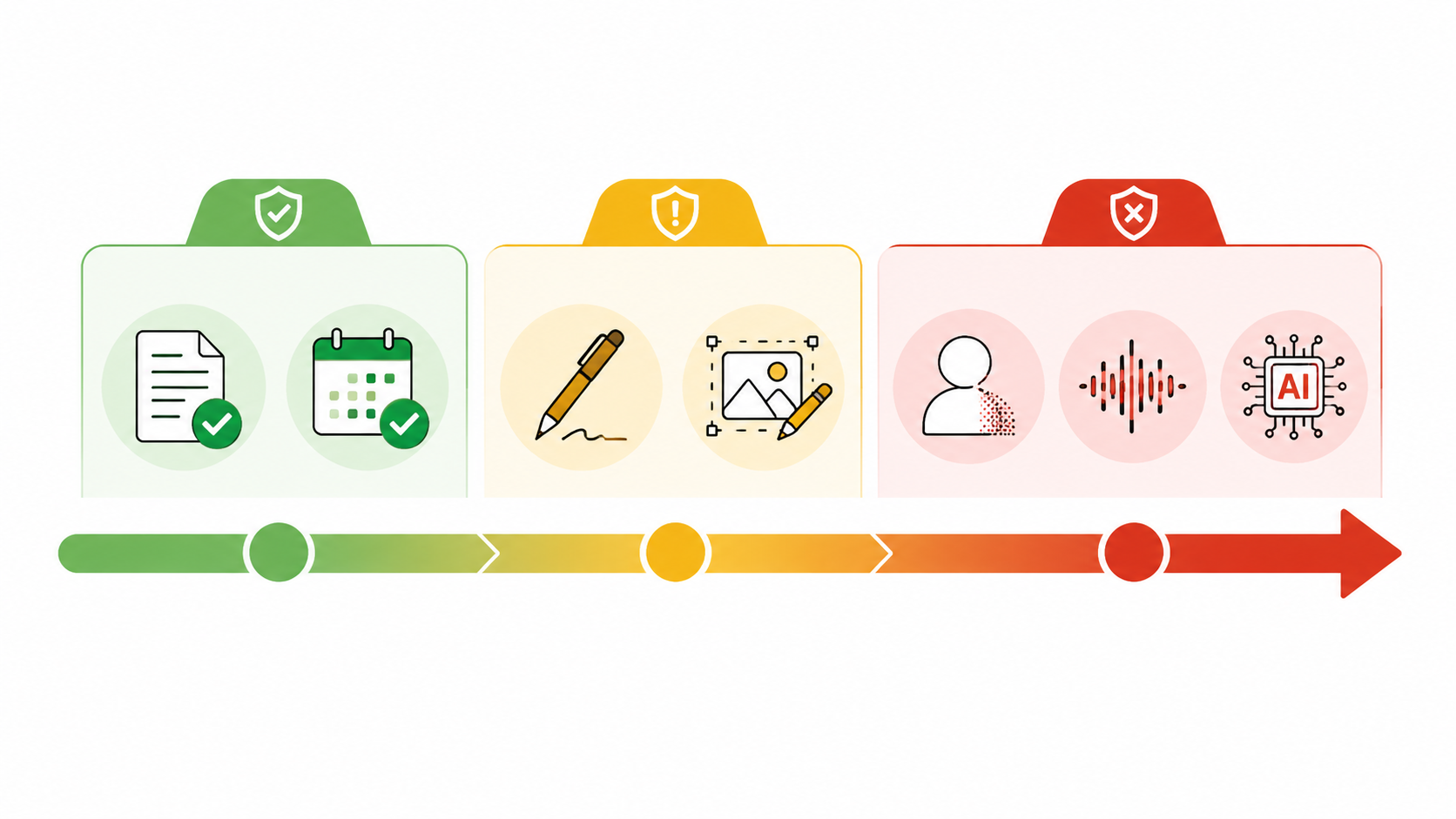
The better operating model is a three-tier disclosure continuum: low-risk AI use that does not require public disclosure, moderate-risk AI use that does require disclosure, and high-risk AI use that always requires disclosure. Capterra’s May 2024 survey of more than 1,600 marketers found that only 30% consistently labeled AI-generated social content, while 62% said mandatory labels would improve social performance; that data is directional rather than a Q3 2026 benchmark, but it captures the operational gap well enough.[1]
Start With the Use Case, Not the Tool
A useful policy does not ask, “Was AI involved?” and stop there. AI is now too embedded in the marketing stack for that question to carry enough meaning. The same content calendar may include AI-assisted proofreading, generative headline variations, automated segmentation, synthetic voiceover, image retouching, and fully generated product visuals. Those are not the same disclosure problem.
Okoone’s disclosure continuum is useful because it classifies AI activity by context, consequence, and audience impact rather than by the mere presence of a model somewhere in the workflow.[2] That framing gives marketing operations something a policy PDF rarely provides: a routing system.
| Tier | Typical AI Use | Public Disclosure Rule | Operational Question |
|---|---|---|---|
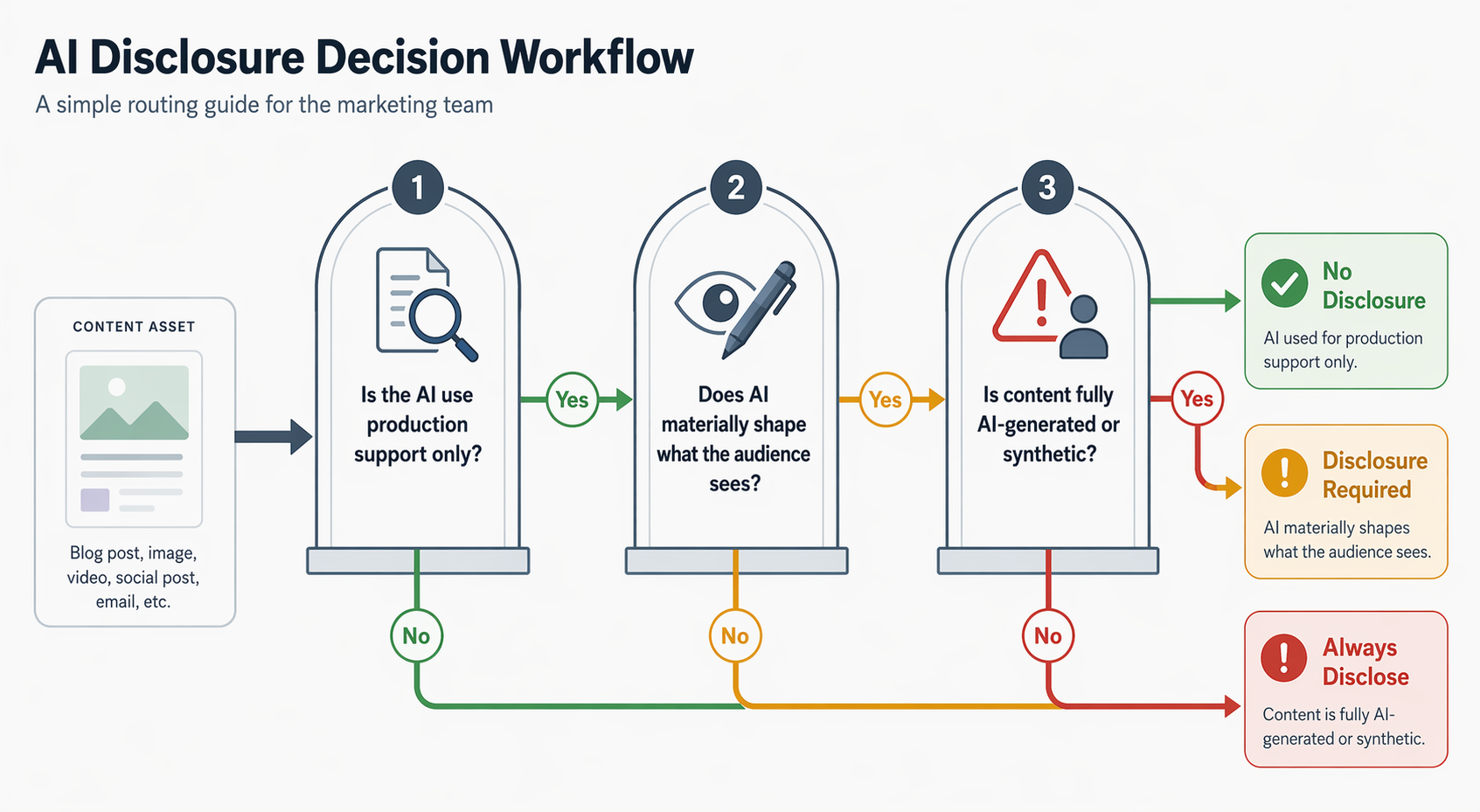
| Low risk | Grammar checking, scheduling, analytics support, formatting assistance | No public disclosure required | Did AI support production without materially changing what the audience sees or believes? |
| Moderate risk | AI-assisted copy, AI-edited images, generated variations, substantial rewriting | Disclosure required when AI materially shapes audience-facing content | Would a reasonable audience care that AI helped create or alter this asset? |
| High risk | Fully AI-generated content, synthetic performers, AI voice cloning, simulated people or endorsements | Always disclose | Could the audience mistake synthetic content for a real person, real event, or human-created experience? |
The table is intentionally plain. If the person approving the post cannot classify the work in under a minute, the policy will not survive launch week.
Tier 1: Low-Risk AI Use That Should Not Trigger a Label
Low-risk AI use is production support. It helps the team work, but it does not materially shape the audience-facing claim, image, message, or experience.
- Proofreading a human-written email for grammar or clarity
- Using AI to summarize performance data for an internal readout
- Scheduling social posts through a platform that uses automation
- Generating internal headline options that a human rewrites before publication
- Formatting a blog draft or adapting metadata fields without changing substantive claims
This tier matters because over-disclosure creates its own failure mode. If every asset says “AI-assisted” because a spelling tool touched it, reviewers stop treating the label as a meaningful signal. Audiences learn the same habit. A disclosure policy should preserve attention for the cases where the audience’s understanding of the content is actually affected.
This is practitioner guidance, not a guarantee that every regulator will treat every low-risk use the same way. The operational standard is narrower: if AI did not materially shape what the audience sees, hears, reads, or is asked to believe, public disclosure is usually not the right control. Internal logging may still be useful if the asset belongs to a regulated campaign, a sensitive category, or a market where local requirements are stricter.
Tier 2: Moderate-Risk AI Use Is Where the Policy Earns Its Keep
Most arguments will happen in the middle tier. This is where AI did not create the whole asset, but it materially shaped something the audience will consume: the wording, image, tone, offer presentation, testimonial framing, product depiction, or creative variation.
The IAB’s AI Transparency and Disclosure Framework uses a risk-based, materiality-driven approach to disclosure in advertising.[3] That materiality lens is the right test for moderate-risk marketing work. The question is not whether an AI tool sat somewhere in the process. The question is whether the AI contribution is material to how the audience interprets the message.
A caption lightly tightened by AI may stay in Tier 1. A caption generated from a short prompt and then approved with minimal edits moves into Tier 2. A product image cropped by an automated tool may stay low risk. A lifestyle image where AI changed the setting, body, face, product appearance, or usage context belongs in Tier 2 at minimum.
A practical moderate-risk rule can be written this way: disclose when AI materially contributes to audience-facing content and a reasonable viewer, reader, listener, or customer would want to know that contribution before evaluating the message.
Moderate-Risk Examples That Need Clear Routing
- AI-assisted copy: disclose when the published copy is substantially generated, rewritten, or personalized by AI rather than merely proofread.
- AI-edited images: disclose when AI changes material visual elements, especially product appearance, people, setting, or implied usage.
- Generated ad variants: disclose when AI creates materially different audience-facing messages at scale and the final variants are not meaningfully human-authored.
- AI-assisted creator briefs: disclose to internal reviewers when AI shaped claims, talking points, or required phrasing, even if the creator later records the content.
- AI-translated or localized content: review for disclosure when AI changes tone, claims, or culturally sensitive meaning rather than simply supporting translation workflow.
This is also the tier where internal disclosure becomes non-negotiable. Debevoise has argued that companies should consider requiring internal disclosure of AI use within the organization.[5] For marketing teams, that means the creator, designer, editor, agency partner, or media specialist must tell the approver how AI was used before the asset reaches legal or publishing.
Without that internal handoff, the public disclosure decision becomes guesswork. Legal cannot evaluate an image edit it cannot see. A social lead cannot label an AI-assisted caption if the freelancer only submits the final text. A brand director cannot defend the absence of a label if no one captured whether AI materially shaped the asset.
Tier 3: High-Risk AI Use Should Always Be Disclosed
High-risk use is different because the audience can mistake synthetic content for a real person, real event, real voice, real endorsement, or human-created experience. This is where optional language and case-by-case improvisation create the most exposure.
- Fully AI-generated videos, images, articles, or campaign assets presented as original brand content
- Synthetic influencers, synthetic employees, or virtual spokespeople
- AI voice cloning, even when the voice is licensed or approved
- Simulated testimonials, demonstrations, events, or customer interactions
- AI-generated people or scenes that could be interpreted as documentary, testimonial, or evidentiary
For these uses, disclosure should not depend on whether the platform requires a tag that day. The disclosure should travel with the asset: in the caption or post copy where appropriate, in the video description when needed, in creator or influencer scripts when relevant, and in the asset record for internal review.
The enforcement environment makes this more than a brand preference. HumanAdsAI reported a maximum penalty of $53,088 per violation in 2026, a 40% increase in enforcement cases in 2025, and a dedicated AI enforcement unit established in January 2026.[4] Those figures should not turn every marketing review into a panic exercise, but they do make “we disclose when it feels important” a weak standard.
Teams that need deadline-heavy compliance detail should use a dedicated FTC checklist rather than trying to bury every rule inside the marketing policy. The policy’s job is to route work correctly; the checklist’s job is to confirm specific wording, roles, and jurisdictional obligations before publication.
Put the Policy Where the Work Already Moves
A disclosure policy that lives in a shared drive will be remembered only when something goes wrong. The working version belongs inside briefs, intake forms, asset records, review checklists, and publishing gates.
The first control point is the creator brief. Anyone producing marketing content should see the same required AI-use field before work begins, not after the asset is finished. The field does not need to be complicated.
| Brief Field | Required Answer |
|---|---|
| Will AI be used in this work? | No; production support only; AI-assisted; fully or materially AI-generated; synthetic person, voice, or performance |
| What will AI affect? | Copy, image, video, voice, translation, targeting, personalization, research, analytics, other |
| Will the AI output be audience-facing? | No; yes; unsure |
| Does the work include a real or synthetic person, voice, testimonial, or endorsement? | No; real person; synthetic person; cloned or simulated voice; simulated endorsement |
| Recommended tier | Low risk; moderate risk; high risk; needs review |
The second control point is content approval. Add one classification field to the review task, not a separate review meeting. The approver should confirm the tier, the disclosure decision, the disclosure placement, and whether asset provenance has been captured.
- Tier confirmed: low, moderate, high, or escalated
- Disclosure decision recorded: no disclosure, disclosure required, or always disclose
- Disclosure copy approved: caption, label, description, on-screen text, landing page note, or other placement
- AI-use notes attached: tool category, affected asset elements, human review owner
- Provenance status checked: source file, edit history, metadata, or content credential when available
The third control point is final publishing. The publisher should not be asked to interpret the whole policy at the last minute. Their job is to verify that the approved disclosure, if required, is present in the actual placement that will go live. If the platform strips metadata, truncates captions, or hides descriptions, the disclosure may need to move into visible copy or on-screen text.
Keep Provenance Close to the Asset
Disclosure is the audience-facing control. Provenance is the operational control. Teams need both.
Dynamis LLP notes that major platforms including Google, Meta, and TikTok have integrated Content Credentials functionality, and describes C2PA provenance metadata as an emerging standard for AI-touched assets.[6] That does not make C2PA mandatory for every marketing team or every asset. It does make provenance a good habit before the team is asked to explain an asset months later.
At minimum, the asset record should show what was created or altered with AI, who reviewed it, which disclosure decision was made, and where the final disclosure appeared. For higher-risk work, keep the source files, prompts or production notes when appropriate, signed voice or likeness permissions, and exported versions with available metadata intact.
This is not glamorous work. It is also the difference between “we think the designer used a tool” and “here is the decision record for why we disclosed this synthetic voiceover in the video description and on-screen intro.”
Disclosure Copy Should Be Specific Enough to Mean Something
A good disclosure is plain, proximate, and tied to the audience-facing use. It does not need to read like a legal memo. It should tell people what they are actually encountering.
| Use Case | Better Disclosure |
|---|---|
| AI-generated product lifestyle image | Image generated with AI for illustrative purposes. |
| AI-edited campaign visual | This image was edited with AI to alter the background. |
| Synthetic spokesperson video | This video features an AI-generated spokesperson. |
| AI voice clone | Voice generated using AI with permission from the speaker. |
| AI-assisted article or guide | This article was created with AI assistance and reviewed by our editorial team. |
Avoid disclosures that are so broad they stop informing anyone. “Made with technology” does not tell the audience what matters. “AI-assisted” may be enough for some content, but it is too vague for a synthetic performer or cloned voice. The more the AI use affects what the audience believes is real, human, live, photographed, endorsed, or experienced, the more direct the disclosure should be.
Labels Help, but They Are Not the Whole Trust Strategy
Disclosure is necessary for transparency and defensibility. It is not a magic trust transfer.
Stanford HAI research involving 1,500 participants found that labeling content as AI-generated did not significantly change the persuasiveness of policy arguments.[7] The study tested policy argument persuasiveness, not commercial advertising, so it should not be stretched into a universal marketing conclusion. It is still a useful caution: labels may inform audiences without automatically changing how they respond.
That matters for policy design. A disclosure label should not be asked to compensate for misleading claims, weak substantiation, unclear endorsements, or synthetic content that should not have shipped in the first place. The label is one control in the review system, not the review system itself.
Escalation Rules Prevent Last-Minute Debates
The policy should name the cases that cannot be approved by the channel owner alone. These are the assets that need legal, brand, privacy, or executive review before publishing.
- Any synthetic person, cloned voice, simulated endorsement, or virtual spokesperson
- Any AI-generated or AI-edited asset involving health, finance, employment, safety, children, political content, or other sensitive categories
- Any AI-altered product depiction that could affect performance expectations, size, fit, results, quality, or availability
- Any creator, influencer, or partner asset where AI materially shapes required claims or visual presentation
- Any campaign running in a market where local AI, advertising, platform, or consumer protection rules may impose additional obligations
For EU-facing work, the team should route questions into a dedicated EU AI Act review rather than relying on a U.S.-centered disclosure policy. The EU AI Act’s Code of Practice on Transparency and Marking was still in draft as of March 2026, so final guidance may differ from interim operating assumptions.
A Working Policy Standard
A marketing team does not need a disclosure rule that treats every AI touch the same. It needs a decision system that people can use while work is moving.
The working standard is straightforward: classify every AI use into low, moderate, or high risk; require internal AI-use disclosure before approval; publicly disclose when AI materially shapes audience-facing content; always disclose synthetic people, cloned voices, simulated endorsements, and fully generated experiences; and keep enough provenance to explain the decision later.
Once those gates are built into briefs, review tasks, asset records, and publishing checks, the policy stops being a warning poster. It becomes part of production.
References
- Should Marketers Label AI-Generated Content on Social Media?, Capterra, May 2024.
- How to Make AI Disclosure Actually Work in Marketing, Okoone.
- AI Transparency and Disclosure Framework, IAB.
- FTC AI Content Disclosure Rules: What Brands Must Know in 2026, HumanAdsAI.
- Why Companies Should Consider Requiring Internal Disclosure of AI Use, Debevoise Data Blog.
- AI Disclosure Rules 2026: What Brands & Influencers Must Do, Dynamis LLP.
- Labeling AI-Generated Content May Not Change Its Persuasiveness, Stanford HAI.
Comments
Join the discussion with an anonymous comment.