
The AI Marketing ROI Stack: Which Use Cases Pay Back Fastest in 2026
A ranked comparison of ten generative AI marketing use cases by blended ROI, payback period, and integration complexity, plus a budget allocation framework that shows why overspending on content tools while underinvesting in governance destroys returns.
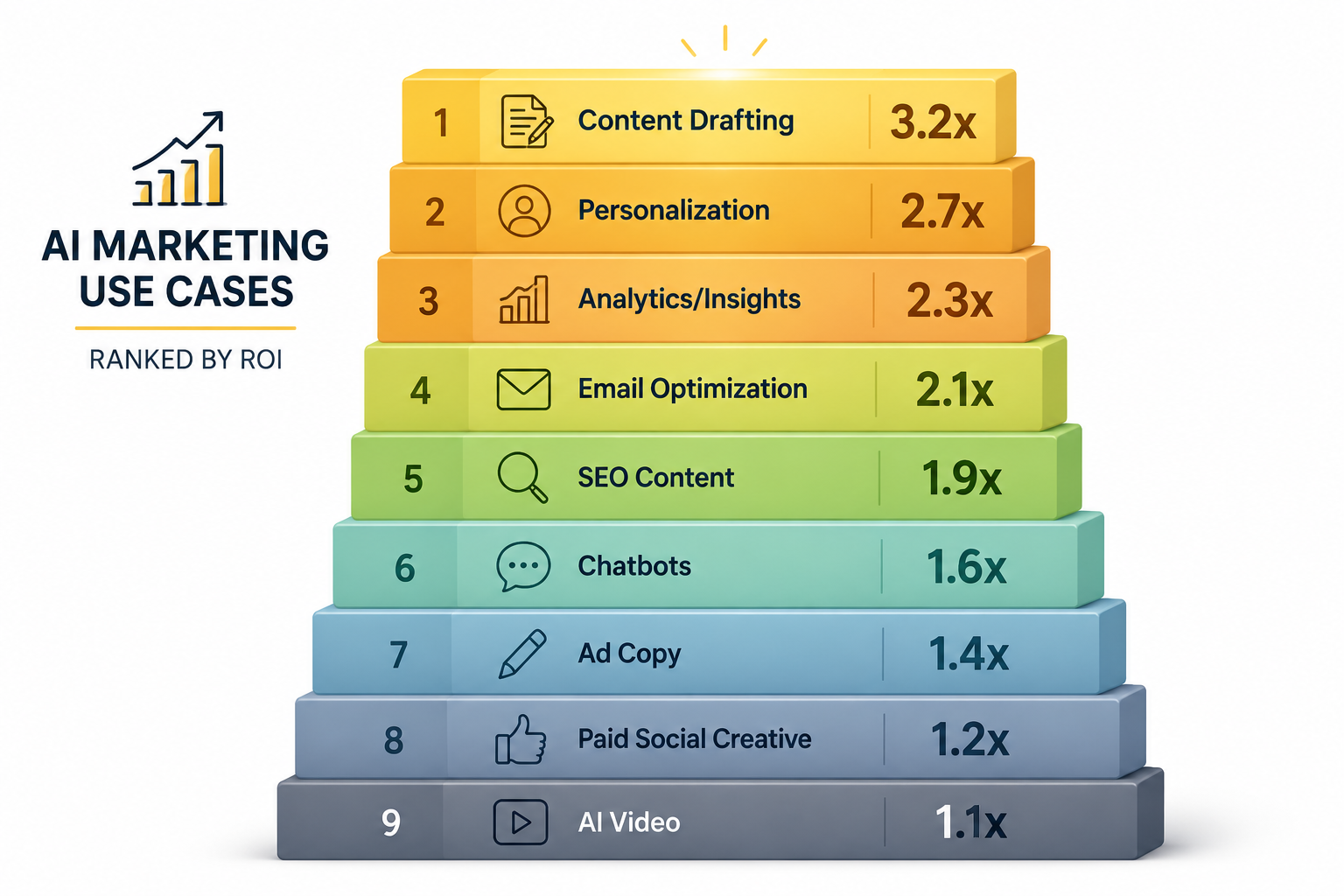
Generative AI in marketing has crossed the awkward line from experiment to operating budget. The median payback period for AI tooling is now 4.2 months, and content-heavy teams can see payback in under 3 months, which is short enough to survive a quarterly planning conversation rather than a two-year transformation deck.[1] The problem is that the use cases do not pay back evenly. In the current benchmark set, content drafting returns 3.2x, while AI video sits at 1.1x and AI-generated paid social creative at 1.2x.[2]
That spread matters because spend is no longer small. Median mid-market AI tool spend rose from $1,200 per month in Q1 2025 to $3,400 per month in Q1 2026, while enterprise teams are budgeting $24,000 to $48,000 per month.[3] At those levels, the question is not whether the team is “using AI.” The question is whether the portfolio is weighted toward workflows that remove real production, optimization, or analysis labor — and whether anyone has funded the controls that keep those gains from turning into review debt.
The 2026 AI Marketing ROI Stack
The ranking below uses McKinsey-cited ROI benchmarks compiled by DigitalApplied. These are blended ROI figures, meaning the respondent pool mixes cost savings and revenue attribution rather than measuring a single controlled outcome. They are useful for allocation decisions, but they should not be read as guaranteed returns for any one team.[2]
| Rank | Use case | Blended ROI benchmark | Payback read | Integration complexity |
|---|---|---|---|---|
| 1 | Content drafting | 3.2x | Fastest; content-heavy teams can pay back in under 3 months | Low |
| 2 | Personalization engines | 2.7x | Strong, but usually slower than drafting because data and journey logic must connect | High |
| 3 | Analytics and insights | 2.3x | Strong where reporting, segmentation, and insight synthesis replace manual cycles | Medium to high |
| 4 | Email optimization | 2.1x | Practical near-term return when testing, targeting, and copy iteration are already disciplined | Medium |
| 5 | SEO content | 1.9x | Useful, but more exposed to editorial quality and search-policy risk than basic drafting | Medium |
| 6 | Chatbots | 1.6x | Moderate; payoff depends on containment, escalation, and customer experience quality | Medium to high |
| 7 | Ad copy | 1.4x | Incremental; usually better as a testing assistant than a stand-alone budget line | Low to medium |
| 8 | Paid social creative | 1.2x | Weak in current 2026 data because obvious AI creative is vulnerable to platform and trust penalties | Medium |
| 9 | AI video creation | 1.1x | Weak; production speed does not automatically translate into distribution or conversion lift | Medium to high |
The ranking has one immediate budget implication: the safest near-term returns are not in the flashiest creative formats. They are in workflows where AI removes repetitive drafting, reporting, testing, or segmentation work from an existing process. That is why content drafting, personalization, analytics, and email optimization deserve more serious budget treatment than AI video demos or fully synthetic paid social creative.
There is also one caveat worth calling out. This benchmark ladder lists nine discrete ROI values. Rather than inventing a tenth number, the better move is to treat governance and agentic infrastructure as enabling budget categories, not ROI-ranked campaign use cases. They do not show up as the prettiest line in a performance table, but they decide whether the high-return workflows stay high-return after the first few months.
Why Content Drafting Pays Back First
Content drafting leads because it attacks a visible cost center with low integration friction. A marketing team does not need a full customer data platform rebuild to shorten first drafts, campaign variants, product descriptions, email subject line options, sales enablement outlines, or internal briefs. The work already exists. The handoff points are familiar. The savings show up quickly as fewer blank-page hours and faster production cycles.
That does not mean the draft is the asset. The 3.2x benchmark, with an interquartile range of 2.4x to 4.1x, is strongest when teams preserve the editorial layer: source checking, brand fit, claims review, legal review where needed, and final human judgment.[2] If the team skips those gates, it may still ship more words, but the burden shifts to editors, approvers, customer support, or whoever has to clean up an inaccurate promise after publication.
This is where task selection matters. Draft acceleration is a good use of generative AI; delegating positioning, proof, and judgment wholesale is not. For teams that need a narrower operating model, a task-level framework such as how to decide which content marketing tasks to delegate to ChatGPT is more useful than a tool roundup.
The Middle of the Stack Is Where Integration Starts to Matter
Personalization engines, analytics, insights, and email optimization sit below content drafting on raw blended ROI, but they may be more defensible for mature teams. Personalization at 2.7x does not pay back because a model writes a clever message. It pays back when customer data, audience logic, content variants, and activation channels are connected well enough to change what different segments actually receive.[2]
Analytics and insights at 2.3x often have a cleaner management case than another generation tool. If analysts spend hours assembling channel reports, summarizing performance swings, or translating campaign data into next actions, AI can compress work that is both expensive and repetitive. The catch is that insight automation only works when definitions, naming conventions, and source systems are reliable enough for the output to be trusted.
Email optimization at 2.1x is similar. The gain is not just “AI writes subject lines.” It is faster variant generation, cleaner testing queues, better audience matching, and less manual production around campaigns that already have measurable conversion paths. Teams with disciplined lifecycle programs can turn that into practical payback. Teams without testing hygiene mostly generate more options to argue about.
The broader adoption landscape still matters, but it should not distract from this portfolio logic. If a team needs a functional map of where AI is being used, how marketers are using AI in 2026 can sit beside the ROI stack. Adoption answers where the activity is. ROI answers where the next dollar should go.
Why Paid Social Creative and AI Video Disappoint
Paid social creative and AI video are tempting because the outputs are visible. A dashboard full of generated ad concepts feels productive. A video that used to require a studio and now appears in a browser feels like a cost breakthrough. In the current 2026 benchmark set, though, paid social creative returns 1.2x and AI video returns 1.1x, placing both near the bottom of the stack.[2]
The paid social problem is not only creative quality. IBM’s discussion of generative AI in marketing points to 2026 ranking updates from Meta, TikTok, and Google that penalize obvious AI-generated creative, which helps explain why AI-generated paid social underperforms in the current data.[5] Platform algorithms change often, so this is an expiration-sensitive finding, not a permanent law. For Q3 2026 planning, it is enough to treat obvious synthetic creative as a riskier budget category than the demo reel suggests.
AI video has a different problem: production speed is not the same as distribution advantage. If the team can make ten videos instead of two but the videos do not earn attention, clear review, brand trust, or channel fit, the production savings get eaten by lower performance and more approval friction. For a deeper look at why AI video and paid social underperform, the narrower ROI breakdown in where AI marketing ROI actually pays off and two places it doesn't is the better companion piece.
The Budget Imbalance That Quietly Destroys ROI
The most useful budget signal is not that teams are spending more. It is where the money is landing. One allocation benchmark puts content generation at 42% of AI budget, personalization at 23%, analytics at 18%, and agentic infrastructure at 17%, while governance receives only 3%.[3][4] A narrower content-tool lens still shows the same imbalance: content tools can absorb 22% of AI budget while governance remains at 3%.[3][4]
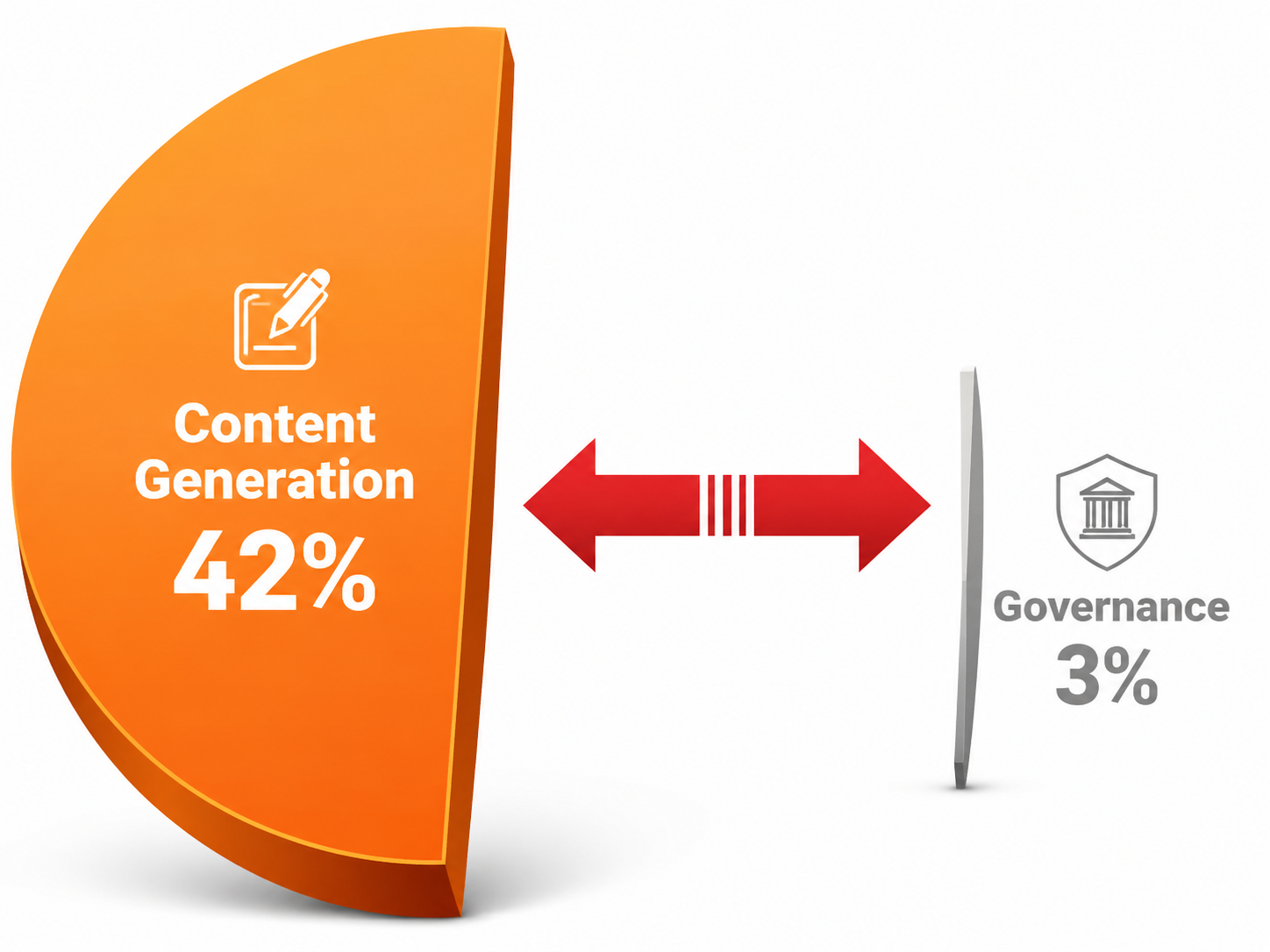
That gap explains why early wins become expensive later. A team buys writing tools, image tools, meeting-note tools, research assistants, campaign builders, and analytics copilots. Six months later, someone has to answer basic operating questions: Which tools touch customer data? Which outputs require legal review? Which prompts are reusable? Which claims were generated from approved sources? Which tools duplicate each other? Which model output caused the incident?
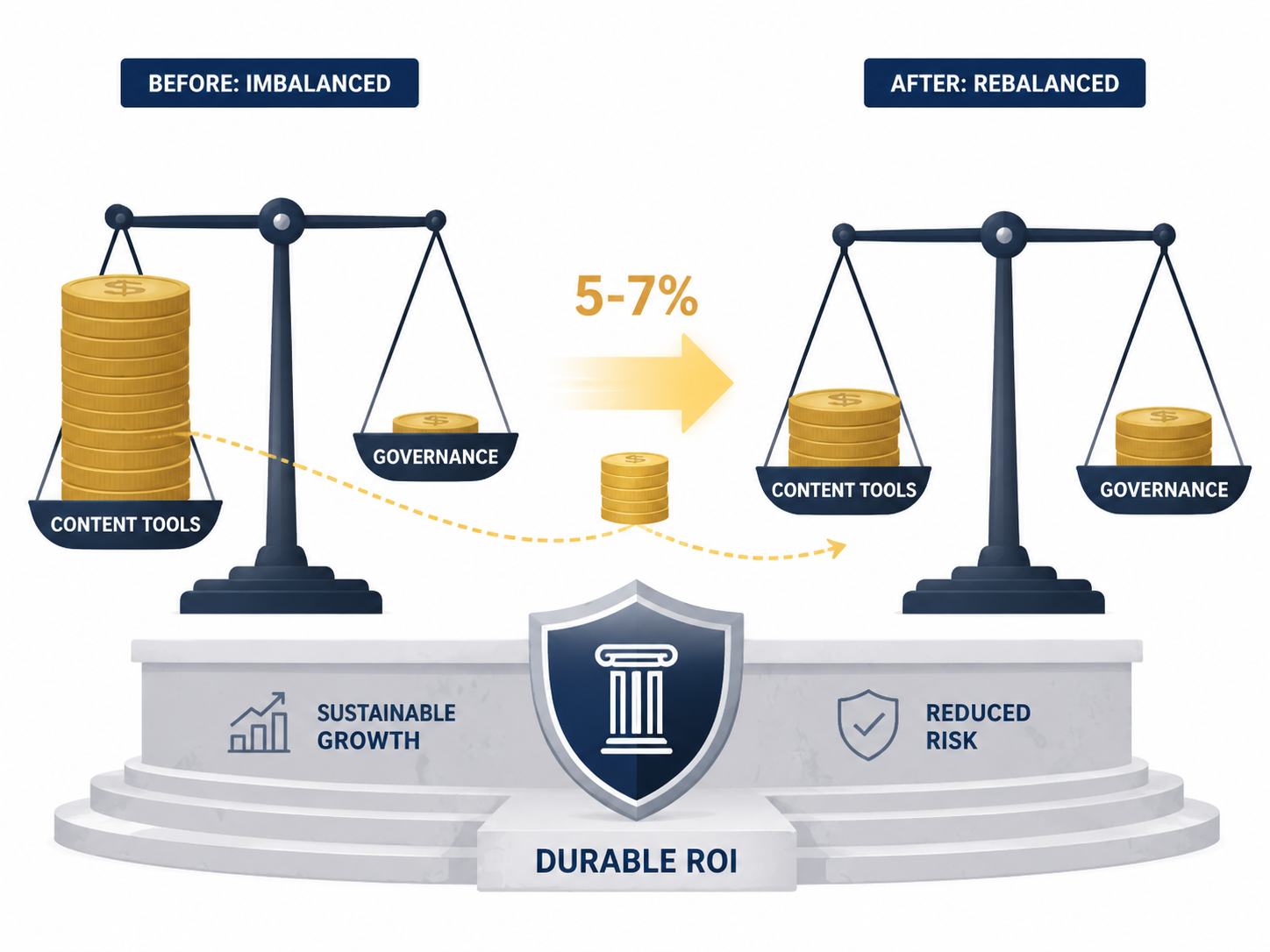
Governance is not a philosophical layer added after growth work. It is the operating system for keeping AI savings from leaking into rework. The strongest corrective is specific: teams that rebalance 5% to 7% of AI budget toward governance infrastructure resolve incidents 60% faster and face 40% lower reputational damage.[4] Those figures should still be treated as benchmark outcomes, not universal guarantees, but the direction is hard to ignore.
A Practical Allocation Framework for Q3 2026
A defensible AI marketing budget does not need to punish teams for using content tools. The high-return workflows should keep funding. What changes is the threshold for adding one more tool and the requirement that a small but real share of the budget goes to controls, review systems, and infrastructure.
| Budget move | What to fund | What to watch |
|---|---|---|
| Protect the top-return workflows | Content drafting, email optimization, analytics synthesis, and personalization where data quality is strong | Do not count draft volume as ROI unless review time, production cost, or conversion impact improves |
| Cap weak creative experiments | Paid social creative and AI video only where there is a clear testing plan and channel-specific review | Do not let demo output become recurring spend without performance evidence |
| Consolidate duplicated tools | Overlapping drafting, summarization, research, and creative platforms | Tool sprawl hides cost and makes procurement, security, and training harder |
| Move 5% to 7% toward governance | Usage policies, approval workflows, source libraries, audit trails, data controls, and incident response | Governance must be funded as infrastructure, not treated as spare-time documentation |
| Separate infrastructure from campaign spend | Agentic workflows, integrations, model access, and approved automation layers | Do not compare infrastructure directly with a single campaign’s short-term ROI |
This framework also helps with leadership conversations. A CFO does not need a tour of every prompt library. They need to know why the fastest-payback workflows are funded, why low-return categories are capped, and why governance deserves real budget even though it does not produce campaign assets. The median planned increase in AI tool spend is 47% over the next 12 months among CMOs who expect spending to grow, and 81% expect that spend to grow.[6] If the increase lands entirely in generation tools, the budget problem gets larger.
Enterprise teams are already treating infrastructure as a separate line item. Shopify reports that 63% of enterprise CMOs now have a dedicated agentic infrastructure budget line, a category that did not exist in most budgets in 2024.[7] That does not mean every mid-market team needs the same architecture. It does mean that “AI spend” is splitting into categories: tools that produce work, systems that coordinate work, and controls that make the work safe enough to scale.
What the Better Programs Have in Common
The practical pattern is visible in the case evidence. Adore Me used product content generation with structured data and a human review gate, achieving a 2- to 4-month payback.[4] The important part is not that a retail brand generated product copy. It is that the workflow had inputs, review, and a constrained output type. That is how a content use case turns into an operating advantage instead of a pile of drafts.
Cushman & Wakefield provides the same lesson from a different angle: localized content at scale with governance guardrails.[4] Localization is exactly the kind of workflow where generative AI can save time and create risk in the same motion. Without guardrails, a team can multiply off-brand claims across regions. With guardrails, localization becomes a controlled production system rather than a distributed guessing exercise.
Those examples are not proof that every brand should copy the same workflow. They are proof that the winning pattern is boring in the right way: structured inputs, known output types, review gates, and clear ownership. The creative team still does the work that requires taste and judgment. The machine removes some of the low-value setup, variation, and formatting labor around it.
How to Defend the AI Marketing Budget
A budget owner can turn the ROI stack into a simple review sequence.
- List every AI marketing tool and workflow, not just the vendor contracts.
- Assign each item to a use case: drafting, personalization, analytics, email, SEO, chatbot, ad copy, paid social creative, video, infrastructure, or governance.
- Mark the expected return type: cost savings, revenue lift, speed, risk reduction, or decision quality.
- Compare the spend mix against the ROI stack and flag low-return categories that are growing faster than proven workflows.
- Move 5% to 7% of the AI budget into governance before adding another content or creative generation tool.
- Require each renewed tool to show a payback story tied to saved labor, improved conversion, faster cycle time, or reduced incident cost.
The measurement conversation will still be imperfect. ROI benchmarks blend different definitions, adoption surveys can overstate true workflow integration, and vendor-sponsored data may not expose every methodological detail. For teams wrestling with that measurement gap, the AI marketing ROI paradox is the right follow-up. The operating answer is not to wait for perfect attribution. It is to stop treating all AI use cases as equal.
In Q3 2026, the fastest payback still comes from practical content and optimization workflows: drafting, personalization, analytics, and email. The traps are the categories where production speed is mistaken for market impact, especially obvious AI paid social creative and AI video. The durable advantage goes to teams that fund enough governance to keep the high-return work auditable, reviewable, and safe to scale.
References
- 350+ Generative AI Statistics, Master of Code
- AI Marketing Statistics 2026, DigitalApplied
- 7 AI Marketing Trends for 2026, Improvado
- 7 AI Marketing Case Studies, Pragmatic Digital
- Generative AI in Marketing, IBM
- 15 Use Cases for Generative AI, CX Today
- 34 AI in Marketing Statistics, Shopify

Comments
Join the discussion with an anonymous comment.