

AI Creative Advertising: Where It Wins CTR, Loses Conversions, and Breaks Even on ROAS
Paid media managers need a data-driven answer to when AI-generated ad creative outperforms human creative. This article provides a decision framework based on average order value, platform, and campaign objective, backed by early 2026 benchmarks.
The awkward pattern in AI creative advertising is no longer hard to spot: the AI ad wins the click, the dashboard gets briefly exciting, and then the advantage thins out somewhere between product page, checkout, lead quality, and ROAS. In the Digital Applied Q1 2026 benchmark of more than 50,000 creative variants across B2C e-commerce, lead gen, and B2B, AI-generated ads produced higher CTR on major platforms, including a 12% lift on Meta and a 7% lift on Google, while TikTok results were mixed.[1]
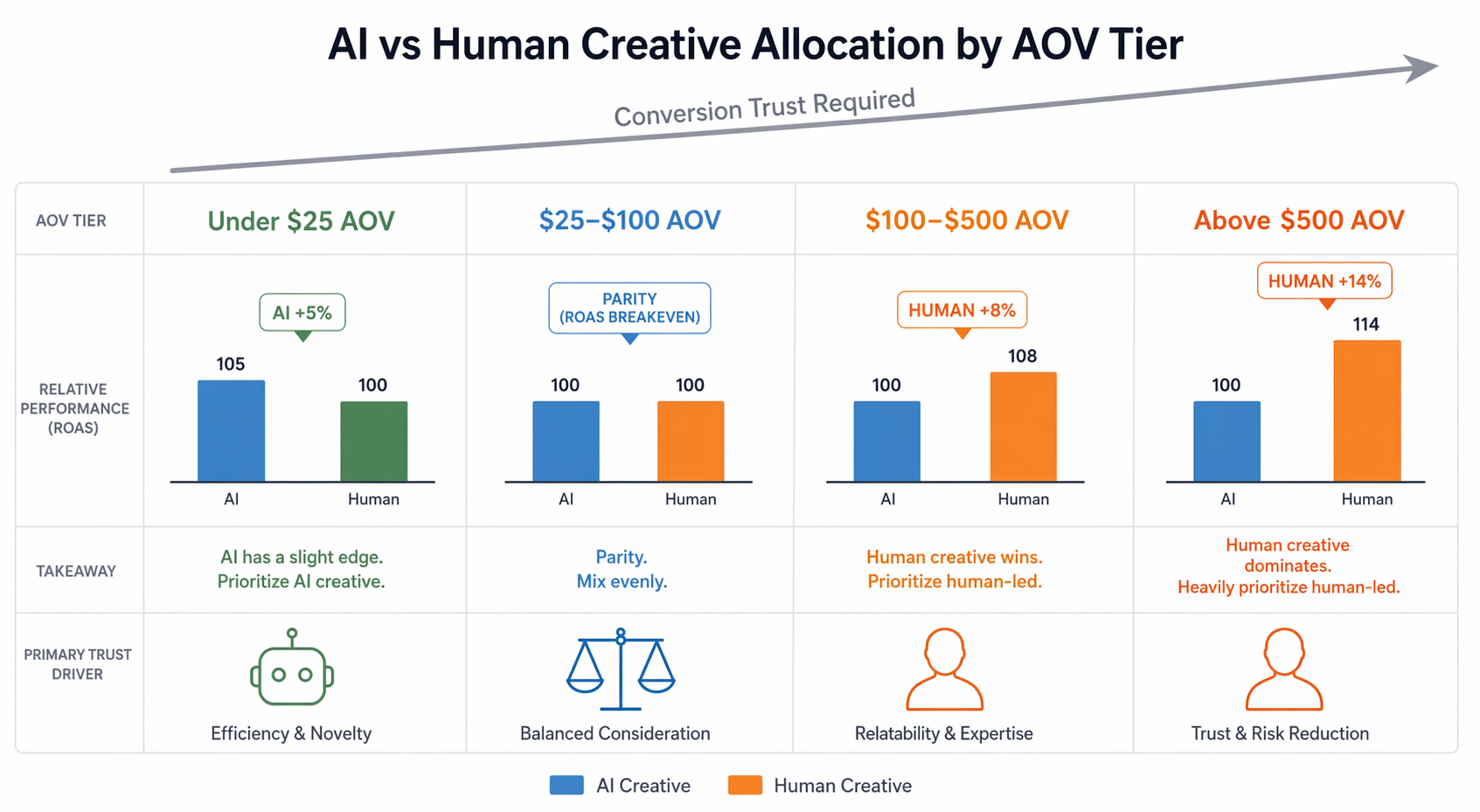
That is useful. It is not proof of business value. The same benchmark gives paid teams a cleaner operating rule: below $25 average order value, AI creative is slightly ahead; from $25 to $100, it reaches ROAS parity with human creative; above $100, AI creative converts 8% worse; and above $500, the conversion gap widens to 14%.[1]
That $100 line is the part worth taking into the next media plan. It turns “AI creative works” into a budget allocation question: how much of this campaign’s persuasion burden can be handed to a variation machine before the conversion rate starts charging interest?
The $100 AOV rule is a starting point, not a law
The benchmark is strong enough to change how a campaign brief gets written, but not strong enough to replace testing. It is one benchmark study, and verticals, audiences, discounting, landing pages, and sales cycles can all move the result. Still, it gives teams a better default than arguing over whether AI or human creative is “better” in the abstract.
| AOV tier | What the benchmark suggests | Practical creative allocation |
|---|---|---|
| Under $25 | AI creative is slightly ahead on ROAS | Let AI carry more of the variation load, especially for prospecting, seasonal offers, and fast hook testing. |
| $25–$100 | AI creative reaches ROAS parity with human creative | Use AI aggressively for variants, but keep human review on claims, offer framing, and landing-page continuity. |
| $100–$500 | AI creative converts 8% worse | Use AI for exploration and first drafts; keep human-led concepts, proof points, and final conversion assets. |
| Above $500 | AI creative converts 14% worse | Treat AI as a support tool, not the lead creative source. Human judgment should own positioning, trust signals, and premium perception. |
For low-AOV products, the math is friendlier to AI because the ad does not have to create much confidence before the buyer acts. A new hook, sharper image treatment, or cleaner product-benefit angle can be enough. If the product is inexpensive and the buying decision is low-friction, volume matters. AI’s ability to save teams more than 20 hours per week and produce 5–10x more creative variations per campaign cycle is not a side benefit; it changes the testable surface area of the account.[1]
The middle tier is where a lot of accounts should stop overthinking the philosophical question. From $25 to $100 AOV, the benchmark shows ROAS parity.[1] That does not mean every AI ad deserves budget. It means the paid team can afford to use AI as a serious production layer, provided measurement is disciplined enough to catch the difference between cheap clicks and profitable orders. If that proof loop is still loose, the better next step is not another batch of AI variants; it is a cleaner measurement plan, like the one outlined in AI Advertising ROI: Where It's Real and How to Prove It.
Above $100 AOV, the campaign is asking the ad to do more than attract attention. It has to reduce hesitation. It has to justify price. It often has to make the product feel credible before the buyer ever reaches a review, demo page, sizing guide, comparison table, or consultation form. That is where the conversion gap starts showing up.
Why AI can win CTR and still lose the purchase
CTR is the signal AI creative is best positioned to chase. There is abundant feedback: which thumbnail gets the pause, which headline gets the tap, which layout earns the click. Platform systems are also built to reward those early response signals. So when AI produces more hooks, more angles, and more formats, it gives the algorithm more chances to find a pocket of response.
Purchase intent is thinner training ground. It depends on context the ad may not fully carry: whether the claim feels believable, whether the product looks worth the price, whether the brand feels safe, whether the buyer can explain the purchase to themselves. For a $19 impulse item, the ad can get away with less. For a $300 product or a high-intent lead form, the creative has to do heavier confidence work.
The IAB/Sonata Insights January 2026 data helps explain the shape of that curve. When consumers perceived an ad as AI-generated, premium perception dropped 17%, inspiration fell 19%, and purchase intent declined 14%.[2] That does not prove every AI ad is detected in market, or that every category suffers equally. It does show why competent-looking creative can still underperform when the buyer is evaluating taste, status, risk, or trust.
This is also why “the AI version looked better” can be a trap in creative reviews. A polished asset can still feel generic. A high-CTR ad can still fail to carry the product’s reason to believe. A clean visual can still make a premium product feel oddly weightless. The conversion loss is not always a visible production flaw; sometimes it is a missing reason to trust.
Platform behavior changes how much AI should own
The platform split matters because AI creative does not perform in a vacuum. On Meta, the 12% CTR lift is amplified by an environment that already rewards large-scale variation and algorithmic delivery, especially inside Advantage+ workflows.[1] That makes Meta a natural place to let AI generate more hooks, formats, and angle tests, particularly when the campaign is prospecting into a broad audience.
Google’s 7% CTR lift is still meaningful, but the creative job often sits closer to expressed intent.[1] Search, Shopping, YouTube, Demand Gen, and Performance Max do not all ask creative to solve the same problem. A product feed image, a short video, and a landing-page-aligned asset carry different burdens. Teams comparing Google and Meta should not treat “AI creative” as one channel-neutral input; the better question is how each platform uses creative signals inside its optimization system. For a deeper platform comparison, see Google Performance Max vs Meta Advantage+: Which AI Ad Platform Should You Trust in 2026?.
TikTok is the caution label. The benchmark reports mixed results there, which should not surprise anyone who has watched platform-native creative beat more polished ad units.[1] AI can help generate scripts, hooks, captions, and edits, but the platform often punishes anything that feels like templated performance creative. On TikTok, the human role is less about making the ad beautiful and more about making it feel socially native.
Match AI responsibility to the campaign objective
AOV is the first filter. Objective is the second. A low-AOV prospecting campaign can hand AI a lot of responsibility because the main job is to discover which hooks get attention at a reasonable cost. The human team still needs to set the offer, guard the brand, and remove weak or misleading claims, but AI can produce most of the raw testing fuel.
Retargeting is different. The audience has already seen something. Repeating a slightly reworded benefit ten different ways may add frequency without adding confidence. This is where human creative should decide what objection needs to be answered next: price, proof, comparison, urgency, fit, implementation, return policy, social proof, or sales support. AI can turn that decision into versions; it should not be trusted to infer the objection from CTR alone.
Lead generation needs another layer of caution. A high click rate can make the CPL look efficient while sales quality deteriorates. If the creative overpromises, simplifies the offer too much, or attracts people who are curious but not qualified, the problem may not show up until the CRM or sales team starts rejecting the leads. Paid teams should evaluate AI lead-gen creative against downstream quality, not just form fills.
Premium and trust-sensitive categories need the most human control. That includes expensive consumer products, financial products, healthcare-adjacent offers, B2B services with long sales cycles, and anything where the buyer needs to feel taste, expertise, or legitimacy before converting. In those campaigns, AI is most useful after the human team has already defined the claim hierarchy, proof points, audience anxiety, and unacceptable brand risks.
A practical allocation model
The cleanest workflow is not AI versus human. It is deciding which part of the creative job is allowed to optimize for clicks and which part must protect conversion quality.
- Use AI heavily for: first-pass hooks, visual variations, headline angles, offer framings, format resizing, rapid localization drafts, and low-AOV prospecting tests.
- Use humans heavily for: campaign premise, product truth, claim selection, premium positioning, objection handling, compliance review, and final approval on high-AOV conversion assets.
- Use shared review for: landing-page match, audience fit, proof density, lead quality, and whether the ad is winning attention from the right buyer.
That division keeps AI close to the work it is good at: producing enough plausible variation for the platform to test. It keeps humans close to the work the model is likelier to flatten: judgment about why this buyer should believe this product at this price.
For teams that want brand-level examples of how the AOV rule plays out, the companion piece AI in Advertising Examples: Where It Works, Where It Doesn't, and the $100 AOV Decision Rule goes deeper into case-study evidence. The point here is more operational: once the campaign crosses the $100 AOV line, the review standard should change before the spend scales.
Governance is now a performance issue
The adoption curve is already ahead of the control systems. IAB reported in August 2025 that 70% of marketers had encountered an AI-related incident such as hallucination, bias, or off-brand content, and 40% had paused or pulled ads as a result.[3] Those are not abstract responsible-AI concerns when a campaign is live and a budget is moving.
The fix is not to slow every account down with theatrical approval layers. It is to apply stricter controls where the downside is larger. A low-AOV hook test may need fast human QA for claims and brand fit. A $700 product launch needs proof review, landing-page continuity, legal or compliance checks where relevant, and someone with authority to reject creative that looks clickable but weakens the product’s perceived value.
A useful review pass asks three questions before scale: Did the AI make a claim the business cannot support? Did it win attention by attracting the wrong intent? Did it make the product feel cheaper, riskier, or more generic than the offer can afford? Teams building that process can use The AI Creative Advertising Playbook: How to Build Governed Workflows That Actually Deliver Performance as the implementation layer.
The decision rule
Classify the campaign before assigning creative responsibility. If the product is under $25 AOV, the platform is Meta, and the objective is prospecting, AI can carry a large share of the creative workload. If the product sits between $25 and $100, AI can still be a primary variation engine, but ROAS measurement has to be clean enough to confirm parity. If the product is above $100, especially above $500, human creative should lead the persuasion strategy while AI supports execution and testing.
The threshold has already moved. Digital Applied’s benchmark places ROAS parity at $100 AOV in early 2026, up from $25 AOV in early 2025.[1] That is encouraging for AI creative, but it is also a reason not to memorize the number as permanent. Revisit the line as models, platforms, and consumer expectations change.
For now, the useful answer is specific: AI creative is strongest as click-seeking variation inside algorithmic systems. It is weaker when persuasion depends on trust, specificity, and premium perception. The paid team’s job is to know which campaign they are running before the CTR chart starts making the decision for them.
References
- AI Ad Creative Benchmarks 2026: CTR and ROAS Data, Digital Applied
- The AI Ad Gap Widens, IAB/Sonata Insights, Jan 2026
- AI Adoption Is Surging in Advertising, but Is the Industry Prepared for Responsible AI?, IAB, Aug 2025

Comments
Join the discussion with an anonymous comment.