

Klarna
Consumer trust in AI-driven brand experiences declined sharply in 2024, creating a new risk for marketers deploying AI in customer-facing roles. This article examines how Klarna, Dove, and Patagonia navigated that trust gap and what their experiences reveal about where AI earns trust and where it loses it.
Outcome
Handled 2.3 million conversations per month, equivalent to 700 full-time employees
This outcome is independently verified via the primary source linked above.
The useful question in many AI marketing examples is no longer whether a brand can automate a campaign, a support queue, or a product description. Most can. The harder question is what consumers believe the brand has traded away to do it.
The trust numbers are already moving in the wrong direction. Consumer comfort with brands using AI fell from 57% in Q3 2023 to 46% in Q3 2024, even as AI adoption kept spreading through marketing and service operations. Only 26% of consumers said they generally trust brands to use AI responsibly. In another set of consumer data, 51% said they were uncomfortable with AI virtual brand ambassadors, while comfort rose only to 43% for AI writing descriptions and taglines. When consumers were asked about the downside of brand AI, 59% named “loss of the human touch,” ahead of or alongside concerns about job losses and the inability to speak to a real person, both at 57%.[1]
Those figures come from different surveys and should be read directionally, not as one perfectly comparable data set. But the direction matters. The market is not simply resisting AI. Consumers appear to be sorting AI use cases by perceived risk: help me faster, suggest something relevant, maybe write the basic copy; but do not make the brand feel unreachable, synthetic, or careless with identity. That distinction is where many AI marketing case studies become more useful than their own promotional framing.
Klarna showed how quickly scale can become a service problem
Klarna is the case to sit with because it contains both sides of the AI promise. The company’s AI customer-service assistant was publicized as handling 2.3 million conversations per month, work described as equivalent to 700 full-time employees.[2] On a slide, that is exactly the kind of number that makes automation look inevitable: enormous volume, lower marginal cost, faster response, fewer repetitive tickets for humans to grind through.
The problem is that customer service is not just message throughput. It is also judgment under ambiguity. A payment issue, a refund dispute, a hardship case, a fraud concern, or a frustrated customer who has already been bounced between channels does not experience “efficiency” as a neutral good. If the machine shortens the queue but lengthens the customer’s feeling of being trapped, the brand has not solved the service problem. It has moved the pain to a place where it is harder for the company to see.
Published reports say Klarna later walked back the full-replacement posture after complex-query satisfaction declined, rehiring human agents and moving toward a hybrid triage model.[2] That narrative should be handled carefully: the reversal story is based on secondary reporting and aggregator accounts, not independently verified internal decision documents. Still, even with that caveat, the strategic lesson is hard to miss. The AI worked best when it absorbed repeatable volume and routed work. It became riskier when the surrounding story treated human service depth as something the company could mostly subtract.
For marketers, this is more than a customer-service operations story. Service is now part of brand media. A support bot that resolves a simple billing question in seconds strengthens the brand promise. The same bot blocking access to a person during a complicated dispute does the opposite. It teaches customers what the brand values when the interaction is no longer convenient.
That is why the Klarna example keeps surfacing in discussions of the AI trust gap. It is not evidence that AI support is doomed. It is evidence that replacement is a much higher-trust claim than routing, drafting, summarizing, recommending, or prioritizing. If a company wants to remove humans from a visible service path, it is not merely changing an operating process. It is asking customers to believe that the brand’s judgment, empathy, and accountability have been preserved somewhere inside the system.
Dove made the AI boundary part of the brand promise
Dove approached the trust problem from a different angle. With “The Code” campaign and its Real Beauty Prompt Playbook, the brand positioned itself directly against AI-generated beauty distortion. The campaign included published prompt guidance and a pledge not to use AI to alter women’s bodies in advertising.[3]
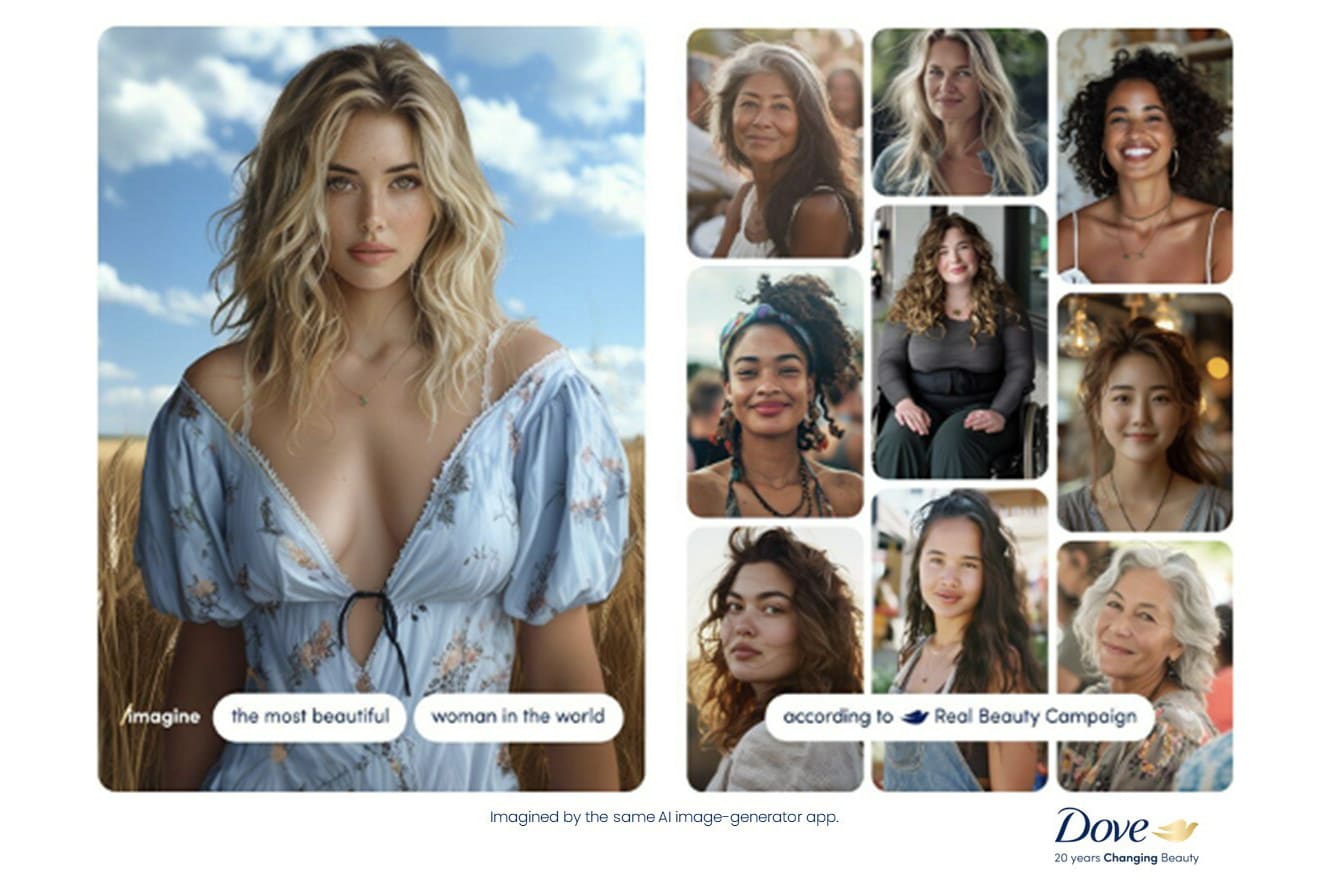
The important move was not that Dove used AI language in a campaign. Plenty of brands have done that and produced very little beyond a novelty asset. Dove connected the technology decision to a long-running brand vulnerability: beauty marketing has always carried the risk of distortion, exclusion, and impossible standards. Generative AI did not create that risk, but it made the production of synthetic perfection cheaper and faster. Dove’s posture turned the AI question into a consumer-facing standard: here is where we will not let the tool go.
That kind of boundary is useful because it is legible. Consumers do not need to inspect the full marketing stack to understand the promise. Employees and agencies also get a clearer operating constraint. The prompt playbook matters less as a perfect enforcement mechanism than as a signal that the brand is willing to translate ethics into production guidance. In categories tied to identity, bodies, health, children, finances, or social status, that translation is not a decorative layer. It is part of the experience.
This is where a brand can use AI ethics as differentiation without pretending that every AI use is a social mission. Dove’s example is narrow enough to be credible: it does not require the audience to believe the company has solved all generative AI concerns. It asks them to notice a specific refusal in a specific category where the brand has something to lose if the refusal is fake.
Patagonia’s quieter lesson: limit the surface area
Patagonia is a shorter case, but it sharpens the same rule. Reported examples of the company’s AI use focus on supply-chain sustainability insights and sentiment analysis, with stakeholder governance involving employees, customers, and environmental groups in evaluating use cases before deployment.[2]
There is no need to inflate that into a sweeping AI transformation story. Its value is the opposite: selective use. For a brand whose credibility depends on environmental commitments and anti-overconsumption signals, broad AI deployment could create unnecessary suspicion. Narrow deployment says something different. It suggests the company is asking where AI can help interpret complexity without letting the tool rewrite the brand’s obligations.
Stakeholder scrutiny also changes the internal politics of AI. A use case that survives review by people outside the growth team is different from one approved only because it promises cheaper content or faster segmentation. The point is not that every brand needs Patagonia’s exact governance model. The point is that visible constraint can be a trust signal, especially when the brand’s public identity depends on values that customers expect it to defend under pressure.
The trust gap is inside the marketing team, too
Consumer skepticism is only half the problem. Marketers themselves are not behaving as though AI outputs deserve blind confidence. Only 13% of marketers fully trust AI insights without human review, while 68% operate in a “trust but verify” middle zone. At the same time, the share of marketers worried that AI may affect their jobs rose from 35.6% in 2023 to 59.8% in 2024.[1]
That internal hesitation matters because customers eventually feel it. If the team does not trust the model’s insight without review, why would a customer trust the model’s answer in a high-stakes service moment? If employees hear AI described mainly as a labor-replacement device, they have little reason to help design the guardrails that make it safer. The brands that handle AI better tend to give the human role a place in the system before the system fails, not after complaints accumulate.
There is still a strong business reason brands keep pushing. AI can reduce friction in campaign production, support, segmentation, research synthesis, and personalization. The ROI case is real enough to keep boardrooms interested, even if the results are uneven; for the measurement side of that debate, see AI for Marketing Campaigns: What the 2026 ROI Data Actually Shows. But the existence of efficiency gains does not settle the placement question. A tool can be economically attractive in one part of the journey and brand-damaging in another.
A practical placement test for AI in marketing
The cleanest framework is not a maturity model. It is a placement test: where does AI create value without asking the consumer to surrender more trust than the interaction can support?
| Use AI more freely when | Keep humans visible when |
|---|---|
| The customer wants speed more than discretion. | The customer may feel exposed, judged, or trapped. |
| The task is repetitive, low-stakes, and easy to correct. | The task involves money, health, identity, eligibility, safety, or ethics. |
| The AI is recommending, summarizing, drafting, routing, or personalizing. | The AI would be deciding, denying, apologizing, escalating, or representing brand values. |
| The user can easily edit, reject, or reach a person. | The user has no clear appeal path or human fallback. |
| The brand can explain the use case simply. | The explanation would require hiding behind vague automation language. |
This test is deliberately plain because most AI failures do not begin as exotic technical errors. They begin as category errors. A team treats a recovery moment like a routing problem. A brand treats synthetic representation as a harmless production shortcut. A company treats governance as an internal policy when the customer is already experiencing the consequences externally.
For teams building 2026 plans, the useful operating distinction is this:
- Use AI where the customer rewards speed, relevance, lower effort, or better recall.
- Use AI behind employees where it helps them see context, summarize history, or prepare better responses.
- Keep humans visible where the interaction requires judgment, empathy, accountability, or a credible appeal path.
- Make the boundary understandable to customers and usable by employees, not just acceptable to legal review.
This is also why the broader perception problem around generative AI ads deserves more attention than it often gets. If customers already suspect AI content is cheaper, less accountable, or less truthful, brands have to design against that suspicion rather than assume it will fade with exposure. For a deeper look at that consumer skepticism, see Why Consumer Skepticism About Generative AI Ads Is Growing and How to Respond.
Governance has to show up in the experience
A governance document that customers never feel is not useless, but it is incomplete. Trust is shaped by the observable parts of the system: whether a human is reachable, whether the AI discloses itself at the right moment, whether the customer can correct an error, whether a refusal can be appealed, whether the brand’s values still hold when automation is cheaper.
That is the common thread between Klarna, Dove, and Patagonia. Klarna’s lesson sits in the recovery path: the human layer has to remain real when complexity rises. Dove’s lesson sits in brand identity: do not let generative tools quietly undermine the promise that made customers trust the brand in the first place. Patagonia’s lesson sits in scope: narrow deployment and stakeholder review can say more about responsibility than a broad claim that AI is being used “ethically.”
There is a smaller but increasingly relevant visibility layer here as well. As AI answer engines and crawlers become part of how customers encounter brand information, decisions about what to allow, block, disclose, or structure for machine access become trust decisions, not just SEO decisions. That should not distract from the core service and identity issues, but it belongs on the governance map. A brand that worries about how AI speaks to customers should also worry about how AI systems learn to speak about the brand.
The better strategic question is not “How much AI can we use?” It is “Where are we asking AI to stand in for trust?” In some places, the answer is harmless or even helpful: faster answers, cleaner handoffs, more relevant recommendations, less repetitive work. In others, the answer exposes the brand: complex service, ethical commitments, body image, money, eligibility, recovery, apology.
The brands most likely to come out ahead are not the ones with the most AI in the stack. They are the ones disciplined enough to decide where AI earns its place, where it needs supervision, and where the customer still deserves a human being.
References
- AI in Marketing Statistics & Use Cases, TechnologyChecker.
- AI for Brands Examples, Leonardom.
- AI Marketing Campaigns, DigitalDefynd.

Comments
Join the discussion with an anonymous comment.