
X Money, Venmo, Apple Pay Compared for Advertisers
This comparison breaks down which of the three payment platforms—X Money, Venmo, and Apple Pay—offers the most valuable ad surfaces, conversion data, and attribution capabilities for performance marketers in 2026, based on available launch data, market statistics, and platform policies.
- Platform
- Apple Maps
- Campaign type
- Apple Maps Ads
- Spend range
- Low (test budget)
- Timeframe
- Summer 0
- Store visit lift
- Not reported
- Verdict
- Win
- Last reviewed
- 0-07-30
If this is a media-plan decision, the short answer is not close: Apple Pay, through Apple Maps ads, is the most actionable test surface in 2026; Venmo is useful when checkout completion, rewards visibility, or social-commerce adjacency matter; X Money is the most interesting closed-loop theory and the least ready place to put performance budget.
The reason is inventory. Apple Maps ads give advertisers an actual paid surface: top-of-search and Suggested Places placements, keyword bidding, and contextual targeting based on query, approximate location, and map view. Digital Applied reported Apple confirmation for a summer 2026 launch in the U.S. and Canada, while noting the placements were not yet live in its mid-June iOS 26.5 beta testing.[1] That is a different class of opportunity from a wallet that has users, or a checkout button that improves conversion after another channel created the demand.
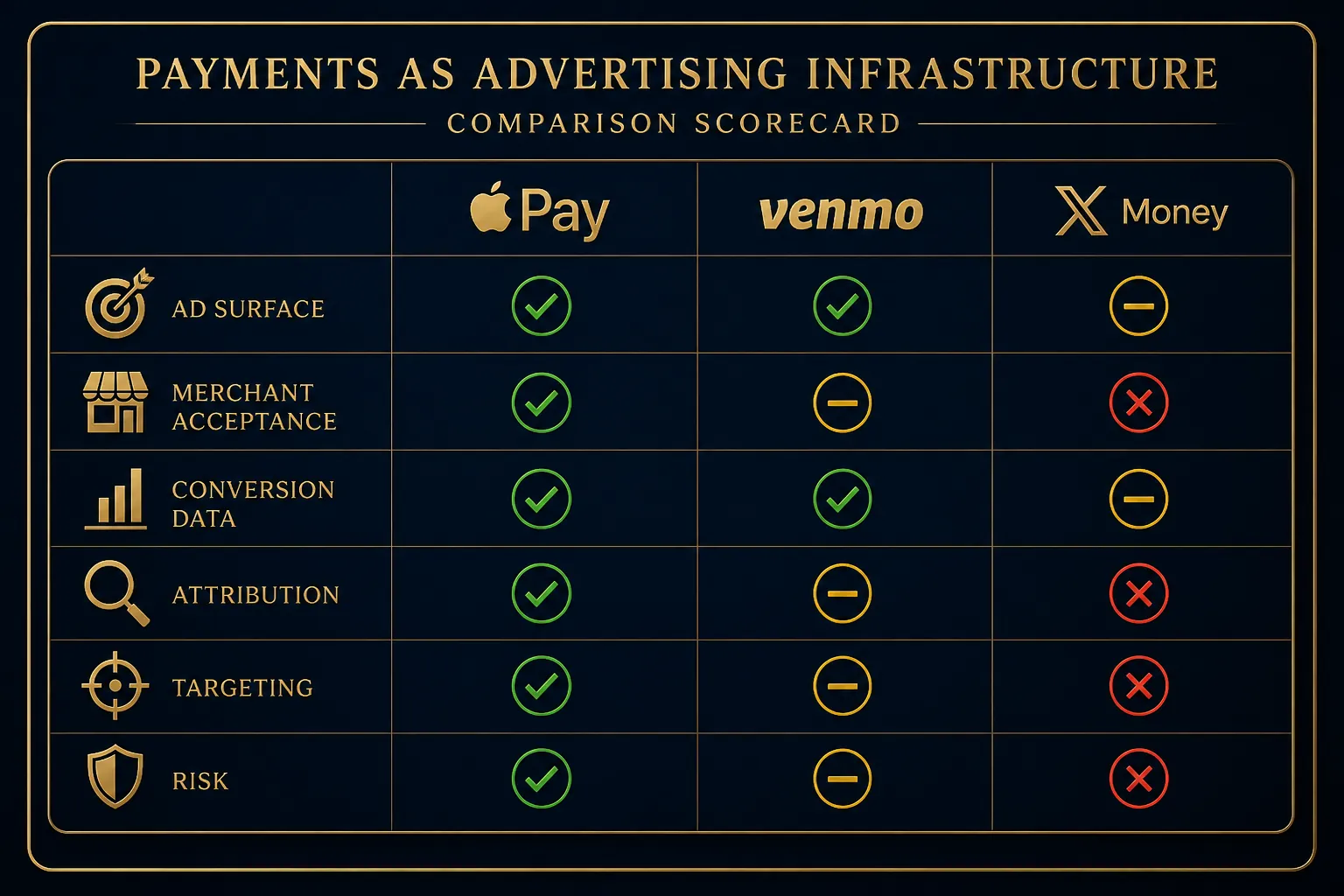
| Advertiser criterion | Apple Pay / Apple Maps | Venmo | X Money |
|---|---|---|---|
| Paid ad surface | Apple Maps top-of-search and Suggested Places; keyword-bid auction planned for summer 2026 [1] | No native ad auction or disclosed performance ad API | No proven payments-native ad product yet; theoretical integration with X ads |
| Merchant or usage scale | Apple Pay has 785M global users, 54% U.S. in-store mobile-wallet share, and 85% U.S. merchant acceptance [2][3] | About 90-95M U.S. users, $325B TPV, and 81% of U.S. P2P digital wallet transactions [4] | Rolled out July 27-28, 2026 to U.S. Premium subscribers only [5] |
| Conversion path | Best fit for local actions: directions, calls, store visits, and Apple Pay-supported checkout | Checkout completion and merchant-funded rewards; Pay with Venmo reports 17% completion-rate uplift and 14% conversion lift when displayed [4] | Potentially direct linkage from X ad exposure to X Money transaction, if adoption and merchant usage materialize |
| Attribution model | Aggregated and privacy-first; no user-level signals, retargeting, or last-click data [1] | Checkout and transaction reporting, but not a full paid-media attribution layer | Theoretically closed loop, but launch data is too thin to treat as validated performance measurement |
| Targeting access | Contextual only: query, approximate location, and map context [1] | No lookalike audiences, retargeting, or native performance targeting disclosed | Could combine social, ad, creator, and payment signals if product scale and policy stability improve |
| Main risk | Teams compare it to Google last-click CPA and undercount local incrementality | P2P dominance gets mistaken for media inventory | Tiny early adoption, Premium-only access, DAU pressure, and account-suspension concern |
The useful comparison is not wallet size
A payment platform becomes interesting to advertisers only when it changes one of the media buyer's working variables: reachable inventory, purchase path, measurable conversion, targeting, or cost. A large user base matters, but only after the platform tells the advertiser where the impression appears and how the advertiser can evaluate what happened next.
That is why Apple Pay looks stronger than its consumer-feature list would suggest. The ad product is not Apple Pay itself; it is Apple Maps sitting beside Apple Pay acceptance, local intent, and broad merchant coverage. Apple Pay's 54% share of U.S. in-store mobile wallet transactions is useful because the consumer can move from map intent to a merchant visit or payment path without introducing a strange checkout step.[2] Merchant Insiders reports 85% U.S. merchant acceptance and no extra Apple Pay merchant fee beyond standard processing, which keeps the test from requiring a new margin conversation before media even starts.[3]
Venmo has the opposite problem. Its P2P scale is real, but P2P share is not ad inventory. SQ Magazine reports roughly 90-95 million U.S. users, $325 billion in total payment volume, and 81% of U.S. P2P digital wallet transactions.[4] Those figures tell a marketer that Venmo is culturally and behaviorally present. They do not tell the marketer how to buy impressions, suppress existing customers, build lookalikes, or reconcile spend to incremental orders.
X Money should make performance marketers pause for a different reason. If payments, identity, ads, creators, and commerce sit inside one account system, the attribution pitch becomes cleaner than anything Apple will offer. But X Money rolled out in the U.S. only on July 27-28, 2026 and initially to Premium subscribers, according to TechCrunch.[5] A closed loop with very few active buyers is not yet a performance channel. It is infrastructure waiting for proof.
Apple Pay and Maps: the cleanest near-term test
Apple Maps ads are the only surface in this comparison that resembles a budgetable paid-media line item right now. The reported placements are straightforward: one sponsored unit at the top of search results and another in Suggested Places. The auction is keyword-bid based, and targeting is deliberately narrow: query, approximate location, and what the user is viewing in Maps, not age, gender, precise history, or retargeting pools.[1]
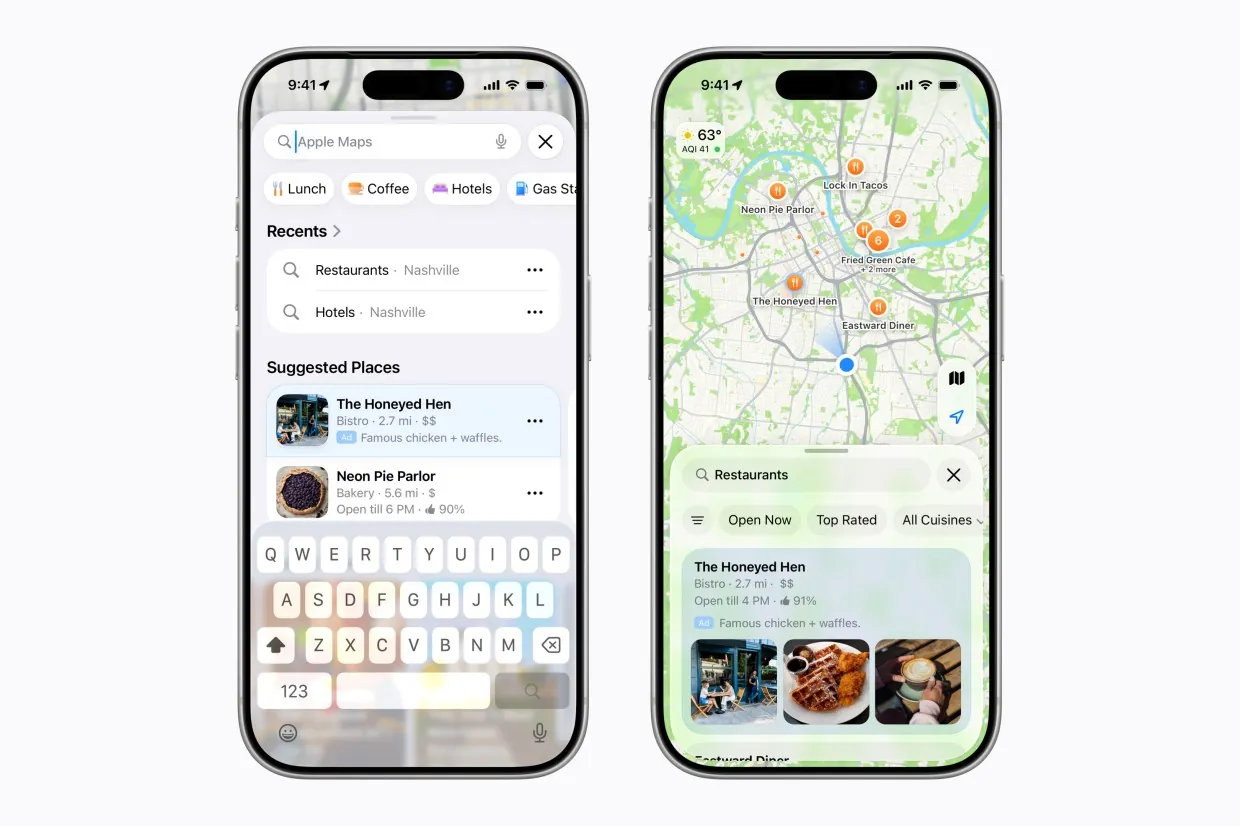
That targeting constraint is annoying if the plan was to rebuild Google Local campaigns inside Apple's ecosystem. It is less annoying if the test is framed correctly. A coffee chain, urgent-care clinic, auto service group, hotel, restaurant group, or local retailer does not need Apple to expose a full user graph to make the placement worth testing. It needs enough commercial intent in the query, enough local relevance in the map session, and enough accepted payment paths to reduce friction after the user chooses a location.
The operating standard should change with the surface. Apple Maps should not be judged first on whether it matches Google's last-click CPA. Apple says ad interactions are not linked to a user's Apple Account and personal data stays on-device, according to Digital Applied's reporting on the iOS 26.5 beta 2 splash screen.[1] That means the strongest measurement design is local incrementality: compare ad-on and ad-off periods by market, store group, or category; watch direction requests, calls, store visits, and payment-supported sales where available; then ask whether the lift is large enough to justify the spend.
This is the same attribution discipline marketers already need as more platform signals move on-device or into modeled reporting. For a related lens on how compressed signals can distort bidding expectations, see the internal analysis of iOS 27 Apple Intelligence and Siri AI ad attribution. The important point here is simpler: weak user-level visibility does not automatically mean weak incrementality. It means the test has to be designed before the first dollar is spent.
Apple's cost structure also helps. Merchant Insiders reports that Apple Pay does not add an extra merchant fee beyond standard card processing.[3] For advertisers, that removes one common objection from finance: the channel does not need to overcome a new payment surcharge before media performance is evaluated. Apple Pay also has a reported fraud rate 50-70% lower than traditional card payments, which matters more to merchants with high card-not-present exposure than to a brand manager chasing awareness.[3]
The constraint is that Apple Maps is still a local-intent product. It will not replace Meta prospecting, TikTok discovery, Amazon retail media, or Google search coverage. Its best first tests are merchants where a map session is already close to a buying decision and where store-level reporting is good enough to separate a real directional change from ordinary foot-traffic noise.
Venmo is a checkout and rewards lever, not a media platform
Venmo deserves budget attention, but not usually from the paid-social or search line. Its useful advertiser role is closer to checkout optimization, merchant visibility, and rewards-led activation. SQ Magazine reports a 16.2% ecommerce checkout market share, a 17% checkout completion uplift, and a 14% conversion lift when Pay with Venmo is displayed.[4] Those are serious numbers for a merchant with mobile checkout leakage. They are not evidence of a native ad auction.
Venmo's business profile and feed mechanics can create discovery, especially for merchants whose customers are already comfortable transacting there. PayPal's newsroom describes Venmo's evolution from a peer-to-peer app into a broader money movement app, including merchant-facing expansion and rewards.[6] SQ Magazine also reports 50% year-over-year merchant growth, 65% weekly engagement, and a user base skewing 68% Gen Z and Millennial.[4] For brands trying to improve checkout completion among younger consumers, those details matter.
The Stash rewards program is the most media-adjacent part of the Venmo story. PayPal has described cash-back offers funded by participating merchants, with examples including Sephora, Ulta, Taco Bell, and Pizza Hut.[6] SQ Magazine reports up to 5% cash back with a maximum of $100 per month.[4] That can influence purchase choice in a way a marketer can recognize: a merchant funds an incentive, Venmo surfaces it, and the consumer has a reason to select that merchant or payment method.
Still, Venmo should not be sold internally as the next Meta. There is no disclosed native ad auction, no retargeting product, no lookalike audience layer, and no performance ad API comparable to the tools media teams rely on elsewhere. PayPal's stated target of reaching $2 billion in Venmo revenue by 2027 was framed by CNBC around strategy including debit card growth and merchant expansion, not a Venmo ads business.[7]
For a media buyer, the practical Venmo question is therefore narrow: will adding Pay with Venmo, merchant offers, or rewards visibility recover enough orders to justify the operational work? If yes, the win may show up as better conversion rate, higher completion, or improved payment preference among a defined audience. It should not be reported as though Venmo delivered paid reach unless the advertiser actually bought paid reach somewhere else to create the session.
X Money has the best attribution pitch and the weakest readiness
X Money is the platform in this comparison most likely to attract a deck slide with a big closed-loop commerce diagram. The appeal is obvious: X already sells ads, hosts creators, owns the feed environment, and now has a payments product embedded in the same consumer account system. If an impression, creator recommendation, wallet balance, debit card, and transaction all sit inside X, the platform could theoretically tell a much cleaner story than an open-web checkout journey.
But the word "theoretically" is doing too much work. TechCrunch reported that X Money began rolling out in the U.S. on July 27-28, 2026, with access limited to Premium subscribers.[5] PaySpace Magazine's early user coverage the next day described account-suspension risk as a dominant concern around financial access.[8] For advertisers, that is not a small product-support issue. If a platform asks consumers and merchants to keep money, payment credentials, or transaction dependency inside an account system, reliability becomes part of the media product.
Scale is the second problem. Forbes' Ron Shevlin argued before launch that the signal to watch was creator transaction volume, not account openings, and described the likely meaningful scale as "hundreds of thousands, not millions."[9] The same analysis cited X mobile daily active users falling 15.2% year over year and subscription conversion below 0.5%.[9] A Premium-only payments launch starts inside that constraint, not outside it.
The existing X ads business also does not erase the risk. European Business Magazine estimated X's 2025 total revenue at $2.9 billion, with $2.26 billion from advertising, or 68% of revenue, and said the ad business remained 35% below Twitter's 2021 peak.[10] That means X still has ad infrastructure and advertiser relationships, but the base is not a clean growth story that can automatically carry a new financial product.
The strongest future use case is creator commerce: a viewer sees a creator post, buys a digital good, sends a tip, joins a paid community, or purchases through a merchant offer without leaving X. PYMNTS framed the product as a test of whether social commerce can hold consumer deposits, which is the right bar for the advertiser case too.[11] If consumers only open accounts for incentives such as 6% APY or 3% cash back, the platform may generate sign-ups without creating dependable transaction volume.[5]
Until X discloses or proves meaningful active payment use, merchant acceptance, creator-led purchase volume, and advertiser-safe account reliability, X Money belongs on the watchlist rather than the test plan. The closed-loop attribution story is attractive precisely because it is so easy to overvalue before the denominator exists.
How to place each one in a 2026 media plan
The clean way to compare X Money, Venmo, and Apple Pay is to stop forcing them into one category. Apple Maps is an ad platform surface attached to a high-acceptance payment environment. Venmo is a checkout and rewards layer with social visibility. X Money is a potential closed-loop commerce infrastructure product that has not yet earned performance-channel status.
| Use case | Best fit | Budget treatment | Reporting standard |
|---|---|---|---|
| Local-intent acquisition | Apple Pay / Apple Maps | Small controlled test beside Google local/search coverage | Direction requests, calls, store visits, and ad-on versus ad-off lift |
| Checkout completion among mobile wallet users | Venmo | Product, ecommerce, or CRM-adjacent test rather than core paid-media budget | Checkout completion, conversion rate, payment-method adoption, and offer redemption |
| Creator-led closed-loop commerce | X Money | Watchlist or limited exploratory partnership only | Active transaction volume, merchant reliability, account stability, and repeat purchase behavior |
Apple Pay and Maps deserve the first test when the advertiser has physical locations, local service areas, or store-level conversion signals. The budget should be carved out as an incrementality test, not as a direct Google CPA replacement. The uncomfortable part is that the reporting will be less granular than many buyers want. The useful part is that the consumer intent is cleaner than most new surfaces pitched as commerce media.
Venmo belongs in the plan when the merchant can actually use Pay with Venmo, has a younger mobile-first customer base, and can fund or measure incentives without pretending the feed is a demand-generation machine. It can make an existing session more likely to finish. It can give a reward a place to live. It does not give a paid-media team the controls they expect from Google, Meta, Amazon, or TikTok.
X Money should be monitored for two signals before it receives serious performance budget: creator transaction volume and account reliability under real financial use. Account openings, APY interest, cash-back headlines, or wallet novelty are not enough. A payments graph becomes valuable to advertisers when buyers and merchants use it repeatedly and safely at a scale large enough to measure.
So the working verdict for an advertiser is conditional, not futuristic. Test Apple Maps where local intent matters and the team can measure incrementality. Add Venmo where checkout completion, rewards, and payment preference can move existing demand. Keep X Money on the diligence list until it proves active commerce volume and advertiser-safe financial reliability.
References
- Apple Maps Ads Are Coming: A Local Paid-Media Guide — Digital Applied
- Apple Pay Statistics [2026]: Usage Trends and Market Growth — Cropink
- Apple Pay Fees Explained: Complete 2026 Guide for Merchants — Merchant Insiders
- Venmo Statistics 2026: Latest Figures That Impress — SQ Magazine
- Elon Musk's X Money app is rolling out in the US — TechCrunch
- Venmo Continues Its Evolution — PayPal Newsroom
- PayPal strategy for Venmo to reach $2 billion in revenue in 2027 — CNBC, February 25, 2025
- X Money Goes Live in the US: Early Users Reveal the Real Challenge — PaySpace Magazine, July 29, 2026
- Elon Musk's X Money: How It Could Win (And Why It Won't) — Forbes, April 17, 2026
- How X Makes Money in 2026 — European Business Magazine
- X Money Tests Whether Social Commerce Can Hold Consumer Deposits — PYMNTS
Built on this evidence
No Bidding tactic or Creative record currently cites this case file. Compare it against other results in Benchmarks.
Related benchmark reading
Report a corroborating or contradicting result
Seeing something different in your own account? Feed the data-integrity loop instead of leaving an open comment.