
Pay for X Ads with the X Money Debit Card and Get 3% Back
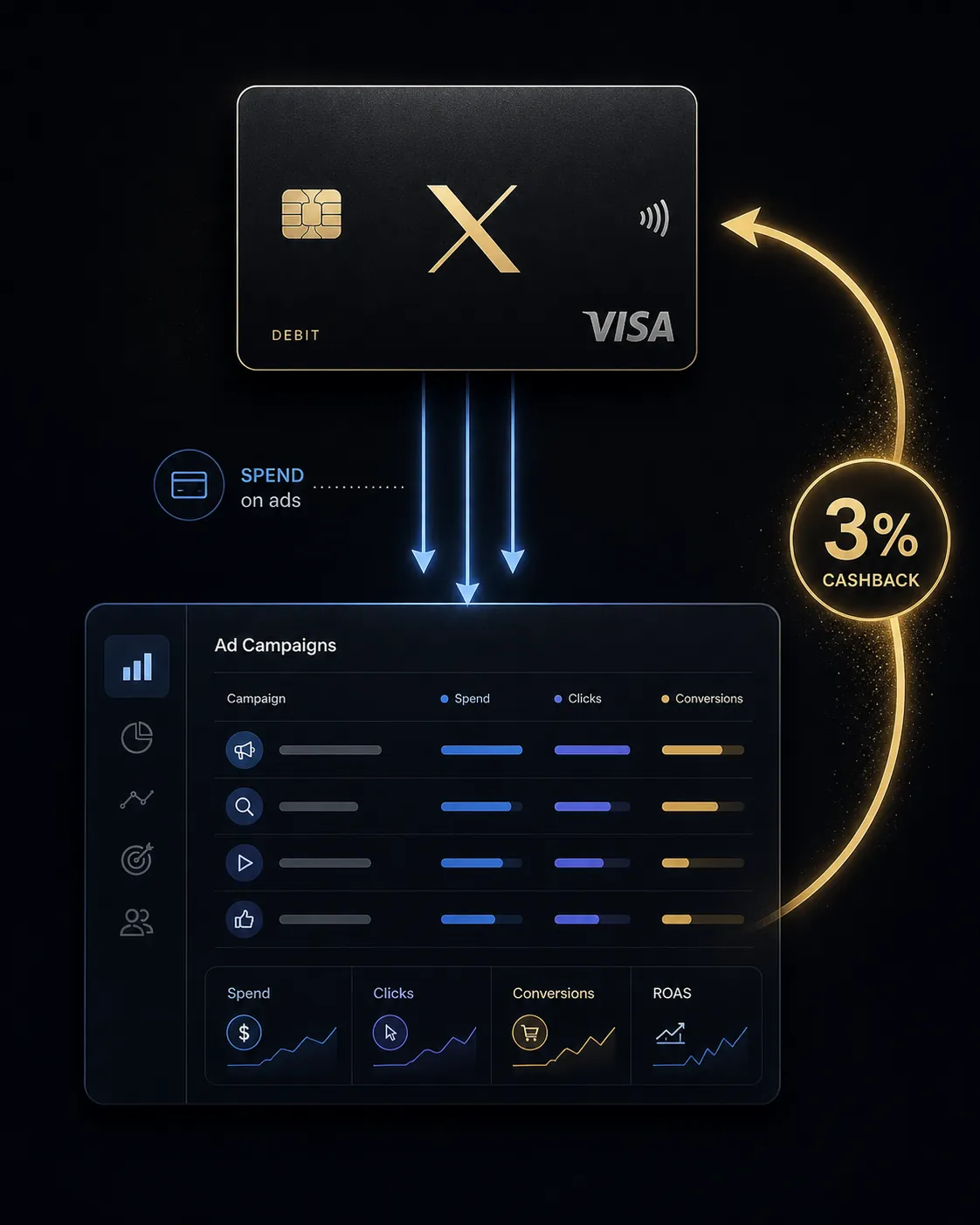
Learn how advertisers can use the X Money Visa debit card to pay for X Ads and earn 3% unlimited cashback. This article breaks down the mechanics, break-even spend thresholds, and net savings so you can decide if the strategy works for your account.
- Platform
- X Ads
- Campaign type
- Self-serve ads
- Spend range
- $0 - $50,000 per month
- Timeframe
- July 0
- Cashback rate
- 0%
- Verdict
- mixed
- Last reviewed
- 0-07-30
Based on July 2026 documentation, the payment route for advertisers looks possible: X Business says self-serve advertisers can pay with Visa debit cards, and the X Money card is described as a Visa debit card issued by Cross River Bank.[1][2] That is the useful part. The part that still needs a label is the 3% cashback conclusion: it is an inference from X Ads billing acceptance and X Money reward terms, not a published case study of an advertiser charging X Ads to the card and receiving the rebate.
That distinction matters for anyone asking which X Money debit card features advertisers can actually use. The card may turn a billing setting into a small reduction in effective media cost, but only if four things stay true at the same time: the advertiser has access to X Money, the X Money debit card is accepted by X Ads billing, ad payments remain eligible for cashback, and the required subscription cost does not eat the rebate.
The payment path comes first
Before the rewards math means anything, X Ads has to take the card. X Business billing documentation lists Visa debit cards among accepted payment methods for advertisers.[1] X Money, in turn, describes its card as a Visa debit card, with 3% unlimited cashback on eligible purchases and zero foreign transaction fees.[2]
Put together, the operational path is straightforward enough to test: fund X Money, use the X Money Visa debit card as the payment method in X Business, and let X Ads charge campaigns against that card. What is not yet documented in the source material is the final confirmation screen that matters most to finance: a completed X Ads charge followed by a posted 3% cashback reward.
So the cleanest way to state the tactic is this: X Ads appears to accept the card rail, and X Money appears to offer the reward rate, but the advertiser should verify cashback eligibility inside the current X Money terms before moving meaningful spend.
The 3% only matters after the subscription drag
X Money was rolling out to U.S. Premium and Premium+ subscribers in late July 2026, not to every X advertiser by default.[3] That makes the subscription requirement part of the media-cost calculation, not a side note.
Using the July 2026 subscription figures in the available material, Premium costs $8 per month and Premium+ costs $40 per month. At a 3% cashback rate, an advertiser needs about $267 in monthly X Ads spend to cover the $8 Premium cost, or about $1,334 to cover the $40 Premium+ cost.[2]
| Monthly X Ads spend | Gross 3% cashback | Net after $8 Premium | Net after $40 Premium+ | Practical read |
|---|---|---|---|---|
| $267 | $8.01 | About break-even | Negative | Enough to offset Premium, not Premium+ |
| $1,334 | $40.02 | $32.02 | About break-even | Enough to offset either subscription tier |
| $5,000 | $150 | $142 | $110 | Worth testing if X Ads already performs |
| $50,000 | $1,500 | $1,492 | $1,460 | Material monthly rebate; $18,000 annual cashback before subscription costs |
The $5,000-per-month account is where the tactic starts to feel like a real media-buyer decision rather than a consumer-card perk. The gross cashback is $150 per month. After the required subscription, the account keeps $110 to $142, depending on whether Premium+ or Premium is required for that user’s setup. That is not a new channel strategy, but it is enough to pay for incremental testing, creative iteration, or a small budget overage without touching bids.
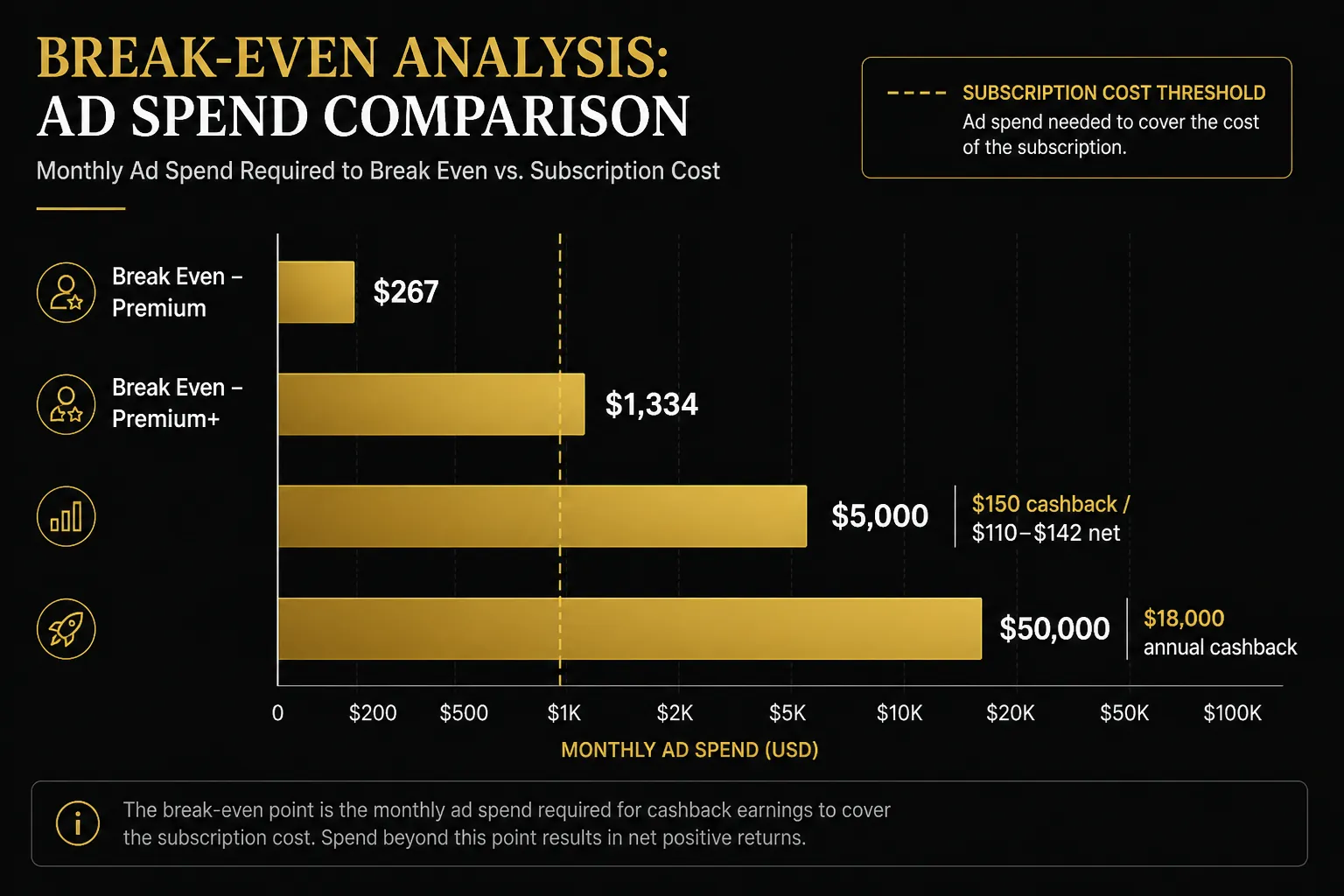
At $1,000 per month, the math is thinner. The card would generate $30 in gross cashback, which clears an $8 Premium subscription but not a $40 Premium+ subscription. At $50,000 per month, the gross rebate reaches $1,500 per month, or $18,000 per year, before subscription costs and before any change in campaign performance.
Who this actually helps
The strongest candidate is not the advertiser looking for a reason to start spending on X. It is the advertiser already spending above the relevant break-even line, already comfortable with X Ads performance, and already able to handle a debit-card funding workflow.
- A small account spending below $267 per month should not treat the card as a savings tool, because the subscription cost can exceed the cashback.
- An account spending $1,000 to $5,000 per month can justify a controlled billing test if Premium access is already useful or required for other reasons.
- A larger account spending tens of thousands per month has enough gross rebate at stake to involve finance, confirm terms, and monitor posted rewards by statement cycle.
- An advertiser still unsure whether X Ads can hit its acquisition or awareness targets should solve that performance question before optimizing the payment rail.
That last point is not theoretical caution. A skeptical read of X’s ad opportunity has to include audience risk: Forbes noted that X mobile daily active users fell 15.2% year over year in 2025.[4] A cashback rate does not repair weak reach, poor audience fit, brand-safety concerns, or an account structure that already fails to convert.
The secondary features are useful, but not the main case
X Money also advertises 6% APY on deposited funds.[2] For advertisers, that sounds better than it usually behaves in practice. If a team parks monthly ad budget briefly before campaigns run, the yield on a typical float is small compared with the 3% cashback. On a $10,000 balance, the available material estimates roughly $50 for a one-month hold, which is not nothing, but it should not drive the decision.
Zero foreign transaction fees are more interesting for a narrower group: advertisers running cross-border campaigns while paying in USD, especially if their alternative card would charge a typical foreign transaction fee. Even then, the value depends on whether the charge is actually treated as foreign and whether the existing payment method already avoids that fee.[2]
Creator-payout routing is adjacent rather than central. AP reported that creator payouts on X would move to X Money by default.[5] A brand that both buys media on X and pays creators there may like the consolidation, but creator settlement is a workflow convenience, not the reason to move ad billing.
What can break the strategy
The obvious failure point is reward eligibility. X Money’s published feature list says eligible purchases earn 3% unlimited cashback, with exclusions including jewelry, precious metals, and gambling; the research material does not show an advertising-platform exclusion.[2] That is not the same as saying X Ads will always qualify. The current cashback terms should be read before the first test charge and checked again before scaling spend.
Availability is the next constraint. The rollout was invite-only in the U.S. and tied to Premium or Premium+ access in late July 2026.[3] An advertiser may have the right spend level and still be unable to use the product in the next billing cycle.
Debit-card funding also changes the cash-flow conversation. A credit card can create float. A debit card pulls from deposited funds. For a buyer managing daily caps, invoices, approvals, and pacing, the operational question is not only “Do we earn 3%?” It is also “Who keeps the X Money balance funded, and what happens if a charge fails during an active campaign?”
Terms can move as well. Cashback rates, APY, foreign transaction fee language, subscription prices, access rules, and merchant exclusions are all product terms, not laws of physics. The savings table is useful because it shows the present breakpoints; it should not be treated as a permanent guarantee.
A sensible test looks boring
For an account already spending above the break-even threshold, the clean test is not to reroute the whole budget on day one. Add the X Money Visa debit card as the payment method, run a small controlled charge, wait for the transaction and cashback posting, then compare the posted reward against the expected 3%.
- Confirm that the account has X Money access and the required Premium or Premium+ subscription.
- Read the current cashback exclusions and look specifically for advertising, business services, cash-equivalent, or platform-payment language.
- Make a small X Ads payment with the X Money Visa debit card before moving recurring spend.
- Verify that the reward posts at the expected rate after the charge settles.
- Document the net value after subscription cost so finance sees the actual margin improvement, not just the headline reward rate.
If that test works, the decision becomes account-specific. At $5,000 per month, the card can produce a modest but visible rebate. At $50,000 per month, it becomes a real line item. Below the subscription break-even point, or in any account where X Ads has not already earned budget on performance, the 3% should not be allowed to pull spend into a channel for the wrong reason.
References
- Billing Basics — X Business — business.x.com/en/help/account-setup/billing-basics
- X Money homepage — X Money — money.x.com/en
- Elon Musk's X Money app is rolling out in the US — TechCrunch — July 28, 2026
- Elon Musk's X Money: How It Could Win (And Why It Won't) — Forbes
- Elon Musk launches invite-only X Money... — AP News
Built on this evidence
No Bidding tactic or Creative record currently cites this case file. Compare it against other results in Benchmarks.
Related benchmark reading
Report a corroborating or contradicting result
Seeing something different in your own account? Feed the data-integrity loop instead of leaving an open comment.