
How iOS 27 Apple Intelligence and Siri AI Degrade Ad Attribution
iOS 27's Apple Intelligence features — on-device summarization, Smart Reply, Siri AI product discovery, and Private Cloud Compute — compress third-party ad signals more aggressively than prior privacy updates. This article explains the specific mechanisms and what media buyers can do to adapt their iOS measurement infrastructure before Q4 2026.
- Platform
- Meta Ads
- Campaign type
- Search
- Spend range
- All budgets
- Timeframe
- 0-07-30
- ROAS
- 0-60%
- Verdict
- mixed
- Industry vertical
- ecommerce
- Last reviewed
- 0-07-30
The operational problem with iOS 27 advertising is not that Apple added another privacy prompt. It is that an iOS buyer can now be summarized, auto-replied, Siri-directed, and privacy-routed before the normal third-party ad stack sees the signals it used to depend on.
As of July 30, 2026, iOS 27 and the new Siri AI layer are still developer-beta material. Fall general availability is expected but not confirmed, so this is not a post-launch benchmark. It is a pre-Q4 measurement risk brief: which announced or beta-visible changes can thin iOS attribution before finance asks why Meta, Google, backend revenue, and Apple Ads are no longer telling the same story.
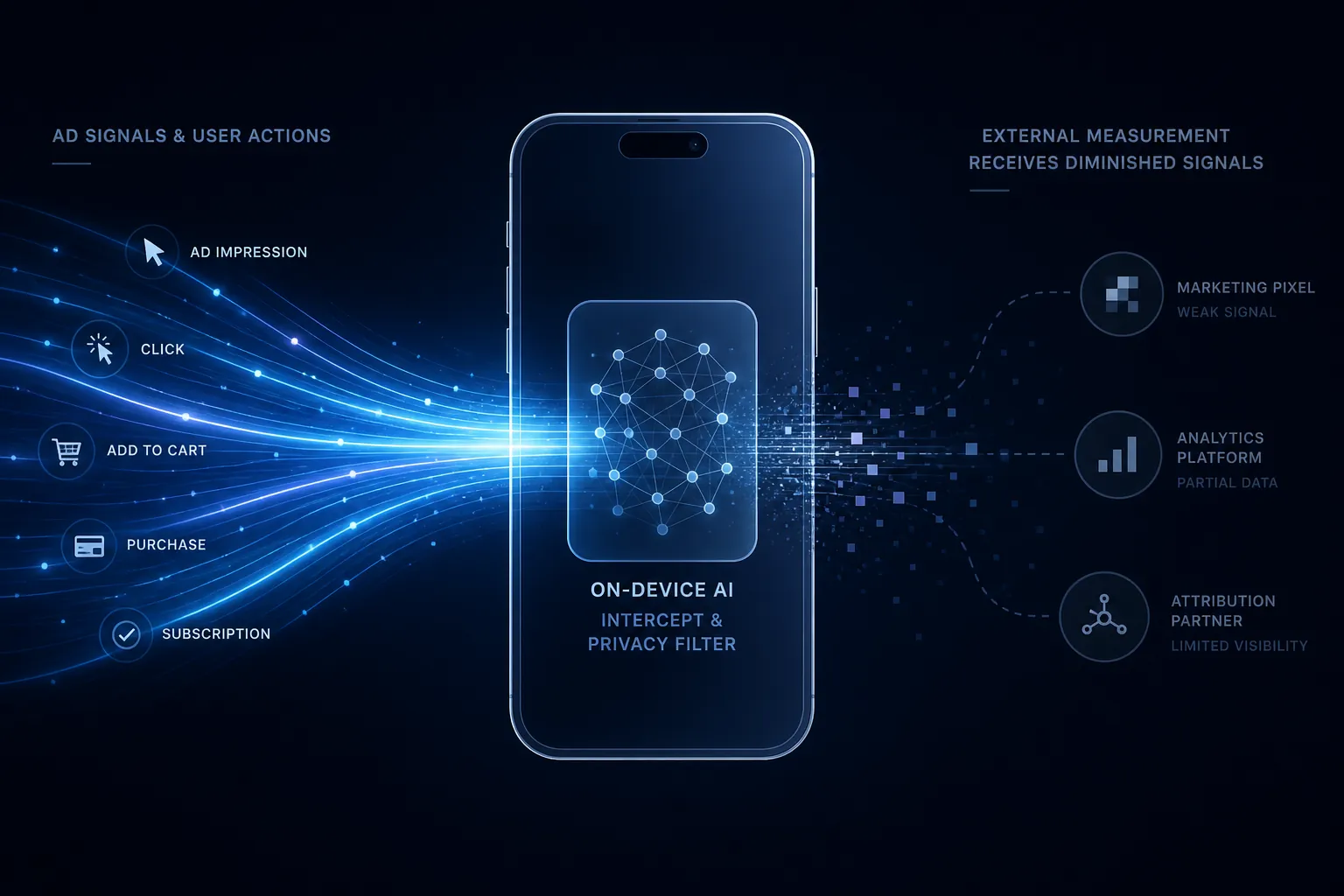
ATT made signal loss visible. A user opted out, an identifier disappeared, SKAdNetwork modeled what it could, and everyone knew the spreadsheet had a hole in it. iOS 27 is messier for operators because Apple Intelligence can reduce the number of observable events before attribution tools get the chance to fail. Fewer page visits, fewer email opens, fewer search sessions, fewer inspectable handoffs: the dashboard can look clean while the journey underneath has been shortened somewhere else.
The signal compression chain
The safest way to read iOS 27 is not as one big privacy change. It is a chain of small interceptions. Each one removes or weakens a signal that performance teams normally use to reconstruct intent.
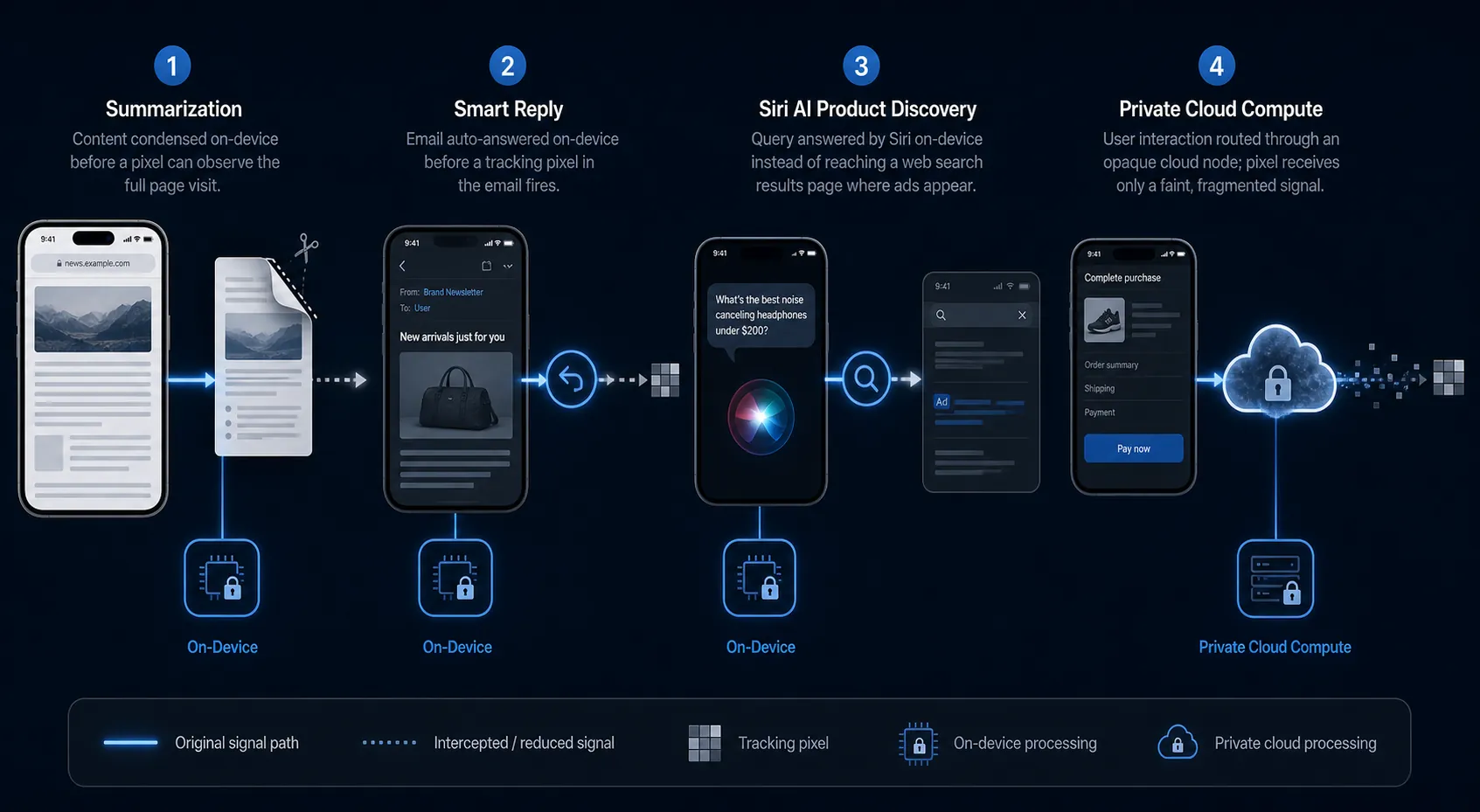
| Interception point | What changes for the buyer journey | What weakens for attribution |
|---|---|---|
| On-device summarization | A user can extract enough information from a page, message, or result without completing the normal visit path. | Landing-page views, scroll depth, retargeting audiences, and pixel-fired engagement events. |
| Smart Reply | A user can respond to or clear an email without opening the full promotional message. | Email opens, click-throughs, triggered flows, and downstream matchback confidence. |
| Siri AI product discovery | A user can ask for an answer, comparison, or recommendation before entering a conventional search results page. | Search ad impressions, organic click paths, query-level intent, and assisted-conversion trails. |
| Private Cloud Compute | More complex requests can be handled through Apple-controlled privacy infrastructure when on-device processing is not enough. | Inspectable intermediate events, third-party tags, and deterministic path reconstruction. |
The first break is summarization. If a user sees enough of a product page, review snippet, shipping policy, or comparison content inside an Apple-generated summary, the advertiser may lose the pageview that would have fired a pixel. That does not mean the user became less interested. It means the interest moved into a surface where the advertiser may not observe the same sequence of events.
That distinction matters for budget decisions. A Meta campaign can still create demand, but if the iOS user later satisfies part of that demand through a summarized surface, Meta may receive less retargeting signal and less conversion-path evidence. The backend may still show revenue. The platform report may show weaker learning. The buyer is left deciding whether performance deteriorated or measurement got thinner.
Smart Reply creates a quieter version of the same problem. Promotional email has always been noisy as a measurement layer, but it still gives acquisition teams useful signals: opens, clicks, flow engagement, post-click purchases, and audience refreshes. If Apple Intelligence helps users handle email content without opening the message or clicking through, some of that behavior no longer lands in the systems that marketers use to distinguish a warm subscriber from a dormant one.
This is not just an email-marketing problem. Paid media teams use email engagement to build suppression audiences, feed lifecycle segments back into ad platforms, and interpret whether a cohort bought because of prospecting, retargeting, a promotion, or a retention flow. Remove enough of those engagement events and attribution models do not merely lose credit. They lose context.
Siri AI is the larger commercial shift because it sits closer to product discovery. Apple’s iOS 27 Foundation Models framework lets apps call on-device large language model inference without sending data off-device, and the broader Siri direction is privacy-preserving answer synthesis rather than a handoff to a fully inspectable web session.[1] For users, that is elegant. For paid search and paid social operators, it means some queries that used to become ad impressions, organic visits, or comparison clicks may become answers first.
A hypothetical example is enough to show the measurement issue. A shopper asks Siri which lightweight running shoes are good for rainy city commuting. If the answer synthesizes product attributes, brand mentions, review language, availability, or app content before the shopper reaches a search results page, the first measurable commercial touch may happen later than it used to. The winning brand may still benefit from being named. The ad platform that would have served the search impression may never log the missed opportunity.
Private Cloud Compute adds opacity to the parts of the journey that cannot be handled fully on-device. The issue is not that Apple is secretly giving advertisers less data than it promised; the announced architecture is explicitly designed to avoid exposing user data. The issue for attribution is simpler: if more of the user’s commercial research moves through Apple-controlled privacy infrastructure, third-party tags and platform pixels have fewer chances to observe the intermediate steps that used to help explain a conversion.
Why the iOS 27 change is harder to diagnose than ATT
After ATT, teams could at least segment the damage. Opted-in users behaved one way, opted-out users behaved another way, and attribution windows became a visible negotiation between platform reports and backend truth. iOS 27 adds more places where a user can express intent without producing the same measurable trail.
That is why practitioner attribution numbers should be read carefully. DOJO AI’s March 2026 analysis says Meta attribution accuracy has deteriorated 40% to 60% cumulatively since iOS 14.5, with iOS 26 and iOS 27 accelerating the decline in 2026. That is practitioner analysis and industry consensus, not an independently audited third-party measurement standard.[2] It is still useful because it describes what operators are seeing in the same dashboards where budgets are actually moved.
The cleaner, narrower D2C data point comes from Wittelsbach AI: premium D2C brands saw 8% to 15% drops in pixel-attributed iOS conversions. The caveat belongs next to the number: the analysis is based on India-market data and may not generalize to every category or region.[3] For a U.S. subscription app, a European marketplace, or a low-AOV consumables brand, the exact percentage may be wrong. The mechanism can still be relevant.
Meta’s own January 2026 attribution-window changes make the diagnosis harder. DOJO AI reports that the removal of 7-day view and 28-day click attribution windows can reduce reported conversions by 15% to 30% for long-sales-cycle advertisers.[2] That drop is not the same thing as iOS 27 signal compression, but it lands in the same reporting meeting. A buyer looking at a weaker Meta report has to separate platform window changes, iOS event loss, creative fatigue, offer weakness, and real demand changes before touching the budget.
The dangerous version of this is a dashboard that appears internally consistent because every visible number got worse together. Pixel conversions fall. Reported ROAS softens. Retargeting pools shrink. Email engagement looks less predictive. If backend revenue falls too, the answer may be business performance. If backend revenue holds while iOS platform reporting weakens, the answer is more likely measurement compression. Those are different decisions.
Apple is not just the privacy layer
The structural asymmetry is what makes iOS 27 different from a neutral browser-level measurement loss. Apple controls the device experience, the privacy architecture, the App Store discovery surface, and a growing ads business. eMarketer forecasts Apple’s U.S. ad revenue at $8.85 billion for 2026; that is an analyst estimate, not an Apple corporate disclosure. Apple reports advertising inside Services, and Services revenue reached $30.98 billion in Q2 2026, up 16.3% year over year.[4]
The point is not that Apple needs every lost Meta signal to become an Apple Ads dollar. The point is that Apple’s ad surfaces sit closer to first-party intent when third-party surfaces lose observability. Apple Ads says Search Ads conversion rates are above 60% for search result ads.[5] That claim comes from Apple, so it should be treated as vendor disclosure, but it also matches the media-buyer intuition: a search inside the App Store is already deep in the funnel.

Personalization opt-outs do not erase that intent surface. Search Engine Land reported in October 2025 that 78% of App Store search volume came from users who had disabled Personalized Ads.[6] That figure may shift with iOS 27, but it shows the asymmetry clearly: Apple can monetize high-intent App Store search even when a user has limited personalization. A third-party pixel does not get the same fallback position.
This is where the privacy debate usually becomes too abstract for the person holding the budget. Whether Apple’s architecture is good for users and whether it is favorable to Apple’s ad business can both be true. A campaign manager still has to decide whether the next marginal dollar belongs in Meta prospecting, Google search, Apple Ads, influencer whitelisting, owned content, or retention. Signal access affects that decision even when the privacy rationale is legitimate.
The content layer now affects paid efficiency
Apple Intelligence also changes what counts as acquisition infrastructure. If Siri AI and on-device answers become part of product discovery, brand content is no longer only an SEO asset or a conversion-rate asset. It becomes material that may help an answer engine decide whether a product is legible enough to mention, compare, or summarize.
Wittelsbach AI and LSEO both frame Apple Intelligence as a new answer or discovery surface where content quality can affect paid acquisition efficiency.[3][7] That does not prove a deterministic ranking formula, and it should not be sold as a new trick for gaming Siri. It does mean product pages, app metadata, comparison content, FAQs, reviews, and structured brand information may influence what users learn before they ever click an ad.
This is the part performance teams are most likely to underweight because it sits outside the media account. A landing page that exists only to catch a click is less useful when the user’s first interaction may be a summary. Product copy that hides compatibility, shipping, pricing, ingredients, sizing, cancellation terms, or use cases behind tabs and vague claims gives Apple’s answer layer less clean material to work with. Creative still matters, but so does whether the product can be understood by a machine-mediated discovery surface.
What to fix before Q4
The practical response is not to abandon iOS buying or treat every platform-reported decline as fake. The response is to stop letting a single ad-platform ROAS column carry the whole truth burden.
- Rebuild first-party measurement around backend revenue, order IDs, subscription starts, refunds, cancellations, and cohort value rather than only pixel-fired purchases.
- Separate iOS from Android in weekly reporting so real demand changes do not get confused with iOS-only observability loss.
- Track platform-reported conversions against backend revenue by acquisition source, campaign type, and attribution window before holiday budgets scale.
- Document January 2026 Meta attribution-window effects separately from iOS 27 beta effects, especially for products with longer consideration cycles.
- Treat Apple Ads as a strategic intent surface, not merely a last-click cleanup channel, when App Store or Apple-controlled discovery is material to the business.
CAPI is still worth the work, but it should be judged as mitigation, not magic. Wittelsbach AI reports that brands running CAPI with hashed identifiers and Event Match Quality scores above 70% see iOS attribution accuracy within 8% to 12% of Android.[3] That is a workable gap for many accounts. It is not the same as recovering the full pre-ATT or pre-AI event trail.
The minimum useful CAPI audit is not complicated. Confirm that purchase, lead, subscribe, add-to-cart, initiate-checkout, and qualified lifecycle events are sent server-side. Check whether email, phone, external ID, IP address, user agent, and click IDs are captured and hashed where required. Watch Event Match Quality by event, not just at the account level. Then compare modeled platform recovery against backend revenue, because better match quality can still coexist with biased platform credit.
For Apple Ads, the audit is different. If the business depends on app installs, subscriptions, in-app purchases, or App Store discovery, search term structure, custom product pages, event mapping, and cohort-level downstream value need the same attention that Meta buyers give creative testing. If Apple-controlled surfaces are where more observable intent remains, the account cannot be managed as an afterthought.
For content, the Q4-ready version is not a full answer-engine optimization program. It is a cleanup pass on the pages and app metadata most likely to be summarized: product-category pages, high-intent comparison pages, pricing and policy pages, app listings, support pages, review snippets, and FAQs. The goal is to make commercial facts clear enough that a user, a search engine, or an on-device answer layer can understand the product without needing three more clicks.
What not to claim yet
There is not enough GA evidence to claim that iOS 27 has already reduced every advertiser’s ROAS by a fixed percentage. There is not enough public evidence to say how much Siri AI will divert commercial queries away from Google, App Store search, Safari, or brand sites in production. There is also no reason to treat all AI-assisted interactions as lost conversions; some summaries may increase confidence and shorten the path to purchase.
The narrower conclusion is stronger: iOS 27 makes third-party attribution thinner at more points in the journey, while Apple-controlled ad and discovery surfaces keep a structurally better position inside the device ecosystem. That is enough to change measurement preparation before Q4, even if the final production-level effect is still unconfirmed.
The accounts that handle this best will not be the ones that argue about whether platform reporting is true or false. They will be the ones that can reconcile iOS and Android behavior, backend revenue, CAPI quality, Apple Ads performance, and content discoverability quickly enough to move budget without pretending the old attribution map still describes the journey.
References
- Apple WWDC 2026 AI Strategy: What It Means for Builders, MindStudio
- Meta Ads Attribution in 2026: Changes & Fixes, DOJO AI, March 2026
- Apple Intelligence & Meta Ads in 2026: Signal, Privacy, and the D2C Implications, Wittelsbach AI, 2026
- Apple ad business quietly contributes to record services revenues, eMarketer
- Apple Ads News, Apple
- Apple Ads: What to know, Search Engine Land, October 2025
- Apple Intelligence and On-Device Answers: Signals Brands Should Watch, LSEO, 2026
Built on this evidence
No Bidding tactic or Creative record currently cites this case file. Compare it against other results in Benchmarks.
Related benchmark reading
Report a corroborating or contradicting result
Seeing something different in your own account? Feed the data-integrity loop instead of leaving an open comment.