
How Zen 7 EPYC's AI acceleration changes ad serving
This article explains why AMD's upcoming Zen 7 EPYC with ACE AI extensions matters for programmatic advertisers: its tri-family architecture directly addresses the tight latency constraints of real-time bidding, potentially lowering bid-decision costs and enabling more agentic strategy testing.
- Platform
- Google Ads
- Campaign type
- Performance Max
- Spend range
- No campaign test
- Timeframe
- 2028-2029
- CPA
- Theoretical
- Verdict
- mixed
- Last reviewed
- 2026-07-29
A bid can lose before the model is wrong. In real-time bidding, the decision has to reach the exchange before the auction window closes, and that window is not generous. Google Authorized Buyers says bidders are expected to return at least 85% of responses within deadline, with auction timeouts that can range from 80 milliseconds to 1,000 milliseconds depending on the request path and integration details.[1] Xandr, now part of Microsoft Advertising, has described a system processing 400 billion requests per day under a 100–150 millisecond round-trip SLA.[2]
That is the operating box behind the Zen 7 EPYC question. The useful version is not whether a future server CPU sounds impressive. It is whether a faster CPU inference path can let a DSP, SSP, or retail media platform score more impressions, apply richer models, and still answer before the deadline.

The bid window is mostly already spent
The auction clock does not begin when a marketer opens a dashboard. It begins when a bid request leaves an exchange or supply path and starts moving through networks, load balancers, bidder infrastructure, feature stores, model servers, budget controls, pacing rules, creative checks, and the return trip. A 100 millisecond round trip is not 100 milliseconds of model time.
Inside that compressed path, the platform has to decide whether the user, page, app, device, publisher, floor price, consent state, geography, frequency exposure, audience membership, and campaign objective justify a bid. If it bids, it must decide how much. If several ads are eligible, it must pick a creative. If a budget or pacing rule says the campaign is already too hot, the bidder may suppress the response entirely.
The media buyer sees the aftermath as reach, win rate, CPM, CPA, learning speed, or missed scale. The infrastructure team sees queueing, model latency, CPU saturation, cache misses, network jitter, and tail latency. Those are not separate worlds. If the bidder cannot score fast enough, the campaign never gets to prove that the audience or creative would have worked.
What has to happen before the response leaves
A simplified RTB inference path looks orderly when drawn as a diagram. In production, the steps overlap, branch, and sometimes abort early. Still, the same basic jobs keep appearing.
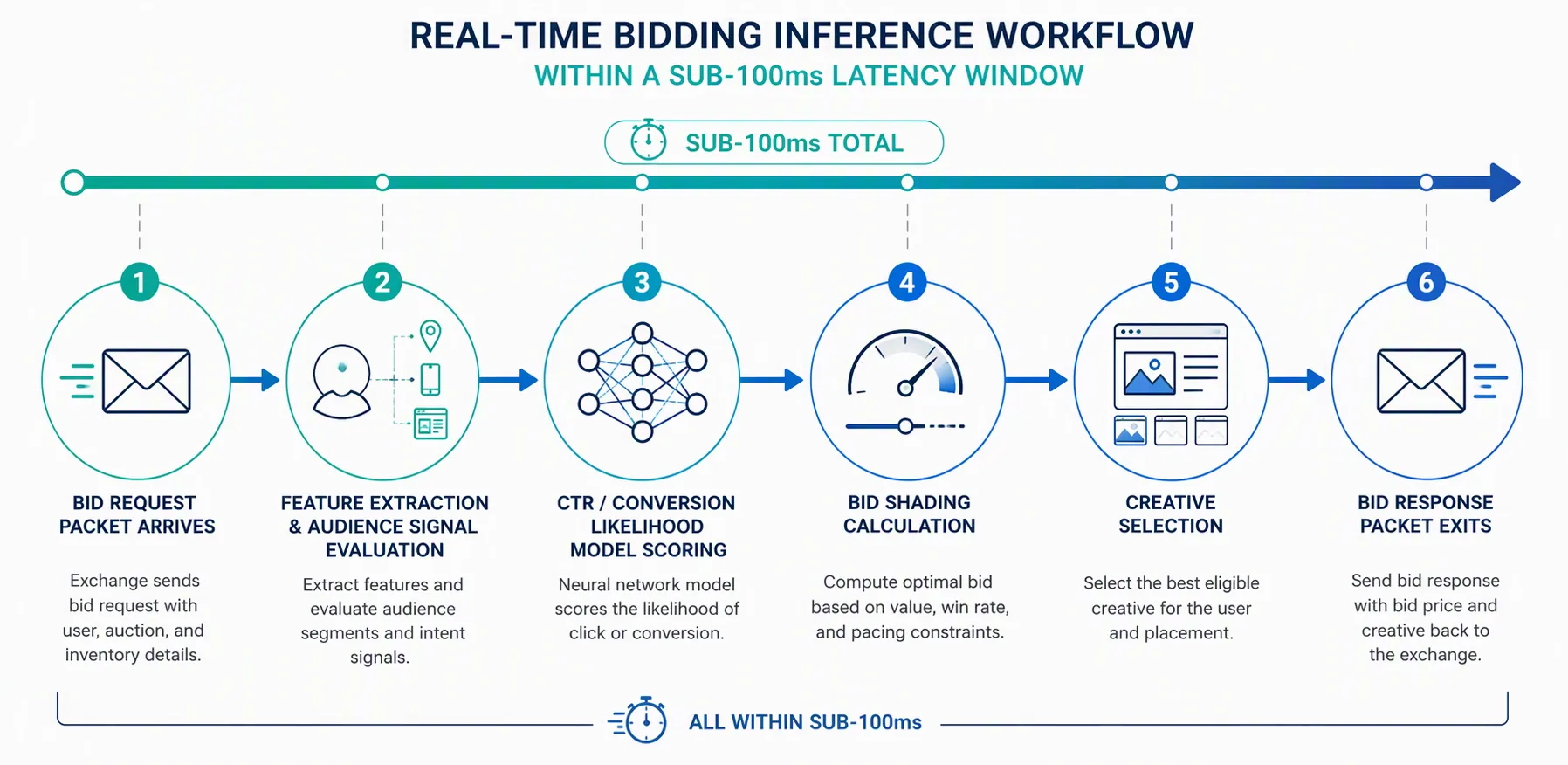
| Bid-path job | What it decides | Why latency matters |
|---|---|---|
| Request intake | Whether the impression is eligible for any campaign | Slow parsing or routing reduces the time left for scoring |
| Feature and audience evaluation | Which user, context, publisher, and campaign signals are available | Missing or late features force simpler decisions |
| CTR or conversion likelihood scoring | How likely the impression is to produce the target action | The model must finish early enough for pricing and response logic |
| Bid shading and price calculation | How much to bid given value, floor, budget, and auction dynamics | A late value estimate can turn into no-bid or a conservative bid |
| Creative selection | Which ad variant is safe, eligible, and expected to perform | Creative checks compete with model scoring for the same deadline |
| Response assembly | Whether the bid returns in the exchange’s required format | A correct bid that arrives late is still economically useless |
The expensive step is not always the largest model in the building. In bid serving, the painful work is often the repeated, tiny, deadline-bound inference job: score this impression now, for this campaign set, under this auction rule, with this much budget left. Recommendation-style models such as DLRM and Wide & Deep architectures are relevant because ad selection often resembles ranking and value prediction more than open-ended generation. AMD’s ZenDNN 5.2 work already calls out DLRM-v2 quantization support for recommender systems on current EPYC CPUs, which matters because quantized recommendation inference is closer to the bid path than a demo chatbot is.[3]
This is where server hardware quietly becomes a bidding issue. A platform can respond to latency pressure by simplifying models, bidding on fewer requests, adding more machines, moving more work to accelerators, or accepting higher timeout risk. Each choice leaks into advertiser-facing behavior. Simpler models can flatten value differences between impressions. Fewer bids can reduce reach. More machines can raise serving cost. More accelerator hops can help throughput while hurting the small-request tail if the handoff overhead is too high.
Why the GPU answer is not automatic
GPUs are excellent when the workload can be batched, kept full, and fed predictably. RTB inference is less cooperative. Requests arrive as a flood of small decisions with hard deadlines. The bidder may not have time to accumulate a beautiful batch if waiting for that batch consumes the auction window. Moving features from CPU memory to a GPU, invoking the model, then moving results back into CPU-side pricing and response logic can be worthwhile for some architectures, but it is not free.
The current agentic bidding reference path from AWS uses ARTF containers with NVIDIA Triton and GPU acceleration, which is useful evidence that the industry is already trying to make richer bidding logic fit inside low-latency ad systems.[4] It is not evidence that every bid-path inference job belongs on a GPU. The more interesting open question is whether CPU-side AI acceleration can handle enough of those small models directly, leaving GPUs for the work that genuinely benefits from them.
For the operator responsible for CPA, the distinction matters. If a platform can score an impression on the same CPU path that already handles request parsing, feature lookup, budget checks, and response generation, it may reduce handoff overhead and simplify scaling. That does not guarantee better CPA. It does create a more plausible route from hardware capability to auction behavior: faster scoring can permit more eligible bid responses, richer value estimates, or lower infrastructure cost per decision.
Where Zen 7 EPYC enters the story
AMD has positioned Zen 7 EPYC as a 2028 server generation split into three families: Florence, Ferrara, and Fidenza.[5][6] The part that matters for ad serving is not the branding. It is the separation of roles. Bid-decision infrastructure, GPU-host infrastructure, and strategy-simulation infrastructure do not have identical needs, even when the vendor dashboard hides all three behind one “AI bidding” label.

Florence is the cleanest fit for the hot bid path: many CPU cores plus ACE matrix acceleration for inference work that has to stay close to request handling. If ACE gives the CPU a faster path for matrix operations used in recommendation and prediction models, a bidder may not need to send every small scoring job to a separate accelerator. That is the most direct ad serving impact to watch.
Ferrara belongs in a different tier. If a platform runs large ranking models, creative generation systems, forecasting models, or heavier agent workloads on GPUs, the host CPU still matters. It has to feed the accelerators, coordinate memory and networking, and keep the rest of the serving system from becoming the bottleneck. For ad tech, that could matter most in environments where training, simulation, and high-throughput inference sit near the bidder but are not necessarily in the millisecond-critical response path.
Fidenza is where the “agentic” language is most tempting and most dangerous. AMD says it is selling certain EPYC configurations “by the agent,” and its AAI 2026 materials claim the EPYC 9006 Venice platform delivers a 174% geomean uplift over Intel Xeon in agentic AI pipeline stages.[5] That is not a campaign benchmark, and it is not Zen 7 silicon proof. It does, however, indicate where AMD thinks CPU value is moving: toward many concurrent planning, reasoning, retrieval, and inference tasks that do not all justify a GPU-first design.
ACE matters only if the software path follows
ACE is described as an x86 matrix-extension effort associated with AMD and Intel, but instruction-level compatibility with Intel AMX should not be assumed.[7] That is a practical caveat, not a footnote. A DSP does not get faster bid decisions merely because the chip exposes new instructions. Its inference stack, compiler paths, model runtimes, quantization strategy, and deployment tooling have to use them.
This is why ZenDNN, vLLM, Triton integration, and container deployment details matter more than a media buyer should reasonably have to know. Signal65 has reported up to 46.54% faster time-to-first-token for EPYC host CPUs versus Intel Xeon in an inference context, and AMD has published ZenDNN 5.2 performance work including a claimed 200% vLLM uplift and DLRM-v2 quantization support on EPYC CPUs.[8][3] Those results are adjacent evidence. They support the plausibility of CPU-side inference gains, but they are not RTB latency benchmarks and should not be read as promised auction lift.
The Criteo precedent is real, but it is not a Zen 7 proof point
Criteo is the case that keeps this from being a purely theoretical chip story. AMD says Criteo runs 80% of its online workloads on AMD EPYC and achieved 16 times more bids with half the servers after moving from 2nd Gen to 4th Gen EPYC.[9] That is a concrete example of CPU generation changes affecting ad-serving economics: more bid capacity, fewer machines, and a different cost curve for the same core business.
It would be sloppy to turn that into “Zen 7 will improve your campaign.” Criteo’s result came from earlier EPYC generations, in Criteo’s own environment, with its own software and serving architecture. The useful lesson is narrower and stronger: ad-serving platforms can materially change their bid capacity and infrastructure footprint when CPU performance, software tuning, and serving architecture move together.
That is also where owned or tightly controlled infrastructure gets an advantage. A platform that controls its serving stack can decide when to rewrite hot paths, pin inference workloads differently, tune model runtimes, or consolidate machines after a generation jump. A buyer using that platform cannot order those changes, but can ask whether they happened and whether the platform can show the auction-level effect.
What richer CPU-side bidding could change
The best-case Zen 7 ad-serving story is not a magic uplift. It is a set of smaller changes that compound inside the auction.
- More bid responses can be returned before deadline if scoring, shading, and response assembly consume fewer milliseconds.
- More features can be evaluated per impression if the CPU path can handle richer recommendation-style inference without violating latency budgets.
- More campaigns can be considered per request if the bidder can run eligibility and value checks at lower per-decision cost.
- More experiments can run if agentic strategy simulations, budget allocation tests, or bid policy evaluations become cheaper outside the live auction path.
- Less infrastructure drag can show up as better margins for the platform, lower fees, or simply more room to maintain performance under traffic spikes.
Only some of those changes would be visible to advertisers, and not all would be passed through. A platform might use lower serving cost to protect its own margin. It might use faster inference to increase bid selectivity rather than bid volume. It might keep the same models and reduce server count. The hardware change creates options; the product and business model decide which options the buyer actually feels.
The better advertiser-side questions are therefore operational, not procurement questions. Ask whether your DSP measures bid timeout rate by exchange and geography. Ask whether model latency is part of auction diagnostics. Ask whether richer prediction models are being constrained by response deadlines. Ask whether infrastructure improvements show up in win rate, eligible reach, experiment velocity, or CPA stability during peak traffic.
Cloud, owned hardware, and who gets the advantage first
The ad-tech infrastructure debate is already visible. AdExchanger reported in June 2026 that PubMatic frames owned infrastructure as a “compounding advantage,” Magnite uses a hybrid cloud approach for live-event bursts, and Index Exchange has launched cloud containers.[10] That split matters because the first platforms to benefit from CPU-side inference acceleration may be the ones that can adapt their serving stack quickly, not simply the ones whose cloud provider eventually offers a new instance type.
There is no clean cloud-versus-on-prem rule for advertisers to apply. Owned infrastructure may offer tighter tuning and better cost control at scale. Cloud deployment may offer faster regional expansion, elastic capacity, and access to specialized accelerators without owning the hardware. Hybrid systems may win during bursty events and still carry complexity in normal traffic. The relevant question is whether the partner can prove that its infrastructure choices improve live auction behavior under the actual deadlines imposed by exchanges.
Where the speculation starts
Zen 7 EPYC is a 2028 roadmap product. Public claims about Florence, Ferrara, Fidenza, ACE, and agent-oriented SKUs describe a direction, not deployed ad-tech infrastructure.[5][6] No cited DSP, SSP, exchange, or retail media platform has publicly committed to Zen 7 for bid serving. No public benchmark yet shows ACE-accelerated Zen 7 running real RTB inference workloads inside Google or Xandr-style latency constraints.
The CPU-only ARTF possibility is also speculative. AWS’s published ARTF implementation uses NVIDIA GPU acceleration.[4] A future ACE-accelerated CPU container could be attractive for smaller sub-100 millisecond bid decisions, but that depends on silicon performance, runtime support, model architecture, batching strategy, and the cost of keeping enough machines close to the exchange path.
Still, Zen 7 EPYC is worth watching because it addresses a real constraint rather than inventing a new category label. Programmatic buying already lives inside an 80–150 millisecond discipline. The most valuable bid models are the ones that finish in time. If ACE lets more of that inference stay on the CPU path, platforms may be able to make richer decisions at lower latency and lower per-bid cost.
Until silicon benchmarks and ad-tech deployments exist, the advertiser’s job is not to switch platforms because of Zen 7. It is to track whether buying partners can prove faster decisions, lower infrastructure drag, and better auction outcomes under real RTB deadlines.
References
- Peer guide, Google Authorized Buyers
- Building Low Latency ML Systems for Real-Time Model Predictions at Xandr, P99 CONF
- ZenDNN 5.2: Accelerating vLLM Inference on AMD EPYC CPUs, AMD, 2026
- Deploy agentic bidding without sacrificing speed: ARTF containers with NVIDIA GPU acceleration on AWS, AWS
- AAI 2026: AMD Delivers Full-Stack Compute for the Agentic AI Era, AMD
- AMD splits Zen 7 into three EPYC families for 2028 and starts selling server CPUs by the agent, Tom's Hardware
- x86 ACE instructions: AMD Zen 7 cores AI acceleration detailed, HWCooling
- Improving AI Inference with AMD EPYC Host CPUs, Signal65
- Criteo, AMD
- Independent Ad Tech Is Reframing Itself Around Cloud Hardware, AdExchanger, June 2026
Built on this evidence
No Bidding tactic or Creative record currently cites this case file. Compare it against other results in Benchmarks.
Related benchmark reading
Report a corroborating or contradicting result
Seeing something different in your own account? Feed the data-integrity loop instead of leaving an open comment.