
What counts as '1 million views' on YouTube and TikTok
A trailer reports 1,000,000 views across YouTube and TikTok, but the two platforms count several different view events, from TrueView views to focused views. This dated benchmark case file pins each figure in the 'You Maniac' record to its exact metric definition and date so you can tell which platform event produced the number — and whether the milestone is a real paid-ad benchmark.
- Platform
- YouTube0 TikTok
- Campaign type
- Video
- Spend range
- Not disclosed
- Timeframe
- Not disclosed
- Views
- 0 views
- Verdict
- mixed
- Last reviewed
- 0-08-27

The “You Maniac” trailer is reported to have reached 1,000,000 views across YouTube and TikTok. Last reviewed: August 27, 2026. That is a usable milestone only after the record identifies what each platform counted. YouTube and TikTok both use the word “view” for multiple events, and those events do not automatically add up to a comparable audience.
Case file: You Maniac trailer
| Record field | Status |
|---|---|
| Creative | “You Maniac” trailer; specific published trailer identity not independently confirmed |
| Platform | YouTube and TikTok |
| Spend range | Not disclosed |
| Campaign timeframe | Not disclosed |
| Reported milestone | 1,000,000 views across the two platforms |
| YouTube metric and count | Not disclosed |
| TikTok metric and count | Not disclosed |
| Reporting dates | Not disclosed |
| Verdict | A reported cross-platform total, not yet a reproducible benchmark |
| Failure cause | The platform split, event definitions, dates, spend, and reconciliation basis are missing |
The title likely refers to the “You maniacs! You blew it up!” line from Planet of the Apes (1968), but the available material does not positively identify a specific public trailer. That uncertainty matters less than the missing measurement fields: no creative identification can substitute for a platform split and dated metric record. The fields are therefore left blank rather than inferred. The 1,000,000 total may be accurate as an operator-reported result, but its benchmark meaning cannot be reconstructed from the total alone.
The comparison ledger
A clean benchmark record gives every number its own row. The reviewer needs the platform, reporting surface, metric label, counted event, threshold, and observation date.
| Platform | Reporting surface | Metric label | Counted event | Applicable threshold | Observation date |
|---|---|---|---|---|---|
| YouTube | Undisclosed | Undisclosed | Could be TrueView views, a public watch-page view, or an Analytics engaged view | Depends on placement; not supplied | Not disclosed |
| TikTok | Undisclosed | Undisclosed | Could be a playback-start video view, a 2-second or 6-second view, or a focused view | Depends on the selected metric or objective; not supplied | Not disclosed |
| YouTube + TikTok | Operator-supplied aggregate | “Views” | 1,000,000 combined platform events, with the event split undisclosed | Not applicable until each component is identified | Not disclosed |
The platform split is the load-bearing part of the case. A million TrueView views cannot be interpreted in the same way as a million playback starts, and a public counter cannot be treated as a paid-delivery field without checking the reporting surface.
What YouTube may mean by a view
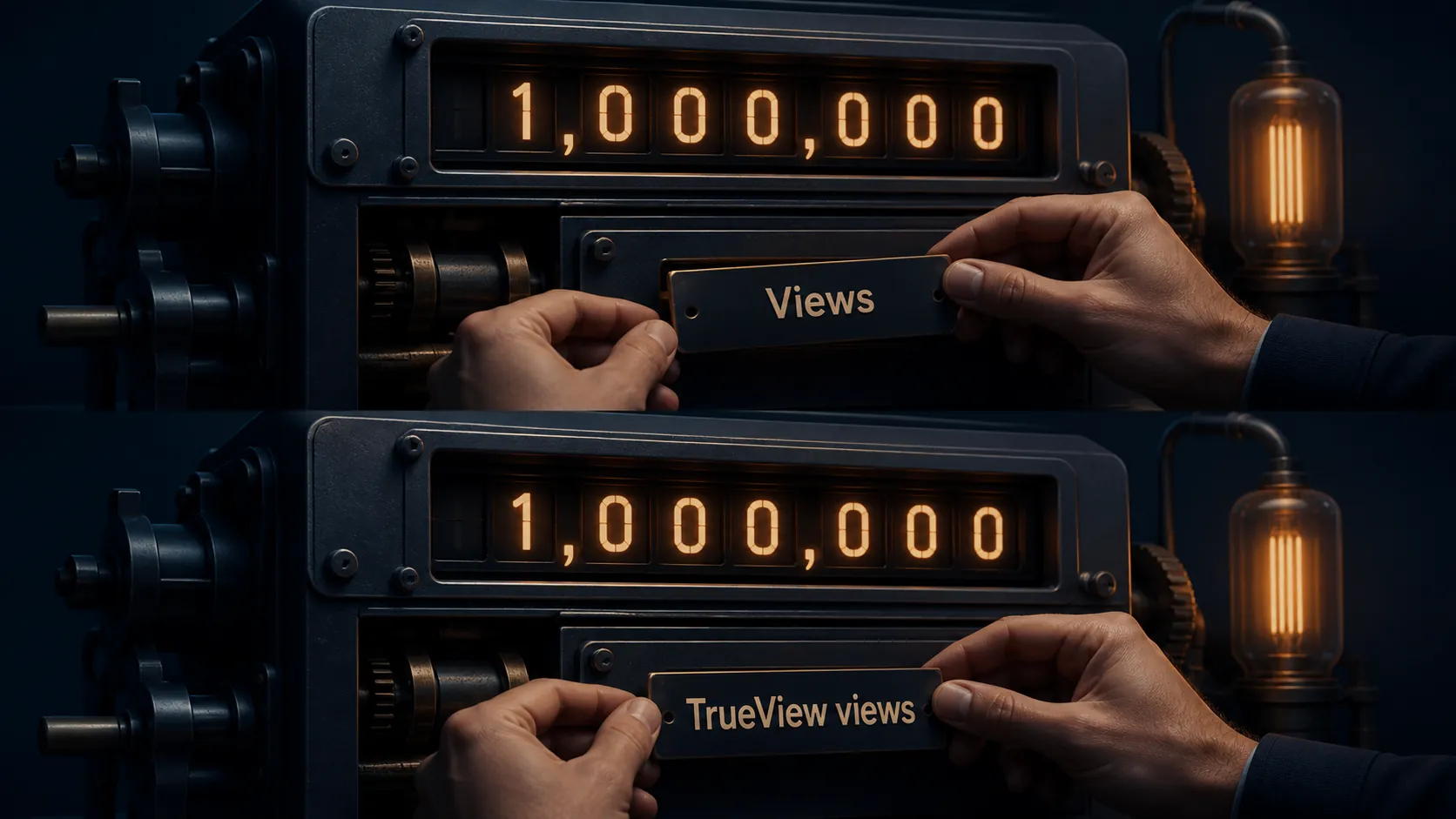
Google Ads renamed “Views” to “TrueView views” in October 2025. The rename did not change the counting or billing, but it did change the label displayed to users.[1] That is a useful warning for a record reviewed in 2026: an undated screenshot or exported column called “Views” is not a stable definition.
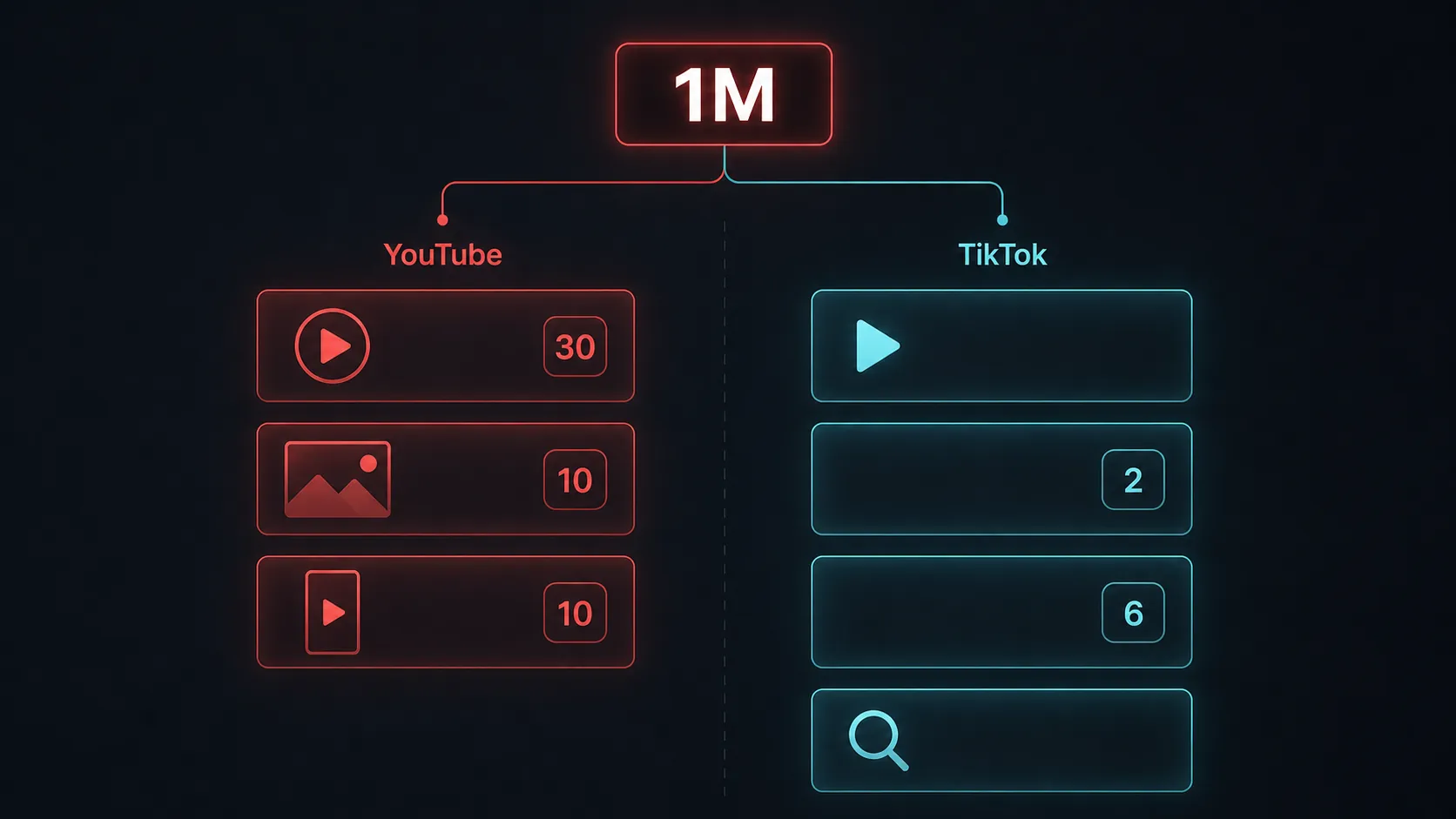
For eligible in-stream placements, a TrueView view is counted when someone watches 30 seconds or reaches the end of the video, whichever comes first, or interacts with the ad. In-feed views use a different rule: a thumbnail interaction or 10 seconds of inline autoplay. Shorts uses 10 seconds or an interaction such as a call-to-action click, Like, Comment, or Share.[2]
Placement is not a footnote here. Bumper ads and non-skippable in-stream ads are not eligible for TrueView views at all.[2] If the You Maniac record used those formats, its million cannot be described as a million TrueView views unless another eligible placement supplied the count.
The public watch-page counter is another field, and YouTube Analytics has its own “Engaged views” reporting. Google specifically directs advertisers to compare Google Ads TrueView views with the “YouTube advertising” row’s engaged views in YouTube Analytics—not with the public counter.[1] The public number can be useful as a visible audience signal, but it is not interchangeable with the paid reporting field.
The reconciliation window also belongs in the case file. YouTube Analytics data can take 48–72 hours to settle. Invalid-traffic corrections can be applied for up to 30 days, and those invalid views are removed without charge. Google says discrepancies above roughly 15–20% between reporting sources are a reason to contact support.[3]
For the YouTube row to be reusable, the operator should record whether the figure came from Google Ads TrueView views, YouTube Analytics engaged views, or the public watch-page counter; identify the placement; attach the reporting date; and note whether the data was allowed to settle.
How TikTok counts views
TikTok’s standard “Video views” metric counts each time a video starts to play, with replays excluded. Two-second and six-second video views are separate ad-event metrics.[4] A playback start can therefore be recorded before the viewer reaches either the two-second or six-second checkpoint.
If the TikTok part of the You Maniac total is playback starts while the YouTube part is TrueView views, the two rows represent different levels of exposure. The arithmetic may be correct; the audience interpretation is not established.
TikTok’s video views objective adds another layer. It optimizes for a “focused view”: watching for six seconds, watching for 15 seconds, reaching completion, or generating a positive interaction within the first six or 15 seconds, depending on the applicable condition. The objective is billed on a cost-per-focused-view basis; interactions within the first second are excluded from billing, and the documented frequency cap is seven times per seven days.[5][6]
A focused view is not just a relabeled playback start. It is a more qualified ad event selected by the objective and its conditions. A TikTok report that says “video views” without stating whether it means starts, two-second views, six-second views, or focused views leaves the most important part of the result unstated.
Organic reporting adds more opportunities for confusion. TikTok can count an organic view when a video starts or auto-loops, while analytics exclude the account’s own views. In the separate Creator Rewards context, “Qualified Views” is stricter: it refers to unique For You feed views watched for at least five seconds.[7] None of these labels should be substituted for the paid metric in the case file.
The TikTok row needs the reporting surface, metric label, campaign objective, event threshold, and date. It should also say whether the count is paid, organic, or aggregated.
What the million proves—and what it leaves open
The narrowest defensible verdict for the You Maniac record is that it reports 1,000,000 platform events. If the operator supplies the missing definitions and dates, each row can prove that the selected YouTube or TikTok event occurred under the platform’s applicable rules.
It does not, on the current record, prove comparable reach across YouTube and TikTok. It does not establish awareness quality, completed viewing, unique people, or organic performance. It also does not establish a cost-efficient benchmark because spend and campaign timeframe are undisclosed.
For the record to become reportable, the operator needs to fill the blank fields: the YouTube metric and placement, the TikTok metric and objective, each platform’s count, the observation dates, spend range, and any reconciliation notes. External averages or trailer records cannot repair an undefined primary record.
That is the same disclosure test used in the site's viral-claim audit: a large result becomes reusable only when its inputs, dates, and measurement definitions are visible. The neighboring benchmark records use the same practical discipline.
References
- About YouTube ads and view metrics — YouTube Help
- Cost-per-view (CPV): Definition — Google Ads Help
- About Video campaigns — Google Ads Help
- Video play metrics — TikTok For Business
- About the video views objective and focused view optimization — TikTok For Business
- Introducing Focused View — TikTok For Business Blog
- TikTok Metrics: What to Track for TikTok Marketing — Sprout Social
Built on this evidence
No Bidding tactic or Creative record currently cites this case file. Compare it against other results in Benchmarks.
Related benchmark reading
Report a corroborating or contradicting result
Seeing something different in your own account? Feed the data-integrity loop instead of leaving an open comment.