
What SoftBank's $64.6B OpenAI Bet Means for ChatGPT Ad Creative
SoftBank's massive OpenAI investment buys compute and infrastructure, not a working ad channel. Early ChatGPT Ads data — 0.91% CTR, falling CPMs, creative tools still not live — shows a platform being funded ahead of its metrics, so media buyers should treat it as a testing ground, not a mature channel.
- Platform
- ChatGPT Ads
- Campaign type
- ChatGPT Ads
- Spend range
- Pilot
- Timeframe
- February 0 – June 2026
- CTR
- 0%
- Verdict
- mixed result
- Last reviewed
- 0-07-29
Two numbers make the ChatGPT Ads story hard to buy cleanly: SoftBank’s OpenAI commitment has been reported at roughly $64.6 billion, while early advertiser-reported ChatGPT Ads click-through rate sits at 0.91%.[1][2] Those numbers can both be true. They just do not answer the same question.
SoftBank can help OpenAI buy compute, hire talent, subsidize infrastructure, and keep product velocity high while the ad business learns in public. That is a meaningful advantage. It is not the same as proving that a media buyer can target reliably, control AI-generated creative, measure outcomes, and explain the test to a client after the first post-click report looks thin.

That distinction matters because SoftBank’s funding can point the ad creative conversation in two very different directions. One is a capital-markets story: OpenAI has enough strategic backing to keep building. The other is a buying decision: ChatGPT Ads deserves budget now. The first claim is well supported. The second still needs more evidence.
Funding Buys Runway, Not Buyer Controls
SoftBank’s exposure to OpenAI is unusually large even by AI-infrastructure standards. Forbes described SoftBank’s multibillion-dollar OpenAI bet in June 2026, and CNBC reported in May 2026 that SoftBank’s Vision Fund had booked a $45 billion to $46 billion paper gain tied to its OpenAI stake.[1][3] Separately, SoftBank announced an April 1, 2026 transaction connected to its OpenAI investment program.[4]
Those facts create pressure around the ad product, not proof of it. Investors may underwrite a future in which ChatGPT becomes a massive commercial surface. A media buyer has a narrower job: decide whether today’s inventory can produce useful learning without hiding basic uncertainty behind the OpenAI brand.
The ad-business timeline is fast enough to deserve attention. OpenAI introduced its advertising approach in February 2026, and third-party coverage described a pilot beginning February 9, 2026, followed by a self-serve launch on May 5, 2026 and Ad Tools Terms published June 17, 2026.[5][6][7] Fast launch sequences can become real channels. They can also produce dashboards before they produce dependable controls.
The Early Performance Data Looks Like a Test Market
The 0.91% CTR figure deserves careful handling. It is advertiser-reported through Adweek, not an OpenAI-published cross-advertiser benchmark, and OpenAI has said it has no published cross-advertiser performance figures.[2] That makes the number useful as a market signal, not as a final verdict.
Still, the contrast is hard to ignore. The same reporting uses a 6.4% Google Search benchmark as a comparison point, which makes ChatGPT Ads look less like a proven intent channel and more like a new surface still looking for its performance model.[2] A lower CTR does not automatically kill a channel; display, video, retail media, and discovery surfaces all have different click behavior. But if the sales story leans on conversational intent, buyers will expect better evidence than a sub-1% reported CTR.
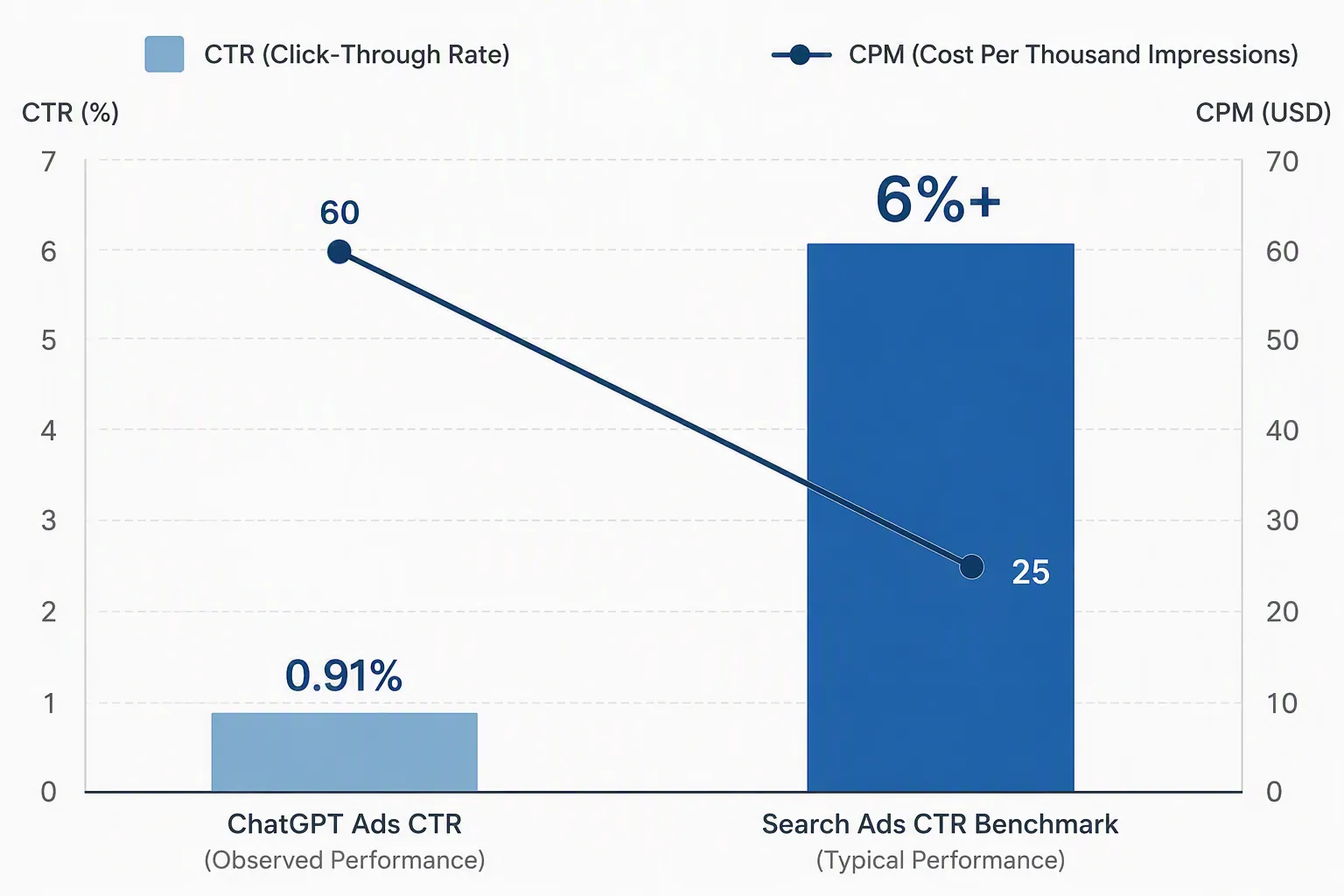
Pricing is sending the same signal. MediaPost reported that CPMs moved from a $60 flat-rate pilot to a $25 to $60 range after self-serve opened.[8] Optimum7 reported recommended CPC starting bids of $3 to $5 and a $3 floor below which delivery fails.[7] Falling CPMs and floor-sensitive delivery do not necessarily mean weak inventory. They often mean the marketplace is still finding clearing prices, buyer demand, and delivery mechanics at the same time.
| Signal | What It Supports | What It Does Not Prove |
|---|---|---|
| 0.91% advertiser-reported CTR | Early campaigns are not yet showing search-like click behavior | That all future ChatGPT Ads formats will underperform |
| $60 pilot CPM moving to $25-$60 after self-serve | Pricing is still being discovered | That lower CPMs alone create efficient acquisition |
| $3-$5 recommended CPC bids with a $3 delivery floor | Buyers may need to bid into a still-fragile auction | That the auction has mature depth across categories |
| Limited attribution and no prompt-level targeting | Performance readouts are constrained | That the platform cannot improve quickly |
The more practical problem is not that the first numbers are imperfect. Every new channel starts with awkward reporting. The problem is that the current combination—low advertiser-reported CTR, moving CPMs, CPC floors, limited attribution, and no prompt-level targeting—makes it difficult to separate bad creative, weak intent matching, auction immaturity, and measurement loss.[2][7][8]
That is why ChatGPT Ads is hard to treat like a mature acquisition channel today. A buyer can test it, but the learning agenda has to be honest. The first test may answer whether the audience responds to the placement at all. It may not answer whether the channel can scale to CPA targets, whether creative fatigue behaves normally, or whether the platform can identify high-intent moments with enough precision.
Creative Tools Are the Most Interesting Gap
The ad creative opportunity is the part worth watching most closely. Search ads inherited keywords. Social ads inherited feeds, profiles, and creator behavior. ChatGPT Ads could eventually inherit context from a live assistant session, then use generative tools to adapt copy, format, language, and landing-path suggestions around what the user is trying to accomplish.
That is the exciting version. The shipped-product version appears less complete. Digital Applied’s June 2026 reading of OpenAI’s Ad Tools Terms says the terms define Creative Tools that can generate, modify, transform, optimize, localize, and translate ad content, and Audience Tools that allow first-party data uploads for targeting.[9] Storyboard18 also reported that OpenAI unveiled ad targeting and AI creative tools allowing advertisers to upload first-party audience data.[10]
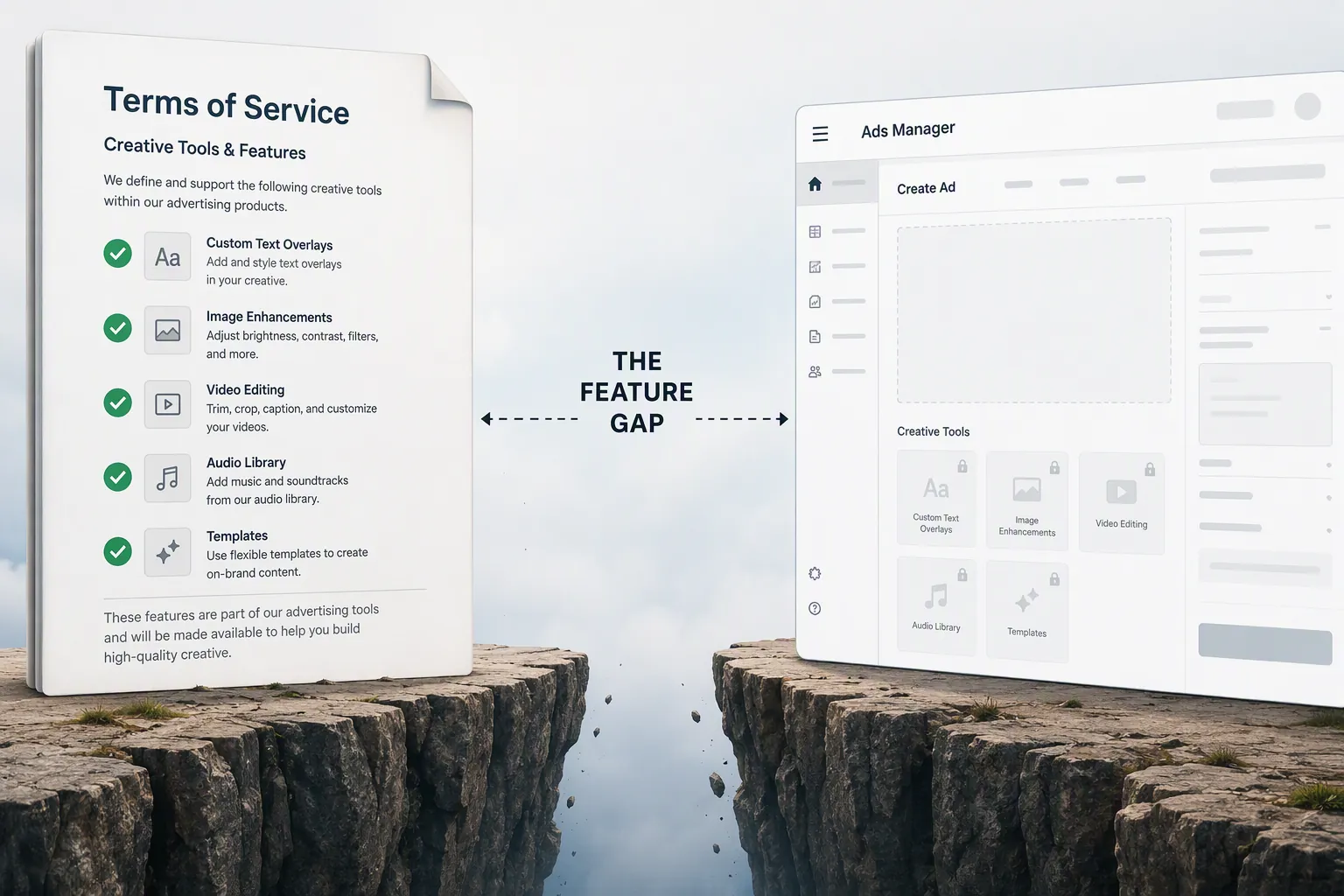
But policy language is not the same as a live buying interface. Digital Applied reported that, as of June 20, 2026, neither Audience Tools nor Creative Tools were confirmed live in Ads Manager, and Digiday’s coverage framed OpenAI’s move toward automated ad creative as emerging rather than fully operational.[9][11] For a buyer, that difference changes the test plan. A tool defined in terms cannot yet be relied on for localization workflow, approval routing, variant management, creative QA, or brand-safety review.
The liability question is not a footnote. Digital Applied’s analysis says Section 2.2 includes an Access Purpose clause allowing OpenAI to use uploaded audience data for product improvement, and describes the scoping as broader than standard Meta or Google-style data-use boundaries.[9] That interpretation should be checked against the binding legal text before any upload. Even at the planning stage, it changes who needs to be in the room: media, legal, privacy, analytics, and whoever owns customer-data permissions.
AI-generated creative also shifts responsibility back to the advertiser. Storyboard18 reported that the tools place full liability on advertisers for AI-generated creative errors.[10] That means a generated claim, mistranslation, noncompliant price reference, or off-brand asset is not just an annoying review issue. It becomes the advertiser’s problem after the platform helped produce it.
This is where SoftBank’s funding could matter later. If OpenAI can spend through the infrastructure and model work required to make creative generation, audience matching, and review workflows dependable, the ad product could improve quickly. The mistake is treating that possibility as if it already appears in Ads Manager.
Investor Forecasts Are Not a Media Plan
OpenAI’s investor story is far more aggressive than the buyer evidence currently supports. Reuters reported in April 2026, citing Axios, that OpenAI projected $2.5 billion in ad revenue in 2026 and $100 billion by 2030.[12] Adweek reported that eMarketer projected the total U.S. chatbot ad market at $5.41 billion by 2030, while also noting that OpenAI’s assumptions include 2.75 billion weekly users by 2030 versus about 900 million as of mid-2026.[2]
The scope mismatch matters. OpenAI’s target is global, while the eMarketer figure cited by Adweek is U.S.-only, so the comparison is not a clean like-for-like forecast.[2] Even with that caveat, the distance between the two numbers is useful. It shows how much of the ad story depends on future user scale, future formats, future buyer tools, and future advertiser confidence.
ARR momentum can be real without making performance buying straightforward. Third-party coverage reported ChatGPT Ads reaching $100 million in ARR within six weeks and more than 600 advertisers during the early period.[6] Adoption says marketers are curious and willing to test. It does not say those tests are efficient, measurable, scalable, or ready to absorb serious budget.
What a Buyer Can Safely Infer Today
The safe inference is narrow: OpenAI has unusual financial runway, and ChatGPT Ads is likely to keep receiving product attention. That makes the channel worth monitoring and, for some advertisers, worth controlled learning spend. It does not make the channel mature.
- Treat SoftBank funding as evidence that OpenAI can keep building, not as evidence that current campaigns will perform.
- Treat the 0.91% CTR as an early market signal, not a universal benchmark, because it is advertiser-reported rather than OpenAI-published.
- Treat CPM compression and CPC floors as signs of marketplace formation, not automatic buying efficiency.
- Treat Creative Tools and Audience Tools as strategically important, but do not build workflow assumptions around them until they are confirmed live and usable.
- Treat first-party data upload and AI-generated creative as legal and operational decisions, not just media optimizations.
A reasonable ChatGPT Ads test in Q3 2026 is a learning allocation with explicit tolerance for measurement gaps, creative review friction, and limited targeting controls. It is not a budget migration argument. If the internal conversation requires CPA certainty, standard attribution, prompt-level control, and clean creative liability before launch, the platform is not there yet.
SoftBank’s money increases the chance that OpenAI gets time to solve those problems. It does not solve them on behalf of the buyer. The opportunity is real enough to test before the playbook becomes obvious, but the test should be priced like an immature channel, measured with caveats, and separated from the financing story that made the channel impossible to ignore.
References
- Behind SoftBank’s Multi-Billion-Dollar Bet On OpenAI, Forbes, June 8, 2026
- OpenAI’s ad business is on pace to miss its own forecast by 90%, analyst says, Adweek, July 2026
- SoftBank earnings FY 2025 Vision Fund OpenAI stake, CNBC, May 13, 2026
- SoftBank Group Corp. press release, SoftBank Group, April 1, 2026
- Our approach to advertising and expanding access, OpenAI
- OpenAI launches ChatGPT Ads, Flyweel
- ChatGPT Ads in 2026: How They Work, Pricing, and the Measurement Problem, Optimum7
- MediaPost article 414390, MediaPost
- OpenAI ChatGPT Ads Audience & Creative Tools 2026 Guide, Digital Applied
- OpenAI unveils ad targeting and AI creative tools, allows advertisers to upload first-party audience data, Storyboard18
- OpenAI moves to automate ad creative, Digiday
- OpenAI projects $2.5 billion ad revenue this year, $100 billion by 2030, Axios reports, Reuters, April 9, 2026
Built on this evidence
No Bidding tactic or Creative record currently cites this case file. Compare it against other results in Benchmarks.
Related benchmark reading
Report a corroborating or contradicting result
Seeing something different in your own account? Feed the data-integrity loop instead of leaving an open comment.