
What the AI boom means for skilled-trade construction jobs
A dated, cited benchmark record of what the AI boom is actually doing to skilled-trade construction jobs. Demand, wage, and shortage figures each carry their source, window, and methodology, so media buyers can tell which claims are citable — and where the boom is not actually happening.
- Platform
- Multiple sources
- Campaign type
- Benchmark review
- Spend range
- No ad spend
- Timeframe
- Q0 2026
- Worker shortage
- 0
- Verdict
- mixed
- Industry vertical
- Construction
- Last reviewed
- 0-08-03
The clean answer is that the AI boom is creating measurable demand for skilled-trade construction jobs, especially around data centers. The less clean answer is that almost every widely shared number measures a different thing: job postings, annual labor gaps, long-range occupational openings, data-center-specific shortages, broad skilled-trade vacancies, or wages in a narrow construction segment.
That distinction matters. A data center may be sold as a cloud or AI asset, but it still has to be poured, wired, cooled, inspected, and maintained. Electricians, HVAC workers, construction crews, and related technical trades are not a footnote to the AI buildout. They are one of the places where the boom shows up in the labor market with the least abstraction.
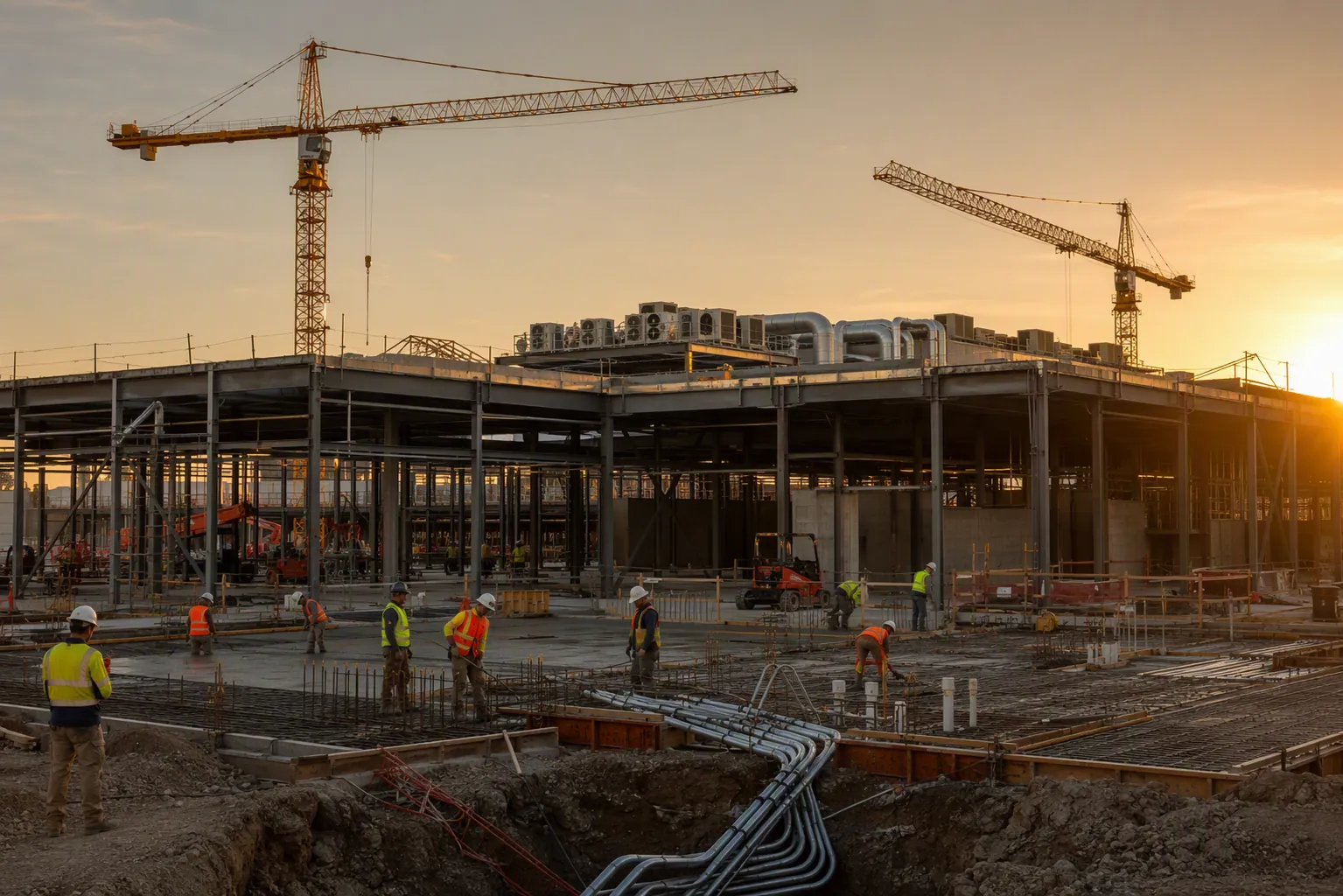
Benchmark record as of Q3 2026
The safest way to use the numbers is to keep the source, window, geography, and method attached. The table below is deliberately fussy, because this is where vague “half-million workers needed” claims usually start to blur.
| Claim | Source and window | Scope | Method note | How citable is this? |
|---|---|---|---|---|
| Robotics technician demand rose 107%, HVAC engineer demand rose 67%, and construction roles rose 30% since late 2022. | Randstad global analysis, 2022-2026. | Global; 50M+ job postings. | Job-posting growth, not filled jobs and not an audited shortage count. [1] | Useful for global demand direction. Do not call it a worker-shortage total. |
| U.S. robotics technician vacancies rose 113.19%, and U.S. HVAC engineer vacancies rose 77.89% over 2022-2026. | Randstad USA analysis, 2022-2026. | United States; 150M postings. | Separate U.S.-only release with different figures from Randstad’s global release. [2] | Citable for U.S. posting growth if kept separate from the global numbers. |
| Time-to-hire for skilled trades reached 56 days, slightly longer than 54 days for desk-based professionals. | Randstad data reported by CNBC, March 2026. | Skilled trades versus desk-based professional roles. | Hiring-window comparison, not a count of missing workers. [3] | Good evidence that skilled trades are not easy-to-fill roles in this cycle. |
| Manufacturing is a net exporter of young workers, with 102 leaving for every 100 entering. | Randstad data reported by Fortune, March 2026. | Manufacturing workforce pipeline. | Flow measure for younger workers; related to trade supply but not limited to data-center construction. [4] | Useful as pipeline context, not as a construction-only statistic. |
| The construction industry needs 349,000 net new workers in 2026 and 456,000 in 2027, a 30.7% increase. | ABC Carolinas methodology summary, corroborated in Fortune coverage, 2026-2027. | U.S. construction industry. | Annual construction labor-gap estimate; the primary ABC release was not available in the crawled materials. [5][6] | Citable if attributed to ABC and described as an annual construction labor-gap estimate. |
| The construction industry faces an approximately 439,000-worker shortage driven by data-center growth. | ITIF, January 2026. | Data-center-driven construction demand. | Data-center-specific shortage framing, not the same methodology as ABC or BLS. [7] | Strongest fit for the AI/data-center claim, but should stay attributed to ITIF. |
| Construction and extraction occupations are projected to have about 649,300 openings per year from 2024 to 2034; electricians are projected to grow more than 9%, much faster than average. | BLS Occupational Outlook Handbook, 2024-2034 projections. | U.S. construction and extraction occupations; electricians separately. | Long-range federal occupational projection including growth and replacement openings; not an AI-specific estimate. [8] | Conservative benchmark. Best used as a baseline, not as proof of AI causality. |
| The U.S. faces 2.1M unfilled skilled-trade jobs by 2030. | U.S. Department of Education, 2030 estimate. | Broad skilled trades, beyond construction. | National skilled-trades estimate; not limited to data centers or construction. [9] | Citable only as a broad skilled-trades pipeline figure. |
| Roughly 600,000 skilled-trade positions were posted in the U.S. last year versus about 150,000 apprenticeship entrants; the labor market has about five retirees for every two replacements. | JLL and U.S. Department of Education, April 2026 context. | U.S. skilled trades. | Pipeline comparison of posted positions, apprenticeship entrants, retirements, and replacements. [9][10] | Useful for explaining why demand does not instantly create supply. |
| Residential construction employment contracted by 33,300 jobs year over year while nonresidential construction added 101,500 jobs. | AGC analysis of federal data reported by Trade Hounds, 2026. | U.S. construction employment split. | Segment-level employment movement; it does not say every construction market is booming. [11] | Essential caveat. Use before making any broad construction-sector claim. |
| Data-center construction workers averaged about $81,800 per year, or $39.33 per hour, about 32% above non-data-center builds. | Skillit data reported by Fortune, March 2026. | Data-center construction workers. | Private labor-market/pay data, not a government wage survey. [4] | Good market-signal wage figure if paired with a conservative wage anchor. |
| Construction craft-worker average hourly earnings reached $38.97 in May 2026, up 5.0% year over year versus 3.6% for the broader private sector. | AGC analysis of federal data reported by Trade Hounds, May 2026. | U.S. construction craft workers. | Broad construction wage trend, not data-center-specific. [11] | Useful for showing wage pressure beyond one niche. |
| Electricians had median pay of $62,350. | BLS Occupational Outlook Handbook. | U.S. electricians. | Federal occupational wage anchor. [8] | Safest salary benchmark. Use it beside higher recruiter or interview-based claims. |
Why the shortage number changes so much
There is no single “AI construction worker shortage” number in the materials. There are several defensible numbers, and they answer different questions.
Randstad’s figures are demand-growth signals. They tell us that postings for certain trades and technical roles rose sharply from 2022 to 2026, with especially large increases for robotics technicians and HVAC engineers. That is valuable, but a posting is not the same thing as a unique worker shortage, a filled job, or a permanent headcount increase. It is a measure of how aggressively employers are trying to hire through posted vacancies.
The two Randstad releases also should not be merged. The global release analyzes more than 50M postings and reports robotics technician demand up 107% and HVAC engineer demand up 67%; the U.S. release analyzes 150M postings and reports robotics technician vacancies up 113.19% and HVAC engineer vacancies up 77.89% over the same broad 2022-2026 period. Those are compatible as direction-of-travel signals, but they are not interchangeable benchmarks. [1][2]
ABC’s annual labor-gap estimate is a different animal. Its 349,000 figure for 2026 and 456,000 figure for 2027 describe net new construction workers needed by the U.S. industry, not just data centers and not just AI-adjacent work. It is a construction labor-gap estimate for a calendar-year hiring need. It should not be rewritten as “AI needs 456,000 workers” unless the attribution and broader construction scope remain visible. [5][6]
ITIF’s roughly 439,000-worker shortage is closer to the data-center question because it explicitly frames the shortage as driven by the growth of data centers. That makes it highly relevant to AI infrastructure, but it still carries its own method and source. It should not be casually averaged with ABC’s annual construction gap or BLS’s decade-long occupational openings. [7]
BLS is the conservative baseline, and also the easiest one to misuse. Its projection of about 649,300 annual openings in construction and extraction occupations from 2024 to 2034 is a long-range occupational outlook, including openings from growth and replacement needs. Its electrician growth projection is useful because electricians are central to data-center work, but BLS is not saying that AI alone caused those openings. [8]
The Department of Education’s 2.1M unfilled skilled-trade jobs by 2030 belongs in the article, but it belongs in the broadest row. It spans skilled trades beyond construction. Paired with JLL’s apprenticeship and retirement pipeline figures, it helps explain why new demand runs into a slow supply system: posted positions can rise quickly; apprenticeship entrants and experienced journeymen do not materialize at the same speed. [9][10]
Which skilled trades are most visible in the AI buildout
The AI boom’s skilled-trade signal is clearest in the work that turns land, steel, power, cooling, and fiber into operational data-center capacity. The recurring occupations in the cited materials are electricians, HVAC-related roles, robotics technicians, construction workers, and manufacturing-linked technical labor.
Electricians sit near the center of the story because data centers are power-intensive facilities. The BLS electrician outlook gives the conservative long-term anchor: median pay of $62,350 and projected employment growth above 9%, much faster than average. That does not make every electrician an AI worker. It does mean the occupation is already projected to grow strongly before adding the extra pressure of data-center construction schedules. [8]
HVAC-related roles are the other obvious pressure point. Randstad’s global and U.S. job-posting analyses both show large increases for HVAC engineers from 2022 to 2026. In data centers, cooling is not a comfort feature; it is part of keeping high-density compute infrastructure usable. The job-posting growth does not prove how many workers were hired, but it does show employers leaning hard into these roles during the AI infrastructure cycle. [1][2]
Robotics technicians are a slightly different signal. They are not the classic image of a construction jobsite, but they show up strongly in both Randstad releases, with the largest reported posting growth among the named roles. That matters because AI infrastructure is tied not only to server halls but also to automated manufacturing, logistics, and technical maintenance ecosystems that compete for overlapping trade talent. [1][2]
Construction is not booming evenly
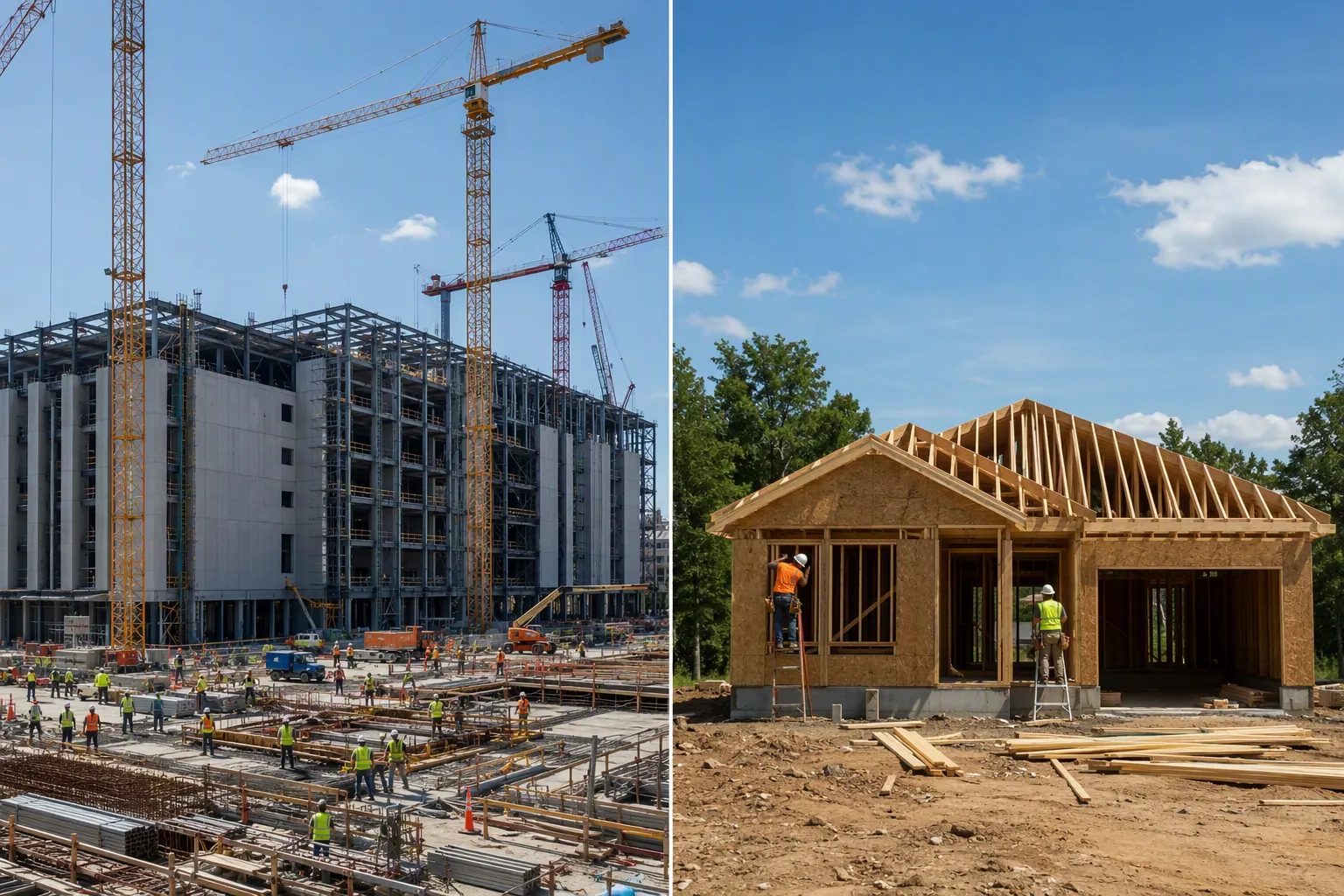
The phrase “construction jobs” is too broad for this cycle. The AI buildout is tied most directly to nonresidential construction and data-center work, while residential construction is moving in the opposite direction in the cited employment split.
AGC’s analysis of federal data, as reported by Trade Hounds, shows the split plainly: residential construction employment fell by 33,300 jobs year over year, while nonresidential construction added 101,500 jobs. That is not a construction boom everywhere. It is a reallocation of pressure toward the parts of the sector building commercial, industrial, infrastructure, and data-center projects. [11]
This matters for staffing. A slowdown in residential work does not automatically solve a data-center labor shortage. Data-center construction demands particular electrical, mechanical, safety, scheduling, and inspection requirements. Some workers and contractors can move across segments; others cannot do so immediately or without retraining, licensing, supervision, or project experience. The labor market can therefore look loose in one construction segment and painfully tight in another.
It also matters for how the story should be described in a deck. “AI is lifting skilled-trade demand in data-center and nonresidential construction” is more defensible than “construction is booming because of AI.” The first statement fits the evidence. The second hides the residential contraction.
Wages: the premium is visible, but the ceiling claims are weaker
The wage evidence supports a narrower claim than the viral version. Data-center construction appears to pay a premium, and broader construction craft wages are rising faster than the private-sector average. That is enough. It does not require turning every high-end interview quote into the market rate.
| Wage figure | What it measures | Best use |
|---|---|---|
| About $81,800 per year, or $39.33 per hour, for data-center construction workers; about 32% above non-data-center builds. [4] | Private data-center construction wage signal reported by Fortune from Skillit data. | Use as evidence of a data-center construction premium. |
| $38.97 average hourly earnings for construction craft workers in May 2026, up 5.0% year over year versus 3.6% for the broader private sector. [11] | Broad construction craft-worker wage trend from AGC analysis of federal data. | Use to show construction wage pressure is not limited to one anecdote. |
| $62,350 median pay for electricians. [8] | Federal occupational wage anchor from BLS. | Use as the conservative baseline beside higher market claims. |
| Reports of young electricians on data-center projects earning up to $260,000, with some claims in the $240,000-$280,000 range. [12] | Interview and recruiter-estimate reporting, not a government wage survey. | Use only as an outlier signal, not as a benchmark salary. |
The data-center premium is the most useful wage point because it connects directly to the AI infrastructure buildout and carries a comparison group: data-center construction versus non-data-center builds. The BLS electrician median is the guardrail. If a salary claim looks spectacular next to $62,350, it may still be real for a specific worker, project, overtime pattern, location, or per diem structure, but it should not be presented as the normal electrician wage without stronger evidence.
What is safe to say about skilled-trade construction jobs and the AI boom
A media buyer, analyst, or agency strategist can safely say that the AI buildout is intensifying demand for skilled-trade construction labor, especially around data centers, electrical work, HVAC-related roles, and nonresidential construction. Randstad’s posting data supports the demand-growth direction; ABC and ITIF support shortage framing, with different scopes; BLS supplies a conservative occupational baseline; JLL and the Department of Education explain the slow supply pipeline.
The citable version should keep the caveats close to the claim:
- Use Randstad for job-posting growth, not for a count of workers hired or missing.
- Use ABC for annual U.S. construction labor-gap estimates, not for a data-center-only shortage.
- Use ITIF for a data-center-driven shortage estimate, with attribution.
- Use BLS for long-range occupational openings and median pay, not for AI-specific causation.
- Use Department of Education and JLL figures for the broader skilled-trade pipeline, not for construction alone.
- Use wage premiums for data-center construction carefully, and keep recruiter anecdotes separate from survey-based benchmarks.
The best one-sentence claim is not that AI is creating a uniform construction boom. It is that the AI buildout is adding pressure to an already constrained skilled-trade labor market, with the clearest effects in data-center and nonresidential construction, and with pay premiums visible where those projects compete hardest for electricians, HVAC talent, and related crews.
References
- AI can't build data centers: global demand for skilled trades soars in the AI era — Randstad — 2026
- U.S. demand for skilled trades grows 3x faster than professional roles — Randstad USA — 2026
- AI data center buildout jobs salary skilled traders worker shortage — CNBC — March 18, 2026
- Skilled trade demand: Randstad report on electricians, technicians, construction workers and data-center boom salaries — Fortune — March 20, 2026
- Construction Industry Labor Shortage: Data, Drivers and Strategic Responses — ABC Carolinas
- U.S. construction industry employment outlook: 500,000 new workers, AI boom, infrastructure and skilled trades — Fortune — February 7, 2026
- Construction Industry Facing Worker Shortage Driven by Growth of Data Centers — Information Technology and Innovation Foundation — January 12, 2026
- Construction and Extraction Occupations — U.S. Bureau of Labor Statistics
- Connecting Talent to Opportunity: A National Challenge to Build Talent Marketplaces — U.S. Department of Education — April 2026
- Critical Skilled Trades Shortage Threatens Economic Losses — JLL
- Construction Pay Rising 2026 — Trade Hounds — 2026
- Data centers pay young electricians up to $260K salaries — New York Post — May 6, 2026
Built on this evidence
No Bidding tactic or Creative record currently cites this case file. Compare it against other results in Benchmarks.
Related benchmark reading
Report a corroborating or contradicting result
Seeing something different in your own account? Feed the data-integrity loop instead of leaving an open comment.