
Qualcomm's Chip Price Hike and Memory Shortage Are Driving Ad Costs
Qualcomm's across-the-board price hike effective September 1, 2026, combined with a historic DRAM shortage that pushed spot prices up more than 10x since January 2025, gives media buyers a supply-chain explanation for the CPM and CPC increases they are seeing. This article traces the cost chain from semiconductor fabrication to ad platform infrastructure and identifies which platform-level signals confirm the pass-through.
- Platform
- Google Ads
- Campaign type
- Performance Max
- Spend range
- All budget tiers
- Timeframe
- Q0 2026
- CPC
- Increase observed
- Verdict
- mixed
- Last reviewed
- 0-07-30
If CPMs and CPCs kept climbing through Q2 and into Q3 2026, there is now a dated supply-chain catalyst worth taking seriously: Qualcomm announced an across-the-board price increase effective September 1, 2026, after citing rising costs in wafer fabrication, assembly, test, advanced packaging, and memory.[1] That does not prove Google, Meta, TikTok, or CTV sellers are passing Qualcomm costs directly into auctions. It does mean the old answer — “auction dynamics” — is no longer enough by itself.
The useful question is narrower than the headline. Not “did Qualcomm earnings move my account?” but “are the same chip and memory costs hitting the infrastructure that runs ad-platform AI, bidding, measurement, creative generation, and video delivery?” On that question, the evidence is much stronger. DRAM spot prices have risen more than 10x since January 2025, data centers are expected to consume over 70% of high-end memory chips in 2026, and big-tech AI capex is projected at $650 billion this year, up roughly 80% year over year.[2]

The Cost Chain Is No Longer Abstract
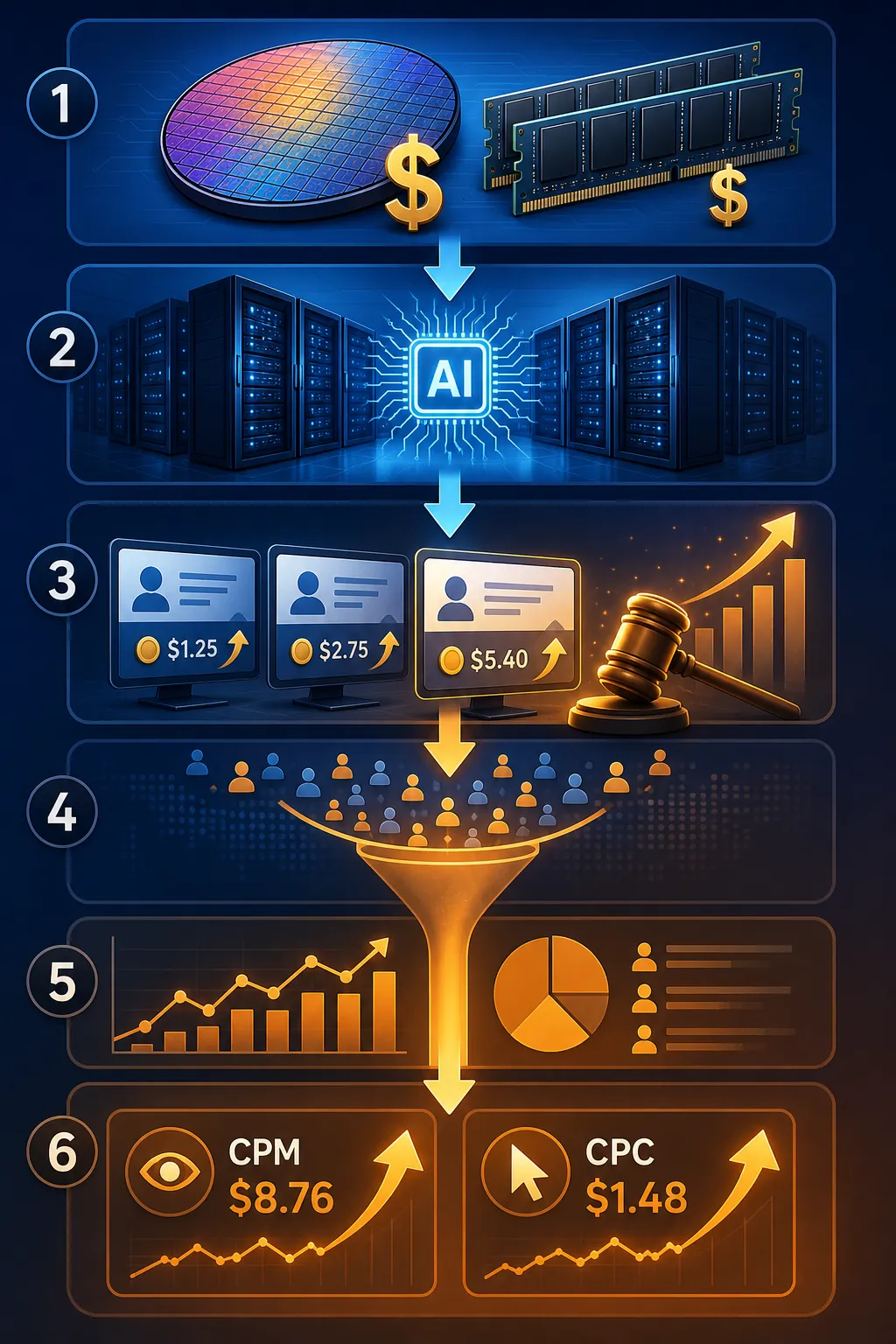
A media buyer does not need to become a semiconductor analyst to follow the route. The ad auction sits on software, but that software runs on compute. The compute runs in data centers. Those data centers need processors, networking, advanced packaging, and memory. When memory tightens, the cost pressure does not stay politely inside a component invoice.
Qualcomm’s September 1 increase matters because it names the pressure points in plain industrial language: wafer fabrication, assembly, test, advanced packaging, and memory.[1] Those are not decorative costs. They are the steps that turn chip designs into usable hardware, and they sit upstream of the devices, servers, and AI systems that now carry more of the advertising stack.
The memory side is the uglier part of the chart. Bloomberg’s report that DRAM spot prices rose more than 10x since January 2025 should not be read as the exact price Google or Meta pays under contract; large buyers do not usually buy like a small shop reacting to spot boards. But spot pricing is still a stress signal. When the most constrained part of the system reprices that violently, contract buyers may be insulated from the full spike, not from the market.
HP’s memory bill of materials is a useful proxy for how quickly this moves from chip-market noise into system inflation. Memory reportedly reached about 35% of laptop BOM, up from 15% to 18% three months earlier.[1] A laptop is not a hyperscale AI cluster, but the proxy is valuable because it shows memory no longer behaving like a quiet background line item.
| Pressure point | Why it matters to ad buyers | What it does not prove |
|---|---|---|
| Qualcomm price increase effective September 1, 2026 | Names current inflation across chip production, packaging, and memory | Does not show a direct CPM or CPC pass-through by any ad platform |
| DRAM spot prices up more than 10x since January 2025 | Signals severe memory scarcity around systems that support AI workloads | Does not equal contract pricing for Google, Meta, Amazon, or Microsoft |
| Data centers consuming over 70% of high-end memory chips in 2026 | Shows AI infrastructure competing for the memory needed to run ad-platform automation | Does not isolate advertising workloads from other AI workloads |
| Big-tech AI capex projected at $650 billion in 2026 | Shows demand pressure large enough to move infrastructure markets | Does not tell us how each platform allocates cost to ad auctions |
That distinction matters because it keeps the argument honest. The cost chain is real. The account-level attribution is not clean. A CPM increase in a retail Advantage+ campaign cannot be reverse-engineered back to a DRAM quote or Qualcomm’s September price notice. But if every infrastructure input around AI serving is getting more expensive while platforms push more campaigns into AI-heavy defaults, ignoring the hardware layer is just as lazy as blaming every increase on platform margin expansion.
Qualcomm’s Apple Problem Is Context, Not the Main Event
Qualcomm is not raising prices from a position of perfect handset momentum. Its Q3 fiscal 2026 handset revenue fell 20% year over year to $5.1 billion.[3] Reuters also reported pressure from Apple’s transition toward in-house modems, with Qualcomm expecting the Apple revenue drop to accelerate.[4]
Cristiano Amon’s consumer comment is the part that sounds familiar outside semiconductors: buyers are shifting toward lower-end premium and older models.[4] That is the same kind of downshift many advertisers see in demand quality before it shows up cleanly in a dashboard. The company is facing weaker mix on one side and rising input costs on the other. The September 1 increase is not a mysterious pricing flex; it is a response from a stressed supplier in a stressed stack.
For the broader chip-economics frame, the earlier Benchmarks piece on ARM’s AI chip stock surge and advertiser costs is the companion read. This article is narrower: the new September 1 Qualcomm catalyst and the memory-shortage mechanism now give buyers a more specific input-cost chain to watch.
Where the Pressure Can Show Up in Ad Accounts
No major ad platform has disclosed a formula that says, in effect, “memory costs rose, so auction floors moved.” That absence matters. Without it, the best a buyer can do is look for patterns that are consistent with infrastructure pressure while ruling out the easier account-level explanations first.
Google Ads: Read CPC Inflation Beside Search Surface Changes
In Google Ads, the first check is not whether average CPC is up. It probably is in many accounts. The better check is whether CPC rose while impression mix, query mix, match-type exposure, and conversion rate all moved in ways that cannot be explained by normal seasonality or budget changes.
AI Overview behavior complicates the read. If organic click-through erodes on informational searches, advertisers may lean harder on paid clicks, and paid demand can rise even before any infrastructure cost is passed through. That is a demand-side pressure sitting next to an infrastructure-cost pressure. In a live account, they look annoyingly similar: higher CPC, fewer cheap clicks, and more budget needed to hold the same volume.
For Performance Max and AI Max, isolate the automation layer before blaming chips. Check whether the campaign expanded into new inventory, changed asset coverage, shifted toward lower-intent search themes, or increased spend after auto-applied recommendations. Those can raise costs without any semiconductor explanation. If those variables are stable and CPCs still rise across comparable segments, the infrastructure thesis becomes more plausible, not proven.
Meta: CPM Movement Needs a Settings Audit
Meta is where buyers are most likely to feel the argument in CPMs rather than CPCs. The platform leans heavily on ranking, creative variation, audience expansion, and delivery optimization; all of that requires more inference, more model-serving, and more infrastructure than the older version of “pick an audience and bid.” The memory shortage gives a credible cost backdrop for that heavier stack.
But Advantage+ can inflate spend for reasons that have nothing to do with DRAM. Creative enhancements, placement expansion, audience broadening, budget shifts, and on-by-default settings can change auction participation. If CPMs rose after those settings changed, the first suspect is the account configuration. If CPMs rose across stable controls, stable creative, stable geo, and stable placement mix, then the buyer has a stronger case that marketwide cost pressure is showing up.
- Compare CPM by placement before looking at blended account CPM.
- Separate Advantage+ campaigns from manually constrained campaigns.
- Check whether creative enhancements or audience expansion changed during the cost increase.
- Look for CPM inflation in prospecting and retargeting separately; one blended number hides too much.
- Treat third-party benchmark direction as context, not as proof for a single account.
CTV: Floors Are the Place to Watch
CTV deserves attention because it sits closer to expensive delivery infrastructure: video serving, measurement, identity resolution, fraud controls, and high-volume data processing. High-bandwidth memory competition from AI hyperscalers matters here because the same capital cycle that funds model training and inference also tightens the hardware market around video and ad-tech infrastructure.
The account signal is floor movement. If a CTV partner raises minimum CPMs, reduces remnant availability, or pushes buyers into higher packages while fill quality does not improve, that is more consistent with supply-side cost pressure than a simple bidding accident. It still may be packaging strategy. The difference is that packaging strategy should show up in deal terms; infrastructure pressure tends to show up as less cheap supply everywhere at once.
The Two Inflation Sources Can Hit at the Same Time

The uncomfortable answer is that buyers may be dealing with two separate inflation sources at once. One comes from real infrastructure costs: memory scarcity, advanced packaging constraints, higher chip production costs, and AI capex crowding the data-center supply chain. The other comes from platform automation: defaults that broaden auctions, generate more variations, expand placements, and spend faster under the language of improvement.
Those two sources produce different management responses. If the issue is infrastructure-driven market inflation, the buyer’s job is expectation-setting: benchmark more often, reset efficiency targets, preserve clean controls, and explain that some cost movement is external to the account. If the issue is automation-driven bloat, the buyer’s job is containment: audit defaults, separate test cells, cap expansion, and force the platform to earn each added surface.
A practical diagnostic starts with timing. Qualcomm’s announced increase begins September 1, 2026.[1] Memory pressure, however, was already building well before that, with Bloomberg’s DRAM figure measured from January 2025 and big-tech AI capex accelerating into 2026.[2] So a CPM increase that began in late 2025 or early 2026 cannot be pinned on Qualcomm’s September price action. It can still fit the broader memory-shortage and AI-infrastructure story.
That is the line worth holding with clients. The September 1 Qualcomm move is a new catalyst, not the beginning of the entire problem. The memory shortage is the deeper mechanism. Platform defaults are the account-level accelerant. Blend those together without separating them and every postmortem turns into a fog machine.
What to Monitor Before Calling It Pass-Through
The cleanest evidence would be platform disclosure, and buyers do not have it. Until then, the reasonable standard is consistency across independent signals. If chip and memory costs are rising, big-tech capex is surging, high-end memory is being absorbed by data centers, and multiple platforms show cost inflation across stable campaign structures, the supply-chain explanation deserves space in the client conversation.
- Google: track CPC by query class, match type, network, and AI-driven campaign type rather than relying on blended CPC.
- Meta: compare CPM movement in Advantage+ against campaigns with fewer automated expansions.
- CTV: watch floor prices, package minimums, fill quality, and the disappearance of lower-cost inventory.
- All platforms: document when defaults changed, when budgets changed, and when cost increases began.
- Reporting: separate “market cost pressure” from “platform automation change” so the client does not hear one vague excuse.
The verdict is limited, but it is useful. Qualcomm’s chip price hike, the memory shortage, and the AI data-center buildout create a real cost-pressure chain that ad buyers should take seriously. They do not give anyone permission to assign a specific CPM or CPC increase to Qualcomm, DRAM, or any single supplier. Without platform disclosures, that pass-through remains unverifiable.
So the next ugly CPM chart should not be explained with a single sentence about “AI costs,” and it should not be dismissed as a pure platform margin grab either. The better explanation is messier: hardware inflation is now close enough to the ad stack to matter, while AI defaults inside the platforms can still make the bill worse on their own.
References
- Qualcomm (QCOM) earnings report Q3 2026, CNBC, July 29, 2026, link
- AI Boom Memory Chip Shortage, Bloomberg, 2026, link
- Qualcomm Announces Third Quarter Fiscal 2026 Results, Qualcomm, July 2026, link
- Qualcomm forecasts weak quarterly profit, expects Apple revenue drop to accelerate, Reuters, July 29, 2026, link
Built on this evidence
No Bidding tactic or Creative record currently cites this case file. Compare it against other results in Benchmarks.
Related benchmark reading
Report a corroborating or contradicting result
Seeing something different in your own account? Feed the data-integrity loop instead of leaving an open comment.