
What Netflix Viewership Data Actually Tells Advertisers
Netflix holds deep first-party viewership intelligence, but the targeting signals advertisers can activate are far narrower than what Meta or Google offer. This article maps the gap so media buyers can set realistic expectations for precision and attribution before allocating budget.
- Platform
- Netflix Ads
- Campaign type
- CAPI Pilot
- Spend range
- Undisclosed
- Timeframe
- 0
- Outperformance
- 0%
- Verdict
- mixed
- Last reviewed
- 0-07-30
Netflix viewership data can tell advertisers something useful about viewing context: what kinds of entertainment people choose, which moods those choices imply, and whether an ad-supported household is spending time in an environment that is hard to reach elsewhere. What it does not yet give buyers is the same kind of directly addressable, user-level behavioral graph they are used to interrogating inside Meta or Google.
That distinction matters before anyone treats Netflix's ad product as a precision targeting channel. Netflix said it had more than 250 million monthly active viewers on its ad-supported plan, but its MAV metric is not a clean count of unique identified people. Netflix defines a monthly active viewer as someone who watches at least one minute of ad-supported content in a month, then scales that viewing through a household multiplier.[1]
So the opening question for a buyer is not whether Netflix has signal. It clearly does. The question is which parts of that signal can be bought against, which parts only inform Netflix's internal systems, and which parts can be measured after the impression.

The First-Party Data Story Is Stronger Than the Buying Controls
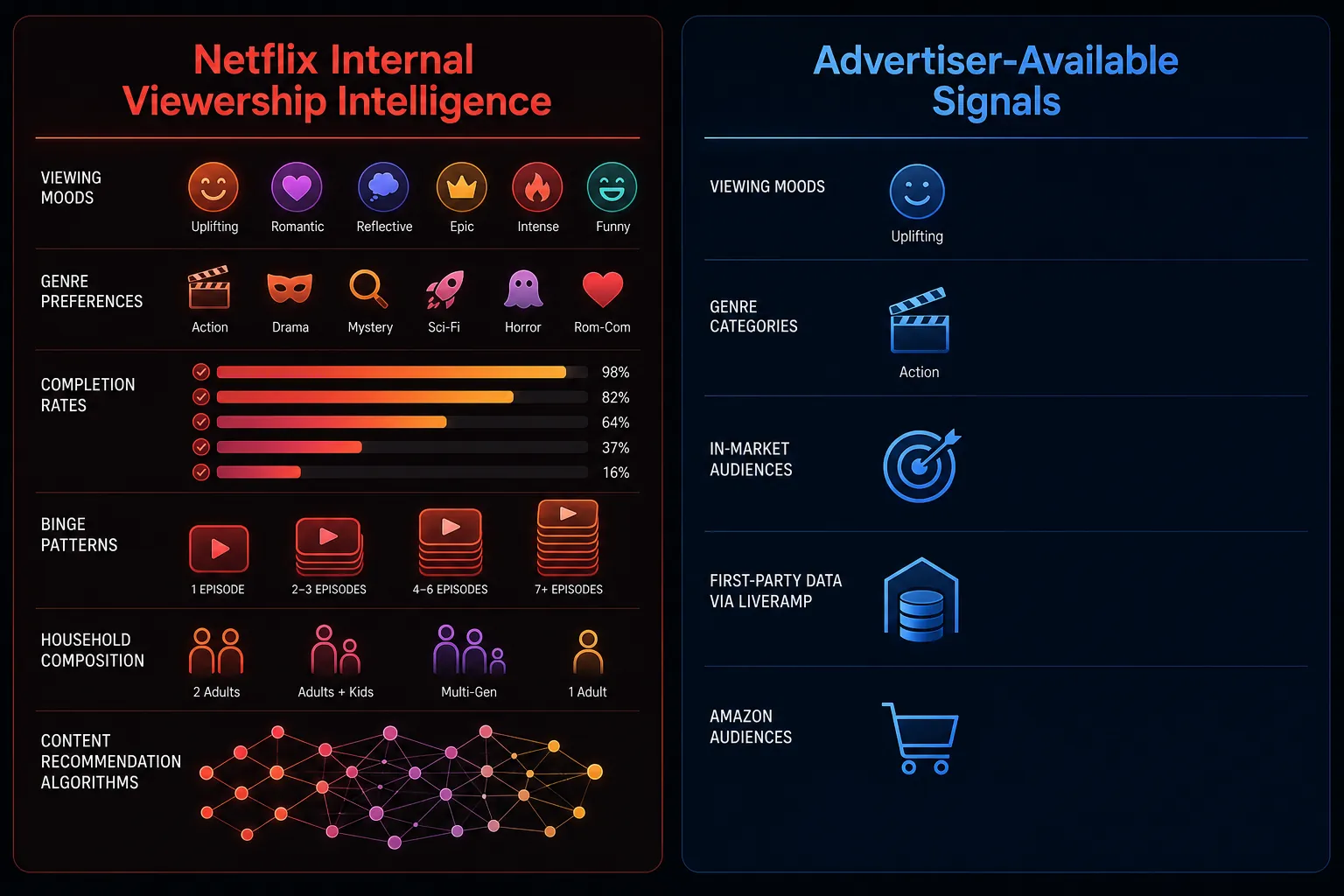
Netflix sits on a valuable kind of first-party behavior: viewing mood, genre preference, completion behavior, binge patterns, household context, and the sequence of content choices that shape its recommendation engine. For advertising, that is more interesting than another generic interest segment stitched together from web behavior and probabilistic identity.
But most of that intelligence is not exposed as a targeting surface. Advertisers can use viewing moods, more than 19 genre categories, in-market audiences such as luxury vehicles, travel, and dining, and first-party data through LiveRamp in 10 countries. Netflix also expanded audience options through Yahoo and Amazon, with Amazon Audiences bringing shopping and browsing signals into Netflix buying paths globally by June 2026.[2]
Those are real levers. They are also bounded levers. A buyer can shape delivery around entertainment context, selected in-market categories, CRM activation, and partner audiences. A buyer cannot open Netflix's recommendation model and target an individual-level cluster based on the full history of what that person completed, abandoned, binged, rewatched, or watched across household members.
| Signal Netflix can plausibly observe | What advertisers can actually activate |
|---|---|
| Viewing mood inferred from content consumption | Nine viewing-mood targeting options |
| Genre preferences across shows and films | More than 19 genre categories |
| Binge behavior and completion patterns | Not exposed as direct advertiser targeting controls |
| Household-level viewing context | Used in platform logic, but not the same as user-level identity resolution |
| Netflix recommendation and predictive signals | Being explored, but not yet available to advertisers |
| Advertiser CRM data | First-party activation through LiveRamp in supported countries |
| Commerce and shopping behavior outside Netflix | Amazon Audiences through supported buying paths |
The cleanest way to read this table is operationally. Netflix may know that a household moves between prestige dramas, competition series, comedy specials, and kids programming in patterns that imply mood and intent. The advertiser generally buys the exposed category or partner audience, not the underlying behavioral sequence.
The 250M+ MAV Claim Is a Reach Argument, Not an Identity Argument
The MAV number is useful if the budget question is incremental reach. It is less useful if the budget question is, "How many known individuals can I target, frequency-cap across publishers, and match back to a conversion path?"
Netflix's methodology deliberately emphasizes ad-viewing opportunity rather than a strict person-level identity count. A household multiplier can make sense for estimating how many people may be exposed in a living-room environment, but it should not be compared casually with monthly active users from logged-in social platforms or unique reach from an identity graph.[1]
This is where the channel can still be attractive. Netflix has said 44% of its ad-tier viewers cannot be reached on linear TV or any other streaming platform.[3] That claim comes from Netflix's own upfront positioning, so it should be treated as a vendor reach claim rather than an independently settled market fact. Still, if even part of that audience is incremental to a buyer's existing video plan, the line item does not need to behave like paid social to have a job.
The practical mistake is to use a reach metric to justify performance expectations that the product cannot support. A large ad-supported audience can improve a connected TV plan's coverage. It does not automatically create deterministic targeting, closed-loop attribution, or cross-platform frequency control.
Buying Path Changes How Much Signal You Can Use
Netflix inventory can flow through Netflix Ads Manager and through programmatic DSPs including The Trade Desk, DV360, Amazon DSP, and Yahoo DSP. That distribution is helpful for buyers who want Netflix inside existing planning and activation systems, but it also means signal fidelity is not one uniform thing across every path.
Direct buying through Netflix Ads Manager is where the platform's own audience packaging is most central. Programmatic buying can make Netflix easier to compare with other CTV supply, but the buyer is then working through the DSP's available integrations, deal setup, audience permissions, and reporting constraints. Amazon DSP adds the obvious appeal of Amazon's commerce signals; Yahoo and other programmatic paths make Netflix easier to slot into broader addressable video plans.[2]
- Use Netflix Ads Manager when the main value is Netflix-native audience packaging, viewing-context controls, and direct platform access.
- Use Amazon DSP when Amazon audience data is central to the hypothesis and the buyer is comfortable measuring Netflix as part of an Amazon-led media plan.
- Use broader DSP paths when process consistency, consolidated planning, or existing CTV governance matters more than maximum access to Netflix-native packaging.
None of those paths turns Netflix into a real-time interest graph. The Current reported that Netflix is exploring how its content recommendation algorithm could support predictive ad signals, citing co-CEO Greg Peters, but those recommendation-derived predictive signals are not yet generally available to advertisers.[4]
The Targeting Surface Is Contextual Plus Partner Data, Not Full Behavioral Access
The most defensible targeting read is this: Netflix can help advertisers move beyond blunt demo or program-level CTV buying, but it has not exposed the kind of granular behavioral audience construction that performance teams associate with mature auction platforms.
Viewing moods and genres are useful because entertainment consumption carries emotional context. Someone watching comfort comedy, sports-adjacent documentaries, true crime, family animation, or high-intensity drama is not just sitting inside a demographic cell. The environment says something about attention and receptivity.
The limitation is that mood and genre are still media-context signals. They do not tell the buyer that a specific person is currently researching a product, comparing prices, abandoning carts, or moving through a known funnel stage. In-market segments and Amazon Audiences can bring the plan closer to commerce intent, but those are partner-data overlays, not evidence that Netflix's own viewing graph has become fully advertiser-addressable.[2]
That distinction should shape campaign structure. A travel brand can reasonably test Netflix audiences around travel intent and relevant viewing contexts. It should be more careful about promising the same optimization cadence it expects from search, shopping, or paid social prospecting. The platform may be helping the buyer find a better video environment; it is not necessarily letting the buyer chase every person-level intent signal.
Measurement Has Improved, but the Loop Still Has Open Ends
Netflix's measurement story is moving in the right direction for performance teams. The platform has introduced CAPI for real-time outcome signals and works with clean room partners including Snowflake, AWS, and InfoSum. That creates more room for conversion analysis, privacy-safe matching, and advertiser-side evaluation than an older CTV buy that ends at impressions and completion rate.
But CAPI and clean rooms do not erase the main attribution questions. They can improve event flow and matching under controlled conditions. They do not necessarily reveal individual-level exposure paths, cross-publisher frequency, or the full sequence of media touches that preceded a conversion.

Tinuiti noted a Netflix CAPI pilot claim of 75% outperformance, but the available material identifies it as a Netflix-announced pilot with a partner agency, not an independently audited benchmark with public sample sizes, control design, or category-level detail.[5] That does not make the result useless. It makes it a reason to test, not a planning assumption.
For buyers, the better question is not, "Does Netflix have performance measurement?" It does. The better question is, "Will the measurement answer the decision I need to make?" A brand trying to compare exposed and matched converters may get enough signal to continue testing. A growth team trying to allocate marginal dollars across Meta, Google, Amazon, retail media, and CTV on a weekly CAC basis will likely find the Netflix read slower and less complete.
What a Sensible Test Should Prove
A Netflix test should be designed around the job the platform can plausibly do. If the plan depends on incremental reach among ad-tier streaming viewers, stronger entertainment context, and some audience shaping through genre, mood, in-market, CRM, or partner-data segments, the test has a coherent premise.
If the plan depends on tight one-to-one identity, rapid creative-audience learning, transparent frequency across publishers, or deterministic lower-funnel attribution, the premise is weaker. Those are the places where Netflix's internal intelligence and advertiser-visible controls are still far apart.
- Define whether the buy is being judged on incremental reach, assisted conversion, site activity, sales lift, or direct response efficiency before the campaign starts.
- Separate Netflix-native targeting from partner-data targeting in the test design so the result does not blur what actually drove performance.
- Treat MAV and unreachable-audience claims as reach inputs, not as proof of unique identity quality.
- Ask which reporting fields differ by buying path before comparing Netflix Ads Manager results with DSP-delivered results.
- Use CAPI and clean rooms to improve outcome visibility, but do not assume they solve cross-publisher attribution or frequency.
The budget implication is fairly narrow. Netflix can be a credible incremental-reach channel with better audience context than many CTV buys. It is not yet a substitute for Meta or Google when the buying requirement is high-frequency optimization against exposed, individual-level behavioral and conversion signals.
References
- Netflix's Third Season of Ads and a Look Ahead at What's Next — Netflix official
- Netflix enriches ad-targeting prowess with Amazon, Yahoo audience data — Marketing Dive
- Netflix Must Prove 250 Million Ad Viewers Justify Premium Prices — Forbes
- Inside Netflix's quest to double ad revenue to $3 billion — The Current
- Netflix Advertising: Specs & Tactics for Marketers (2026) — Tinuiti
Built on this evidence
No Bidding tactic or Creative record currently cites this case file. Compare it against other results in Benchmarks.
Related benchmark reading
Report a corroborating or contradicting result
Seeing something different in your own account? Feed the data-integrity loop instead of leaving an open comment.