
What the John Wick Sprite Tells Us About Fortnite Ad Costs
Brand activations inside Fortnite range from $20K to $500K, but the metrics used to justify those prices are inconsistent and often misleading. This article breaks down the real cost ladder and measurement conflict using the John Wick Sprite as a timely entry point, so media buyers can set their own KPI hierarchy before contracting.
- Platform
- Fortnite
- Campaign type
- Branded game object
- Spend range
- 0K-500K
- Timeframe
- 0-09
- Unique visitors
- 0
- Verdict
- mixed
- Last reviewed
- 0-07-30
The Fortnite Sprite tied to John Wick is the kind of branded object that deserves a closer look before anyone reaches for the eye-roll. It is Reload-exclusive, unlockable through four different methods, and its Mythic power is not cosmetic filler: after an elimination, it reveals nearby enemies. The marketing works because the object first behaves like a game mechanic, then like a franchise tie-in. That is the right order.
But there is no public performance data for the John Wick Sprite as of July 30, 2026. No published unique visitors, no quest completions, no redemptions, no lift study, no peak concurrent-player figure, and no sales proxy that can be checked outside the launch announcement. That absence does not make the activation weak. It makes it unusable as proof of media value.
That distinction matters because Fortnite brand work is now sold across a very wide price range. A clever in-game object, a rented placement inside an existing map, and a fully custom branded destination can all appear in the same client deck under the same loose heading: Fortnite activation. They should not be judged by the same metric.
The cost ladder is the real starting point
The most useful public benchmark comes from Digiday’s September 2025 reporting: custom-branded Fortnite maps were described as running $300,000 to $500,000, while integrations into pre-existing high-traffic maps were described as running $20,000 to $50,000. Digiday attributed those ranges to four unnamed marketers and to named creator studios including Good Gamers and Look North World; Epic Games does not publish an official public rate card for this inventory.[1]
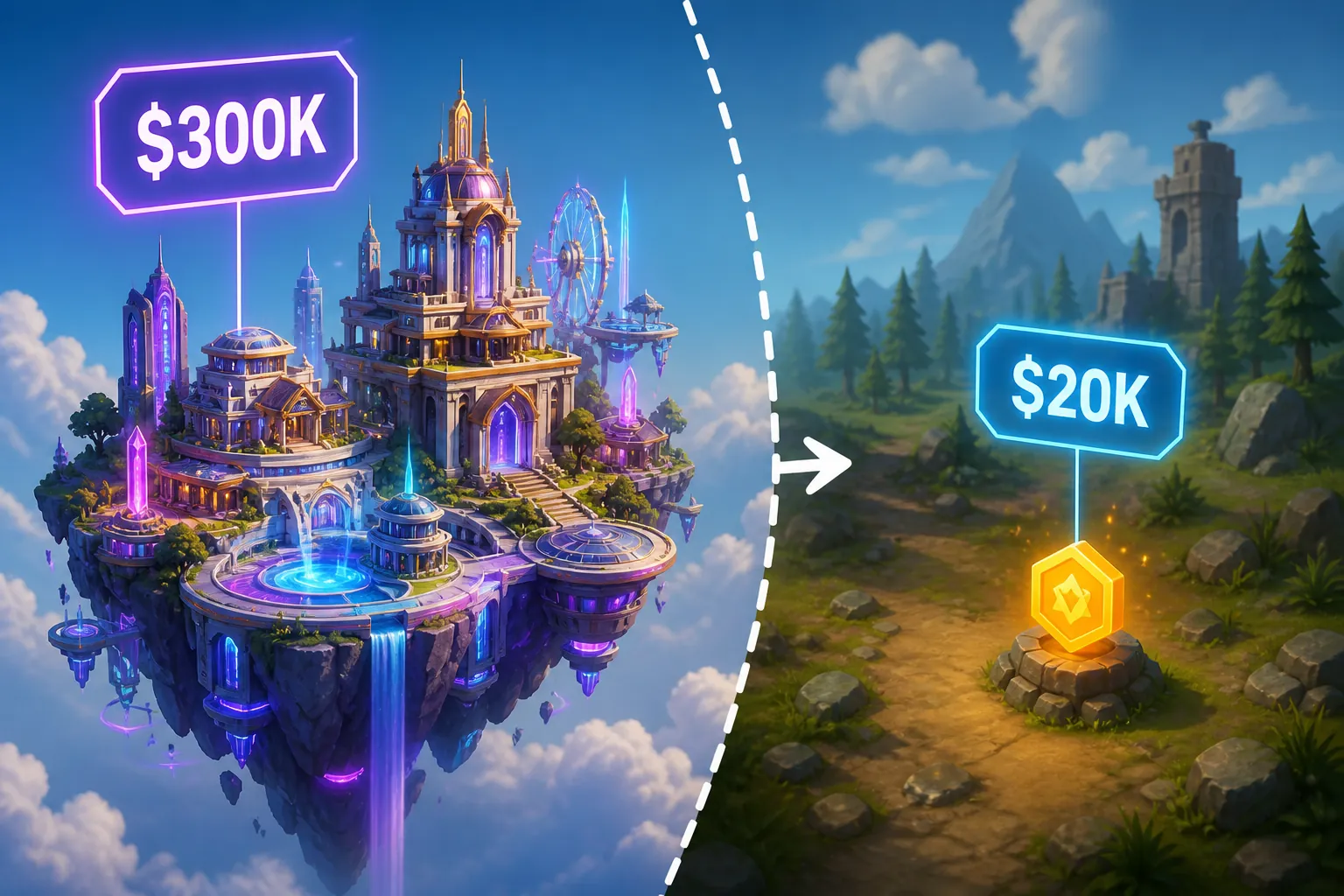
That gap is large enough that the buyer should treat the two products as different media decisions, not different sizes of the same idea. At $20,000 to $50,000, an integration can be evaluated like a high-context sponsorship: the brand is paying to enter a place where players already are. At $300,000 to $500,000, the brand is funding a destination and taking on the harder burden of getting players to choose it.
| Fortnite activation tier | Publicly reported cost range | What the spend appears to buy | Metric that can justify it | Metric that cannot carry it alone |
|---|---|---|---|---|
| Integration into an existing high-traffic map | $20K-$50K | Placement inside a map that already has player flow | Unique visitors, quest completions, redemptions, qualified interactions | Generic impressions without player-action context |
| Custom-branded map | $300K-$500K | A destination built around the brand, plus the burden of driving traffic | Sustained players, qualified visits, completion rate, downstream action | Launch views or earned social views by themselves |
| Native-feeling branded game object | No public benchmark from the provided materials | A playable mechanic tied to brand or IP recognition | Usage, unlocks, repeat use, match impact, downstream brand action if available | Creative fit alone |
The John Wick Sprite fits most naturally into the third row. It may be stronger creative than another branded façade because it gives players a reason to interact. Still, without public usage or conversion data, it cannot answer the budget question. A buyer can admire the mechanic and still refuse to let it stand in for performance.
A lower price can still buy the more useful signal
Popeyes is the cleanest example in the public record because the campaign produced an action outside the island. Its April 2025 Murder Mystery integration, tied to #PopeyesPickleQuest, reached 721,000 unique visitors and generated 892 verifiable coupon redemptions, according to Good Gamers’ strategic partnerships manager.[1]
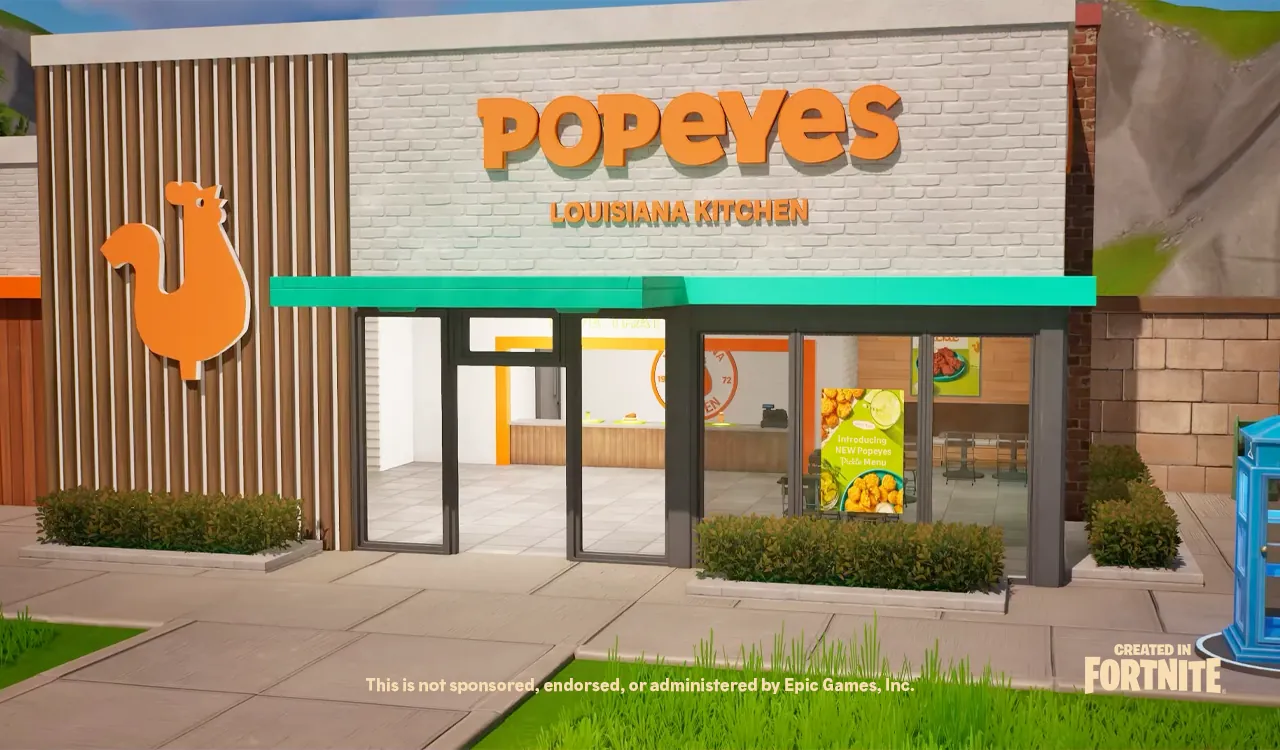
The redemption count is small next to the visitor count, but it is still the more valuable number. It tells the buyer that some players moved from in-game participation to a trackable offer. The campaign can be discussed as awareness, engagement, and response without pretending those are the same thing.
That is exactly where many Fortnite case studies get slippery. Unique visitors are not sales. Quest completions are not purchase intent. Views are not players. But when the downstream action is labeled clearly, the buyer can decide whether the cost per action is tolerable, whether the audience quality is relevant, and whether the same creative would have worked better in a cheaper or more measurable channel.
For a $20,000 to $50,000 integration, 721,000 unique visitors would be worth attention even before redemptions. The coupon data makes the case stronger because it gives the post-campaign review something firmer than reach. It does not prove the format always works. It proves that, in at least one named campaign, a lower-cost integration produced a measurable consumer action.
The metric conflict is not a detail; it is the risk
The General campaign shows why the same activation can look impressive or weak depending on who controls the metric. Look North World reported more than 50 million total views, while REVXP recorded sub-200 peak concurrent players.[1]
Both numbers can be technically true. They just answer different questions. Total views can include exposure around the experience, earned attention, creator content, or other distribution surfaces depending on methodology. Peak concurrent players answers a narrower, harsher question: how many people were inside the experience at the same time when measured by Fortnite activity.
A studio can care about views because views help package the campaign as cultural reach. A map operator can care about peak concurrency because it reveals whether the island had real in-game gravity. A media buyer has to care about the mismatch, especially when the proposal sits in the $300,000 to $500,000 tier.
A custom island with low concurrency may still have value if the objective is PR, creator amplification, or brand-world experimentation. But then the contract should say that. The problem starts when a high price is justified with in-game language during the pitch and out-of-game attention during the recap.
Engagement numbers need a job
Dairy MAX reported 2 million quest completions, which is a meaningful top-of-funnel engagement signal.[1] It suggests that players did more than pass by a logo. They completed an assigned in-game action at scale.
The limit is just as important: quest completions do not automatically indicate incremental sales, purchase intent, brand lift, or repeat behavior unless those outcomes were separately measured. A completion can be a strong engagement KPI for a campaign designed around interaction. It should not be promoted into a revenue KPI after the fact.
This is where Fortnite’s creative strength complicates media judgment. The better the mechanic, the easier it is for a recap deck to blur the line between play and persuasion. A player completing a quest may have enjoyed the experience. That is useful. It is not the same as proving the player will buy milk, chicken, insurance, or a movie ticket.
Fortnite is no longer fringe, but scale does not settle price
The channel is large enough to deserve serious media planning. GEEIQ reported that brand activations inside Fortnite grew 99% year over year, from 136 in 2023 to 270 in 2024, and that branded maps made up 33% of all virtual-world activations.[2]
Those figures explain why more brands are testing the space. They do not explain whether a specific buyer should fund a custom island, sponsor an existing map, or negotiate a smaller native integration around an object like the John Wick Sprite. Adoption is market context, not effectiveness.
Daily active user estimates should be handled with the same caution. Public DAU figures now often come from third-party sources such as DemandSage citing ActivePlayer.io and Electro IQ, not from Epic’s own regular player disclosures after 2023.[3] That does not make every estimate useless, but it does mean a buyer should avoid using broad platform audience estimates as a substitute for campaign-level delivery.
Academic context has a timing problem too. A 2025 study by Sidorenko-Bautista and co-authors in Cogent Social Sciences examined brand activations through mid-2023, before the John Wick Sprite and before the fuller 2025-2026 collaboration pattern described in current trade coverage.[4] It can help frame how brand worlds developed; it cannot validate today’s Sprite system or current cost-performance claims.
What to define before the contract
The negotiation problem is not that Fortnite lacks metrics. It has too many metrics that can be arranged to flatter different stakeholders. The buyer’s job is to decide the order of authority before the campaign goes live.
| If the campaign is sold as... | Primary KPI to define first | Secondary KPI | Metric to keep in its lane |
|---|---|---|---|
| A custom branded destination | Qualified visits or sustained player activity | Completion rate, return visits, average session behavior | Earned views |
| An integration inside an existing map | Unique visitors exposed to the integration | Quest completions or interaction rate | Broad platform reach |
| A playable branded object or power | Unlocks, uses, repeat uses, or match-relevant interactions | Brand recall or downstream action if separately measured | Creative novelty |
| A commerce-adjacent activation | Redemptions, sign-ups, scans, or other verifiable actions | Qualified visitors and completion behavior | Impressions |
| A PR or culture play | Earned media methodology agreed in advance | Creator distribution and view quality | In-game concurrency |
The order matters because the recap will usually emphasize the strongest-looking number. If the contract says redemptions are primary, then views cannot rescue a weak response result. If the contract says earned reach is primary, then the buyer should not later pretend the campaign proved in-game demand. If the contract says sustained players are primary, then a launch-day social spike is supporting evidence, not the headline.
For a lower-cost integration, the buyer can tolerate more upper-funnel ambiguity if the map already has player flow and the campaign includes a measurable interaction. For a $300,000 to $500,000 custom build, the tolerance should be much lower. A custom map has to justify not only the production cost but also the decision to create a separate destination instead of entering an existing one.
That does not make custom maps irrational. It makes them demanding. A brand with a strong entertainment property, a launch calendar, creator distribution, paid support, and a measurement plan may have reasons to build its own island. But the price should come with a defined success metric that would be acceptable in the post-campaign review before anyone starts debating art direction or game mechanics.
Where the John Wick Sprite fits
The John Wick Sprite is a better creative signal than a static placement because it changes play. A player has to obtain it, understand its value, and use the elimination-triggered enemy reveal at a useful moment. If those behaviors were measured, they could tell a richer story than a simple impression count.
The missing data points are straightforward: how many players unlocked it, which unlock path was most common, how often it was used after acquisition, whether use changed match behavior, whether players repeated the interaction, and whether any brand or franchise outcome was measured outside the match. Without those numbers, the Sprite is a good example of native-feeling integration, not a benchmark for media performance.
Fortnite can make advertising feel less like advertising when the brand asset becomes part of play. The budget decision still belongs to measurement. A $20,000 integration, a $500,000 island, and a Mythic Sprite should not be allowed to borrow credibility from one another just because all three live inside Fortnite.
Fortnite activations can produce very different value depending on whether the brand buys a custom destination or rents attention inside an already popular experience. Until the industry has a stable measurement framework, the KPI hierarchy has to be set before contracting. Views cannot overrule players. Visitors cannot imply sales. And a $300,000 proposal should not survive unless everyone already knows which number will decide whether it worked.
References
- Digiday report on Fortnite custom-branded map and integration costs, Digiday, September 2025.
- GEEIQ growth data on Fortnite brand activations, GEEIQ.
- Fortnite player estimates cited from ActivePlayer.io and Electro IQ, DemandSage.
- Brand activations in Fortnite through mid-2023, Sidorenko-Bautista et al., Cogent Social Sciences, 2025.
Built on this evidence
No Bidding tactic or Creative record currently cites this case file. Compare it against other results in Benchmarks.
Related benchmark reading
Report a corroborating or contradicting result
Seeing something different in your own account? Feed the data-integrity loop instead of leaving an open comment.