
How Did Gusto’s Cold Noodle Coupons Drive Traffic in 2026?
This case file examines Gusto's 2026 summer cold noodle campaign, where coupons distributed through owned channels—the Skylark app, social media, LINE, and SmartNews—drove same-store sales gains. It shows how a restaurant chain used paid media for app acquisition and re-engagement rather than direct-response discounts, and what the measurable results were.
- Platform
- Meta Ads
- Campaign type
- Performance Max
- Spend range
- National chain
- Timeframe
- 2026-05-21 to 2026-06-10
- Same-store sales
- 11.4% YoY
- Verdict
- mixed
- Industry vertical
- QSR
- Last reviewed
- 2026-07-29
The useful part of Gusto’s 2026 summer cold noodle push is not that a restaurant chain discounted seasonal food. It is that the discount was not left to float around the deal ecosystem. The May campaign sent customers through the Skylark app, Gusto’s official X account, Skylark Instagram, LINE Coupon, and SmartNews, with the coupon acting as controlled traffic fuel rather than a generic bargain listing.
For marketers evaluating the campaign, the cleanest measurable frame is this: from May 21 to June 10, Gusto ran a “26% OFF Popular Menu Coupon Fest” covering 20 menu items, with coupons distributed through five owned or semi-owned touchpoints and no disclosed third-party coupon aggregator dependency.[1] Skylark Group then reported same-store sales of +7.3% year over year in April, +11.4% in May, and +1.7% in June; the May figure included traffic up +5.9%, while the June report noted traffic decline and weather or typhoon pressure.[2][3]
That is a strong signal, not a clean causal proof. The sales data is for Skylark Group across brands, not Gusto alone. Campaign-level media spend is not public. The source material is Japanese-language material translated into English. Still, the May IR attribution to coupon distribution makes this more useful than a menu-launch anecdote, especially because the distribution architecture was unusually disciplined for a discount campaign.
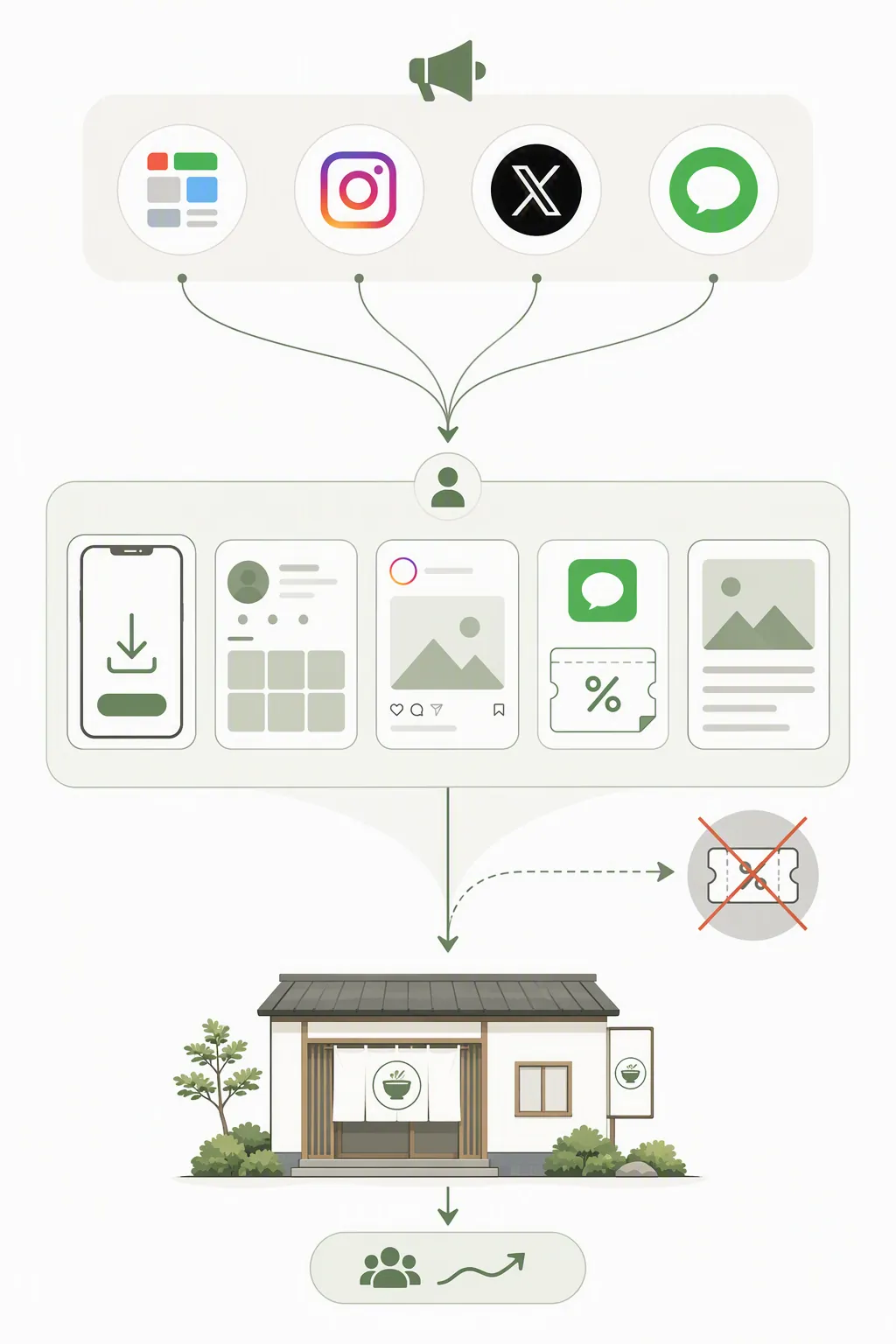
The Coupon Was the Middle of the Funnel, Not the Media Buy
A less controlled restaurant promotion usually leaks at the moment the discount becomes portable. Customers find the deal on an aggregator, screenshot it, redeem once, and return to browsing for the next brand’s markdown. Gusto’s May setup kept the customer closer to Skylark’s own demand system.
| Touchpoint | Practical role in the campaign |
|---|---|
| Skylark app | Install or re-engagement surface for coupon access |
| Gusto official X | Social reach for time-limited offer discovery |
| Skylark Instagram | Visual menu and campaign reminder channel |
| LINE Coupon | Relationship capture through a messaging platform customers already use |
| SmartNews | Discovery layer that can introduce the offer without handing the customer to a coupon aggregator |
The paid-media point sits above that table. SmartNews, Instagram, X, and LINE can all be used as reach or reactivation surfaces, but the campaign endpoint was still a brand-controlled coupon path. Gusto was not asking the market to “find the deal somewhere.” It was using distributed reach to pull customers toward channels Skylark could reuse.
That distinction matters because a coupon campaign trains behavior. If the cheapest path to redemption is a third-party feed, the brand pays for the visit and may also teach the customer where to shop against it next time. If the cheapest path runs through the app, LINE, or social follow, the discount can still be expensive, but at least some of that expense buys future addressability.
The Price Mechanics Were Simple Enough to Travel
The May discount was broad rather than delicate: 20 popular items at 26% off. For the cold noodle range, published campaign pricing put regular prices around ¥850 to ¥1,099 and coupon prices around ¥629 to ¥703, implying an effective discount of roughly ¥221 to ¥258 depending on the item and store conditions.[4]
The pricing also had a small operational wrinkle that matters when comparing screenshots to receipts: a 10% late-night surcharge after 22:00 could create store-level variance.[4] That does not weaken the campaign; it just limits how neatly an outside analyst can convert the promotion into a single universal ticket-price assumption.
The offer mechanics were not complicated, which is part of why the funnel is worth studying. The customer did not need to understand a loyalty tier, a bundle ladder, or a multi-visit unlock. The brand needed the customer to enter one of its chosen channels, see a familiar discounted item, and make a visit during a three-week window.
What the Sales Data Can and Cannot Say
The headline number is May: Skylark Group same-store sales rose +11.4% year over year, with traffic up +5.9%.[2][3] The May disclosure explicitly pointed to coupon distribution as a driver of traffic, which is why this campaign belongs in a performance file rather than only a food launch archive.[3]
The clean reading stops there. The data does not isolate Gusto from other Skylark brands such as Bamiyan, Jonathan’s, or Syabu-Yo. It does not disclose incremental app installs, coupon redemption volume, repeat visits, CAC, CPM, or contribution margin. It also does not prove that cold noodles themselves caused the May lift. What it does support is narrower and still valuable: during the month when Skylark called out coupon distribution, group same-store sales and traffic both moved materially upward.
| Month | Skylark Group same-store sales | Traffic signal | Interpretation limit |
|---|---|---|---|
| April 2026 | +7.3% YoY | Not cited here as coupon-led | Useful baseline before the May coupon window |
| May 2026 | +11.4% YoY | +5.9% YoY traffic | Strongest campaign-period signal; group-wide, not Gusto-only |
| June 2026 | +1.7% YoY | Traffic down −1.4% | Weather and typhoon caveat complicates the read |
June is the useful guardrail. Same-store sales stayed positive at +1.7%, but traffic fell −1.4%, and the IR notes pointed to weather and typhoon disruption.[2] If the May number is presented as a universal coupon-funnel win, June quickly makes the claim too neat. Seasonality can help restaurant demand, but it can also interrupt it.
Scale also matters. Gusto had 1,211 stores as of June 2026, down from 1,230 in January 2026, which gives the campaign enough footprint to be meaningful but also makes brand-level isolation more important.[2] A smaller chain could copy the channel logic and still fail if its app base, LINE reach, or store density cannot create the same redemption pressure.
Why the July Menu Launch Gave the Campaign a Second Life
The July phase changed the job from discount activation to menu renewal. On July 16, Gusto launched its “Hiyari Ryomen” and “Gusto Shokudo” lineup: four cold noodle SKUs and four rice bowls. The cold noodle set included Sesame Cold Soy Milk Tantan Udon, the returning Shrimp & Steamed Chicken Rich Cold Noodles, a new Tofu & Meat Miso Salad Udon, and the Original Japanese Salad Udon revived after a 20-year absence.[5]
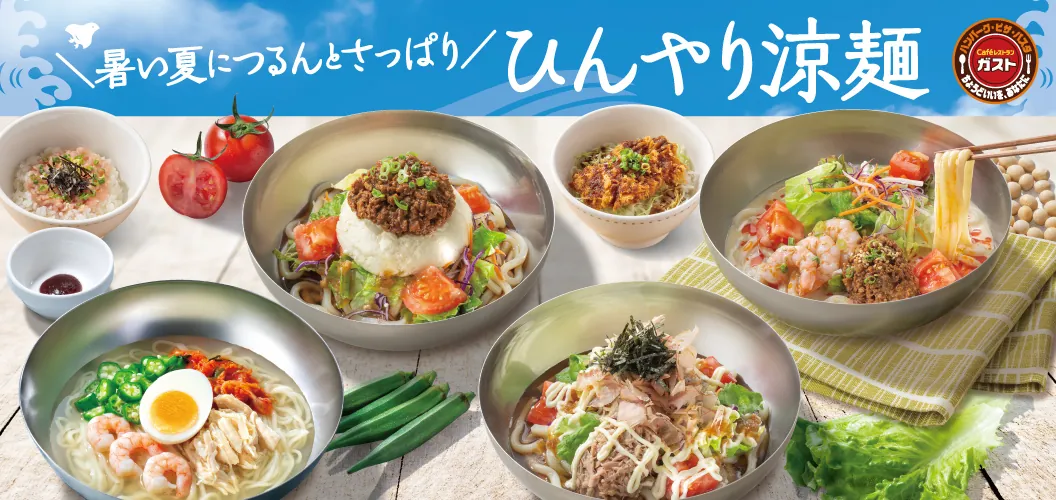
The flagship cold noodle had a useful credibility hook before the 2026 relaunch: Gusto’s PR copy said it sold about 1.3 million servings between April 1 and October 31, 2025.[1] That figure is unaudited and comes from the company, so it should not be treated like independent category data. It is still a reasonable internal proof point for why the chain would put cold noodles back into a summer traffic plan.
The nostalgia item did a different job. The Original Japanese Salad Udon revival gave editors something to write besides “summer noodles are back,” and Gourmet Watch covered the return shortly after launch.[6] That kind of earned-media surface is helpful, especially when the product has a 20-year absence attached to it. It should not be confused with the May traffic mechanism. Nostalgia helped the July story travel; the May case rests on coupon distribution and measured group traffic.
The Portable Lesson Is Channel Control, Not Cold Noodles
The campaign’s most transferable feature is the refusal to let the coupon become anonymous inventory. Gusto used a seasonal product, a clear discount, and broad media surfaces, but kept redemption attached to channels Skylark could continue to use. That is a better benchmark than “discount seasonal menu items,” which most restaurant brands already know how to do.
The model still needs four conditions before it travels well: enough app or LINE reach to make controlled distribution meaningful, a store base that can absorb and measure visit lift, a product with real seasonal demand, and brand-level reporting clean enough to defend the result. Without those, the same structure can look disciplined in a deck and still disappear inside group sales noise.
Gusto’s 2026 cold noodle campaign is therefore a strong restaurant benchmark, not a guaranteed playbook. It shows how paid reach can feed owned coupon channels instead of outsourcing demand to deal discovery platforms. The measurable lift is encouraging, especially in May, but it remains group-wide, weather-sensitive, and incomplete without spend, redemption, and brand-specific contribution data.
References
- Gusto '26% OFF Popular Menu Coupon Fest' Press Release, PR Times, May 19, 2026.
- Skylark Holdings Monthly Business Performance IR Data, Skylark Holdings, FY2026.
- Skylark Group May 2026 IR Report (Yahoo Finance Disclosure), Yahoo Finance Disclosure, June 4, 2026.
- Coupon campaign detail with pricing, Tokubai.
- Gusto 'Hiyari Ryomen' & 'Gusto Shokudo' Launch Press Release, PR Times, July 15, 2026.
- Gourmet Watch article, Gourmet Watch, July 20, 2026.
Built on this evidence
No Bidding tactic or Creative record currently cites this case file. Compare it against other results in Benchmarks.
Related benchmark reading
Report a corroborating or contradicting result
Seeing something different in your own account? Feed the data-integrity loop instead of leaving an open comment.