
How to Run DraftKings Promo Code Paid Search in 2026
An operational guide for performance marketers on running Google Ads for DraftKings promo codes in 2026, covering the per-jurisdiction certification process, the March 2026 domain-ownership mandate, state-specific geo-targeting rules, keyword compliance, and the tracking architecture that survives audits.
- Platform
- Google Ads
- Campaign type
- Search
- Spend range
- Varies by state
- Timeframe
- 2026
- CPA
- Various
- Verdict
- Mixed
- Industry vertical
- Sports betting
- Last reviewed
- 2026-07-29
A DraftKings promo code paid search strategy in 2026 starts before the first keyword build. The account has to be eligible to advertise gambling content under Google’s Gambling and Games policy, the advertiser has to be certified for the exact jurisdiction being targeted, the landing domain has to pass ownership requirements, and the campaign has to show the right state disclosures to the right users. If those pieces are not already settled, bidding strategy is just a faster way to reach a suspension queue.[1]
That is the uncomfortable difference between this market and ordinary promo-code search. In retail or software, a sloppy launch usually wastes budget. In regulated sportsbook search, the same habits can connect an uncertified account, a mismatched landing page, a prohibited claim, and a missing helpline disclosure into one review failure.
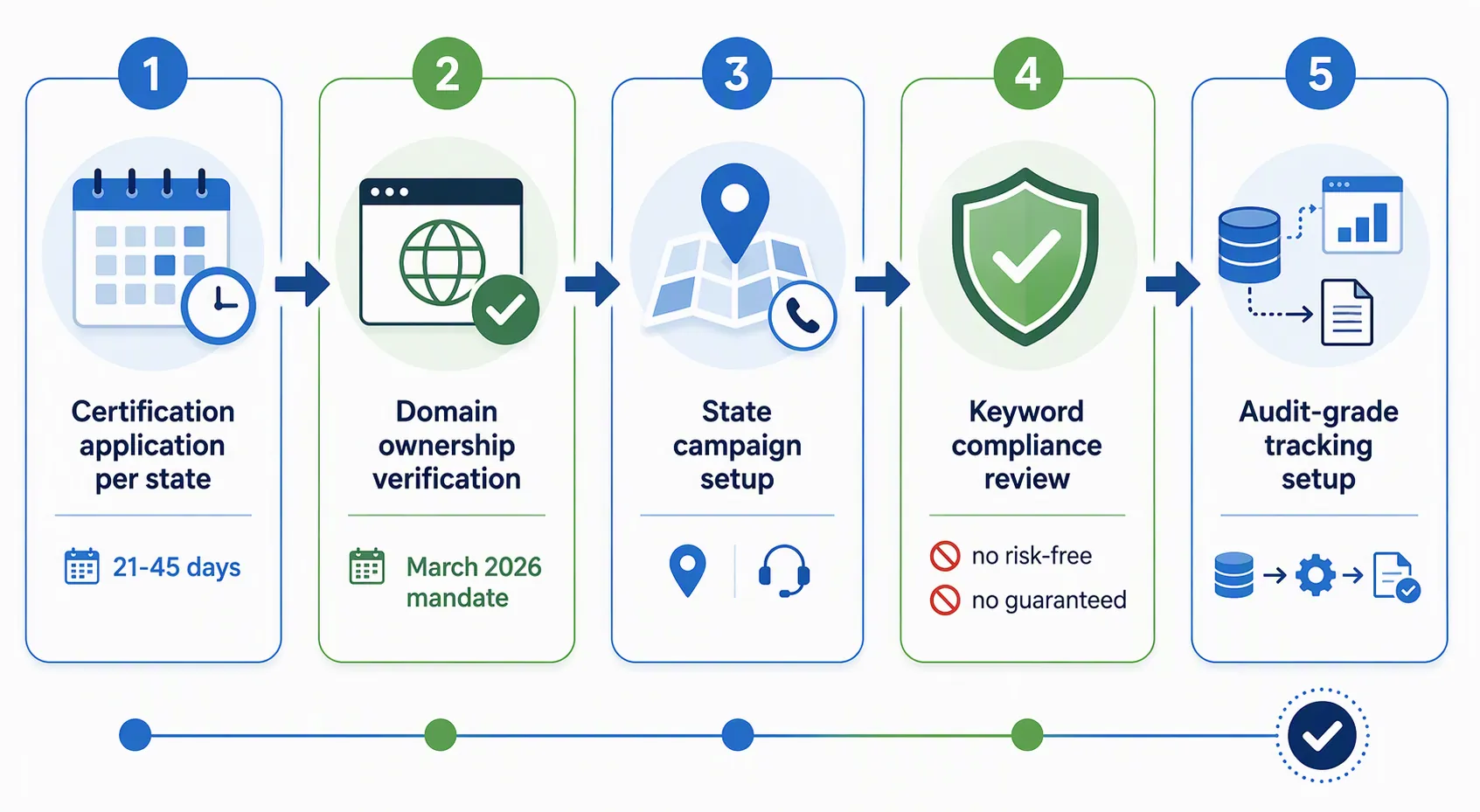
| Preflight gate | What must be true before spend | Why it matters |
|---|---|---|
| Jurisdiction certification | The advertiser has Google gambling certification for each state or market being targeted. | A single national approval is not enough for state-level sportsbook activity. |
| Domain control | The advertiser controls the second-level domain used in the ad and landing experience. | Subdomain proxy setups are now treated as a structural review problem. |
| State campaign architecture | Campaigns are isolated by state with matching geo-targeting and responsible-gambling disclosures. | Disclosure mistakes are easier to prevent at campaign level than to patch inside ad copy. |
| Keyword and claim review | Promo-code coverage excludes prohibited or high-risk claims such as “risk-free” and “guaranteed.” | The search term plan has to match gambling policy, not just conversion intent. |
| Auditable tracking | GCLID capture, server-side postbacks, and offline conversion imports are planned before launch. | The conversion trail has to survive review, partner reconciliation, and account-level questions. |
Certification Is a Launch Calendar Item, Not an Admin Task
Google’s gambling certification process is jurisdiction-specific. Track360 describes the 2026 process as requiring a separate certification application for each jurisdiction, with licensing checked against regulatory databases in real time. A brand licensed in five markets should expect five applications, not one approval that gets stretched across a national campaign structure.[2]
That sequencing matters because certification is not instantaneous. Track360 and PostAffiliatePro both describe the approval window for private licensed operators as 21–45 days.[2][4] A media plan that assumes “we’ll get the account approved during the first week of testing” is not a plan; it is an avoidable bottleneck.
For DraftKings promo code search, this means the state list comes before the keyword list. If New Jersey, Massachusetts, and Pennsylvania are in scope, each market needs its own certification status checked before campaigns are allowed to serve there. If a state is still pending, it stays out of targeting, landing-page claims, ad extensions, and conversion reporting assumptions.
The safest operating file is boring: jurisdiction, license basis, Google certification status, application date, expected review window, approved domain, approved landing path, responsible-gambling disclosure, and campaign ID. That file should be finished before a buyer starts splitting match types or testing promo-code wording. The person who inherits the account later will need to know why the campaign was allowed to run, not just which ad group produced registrations.
There is also a timing wrinkle for 2026 maintenance. Track360 flags an August 26, 2026 Google certification form update, so teams publishing or relaunching after that point should verify the live workflow before relying on old application notes.[2] As of July 29, 2026, that date is still ahead of publication, which makes it a calendar risk rather than a completed operational fact.
The Domain Rule Changes the Affiliate Site Model
The March 23, 2026 domain-ownership mandate is the policy change that breaks a lot of old affiliate plumbing. YeezyPay describes the rule as requiring second-level domain ownership and says subdomains on third-party hosts trigger automatic rejection.[3] PostAffiliatePro also discusses domain and certification constraints for betting affiliates, but Google’s own policy language remains the version that should be checked before any compliance note goes live.[1][4]
The practical effect is simple enough: do not build a DraftKings promo code funnel on a borrowed subdomain and expect paid search review to treat it like a controlled property. A setup such as a partner page living under someone else’s root domain may be convenient for launch speed, but convenience is not the review standard. The advertiser needs a domain relationship that can be explained cleanly when Google reviews the account, the ad, and the landing experience together.
This is where affiliates often lose time by trying to solve the wrong problem. Changing the hero copy, hiding a promo block, or swapping a tracking link will not fix a domain control issue. If the second-level domain cannot pass ownership expectations, the campaign is not one copy edit away from approval.
- Use a domain that the advertiser can document and maintain, not a temporary subdomain created for a traffic test.
- Keep the display URL, final URL, tracking redirects, and landing content consistent enough that review can follow the user path.
- Avoid proxy pages that exist only to pass the click onward while hiding the sportsbook relationship.
- Treat ownership verification as a launch blocker, not as a cleanup item after the first disapproval.
Build Campaigns by State Before You Build Them by Intent
The clean DraftKings promo code account is state-isolated first and intent-segmented second. That may feel inefficient to anyone coming from national lead gen, but sportsbook search has a different failure mode. If New Jersey and Massachusetts users see the wrong helpline disclosure, the problem is not only conversion-rate noise; it is a compliance defect.
YeezyPay identifies state helpline mismatch as a top disapproval reason and gives the common example: New Jersey campaigns need 1-800-GAMBLER, while Massachusetts campaigns need 1-800-327-5050.[3] Those are not interchangeable footer details. They belong in the campaign architecture, because the campaign is where geography, budget, ads, assets, landing paths, and exclusions can be kept together.
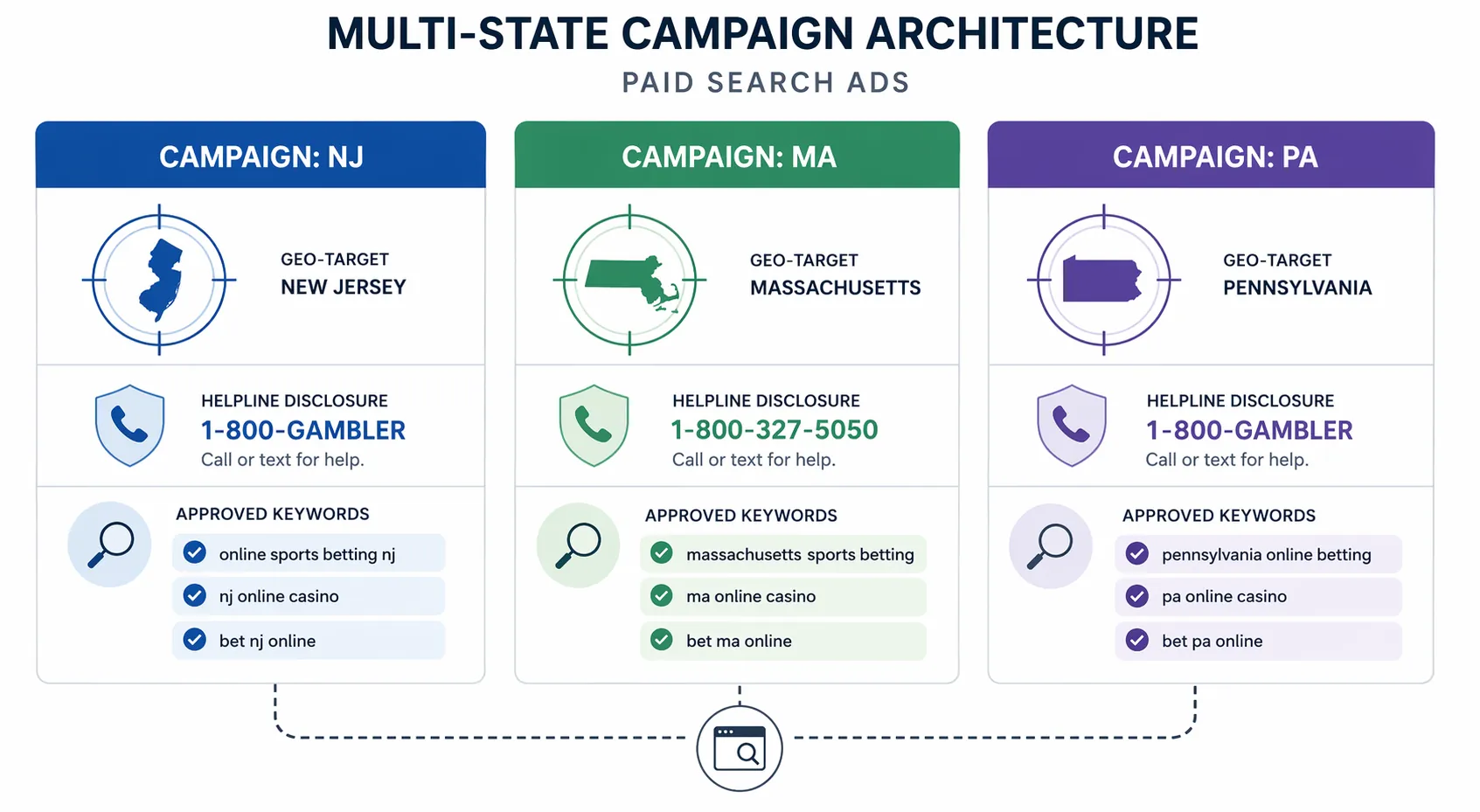
A generic national campaign with state disclosures patched into copy is the wrong shape for this job. It makes the account harder to audit and creates too many small places for mismatches to hide: one location group, one sitelink, one old responsive search ad asset, one landing variant, one excluded state that was not actually excluded.
| Campaign element | State-level control to verify |
|---|---|
| Location targeting | Include only the certified, approved state; exclude states where certification or operator eligibility is not cleared. |
| Ad copy and assets | Use only terminology approved for that state and include the matching responsible-gambling disclosure where required. |
| Landing page | Show the same state offer, eligibility language, and helpline expected from the ad. |
| Budget and bidding | Keep spend isolated so a paused or disapproved state does not disturb approved states. |
| Reporting | Preserve state-level conversion and review evidence instead of blending all registrations into one national line. |
This structure also makes state exclusions explicit. If a market is uncertified, not licensed, pending review, or outside the approved DraftKings offer path, it should not be reachable through broad geo settings, radius spillover, search partner ambiguity, or a landing page that invites out-of-state registration. The account should show what it is not targeting as clearly as what it is targeting.
Promo-Code Keywords Need a Policy Vocabulary
The target keyword sounds commercial, but the keyword system cannot be built like an ordinary coupon account. “DraftKings promo code,” “DraftKings sportsbook promo,” and state-qualified variants may be relevant search demand, but the account still has to avoid claims that create gambling-policy or responsible-marketing risk.
The obvious danger terms are “risk-free” and “guaranteed.” The first implies a gambling outcome or financial exposure that regulators and platforms scrutinize heavily; the second can turn an offer into a promise the advertiser should not be making. Even if a competitor appears to be using aggressive language, copying it is not evidence that the term is safe.
- Treat “risk-free,” “guaranteed,” and similar certainty language as exclusion candidates, not expansion opportunities.
- Separate brand, promo-code, and state-modified terms so each group can be reviewed against the correct landing page and disclosure.
- Keep negative keywords for prohibited gambling claims, unavailable states, social casino confusion, and underage-intent language.
- Review search terms on a compliance schedule, not only on a CPA schedule.
Social casino deserves a separate note because it is an easy way to contaminate the account. PostAffiliatePro and YeezyPay both state that affiliates are banned from running Google Ads for social casino games as of late 2025.[4][3] A sportsbook promo-code campaign should not drift into social casino queries, ad copy, or landing content just because the auction looks cheaper.
The real search job is not maximum reach. It is building enough approved coverage to capture qualified demand while leaving a review trail that shows why the account is eligible, why the user is in an approved jurisdiction, and why the offer language does not overstate the promotion.
Tracking Has to Prove More Than the Click
In a cleaner vertical, a buyer can sometimes get away with browser pixels, last-click reports, and a weekly reconciliation spreadsheet. DraftKings promo code paid search needs a sturdier chain. Track360 and ClickGuard identify server-to-server postbacks, GCLID capture, and offline conversion imports as the tracking architecture that can survive audits in sports betting and gambling PPC.[2][5]
The reason is not only attribution accuracy. A compliant setup has to connect the Google click, the landing domain, the state-specific campaign, the registration or deposit event, and the partner-side conversion record without depending entirely on fragile client-side signals. If a review question comes later, “the platform said we had conversions” is a weak answer.
| Tracking component | Compliance value |
|---|---|
| GCLID capture | Preserves the Google click identifier so conversions can be tied back to the original ad interaction. |
| Server-to-server postback | Reduces reliance on browser-side tracking and gives the affiliate or operator a cleaner event trail. |
| Offline conversion import | Lets approved downstream events be imported back into Google Ads after validation. |
| State and campaign metadata | Shows which jurisdiction, disclosure set, and landing path produced the event. |
| Retention of approval records | Keeps certification, landing-page, and conversion documentation available if the account is reviewed. |
This tracking plan should be mapped before launch because it affects URLs, redirects, consent handling, partner postback parameters, CRM fields, and Google Ads import settings. Retrofitting it after spend starts usually leaves gaps: clicks without state metadata, registrations without GCLID, approved conversions that cannot be imported, or partner events that cannot be reconciled to the campaign that generated them.
A Spend-Ready Standard
A DraftKings promo code account is not ready because the keyword list is large or the offer is timely. It is ready when each targeted jurisdiction has the required Google gambling certification, the domain can pass ownership review, campaigns are segmented by state with matching helpline disclosures, prohibited claims are excluded from keywords and copy, and the conversion path can be audited from click to validated event.
If any of those pieces are still “being sorted,” the campaign is not ready to spend.
References
- Gambling and games policy, Google Ads Help, link
- Google Ads for Gambling & Casino Certification Policy Guide 2026, Track360, June 2026, link
- Running Gambling Ads on Google in 2026, YeezyPay, 2026, link
- Betting Affiliate Google Ads Compliance, PostAffiliatePro, 2025, link
- PPC Strategies for Sports Betting, ClickGuard, 2026, link
Built on this evidence
No Bidding tactic or Creative record currently cites this case file. Compare it against other results in Benchmarks.
Related benchmark reading
Report a corroborating or contradicting result
Seeing something different in your own account? Feed the data-integrity loop instead of leaving an open comment.