
How Gen Z's Financial Struggles Break AI Ad Targeting
Gen Z's rising financial strain—42% live paycheck to paycheck—is degrading the behavioral signals that Advantage+, Performance Max, and Symphony rely on for automated targeting. This article explains the four main vectors of signal decay and what media buyers can do to diagnose and adjust.
- Platform
- Google Ads
- Campaign type
- Performance Max
- Spend range
- General
- Timeframe
- 0
- CPA
- Variable
- Verdict
- Mixed
- Industry vertical
- Ecommerce
- Last reviewed
- 0-07-30
The first symptom usually does not look like a generational trend. It looks like a Gen Z-heavy Performance Max campaign that used to clear target CPA and now swings by week. Or an Advantage+ audience expansion that keeps finding buyers, but the next seed built from those buyers comes back softer. Or a TikTok Symphony setup that gets plenty of purchase events during a sale window, then cannot hold the same economics once the offer ends.
The lazy read is that Gen Z has become less valuable. The more useful read is that the behavioral trail has become noisier. A cohort can still buy, still discover products quickly, and still respond to creative, while also feeding automated bidding systems conversion signals that are harder to interpret. When 42% of Gen Z says they live paycheck to paycheck, that is not just a consumer-confidence fact. For paid media, it changes what a click, cart, purchase, repeat purchase, or lookalike seed may actually mean.[1]

That is the practical answer to the question behind gen z financial struggles impact on ad targeting: financial pressure does not simply lower demand. It changes the composition of the demand that platforms observe. Survival spending can look like intent. Discount arbitrage can look like affinity. A BNPL-funded order can look like the same conversion value as a cash or debit-funded order. A one-session purchase from social discovery can look cleaner than it really is.
None of this proves that Advantage+, Performance Max, or Symphony has a Gen Z-specific flaw. The risk is inferred from how automated campaigns generally optimize: they reward recent conversion behavior, expand from converters, and reallocate budget toward patterns that appear to produce value. If the conversion event itself starts mixing durable demand with constrained cash-flow behavior, the model is still doing what it was asked to do. The buyer’s job is to check whether the event still means what last quarter’s report said it meant.
The Four Ways Gen Z Financial Pressure Degrades Paid Media Signals
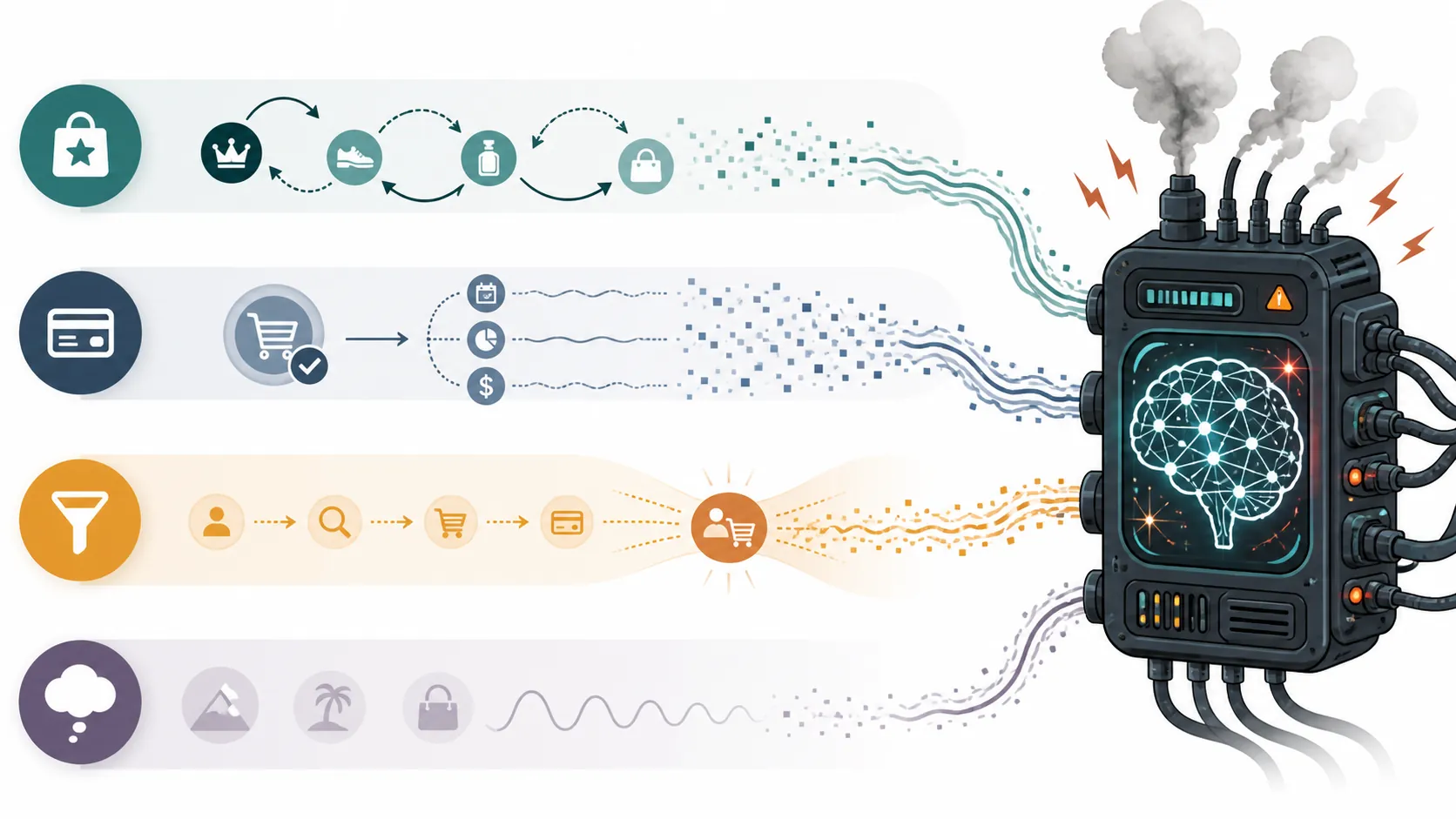
The useful frame is not “Gen Z is broke,” because that does not tell an account owner what to change. The useful frame is signal decay. Four behaviors matter most because each one can be misread by automated targeting and bidding systems.
| Signal vector | What the campaign sees | What may actually be happening |
|---|---|---|
| Brand-switch velocity | Recent buyers jump between brands and retailers | Cost pressure is overriding loyalty, making converter-based audiences less stable |
| BNPL-distorted conversion events | A purchase fires with full order value | The order may depend on payment timing, installment appetite, or credit availability |
| Collapsed funnel compression | Discovery, consideration, and purchase happen inside one short social path | Attribution may over-credit the session that captured demand rather than created it |
| Aspirational intent suppression | Fewer high-intent browsing, wishlist, and full-price signals appear | The consumer may still want the product but is delaying, substituting, or waiting for a sale |
These are not clean buckets in the wild. A sale-period buyer can also use BNPL, arrive from a creator video, and switch brands the next month. That overlap is exactly why account-level averages get dangerous. The platform sees conversion density. The operator has to ask what kind.
Brand Switching Makes Recent Converters a Weaker Loyalty Proxy
Dentsu’s UK Consumer Navigator found Gen Z consumers were 48% more likely to switch brands due to cost.[2] That does not mean every Gen Z buyer is promiscuous or that brand equity is irrelevant. It means cost pressure is strong enough that a recent purchase is less reliable as a loyalty signal.
That distinction matters inside automated accounts. A platform can learn from a Gen Z converter and find more people who resemble that converter’s recent behavior. But if the purchase happened because your product was temporarily cheaper, bundled better, or surfaced during a sale, the model may expand toward bargain-path behavior rather than durable category demand.
This is where lookalike softness often starts. The first campaign looks acceptable because the offer caught buyers in the moment. The next audience or campaign trained from those buyers underperforms because the seed was not full of future loyalists. It was full of people making financially constrained substitutions.
The geographic caveat belongs here. The Dentsu data is UK-based, and Gen Z debt, healthcare exposure, student-loan structures, and retail financing habits differ by country. The targeting lesson still travels, but the magnitude should not be copy-pasted into a US account forecast.
BNPL Turns a Real Conversion Into a Messier Training Event
BNPL is the cleanest example of why “the purchase is real” and “the purchase is a clean optimization signal” are not the same claim. J.D. Power and LendingTree data found that 54% of Gen Z used buy now, pay later for holiday purchases.[3] For the platform, the conversion can arrive like any other order. For the business, the customer economics may be different.
A BNPL-funded order can carry the same cart value as another order in the ad platform, but it may reflect different cash-flow constraints, different sensitivity to promotions, different return behavior, and different repeat-purchase probability. Those differences do not automatically make the order bad. They make the order under-described.
That under-description becomes a bidding problem when the platform is optimizing toward purchase value or purchase volume without payment-method context. If a sale period produces a spike in BNPL-heavy Gen Z purchases, the algorithm may treat the spike as evidence that this pocket of traffic deserves more budget. It cannot know, unless the advertiser passes or analyzes the data elsewhere, whether those purchases behave like the non-BNPL customers the account historically depended on.
This is one reason platform-reported ROAS can feel persuasive and still be incomplete. The sale may have generated revenue. The attribution may be correctly recorded. The problem is that the bid system may be learning from conversion value before the advertiser has checked contribution margin, refunds, repayment-related risk, repeat rate, or post-purchase quality by payment method.
It also affects audience expansion. A lookalike or automated expansion path trained on recent BNPL-heavy converters may learn patterns associated with installment-enabled affordability rather than category commitment. That can be fine if the business wants that buyer and has margins to support the acquisition cost. It is not fine if the account treats those buyers as interchangeable with full-price repeat customers.
The country boundary matters even more for BNPL than for brand switching. The 54% holiday-usage figure is US-market data, and BNPL regulation, provider mix, repayment norms, and merchant economics vary by country. A US apparel account, a UK beauty account, and an Australian electronics account may all see BNPL conversions, but the signal-quality question should be answered locally.
Compressed Social Funnels Make Attribution Look Cleaner Than the Journey
The collapsed-funnel argument should be kept in its lane. Forbes, citing Vogue Business data and industry observation, described Gen Z consumer behavior as compressing discovery, consideration, and purchase into a shorter social-commerce path.[4] That is useful context, not controlled proof that any specific platform touch caused incremental revenue.
For the buyer, the issue is attribution window interpretation. A one-session purchase from a creator clip, social search, product page, and checkout can look beautifully direct in a 7-day click or 1-day view report. But compressed does not always mean incremental. The session may have captured price comparison, social proof, discount validation, and checkout all at once.
When Gen Z financial pressure is layered onto that path, the click may be doing several jobs at once. The consumer may be checking whether the product has a dupe, whether a code exists, whether BNPL is available, and whether the purchase can be justified now. If the campaign only records the final purchase event, the model gets a simplified version of a much more conditional decision.
Loud Budgeting Suppresses the Signals Platforms Usually Like
Aspirational intent has not disappeared. It is being filtered through more public and more deliberate spending restraint. Bank of America reported that 75% of Gen Z were actively looking for ways to save when making social plans, and 41% felt guilt about spending weekly.[1] Operation HOPE and Beyond Finance reported that 71% of Gen Z and millennials said survival spending is the norm and wealth is out of reach.[5]
That shows up in the data exhaust. Fewer full-price purchases, more waiting, more substitution, and more selective checkout behavior can reduce the volume of clean upper-funnel and mid-funnel signals an automated system might normally use. The consumer may still want the brand. The platform may simply see hesitation, price sensitivity, or inconsistent engagement.
PwC’s Gen Z consumer trends data points in the same direction: 82% planned to buy dupes, 79% waited for sales, and only 21% frequently paid full price.[6] Intuit’s 2026 Financial Forecast also found 49% committed to mindful spending.[7] Those are attitude and behavior indicators around price discipline; they are not evidence that Gen Z cannot be acquired profitably.
Why CPA Drift Shows Up Before the Narrative Catches Up
Automated campaigns do not need a perfect consumer theory to spend money. They need usable feedback. If recent converters become more mixed in quality, campaign performance can start wobbling before the team has a language for what changed.
The obvious finance backdrop is real enough. Fortune, citing LendingTree, reported average Gen Z personal debt at $94,101, though that figure includes mortgages, student loans, auto loans, and credit card debt.[8] Deloitte’s 2026 Global Gen Z and Millennial Survey found 55% delaying major life decisions.[9] Those facts help explain why the purchase path is more conditional, but they should not be flattened into a single “Gen Z debt” targeting rule.
Debt composition matters. Mortgage debt can coexist with higher income and household formation. Credit-card debt may imply a different acquisition and retention risk. Student-loan pressure may affect categories unevenly. If those differences are collapsed into one generational label, the account learns nothing actionable.
The more immediate paid-media problem is that platform optimization works faster than human diagnosis. If a campaign receives a burst of Gen Z conversions during a sale, it can reallocate before the buyer has checked payment method, discount concentration, first-order margin, repeat quality, or return rate. By the time CPA moves, the campaign may already have reinforced the wrong pattern.
Account Diagnostics Before You Blame the Platform
There is no Signal & Convert-owned benchmark behind this topic yet, so the right posture is diagnostic, not declarative. The third-party data supports a strong signal-quality concern. It does not support a universal CPA adjustment, a fixed ROAS haircut, or a claim that one platform handles Gen Z better than another.
Start by separating the question “Did Gen Z convert?” from “What did those conversions teach the model?” The second question is the one that changes bidding, audience seeds, and budget splits.
Compare Gen Z-Heavy Cohorts Against Older Cohorts
Do not start with a platform-wide average. Build cohort cuts where age data is available or reasonably inferred through your first-party customer records, surveys, loyalty data, or post-purchase profiles. Then compare Gen Z-heavy cohorts with non-Gen Z cohorts on metrics that describe quality, not just acquisition.
- First-order CPA and first-order ROAS
- Repeat purchase rate by acquisition month
- Refund, cancellation, or return rate
- Average order value with and without promotions
- Margin after discounting, shipping, and payment costs
If Gen Z-heavy cohorts look healthy on first-order ROAS but weaker on repeat rate or margin, the campaign may not be failing. It may be optimizing toward a customer definition that finance would not have approved if it had seen the cohort split earlier.
Separate BNPL and Non-BNPL Purchasers Wherever Possible
If your ecommerce or CRM stack can expose payment method, use it. At minimum, compare BNPL and non-BNPL purchasers by age-heavy cohort, campaign source, discount usage, order value, refund rate, and second-purchase behavior. This does not require assuming BNPL buyers are worse. It requires refusing to let two different economic behaviors train the account as if they were identical.
The adjustment depends on what you find. If BNPL buyers repeat well and carry acceptable margin, they may deserve their own budget logic. If they spike only during discount windows and fade afterward, they should not dominate broad value-based bidding or audience seeds. If payment method cannot be passed into the platform, keep the analysis in the warehouse and use it to guide campaign exclusions, value rules where appropriate, promo calendars, and seed construction.
Inspect Discount Concentration Before You Trust Converter Seeds
A converter seed built after a sale is not neutral. Check what share of Gen Z-heavy conversions occurred during sale periods, with promo codes, through clearance SKUs, or on bundles that do not represent normal pricing. PwC’s data on dupes, sale waiting, and low full-price frequency makes this especially important for categories where substitutes are easy to find.[6]
If a recent seed is heavily discount-shaped, consider building a cleaner seed from full-price purchasers, repeat purchasers, higher-margin buyers, or customers acquired outside the sale period. The goal is not to punish discount buyers. The goal is to stop a temporary promotional behavior from becoming the account’s definition of future demand.
Review Attribution Windows Around Social-Session Purchases
For Gen Z-heavy campaigns, isolate purchases with very short discovery-to-checkout paths when the data is available. Look at same-session purchases from paid social, creator-driven traffic, social search, and retargeting pools. Compare them with longer-consideration buyers on repeat rate and discount dependency.
A short path is not automatically low quality. It is simply more vulnerable to over-crediting the final paid touch. If the same buyer had already seen organic creator content, searched for a dupe, waited for a code, and then clicked the ad, the platform report may be operationally useful but strategically incomplete.
Be Careful With Lookalikes Trained on Recent Gen Z Converters
The riskiest seed is not “Gen Z purchasers.” It is recent Gen Z purchasers from a narrow period when BNPL usage, sale intensity, creator virality, or price comparison behavior was unusually high. That seed can still produce volume, but the next ring of users may carry the same fragility.
For audience expansion, test seed variants instead of arguing about the generation. Use repeat purchasers, non-discount purchasers, high-margin purchasers, non-BNPL purchasers, or purchasers with acceptable post-purchase quality as separate inputs where the platform and data permissions allow it. Then judge the downstream cohort, not just the launch-week CPA.
Settings and Reporting Changes That Usually Matter First
The exact controls differ by platform, and no public platform statement says Advantage+, Performance Max, or Symphony processes Gen Z BNPL behavior in a special way. Keep the fixes at the level the evidence supports: cleaner conversion inputs, better cohort reporting, and more cautious budget interpretation.
- Audit conversion value definitions so purchase value does not hide margin, refund, payment-method, or discount differences.
- Create cohort reports that split Gen Z-heavy buyers by payment method, promotion use, and acquisition window.
- Avoid building broad expansion seeds from sale-period converters until repeat and margin quality are known.
- Compare attribution-window performance against post-purchase quality, especially for social-session purchases.
- Use budget tests to validate Gen Z-heavy segments rather than assuming the platform-reported ROAS lift will survive outside the promo context.
If the account uses value-based bidding, the most important question is whether the value being passed is the value the business wants optimized. Gross revenue can be a poor teacher when a cohort is more promotion-sensitive, more likely to finance the order, or more likely to buy only when the price drops. Adjusting value inputs or offline conversion imports may matter more than changing creative or blaming the campaign type.
If the account uses purchase-volume optimization, watch for cheap conversion clusters that do not mature. A lower CPA during a sale can be useful, but only if the buyer knows whether those customers return, keep the product, or need another discount to buy again.
If the account relies heavily on broad targeting, resist the urge to solve every wobble with more exclusions. Broad systems can still work when the event quality is honest. The better first move is usually to clean the feedback loop: what counts as a valuable conversion, which customers become seeds, and which reporting cuts decide whether a campaign scales.
What Not to Overclaim
This evidence does not prove that Gen Z audiences are unprofitable. It does not prove that BNPL buyers are bad customers. It does not prove that collapsed funnels make paid social non-incremental. It also does not justify a universal bid modifier, because the cited research is third-party consumer data, not a controlled benchmark across ad accounts.
Gen Z can still convert. The audit is whether those conversions represent durable demand, debt-timed purchasing, discount dependence, one-session social discovery, or some mix of all four. Until payment method, discount dependence, funnel timing, and repeat quality are visible, automated bidding and audience expansion are learning from a signal that is real but not clean.
References
- BofA Study Finds Fewer Gen Z Rely on Family for Financial Assistance, Bank of America, May 2026, link
- Gen Z consumer behaviour in 2026, Dentsu, 2026, link
- J.D. Power/LendingTree Gen Z holiday BNPL usage data, J.D. Power/LendingTree, link
- How Gen Z’s Consumer Behavior Collapsed The Marketing Funnel, Forbes, June 2026, link
- Over Seventy Percent of Gen Z and Millennials Say Survival Spending Is the Norm and Wealth Is Out of Reach, Operation HOPE/Beyond Finance, link
- Gen Z consumer trends, PwC, link
- 2026 Financial Forecast, Intuit, link
- Gen Z, the economy, and disillusionomics, Fortune, 2026, link
- 2026 Global Gen Z and Millennial Survey, Deloitte, 2026, link
Built on this evidence
No Bidding tactic or Creative record currently cites this case file. Compare it against other results in Benchmarks.
Related benchmark reading
Report a corroborating or contradicting result
Seeing something different in your own account? Feed the data-integrity loop instead of leaving an open comment.