
What Claude Opus 5 API Actually Costs Advertisers
Claude Opus 5's API pricing translates to roughly $0.005 per ad-copy call, but optimization levers like prompt caching and batch API can drop effective costs to $2–$5 per month for a mid-size agency. This article compares those costs against performance data from a 247-campaign A/B test to help advertisers decide whether the higher output quality justifies the investment.
- Platform
- Google Ads
- Campaign type
- Performance Max
- Spend range
- $0–$20 per month
- Timeframe
- July 0
- CPA
- $0
- Verdict
- win
- Industry vertical
- ecommerce
- Last reviewed
- 0-07-25
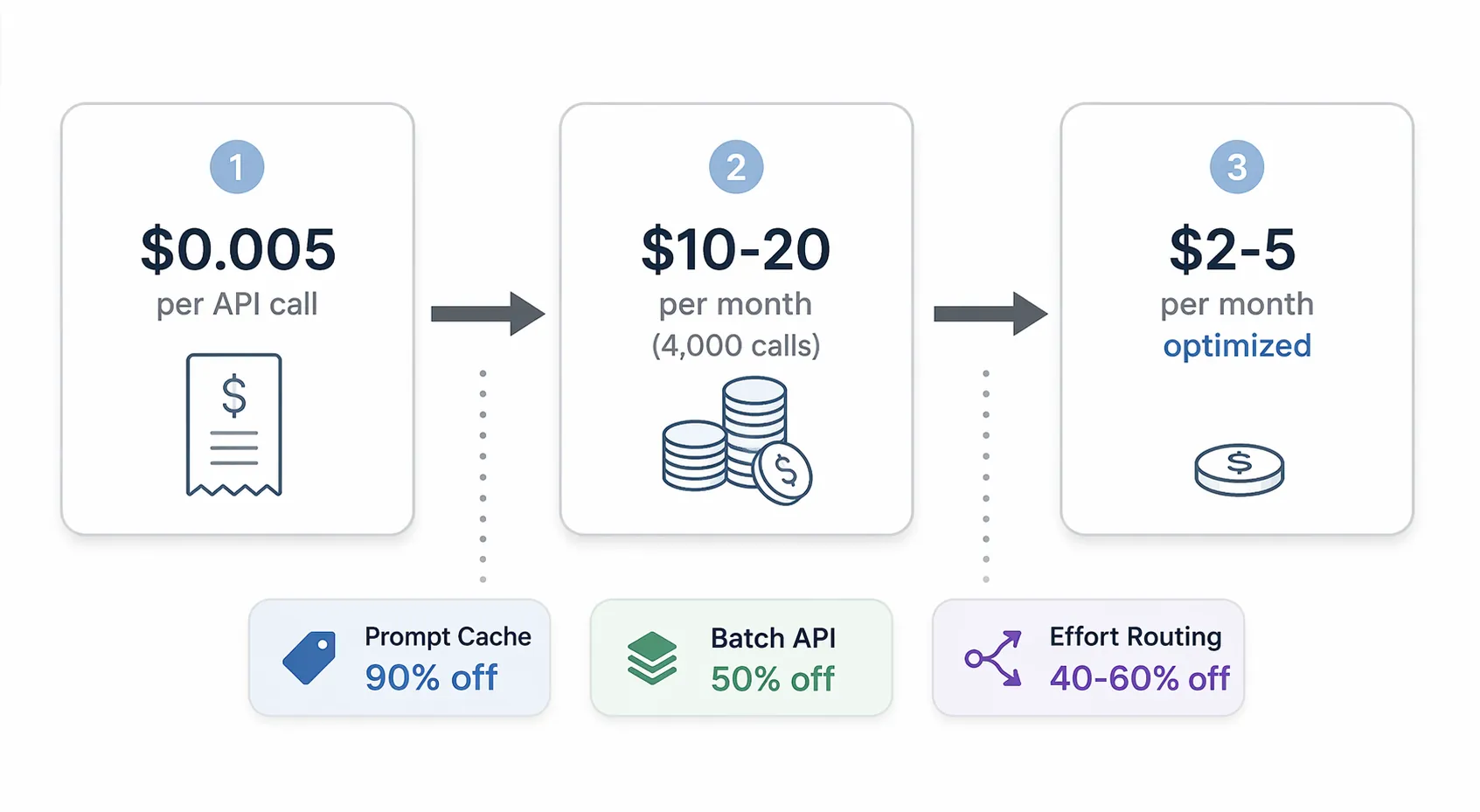
For ordinary ad-copy generation, Claude Opus 5 API cost is not the budget line that should decide the media plan. At the quoted $5 per million input tokens and $25 per million output tokens, a small ad-copy call lands in the half-cent to one-cent range depending on output length, caching, and how much reusable prompt text is counted each time. Using the common 500-token prompt plus 300-token output planning example, the working estimate is roughly $0.005 per call; even a stricter uncached reading of the list prices keeps the number around a penny, not dollars.[1][2]
Scale that to an agency running 200 campaign briefs a month with 20 variants each. That is 4,000 calls. The raw monthly bill is roughly $10–$20 in the planning model used for advertiser scenarios, before optimization. With prompt caching, Batch API, and low-effort routing for routine variants, the same workflow can fall into the $2–$5 range.[3][4]
The Campaign Math Before Anyone Debates the Model
Claude Opus 5 was announced on AWS Bedrock on July 24, 2026, with the model ID global.anthropic.claude-opus-5. The $5/$25 per million-token price level is also listed in BenchLM.ai’s July 2026 Claude API pricing registry, matching the upper Claude tier rather than the cheaper Sonnet or Haiku lanes.[1][2]
As of July 25, 2026, that pricing should still be treated as something to verify in the channel where you actually buy compute. AWS Bedrock availability is confirmed, while the exact direct Anthropic API model identifier was not confirmed in the provided research. The point for advertisers is narrower: at the published Opus-class token price, the bill is still tiny beside normal paid-media waste.
| Advertiser Workflow | Volume | Estimated Opus 5 API Cost |
|---|---|---|
| One ad-copy generation call | 500-token prompt + 300-token output | Roughly $0.005 planning cost; around one cent if fully uncached at list price |
| One campaign brief | 20 variants | About $0.10–$0.20 |
| Mid-size agency month | 200 briefs x 20 variants = 4,000 calls | About $10–$20 raw in the advertiser scenario |
| Optimized agency month | Cached prompts, async batches, low effort for bulk variants | About $2–$5 |
That table is why the token-price argument often feels disconnected from the account. One weak creative test can burn through more than the monthly Opus 5 bill before lunch. If a team is spending an hour defending a $15 API line while letting unproven angles absorb hundreds or thousands in media, the budgeting conversation has drifted away from the expensive part of the system.
Where Optimization Actually Changes the Invoice
The cheapest version of an Opus 5 ad workflow does not send every request as if it were a brand-new strategic problem. Most ad production has repeated material: brand rules, offer constraints, compliance language, landing-page context, audience notes, and examples of approved copy. If those parts are stable, prompt caching matters more than shaving a few words from the user prompt.
Anthropic’s prompt caching documentation gives a 90% discount on cached input reads, and its Batch API applies a 50% discount for asynchronous work.[4] For advertisers, the clean split is simple: cache the reusable account and brand context, batch the overnight variant generation, and reserve real-time calls for briefs that someone is actively editing.
- Cache the durable context: brand voice, prohibited claims, offer mechanics, product facts, funnel stage, and previous winning angles.
- Batch non-urgent production: bulk variants, first-pass headline sets, audience-specific rewrites, and refreshes for older ad groups.
- Route by importance: low effort for routine variations, higher effort for hero concepts, new positioning, or expensive launch tests.
- Audit output length: long rationale blocks and unused analysis can cost more than the ad copy itself.
The effort setting deserves a real note because it is the kind of thing that makes invoice reconciliation annoying later. Metacto’s analysis of Opus 4.8 adaptive thinking says higher-effort defaults can increase thinking-token usage, and low effort can reduce thinking tokens by roughly 40–60% for routine work.[5] That does not mean every Opus 5 implementation behaves identically, but it is enough reason to make effort level an explicit field in the workflow rather than letting defaults quietly decide the bill.
The APIpulse agency model is useful as a sanity check, not as proof of a pure Opus 5 stack. Its mid-size agency example estimated $19–$120 per month in total AI API spend using a tiered mix of models, including cheaper options, so a 100% Opus 5 workflow would start higher before optimization.[3] The practical lesson still holds: agencies do not need to route every task through the premium model to get premium-model value where it matters.
The Real Question Is Whether Better Copy Moves Paid Results
Low API cost does not prove campaign lift. It only removes a bad objection. The stronger model still has to produce angles, hooks, structures, and landing-page continuity that survive auction pressure, audience fatigue, compliance review, and the account’s actual conversion economics.
The best performance evidence in the provided material is Ryze AI’s 247-campaign A/B test comparing a Claude Sonnet-class model against ChatGPT-4o for ad copywriting. Ryze reported 23% higher CTR for Claude, with 2.47% versus 2.01%; 18% lower CPA, with $47.50 versus $57.80; and 31% higher conversion rates, with 4.2% versus 3.2%.[6]
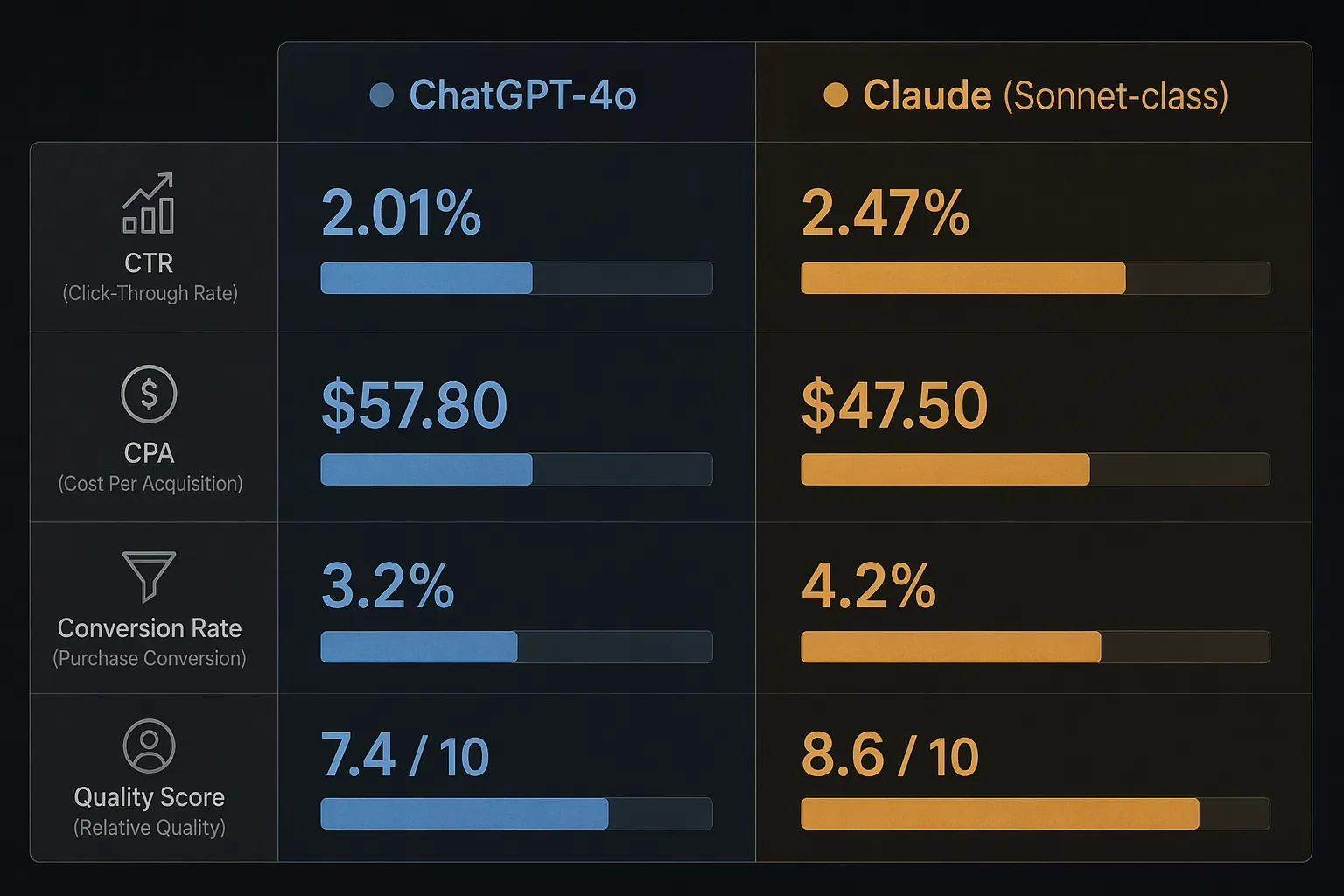
That is meaningful directional evidence, but it is not an Opus 5 A/B test. The Ryze result used Claude 3.5 Sonnet against ChatGPT-4o, not Claude Opus 5 against today’s full competitive set. It supports the narrower claim that a Claude model performed better than ChatGPT-4o in that published ad-copy test. It does not prove that Opus 5 will deliver the same CTR, CPA, or conversion-rate deltas in every vertical.
Still, the size of those deltas explains why the API invoice is the wrong place to obsess. If better copy lowers CPA by even a small fraction of the Ryze-reported gap in a real account, the difference overwhelms a few dollars of token spend. If it does not move CPA, conversion rate, or ROAS, then the premium model is a writing-quality upgrade without a paid-media business case.
Use Opus 5 Where the Copy Has Leverage
The right workflow is not “Opus 5 for everything” or “never pay premium token prices.” It is routing. Use the expensive model where judgment, positioning, and nuance could change the test outcome. Use cheaper models for mechanical expansion, formatting, localization drafts, naming conventions, and first-pass permutations that a buyer or strategist will filter anyway.
| Task | Sensible Routing |
|---|---|
| New campaign angle development | Opus 5, especially for high-spend launches or crowded markets |
| Hero ad concept, landing-page promise, or offer reframing | Opus 5 with higher effort and human review |
| Twenty routine headline/body variants from an approved angle | Lower effort, cached context, often batched |
| Compliance-safe rewrites and character-count resizing | Cheaper model or low-effort Opus route |
| Weekly refreshes for fatigue management | Batch processing unless the spend level justifies active review |
This is also how to defend the workflow in a budget meeting. Do not argue that Opus 5 is smarter in the abstract. Show that premium calls are reserved for the parts of the account where better language can plausibly change auction behavior or post-click intent, while commodity production is cached, batched, or routed down.
Small Bills Can Still Be Misread
Two operational details can make a clean-looking cost model drift. First, tokenizer changes can make identical text count differently across Claude versions. Metacto and Coursiv both flag tokenizer and model-generation differences around the newer Opus line, with reported token-count inflation ranging from 1.0x to 1.35x versus older Opus 4.6-style baselines.[5][7] If an agency migrates prompts unchanged and sees a higher bill, the copy did not necessarily get longer; the counting may have changed.
Second, effort defaults can make routine variants more expensive than intended. A prompt that asks for 30 headline options does not need the same reasoning budget as a launch-positioning brief for a seven-figure quarterly push. If the workflow does not set effort deliberately, the team may end up paying for deep thinking on copy that will be skimmed, filtered, and rewritten anyway.
Neither issue turns Opus 5 into a budget threat. They just make clean measurement harder. Tag calls by task type, model, effort level, cached versus uncached input, and campaign or client. Without that, the invoice becomes one blended number, and nobody can tell whether premium spend went to strategy, bulk variants, or accidental overprocessing.
The Decision Rule for Advertisers
Do not reject Claude Opus 5 because the token price looks high on a pricing table. At ad-copy scale, the API cost is usually a rounding error once prompt caching, Batch API, and effort routing are in place. The bigger mistake is treating a better model as if it automatically means better ROAS.
Run Opus 5 where copy quality could plausibly affect paid results: new offers, new audiences, high-spend creative tests, repositioning work, and places where weak messaging has already shown up as low CTR, poor conversion rate, or high CPA. Keep routine production cheap. Then judge the workflow by measured CPA or ROAS movement in the account, not by whether the API invoice is $4 or $19.
References
- Introducing Claude Opus 5 on AWS, AWS, July 24, 2026
- Claude API pricing registry, BenchLM.ai, July 2026
- AI API Cost for Advertising & Marketing, APIpulse
- Anthropic platform pricing docs, Anthropic
- Claude API Pricing 2026, Metacto
- Claude vs ChatGPT for Ad Copywriting: Which AI Wins in 2026?, Ryze AI
- Claude Opus 5: Release Date & Model Guide, Coursiv
Built on this evidence
No Bidding tactic or Creative record currently cites this case file. Compare it against other results in Benchmarks.
Related benchmark reading
Report a corroborating or contradicting result
Seeing something different in your own account? Feed the data-integrity loop instead of leaving an open comment.