
Chinese robot ban signals ad-tech AI regulatory risk
The FCC's ban on Chinese humanoid robots uses the same legal rationale as active investigations into Chinese AI models used by US advertisers. This article maps the regulatory escalation path and offers a monitoring framework for media buyers tracking ad-tech AI exposure.
- Platform
- Google Ads
- Campaign type
- Performance Max
- Spend range
- Variable
- Timeframe
- 0-07-28
- CPA
- Not quantified
- Verdict
- mixed
- Last reviewed
- 0-07-30
The July 28, 2026 FCC action against Chinese humanoid robots is not mainly useful to media buyers because of the robots. It is useful because the agency used familiar national-security and data-collection logic through a Covered List-style mechanism, the same kind of regulatory plumbing now appearing around Chinese AI model use by US companies.
That does not mean an advertising AI ban has been announced. No US official has said Performance Max, Advantage+, TikTok Symphony, creative automation vendors, bidding tools, or SaaS copilots are next. The point is narrower and more operational: the escalation path is no longer a thought experiment. If a platform, cloud vendor, workflow tool, or optimization layer quietly depends on a cheaper Chinese model, the person explaining a campaign interruption will probably be the media buyer long before the vendor’s legal team publishes a clean dependency map.

The robot ban matters because the mechanism is reusable
The FCC’s official Covered List order, DOC-423682A1, framed the humanoid robot restriction around communications-security risk, data collection, and national security rather than a narrow consumer-product defect.[1] Reuters, AP, and The Guardian treated the July 28 action as part of a widening US-China technology deceleration cycle, following DJI drone restrictions in December 2025 and semiconductor export-control pressure.[2][3][4]
For ad-tech teams, the important part is not whether a robot has arms, cameras, or a warehouse route. The important part is that the government has a working template: identify a technology supplier, argue that its sensors, software, or data flows create national-security exposure, then restrict access through an existing security mechanism. That same template does not need much imagination to reach AI model providers, model-routing services, or vendors that embed third-party models into marketing workflows.
The live connection is already visible outside advertising. House Homeland Security and the House Select Committee on China sent investigative letters to Cursor and Airbnb over Chinese AI model use, asking how US companies were using or exposing data to Chinese systems.[5] Those letters matter because they move the issue from abstract model competition into vendor procurement, data handling, and enterprise exposure — the exact terrain where paid-media stacks are messiest.
That is where the annoyance starts. Media buyers do not buy “AI infrastructure” as a clean line item. They buy campaign automation, creative scoring, feed enrichment, landing-page testing, customer routing, budget pacing, audience prediction, reporting cleanup, and support copilots. Somewhere underneath, a vendor may be choosing models based on latency, quality, price, margin, or availability. The advertiser may never approve that substitution directly.
Chinese model use is operationally present, not a fringe lab habit
The adoption numbers explain why this is showing up now. CNBC reported on July 7, 2026 that Chinese AI models had more than 30% token share on OpenRouter, with some weeks reaching 46%.[6] Token share is not the same thing as effectiveness, enterprise adoption, or advertising-platform dependency. It is still a useful pressure gauge: developers and vendors are routing real workload through these models.
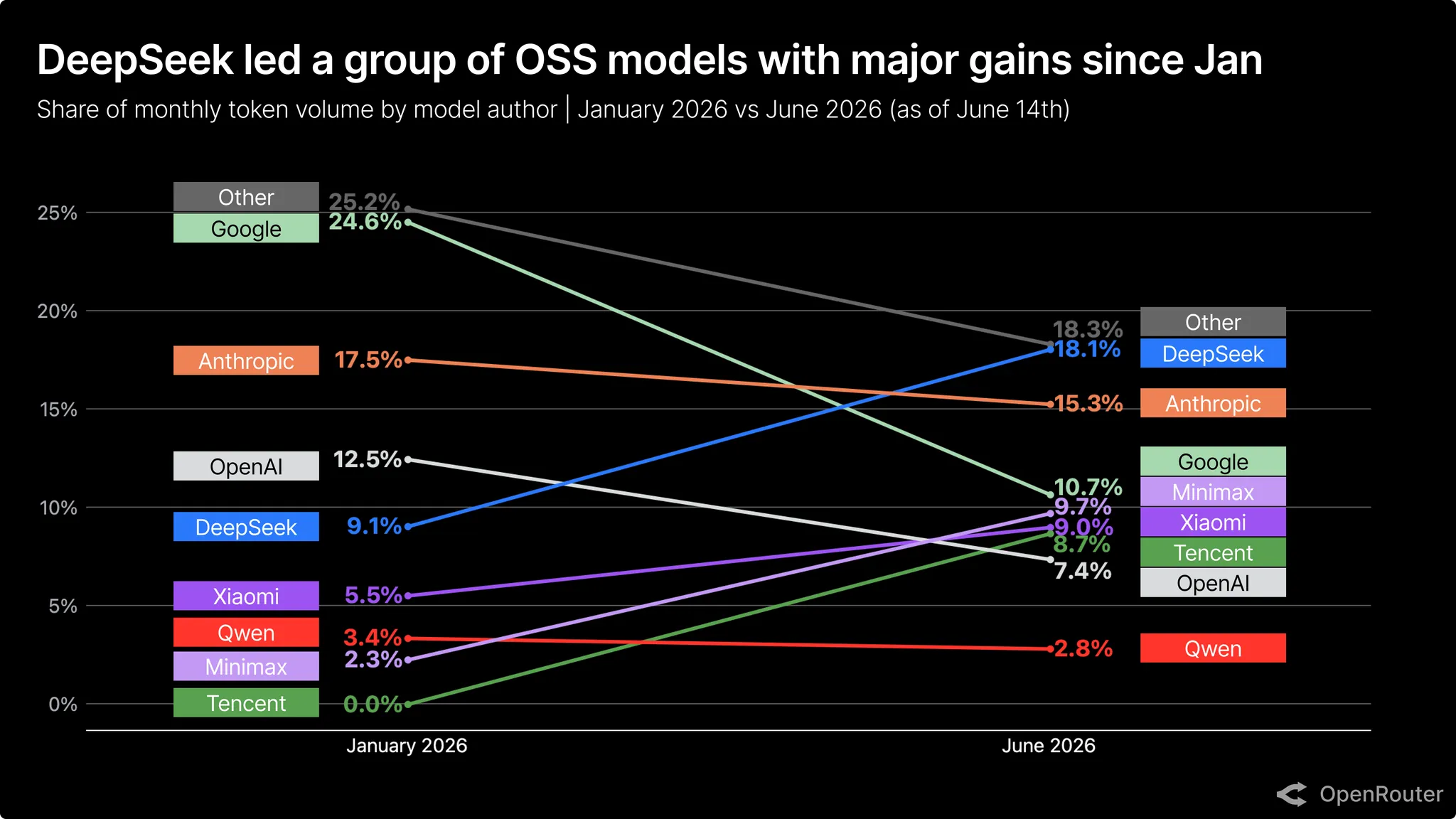
Cost is the obvious reason. NPR reported on July 15, 2026 that some startups were switching to Chinese models for 60% to 90% cost savings, including Lindy.ai’s full migration to DeepSeek V4.[7] That does not prove the cheaper model is safer, better, or suitable for every advertising use case. It proves that the incentive to switch is large enough for vendors to take seriously.
In ad tech, that incentive lands in places buyers rarely see. A creative vendor may use one model to generate variants and another to classify winning hooks. A reporting tool may use a low-cost model to summarize account changes. A bidding-adjacent workflow may route text, feed, or audience inputs through a general-purpose model without calling it an advertising model. The advertiser experiences the feature as “AI optimization,” not as a named model dependency.
The cost impact question is real, but it is not the center of this piece. The existing tracker article Will a Chinese AI Ban Raise Your CPC and CPA? covers the mechanics of how a forced model change could flow into CPC, CPA, creative throughput, and vendor pricing. The July 28 robot action adds a different question: what regulatory signal would tell a buyer that a forced model change has become more likely?
The pressure chain is no longer only congressional
The House letters are one part of the chain. Sanctions language is another. BBC reported that White House OSTP director Michael Kratsios accused Moonshot AI of distilling Anthropic’s models, while Treasury Secretary Scott Bessent said sanctions were “on the table.”[8] That is a different lever from procurement questions. It points at named AI labs and model providers rather than only at the US companies using them.
Then there is the industry response. CNN reported on July 29, 2026 that Mark Zuckerberg warned against banning Chinese AI models.[9] The warning does not prove a ban is imminent. It does show that the possibility is serious enough for a major platform executive to intervene publicly, one day after the FCC’s robot action.
This is the part that should make an operator slow down. The chain now includes an agency mechanism, congressional inquiry, sanctions language, and public pushback from a platform leader. None of those pieces alone says “ad-tech AI is next.” Together, they make Chinese model exposure a procurement and continuity issue, not just a policy debate.
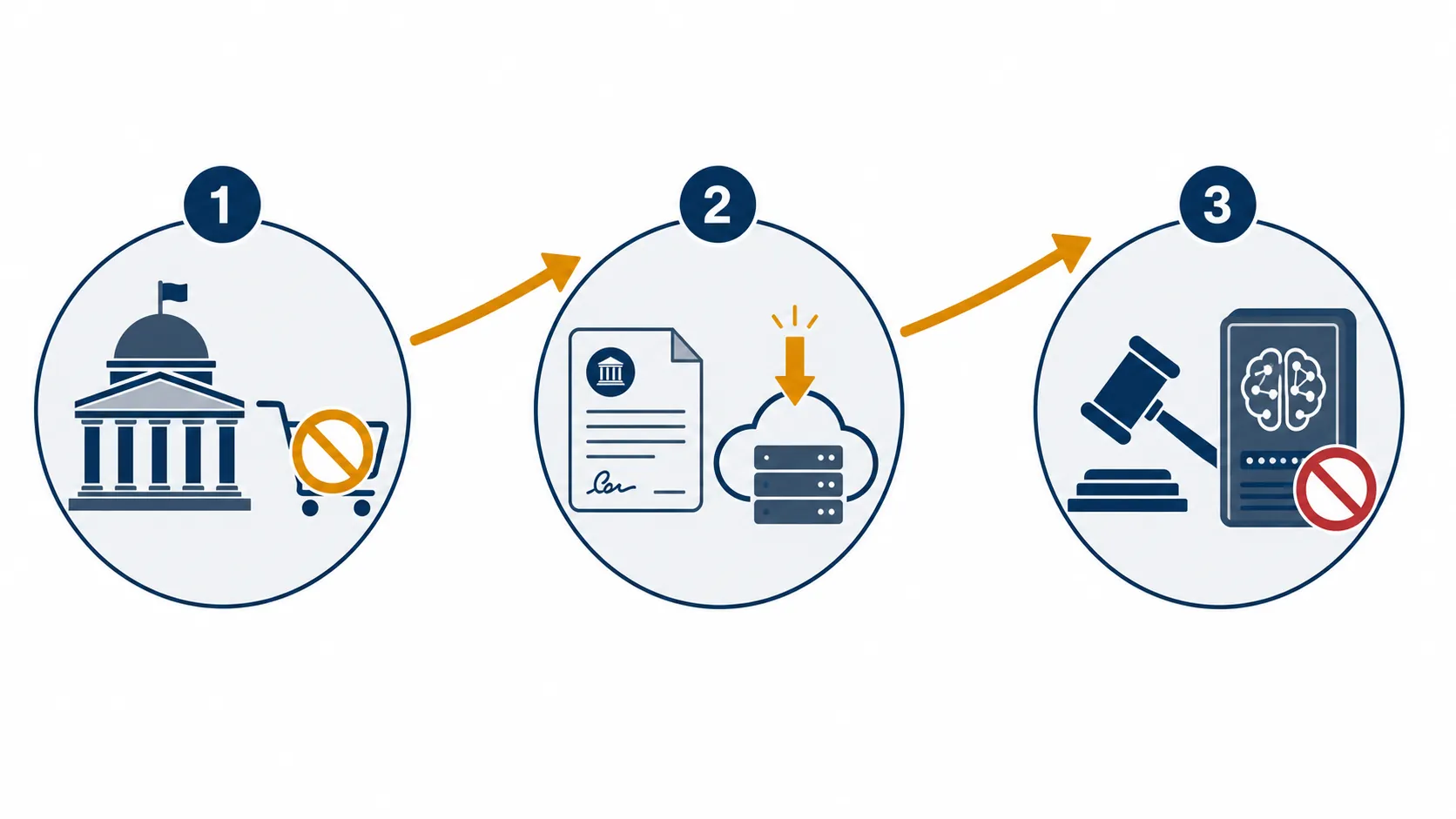
Three escalation paths to watch
The evidence supports three plausible paths. It does not support assigning probabilities, dates, or a confident claim that any one path will happen. The useful exercise is to map which kind of signal would matter to a media buyer before it shows up as a platform notice or vendor price increase.
1. Federal procurement restrictions hit vendors before advertisers
The first path is the least dramatic for private advertisers but still disruptive. Federal agencies, contractors, and grant-funded organizations could face restrictions on tools that use named Chinese AI models. The direct rule would sit in government procurement, but the indirect effect would land with vendors that serve both public-sector and commercial customers.
If a SaaS vendor has to maintain one compliant model stack for federal clients and another cheaper model stack for everyone else, that vendor has a margin problem. It may standardize on the compliant stack, raise prices, remove features, or slow rollout for certain AI functions. The media buyer may never see the words “procurement restriction.” They may see slower creative generation, fewer automated recommendations, more expensive enrichment, or a support note saying a feature is temporarily unavailable.
2. Congressional and agency pressure forces disclosure from platforms and SaaS vendors
The second path grows directly from the Cursor and Airbnb letters. Investigators do not need to ban a model to create pressure. They can ask vendors which Chinese models they use, what data is sent, whether customer prompts are retained, whether outputs enter customer-facing workflows, and whether sensitive user or business data is exposed.[5]
For advertising, that path matters because the dependency graph is layered. A brand may buy a media platform, an agency may add a creative-testing tool, the tool may call a model router, and the router may use a Chinese model for some tasks because it is cheap or fast. If congressional letters start naming ad-tech vendors, marketing-cloud vendors, social platforms, creative AI tools, or model-routing services, the operational question changes from “is there a ban?” to “which vendors can document their model stack under pressure?”
This is also the path where buyers can do the most before a formal rule appears. Procurement teams can ask for model-provider disclosures, data residency statements, subprocessors, fallback plans, and notice periods for model substitutions. A vendor that cannot answer those questions may still be a fine product vendor. It is not a low-risk vendor if a campaign’s automation, reporting, or creative throughput depends on it.
3. Named model providers face sanctions or Covered List-style treatment
The third path is the sharpest. If Treasury or another federal authority targets named Chinese AI labs, vendors using those models would have to respond quickly. Bessent’s “on the table” sanctions comment is not a rule, but it places model-provider sanctions inside the official option set.[8]
A Covered List-style approach would be different from ordinary vendor diligence because it would create a public designation problem. Once a provider is named, downstream users have less room to treat the model as a neutral commodity. Platforms and SaaS vendors may remove the model, route around it, suspend affected features, or rewrite contract language. Buyers would be left sorting out which performance changes came from normal auction movement and which came from infrastructure replacement.
This is where platform abstraction becomes a risk. PMax, Advantage+, and Symphony are already black-box enough from the buyer’s seat. Add undisclosed model dependencies underneath creative generation, recommendation systems, support tooling, or measurement assistance, and a regulatory shock can look like a routine performance wobble until the vendor finally explains what changed.
| Path | What would change first | Why media buyers should care |
|---|---|---|
| Procurement restrictions | Government-facing vendors adjust approved AI stacks | Commercial customers may inherit higher costs, slower features, or reduced automation |
| Vendor investigations | Platforms and SaaS tools face disclosure pressure over Chinese model use | Advertisers need model dependency answers before disruption becomes public |
| Sanctions or Covered List-style treatment | Named AI labs or model providers become restricted counterparties | Fallback routing, feature suspensions, and pricing changes could hit campaign workflows |
What this does and does not say about ad-tech AI
It does not say Google, Meta, TikTok, or any named ad platform is using a restricted Chinese model in a way that will trigger enforcement. The provided record does not establish that. It also does not say Chinese models are ineffective, unsafe in every use case, or uniquely risky compared with every US alternative.
It says the regulatory rationale being used against connected Chinese hardware overlaps with the rationale being used to investigate Chinese AI model exposure: data collection, national security, and the ability of US organizations to verify where sensitive information goes. It also says the economic incentive to use cheaper Chinese models is strong enough that buyers should not assume their vendors avoided them out of caution.
That distinction matters in budget meetings. A media buyer does not need to tell finance that a Chinese AI ad-tech ban is inevitable. They can say something more defensible: recent FCC, congressional, Treasury, and platform-executive signals make AI model dependency a live regulatory exposure, and campaign-critical vendors should be able to explain their model stack and fallback plan.
The monitoring framework
The next useful signals are specific. Broad commentary about an AI cold war is less useful than dated documents, named vendors, and mechanisms that force operational change.
- Watch for new Covered List or FCC language that names AI model providers, model-routing infrastructure, or software systems rather than only hardware.
- Watch for additional congressional or agency letters to ad-tech platforms, marketing-cloud vendors, creative AI tools, workflow SaaS companies, or model routers about Chinese model use.
- Watch for Treasury, White House, or sanctions signals aimed at named Chinese AI labs, especially if the language ties model training, distillation, data access, or national-security exposure to commercial use.
- Ask critical vendors whether they use Chinese AI models directly or through subprocessors, whether customer data is sent to those models, and how much notice customers receive before model substitutions.
- Separate auction movement from infrastructure movement when performance changes. A CPC or CPA shift after a vendor model swap is a different problem from ordinary competitive pressure.
This belongs in the Tracker because it is a dated regulatory signal, not a finished prediction. The path may escalate, narrow, or cool. Until then, the July 28 FCC robot ban is worth logging as a public test of a mechanism that could reach the AI infrastructure sitting underneath advertising workflows.
References
- FCC DOC-423682A1, Federal Communications Commission, July 28, 2026.
- FCC bans Chinese humanoid robots over national security concerns, Reuters, July 2026.
- US moves to restrict Chinese humanoid robots, AP, July 2026.
- US ban on Chinese humanoid robots raises tech security concerns, The Guardian, July 2026.
- House committees investigate Cursor and Airbnb over Chinese AI model use, CNBC, July 8, 2026.
- Chinese AI models gain more than 30% token share on OpenRouter, CNBC, July 7, 2026.
- Startups switch to Chinese AI models for lower costs, NPR, July 15, 2026.
- US officials accuse Moonshot AI of distilling Anthropic models as sanctions loom, BBC, 2026.
- Zuckerberg warns against banning Chinese AI models, CNN, July 29, 2026.
Built on this evidence
No Bidding tactic or Creative record currently cites this case file. Compare it against other results in Benchmarks.
Related benchmark reading
Report a corroborating or contradicting result
Seeing something different in your own account? Feed the data-integrity loop instead of leaving an open comment.