
Palantir CEO's AI regulation warning hits home for adtech this week
Alex Karp warned against overregulation, but multiple AI ad rules take effect this week. This article breaks down the specific regulatory deadlines, which platform features they affect, and what to check in your campaigns before enforcement escalates.
- Platform
- Google Ads, Meta Ads, TikTok Ads
- Campaign type
- Performance Max, Advantage+, TikTok Symphony
- Spend range
- All
- Timeframe
- July to August 2026
- Regulatory deadlines count
- 4
- Verdict
- mixed
- Industry vertical
- ecommerce, B2B, local service
- Last reviewed
- 2026-07-29
Alex Karp gave the week its headline when he warned U.S. policymakers not to copy Europe’s AI regulation model, arguing that Europe had “regulated itself out of business.” The useful part for adtech is not the theater of the quote. It is the calendar sitting behind it: EU AI Act Article 50 transparency obligations are scheduled to apply on August 2, 2026; New York’s synthetic performer disclosure law is already live; and Google’s July 2026 AI labeling update is already changing what can appear inside ad creatives. For anyone running Performance Max, Advantage+, TikTok Symphony, or agency-built AI video at scale, the impact of the Palantir CEO’s AI regulation warning on adtech is no longer an abstract policy argument. It is a launch-readiness problem. [1][2][3][4]

| Change | Effective timing | Who should care | Campaign feature to check |
|---|---|---|---|
| EU AI Act Article 50 transparency requirements | Scheduled for August 2, 2026, with delay proposals noted | Advertisers reaching EU audiences, even if the buyer sits outside the EU | AI-generated or AI-manipulated creative, disclosure workflows, synthetic media labels, automated deployment controls |
| Google Ads AI labeling update | Rolled out July 2026 | Teams using Google AI tools or uploading synthetic assets into Google Ads | Creative specs, label eligibility, auto-labeling behavior, asset review notes |
| New York synthetic performer disclosure law | Effective June 9, 2026 | Advertisers using AI-generated performers in creative connected to New York obligations | AI actors, voice likenesses, synthetic spokespeople, agency-produced video |
| FTC AI advertising enforcement activity | Active through Operation AI Comply; Growth Cave settlement reported in early 2026 | Advertisers making AI performance claims or using AI-driven offers | Claims substantiation, landing pages, funnel language, vendor claims |
That table is the part most accounts need before the policy debate. If a campaign cannot be launched, labeled, reviewed, or geo-controlled correctly, the philosophical question of whether Europe is moving too fast does not help the buyer who owns the budget line.
Karp is a useful hook, not the operating manual
Karp’s complaint is not just anti-regulation boilerplate. Palantir has argued for regulating AI in application context rather than treating general-purpose AI as one undifferentiated category. That position matters in advertising because the work is already application-specific: one campaign may use synthetic performers, another may rely on automated audience expansion, another may generate image variations inside a platform tool, and another may use AI only for internal copy drafting. Those are not the same risk surface. [5]
The conflict is also worth keeping in view. Palantir sells AI infrastructure and has commercial reasons to prefer rules that do not slow enterprise deployment. Its critique of broad regulation can still be right in places, but buyers should not let vendor-side anxiety replace account-level inspection. Adtech is not waiting for a grand settlement over AI. It is accumulating dated obligations and platform policy changes one surface at a time.
The EU deadline is the one to open first
Article 50 of the EU AI Act is the most urgent item because it is scheduled to apply on August 2, 2026, four days from the current publication date. Charles Russell Speechlys’ 2026 advertising lookahead says the transparency requirements can affect advertising that reaches EU audiences regardless of where the advertiser is based, and it cites penalties of up to €15 million or 3% of global annual turnover for non-compliance. The same analysis notes that proposals to delay some provisions exist, so the date should be tracked rather than treated as politically immune. But a possible delay is not a campaign-control strategy. [2]
The practical audit starts with geography. Pull campaigns reaching the EU directly, then pull campaigns that may reach the EU through broad location settings, expansion products, reseller campaigns, affiliate traffic, catalog syndication, or “worldwide” prospecting that nobody has looked at since launch. This is where automated campaign types create boring but expensive problems: the account may not be targeting Europe in the media plan, while the platform is still eligible to find users there.
Then inspect the creative layer. Article 50 is a transparency issue, so the immediate concern is not whether AI helped write a headline in a spreadsheet. The concern is whether the ad presents synthetic or manipulated content in a way that triggers disclosure expectations, and whether the platform or buyer has a reliable route to label it. For paid social and video, that means AI actors, cloned voices, altered demonstrations, synthetic product usage scenes, virtual influencers, and “before/after” visuals generated or materially changed by AI. For search and shopping-heavy accounts, it means product imagery, auto-generated assets, and AI-assisted creative variations that may be served into EU inventory.
The next layer is deployment. Performance Max, Advantage+, and other automated products are built to reduce manual campaign construction. That is useful until the missing manual step is a disclosure gate. Buyers should identify which assets were generated inside platform tools, which were uploaded from external AI tools, which were produced by agencies or creators, and which have no provenance record at all. The last category is where review teams lose time.
Google’s July labeling change moves this from legal review into creative specs
Google’s July 2026 Ads policy update matters because it changes the launch surface buyers actually touch. Google says it now permits AI labels in ad creatives and may automatically label assets produced from its AI tools. That is not the same as a general statement that all AI creative is safe or all disclosure is handled for the advertiser. It means the ad spec and review behavior have changed, especially for assets created or modified inside Google’s ecosystem. [3]
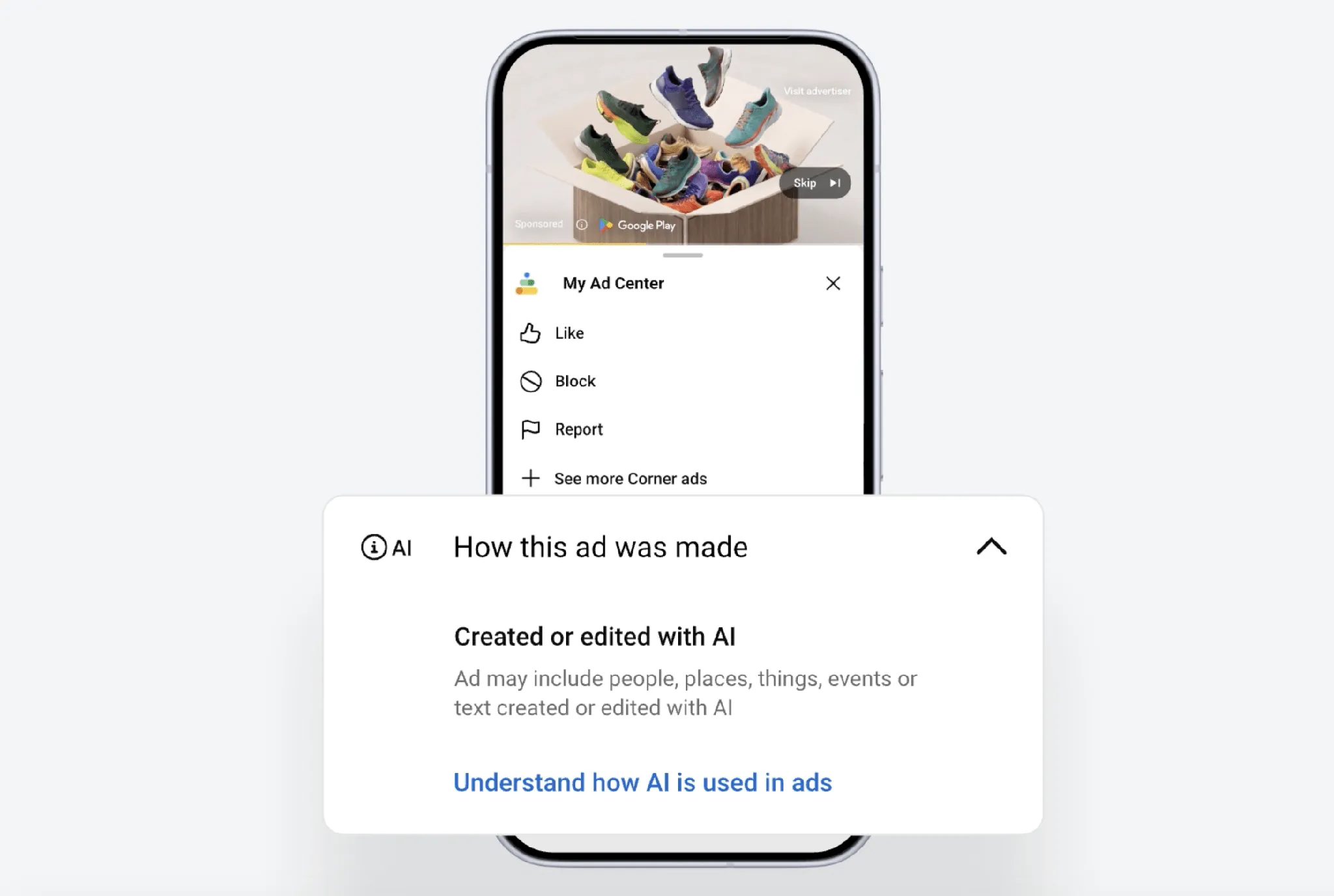
The check here is simple but usually skipped: look at live and pending Google Ads assets that were generated with Google AI tools, then compare what the buyer sees in the asset library with what the user may see in the ad. If a label appears, confirm whether it is acceptable in the creative layout and whether it changes the approval status, landing-page promise, or brand review. If a label does not appear, do not assume the asset is outside disclosure scope; verify whether it was produced externally, edited after generation, or uploaded through a workflow that does not preserve the same metadata.
This is also a budget-control issue. If an asset group depends on AI-generated video or image variations and those assets start receiving labels, disapprovals, or limited serving in certain jurisdictions, automated bidding will keep trying to allocate within the options it has. The buyer’s job is to avoid discovering the restriction only after spend has shifted into weaker backup assets.
New York makes synthetic performers a U.S. creative-review problem
New York’s synthetic performer disclosure law took effect on June 9, 2026. ArentFox Schiff describes it as the first U.S. law to impose disclosure obligations directly on downstream ad creative using AI-generated performers, with similar bills introduced in multiple other states. For ad ops, that is the important distinction: this is not only a vendor-contract issue upstream. It can attach to the creative that gets trafficked. [4]
Accounts most likely to need review are not limited to entertainment or gaming. Synthetic performers show up in financial lead-gen explainers, health and wellness testimonials, SaaS demo videos, creator-style product ads, multilingual voiceovers, and local-service spots where an AI presenter makes the unit cheaper to version. If a performer is synthetic, partly synthetic, or based on a real person’s likeness, the media team needs documentation before the asset is pushed into high-volume testing.
The audit question is not “does this look fake?” It is “can we prove what this performer is?” Store the vendor declaration, creator release, agency note, model-release language, or internal generation record next to the asset ID. If the account uses multiple naming systems across Meta, TikTok, YouTube, and DAM folders, add one shared field for synthetic performer status. Reviewers should not have to infer it from the video.
Enforcement appetite is not hypothetical, but do not overread one settlement
FTC activity belongs in the file because it shows that AI claims in advertising are not being treated as a novelty category. ArentFox Schiff reports that Operation AI Comply has brought more than a dozen enforcement actions and cites a $48.6 million settlement with Growth Cave in early 2026. The settlement amount should be verified against the FTC’s original release before it is used in client-facing risk language, because the cited figure comes here from a secondary legal summary rather than the agency source. [4]
Even with that caveat, the operating lesson is narrow and useful: do not let AI performance claims travel faster than substantiation. If the funnel says an AI system will generate income, automate a professional decision, replace a specialist, improve health outcomes, or personalize an offer in a materially superior way, the claim needs evidence before the campaign scales. That review belongs next to media launch, not three weeks later when the winning ad has already produced the majority of spend.
Why this will catch accounts unprepared
The gap between AI adoption and AI governance is not subtle. IAB reports that 70% of marketers have encountered an AI-related incident in advertising, while fewer than 35% invest in AI governance. That combination explains why dated rules create mess inside accounts: many teams are already using AI in production, but fewer have the asset records, approval gates, or platform notes needed when a disclosure obligation appears. [6]
The incidents do not have to be dramatic to be expensive. A mislabeled asset can stall a launch. An unlabeled synthetic performer can force a takedown. A broad geo can pull an EU audience into a campaign the buyer thought was domestic. A vendor-generated video can sit in the asset library with no record of which tool produced it. None of that requires a sci-fi failure mode. It requires ordinary campaign sprawl.
The campaign audit to run before enforcement escalates
Start with live spend, not the policy folder. Pull the campaigns currently spending against EU audiences, New York-relevant creative, Google AI-generated assets, and synthetic performer concepts. Then work outward to pending launches and evergreen creative libraries. Old winners are often more dangerous than new tests because they keep spending while nobody remembers how they were made.
- Geography: identify campaigns reaching EU audiences, including broad targeting, expansion settings, catalog feeds, reseller activity, and automated placements.
- Creative provenance: mark whether each image, video, voiceover, product scene, performer, and text variation was human-made, AI-assisted, AI-generated, or unknown.
- Disclosure state: confirm whether labels are required, permitted, automatically applied, manually added, or missing in Google, Meta, TikTok, YouTube, and creative files.
- Synthetic performer status: flag AI actors, cloned voices, virtual influencers, likeness-based assets, and agency-produced presenter videos before they enter scale tests.
- Claims substantiation: review ads and landing pages where AI is used to promise performance, income, personalization, professional judgment, health results, or automation.
- Fallback behavior: check what the platform serves if labeled or restricted assets lose eligibility, because budget may move into weaker or less compliant backup creative.
For Performance Max, the highest-value pass is asset-group provenance and location eligibility. For Advantage+, check synthetic media, creator-style video, audience expansion, and whether brand review can see the same asset history the buyer can. For TikTok Symphony or similar AI creative tools, preserve the generation record and confirm whether the final ad needs a synthetic media label in each market where it serves. The platform may assist with labeling; it does not automatically solve buyer-side documentation.
Agencies should also decide who is allowed to answer the platform’s disclosure prompts. That should not be left to whoever is trafficking at 6 p.m. If the answer affects legal exposure, the campaign brief needs a pre-approved field: AI-generated asset, synthetic performer, material manipulation, voice clone, likeness permission, and disclosure instruction. The trafficker can then execute instead of interpret.
Track rules as dated entries, not background noise
Karp may be right that broad AI regulation can harden into a competitiveness problem. He may also be using a real policy concern in a way that benefits companies selling AI deployment. For media buyers, that debate is less urgent than the four places where work is already changing: EU Article 50 timing, Google’s July labeling behavior, New York’s synthetic performer disclosure rule, and enforcement signals around AI advertising claims.
Log those items in the site’s Tracker as dated entries, with the August 2, 2026 Article 50 deadline separated from any later delay or enforcement update. Tie Google’s July policy update to affected creative specs. Keep New York’s synthetic performer rule attached to asset provenance, not a vague “state AI laws” bucket. Then cross-check the relevant Benchmarks records where AI-on versus AI-off platform behavior has changed spend allocation, asset mix, or approval outcomes.
This is not a prediction about the future of AI regulation. It is a list of live campaigns that deserve inspection now.
References
- Palantir CEO warns US not to copy Europe's AI regulations, Fox Business, July 2026.
- AI in Advertising: A Regulatory Lookahead for 2026, Charles Russell Speechlys.
- Updates to AI labeling requirements (July 2026), Google Ads Policy Help, July 2026.
- Advertising Law Compliance in 2026: Five Developments Every Advertiser Should Know, ArentFox Schiff, February 2026.
- Palantir AI Policy Contributions, Palantir.
- AI Adoption Is Surging in Advertising, but is the Industry Prepared for Responsible AI?, IAB.
Built on this evidence
No Bidding tactic or Creative record currently cites this case file. Compare it against other results in Benchmarks.
Related benchmark reading
Report a corroborating or contradicting result
Seeing something different in your own account? Feed the data-integrity loop instead of leaving an open comment.