
How Amazon's New Frontier AI Model Shift Affects Ad Creative
Amazon just deprecated most Nova flagship models while pushing advertisers toward AI creative tools built on them. This article breaks down the timeline risk for Creative Agent, Video Generator, and Audio Generator and gives media buyers a framework for deciding when to commit workflows.
- Platform
- Amazon Ads
- Campaign type
- Sponsored Brands
- Spend range
- Low
- Timeframe
- 0
- ROAS
- 0% ROAS lift
- Verdict
- mixed
- Industry vertical
- ecommerce
- Last reviewed
- 0-07-30
Amazon’s latest frontier-model shift gives AI ad creative a calendar problem. On July 28, 2026, Amazon deprecated most of the Nova flagship model family — Premier, Omni, Reel, and Canvas — at the same time Amazon Ads is expanding Creative Agent globally and pushing advertisers toward AI-assisted image, video, and audio production.[1][2][3]
That does not mean Creative Agent, Video Generator, or Audio Generator have been deprecated. The ad tools remain live. The risk is one layer lower: the foundation-model stack under the workflow is being reorganized while buyers are being asked to build repeatable creative operations on top of it.
For a media team heading into Q4 planning, that distinction matters. A test budget can tolerate some model churn. A holiday creative process with naming conventions, approvals, export rules, localization, and retail calendar dependencies has less room for “we’ll migrate you later.”

The July 28 Change Was Not Small
The reported cut was not a cosmetic model-menu cleanup. Reuters, citing Business Insider reporting, said Amazon was winding down most of its flagship AI models as part of a strategy overhaul.[1] Business Insider identified the affected models as Premier, Omni, Reel, and Canvas, while Nova 2 Lite, Nova 2 Sonic, Nova Forge, and Nova Act remained in place.[2]
| Model or model group | Status reported July 28, 2026 | Why ad teams should care |
|---|---|---|
| Premier | Deprecated | Part of the flagship layer Amazon had positioned around advanced model capability. |
| Omni | Deprecated | Relevant because multimodal model direction affects creative workflows that combine text, image, video, and product context. |
| Reel | Deprecated | Relevant because video generation is one of the ad creative areas buyers will watch for dependency changes. |
| Canvas | Deprecated | Directly adjacent to image-generation expectations inside ad creative operations. |
| Nova 2 Lite | Survives | A remaining Nova model, but survival is not the same as a long-term workflow guarantee. |
| Nova 2 Sonic | Survives | Relevant to audio generation and voice-style creative workflows. |
| Nova Forge | Survives | Part of the remaining Nova path, though the broader flagship direction is shifting. |
| Nova Act | Survives | Relevant to Amazon’s agentic direction rather than only asset generation. |
Amazon has said remaining Nova models will be supported and that customers will receive clear guidance and migration paths.[1][2] That is the line buyers need to hear. It is also not the whole operating picture. Business Insider reported employee descriptions of the surviving models as being in KTLO, or “keep the lights on,” mode.[2]
Those two signals can coexist, but they do not mean the same thing. “Supported” can mean the API or tool keeps functioning, incidents get handled, and customers are not abandoned. KTLO suggests limited forward investment. A production creative workflow needs to know which version of support it is actually buying.
Where the Ad Creative Tools Sit
Creative Agent is being sold as a practical fix for a very ordinary pain point: brands need more usable creative variations than their teams can comfortably produce. Amazon Ads describes the tool as an agentic AI creative system that can help advertisers generate campaign-ready assets across formats.[3]
The dependency chain is the part to keep in view. Amazon’s own AWS discussion of ad creative generation describes the stack as using Amazon Bedrock and Amazon Nova, with Anthropic Claude also part of the workflow through Bedrock.[4] In other words, the buyer-facing tool is not a sealed appliance. It is a workflow surface built over model choices Amazon can change.
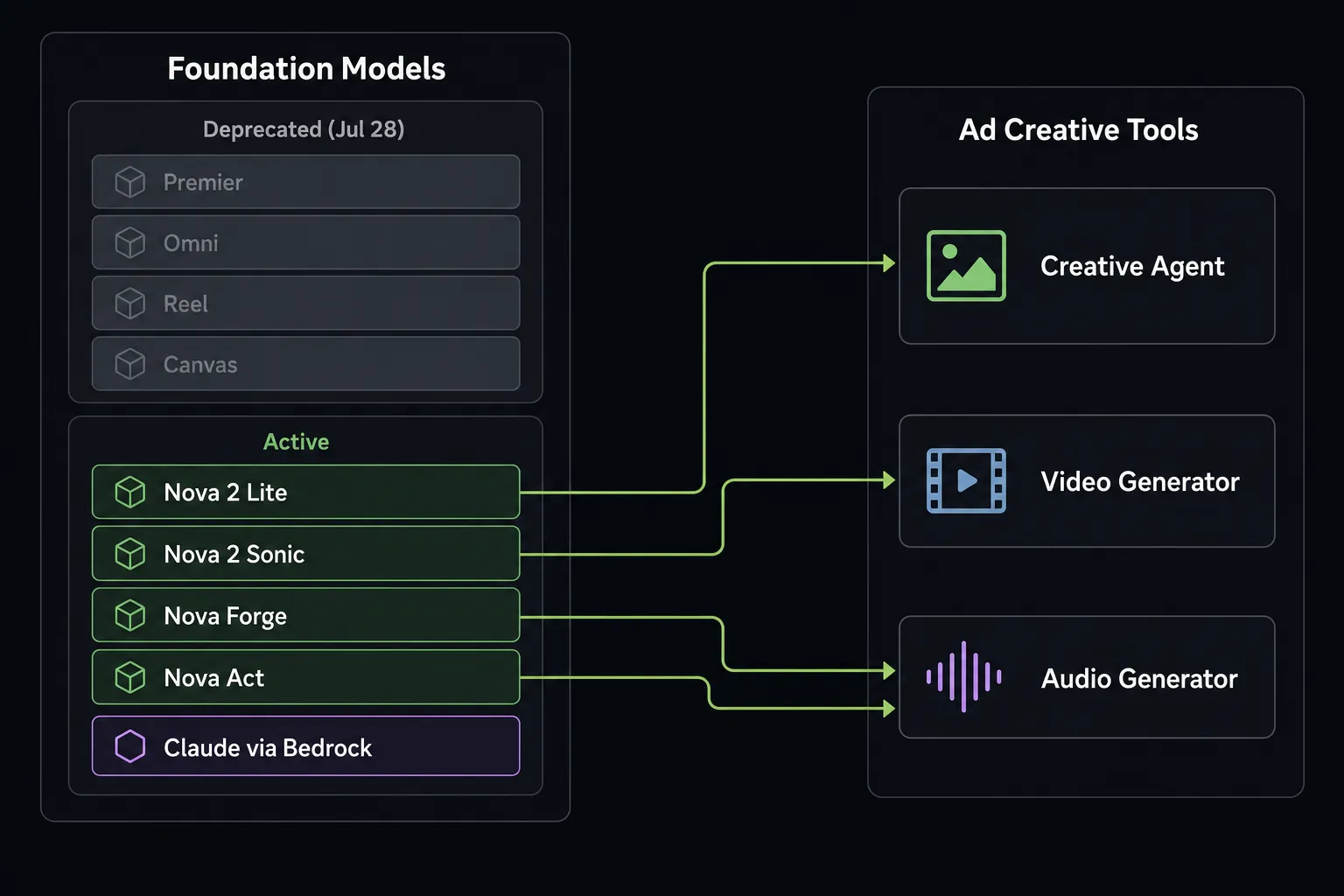
| Buyer-facing tool | Known foundation layer | Operational implication |
|---|---|---|
| Creative Agent | Nova plus Anthropic Claude through Bedrock | Safe to test, but process owners should document prompts, approvals, and output handling outside the tool. |
| Video Generator | Nova plus Bedrock-based model orchestration | Useful for variant creation, but risky as the only source of Q4 video assets until migration signals are clearer. |
| Audio Generator | Nova plus Bedrock-based model orchestration | Worth piloting for low-risk creative versions, with fallback production capacity for launch-critical audio. |
This is not a reason to ignore the tools. It is a reason to separate tool adoption from workflow lock-in. A buyer can learn whether Creative Agent produces usable lifestyle concepts, whether Video Generator can get through internal review, and whether Audio Generator fits brand-safety requirements without making any of those systems the only path to market.
Amazon Has Strong Incentive to Keep Creative Automation Moving
The business incentive is not subtle. Amazon Ads reported $17.2 billion in Q1 2026 revenue, up 22% year over year.[3] A platform with that much ad revenue has every reason to reduce creative bottlenecks, especially for sellers and brands that can fund media but cannot produce enough fresh assets for every placement, audience, and retail moment.
Amazon’s performance claims explain why advertisers are paying attention. Amazon has said AI-generated lifestyle images for Sponsored Brands delivered a 10.3% ROAS lift, 40% higher mobile click-through rate, and enabled five times more products to be advertised in its own beta data.[5][6] Those are useful signals, not final proof. The claims come from Amazon-linked channels and assessments of Amazon’s reported data, not from an independent audit of every category, creative format, or advertiser type.
The adoption signal is more interesting than the headline lift. Jay Richman told AdExchanger that about 50% of AI-generated creative assets were being used.[5] That suggests the constraint is not merely “can the model generate something?” It is whether the output survives brand review, retail compliance, internal taste, legal checks, and the awkward last mile of getting an asset into a live campaign.
That 50% usage rate matters more after the model news. If only half the generated assets were making it into use before the roadmap became murkier, the workflow around the model needs to be treated as the product. Prompting is only one piece. Approval notes, export quality, rejected-output handling, alternate aspect ratios, and repeatability across launches are where the time gets won or lost.
The Frontier Pivot May Be Temporary, But It Is Still a Pivot
The strategic explanation is that Amazon is moving resources toward a Frontier Model Research effort led by Pieter Abbeel, the former UC Berkeley professor and Covariant co-founder, with a new flagship model expected around re:Invent 2026.[1][2] That expectation is important, but it is not the same as a shipping migration plan.
If the new flagship lands cleanly at re:Invent, the July deprecations may look like a messy but temporary bridge between Nova’s first flagship lineup and a stronger model family. If it slips, changes scope, or arrives without clear ad-tool migration details, advertisers who built hard dependencies in Q3 will carry the operational risk into Q4 and early 2027.
The uncomfortable part is timing. July 28 is late enough in the year that enterprise and marketplace teams are already building holiday calendars, producing fall refreshes, and negotiating media plans. A model transition that looks manageable from a platform roadmap can still land badly inside a creative-ops calendar.
How to Treat the Tools in Q3 and Q4 2026
The cleanest decision is not yes or no. It is deciding which parts of the workflow can absorb change.
- Use Creative Agent for structured testing now: prompt libraries, concept exploration, image variants, and low-risk campaign extensions are reasonable places to learn.
- Avoid making Creative Agent the only path for launch-critical assets: keep designer, agency, or in-house fallback capacity for deadlines that cannot move.
- Keep assets exportable: save final files, source prompts, approval notes, and version history outside Amazon’s interface wherever possible.
- Separate experimentation metrics from production metrics: a good test result does not automatically prove the workflow can scale across every retail event.
- Revisit the commitment level after Amazon clarifies migration paths or ships the expected re:Invent 2026 flagship.
Video deserves the tightest guardrails. Static image variants can often be replaced faster if the model experience changes. Video usually has more review friction: story sequence, product accuracy, subtitles, claims, music, voice, and format-specific delivery requirements. If Video Generator is useful, use it. Just do not make it the only way a Q4 product story gets cut.
Audio sits somewhere in between. Nova 2 Sonic surviving the July cut is relevant, but survival still needs to be translated into practical assurances for brands using generated voice, sound, or audio variants. A test-and-learn program can move now. A brand-wide audio identity workflow should wait for clearer support language.
A Simple Commitment Filter
| Question | If the answer is yes | If the answer is no |
|---|---|---|
| Can the asset be recreated quickly outside Amazon’s AI tool? | Good candidate for testing. | Keep a fallback production path. |
| Does the campaign depend on exact visual or audio consistency across many placements? | Document prompts and outputs aggressively. | Use the tool more freely for exploration. |
| Would a model migration in Q4 delay launch? | Do not standardize yet. | Proceed with a controlled pilot. |
| Can the team measure whether generated assets are actually used, not just created? | The test can produce operational learning. | Fix tracking before scaling. |
| Has Amazon provided tool-specific migration guidance? | Consider expanding usage. | Treat the workflow as provisional. |
The key line in that filter is “tool-specific.” General reassurance that models are supported is not the same as an answer for the team that needs to know whether a Creative Agent prompt library, a Video Generator template, or an Audio Generator review process will survive the next model shift.
What Would Reduce the Risk
Amazon can make this much easier for advertisers without revealing every model-roadmap detail. Buyers need a few concrete signals: which creative tools depend on which surviving models, what changes when deprecated models are removed from the path, whether old outputs remain editable, and how much notice teams will get before workflow behavior changes.
A credible migration note for Creative Agent would matter more than another broad agentic-AI announcement. The same goes for Video Generator and Audio Generator. Media buyers do not need a philosophical explanation of frontier models. They need to know whether the asset they approved last week can be regenerated next month, whether the next version will look materially different, and who owns the gap if it fails review.
Until that arrives, the safe posture is practical and slightly boring: run pilots, measure usage, preserve fallback capacity, and avoid treating Amazon’s current AI creative layer as a fixed production standard.
The July 30 Read
As of July 30, 2026, Amazon’s ad creative tools are not being deprecated. Creative Agent is expanding, the business incentive is real, and the performance claims are strong enough to justify testing. But the foundation-model layer underneath those tools is in transition only two days after a major deprecation report.
That makes the current risk manageable, not imaginary. Creative Agent, Video Generator, and Audio Generator are safe enough for learning, controlled pilots, and incremental asset production. They are not yet safe enough to become the sole production path for high-stakes Q4 workflows unless Amazon provides clearer migration commitments or the expected re:Invent 2026 flagship arrives with a clean bridge from the surviving Nova stack.
References
- Amazon winds down most flagship AI models in strategy overhaul, Business Insider reports — Reuters, July 28, 2026
- Amazon overhauls its AI strategy, winding down most flagship models — Business Insider, July 28, 2026
- Amazon Ads launches new agentic AI creative tool — advertising.amazon.com
- Supercharging Ad Creative with Amazon Bedrock and Amazon Nova — AWS Blog
- Amazon Ads Introduces Agentic Functions To Its Generative AI Creative Studio — AdExchanger
- Amazon Claims AI Images Boost ROAS by 10%. An Assessment — Sellermetrics
Built on this evidence
No Bidding tactic or Creative record currently cites this case file. Compare it against other results in Benchmarks.
Related benchmark reading
Report a corroborating or contradicting result
Seeing something different in your own account? Feed the data-integrity loop instead of leaving an open comment.