
How Amazon's Nova model cuts affect your ad tools
Amazon's July 28, 2026 deprecation of the Nova Canvas, Reel, Premier, and Omni models directly impacts Creative Agent, Image Generator, and Video Generator. This article maps which ad tools are affected, which survive, and what media buyers should do before Q4 given the 'keep the lights on' status and uncertain migration timeline.
- Platform
- Amazon Ads
- Campaign type
- Sponsored Brands
- Spend range
- General
- Timeframe
- July 0
- ROAS
- 0%
- Verdict
- mixed
- Last reviewed
- 0-07-30
Last reviewed: July 30, 2026. The short answer for advertisers is this: Amazon's July 28 deprecation of Nova Canvas, Nova Reel, Nova Premier, and Nova Omni puts the native generative layer behind several Amazon Ads creative workflows into maintenance mode, while some other Nova models remain active and Ads Agent appears less exposed because Claude is still part of its stack through Bedrock.[1][2]
That does not mean every button in Creative Agent, Image Generator, or Video Generator stopped working overnight. It means the models that made those tools feel like platform-native production infrastructure are no longer being treated as growth models. For Q4 planning, that distinction matters more than the headline.
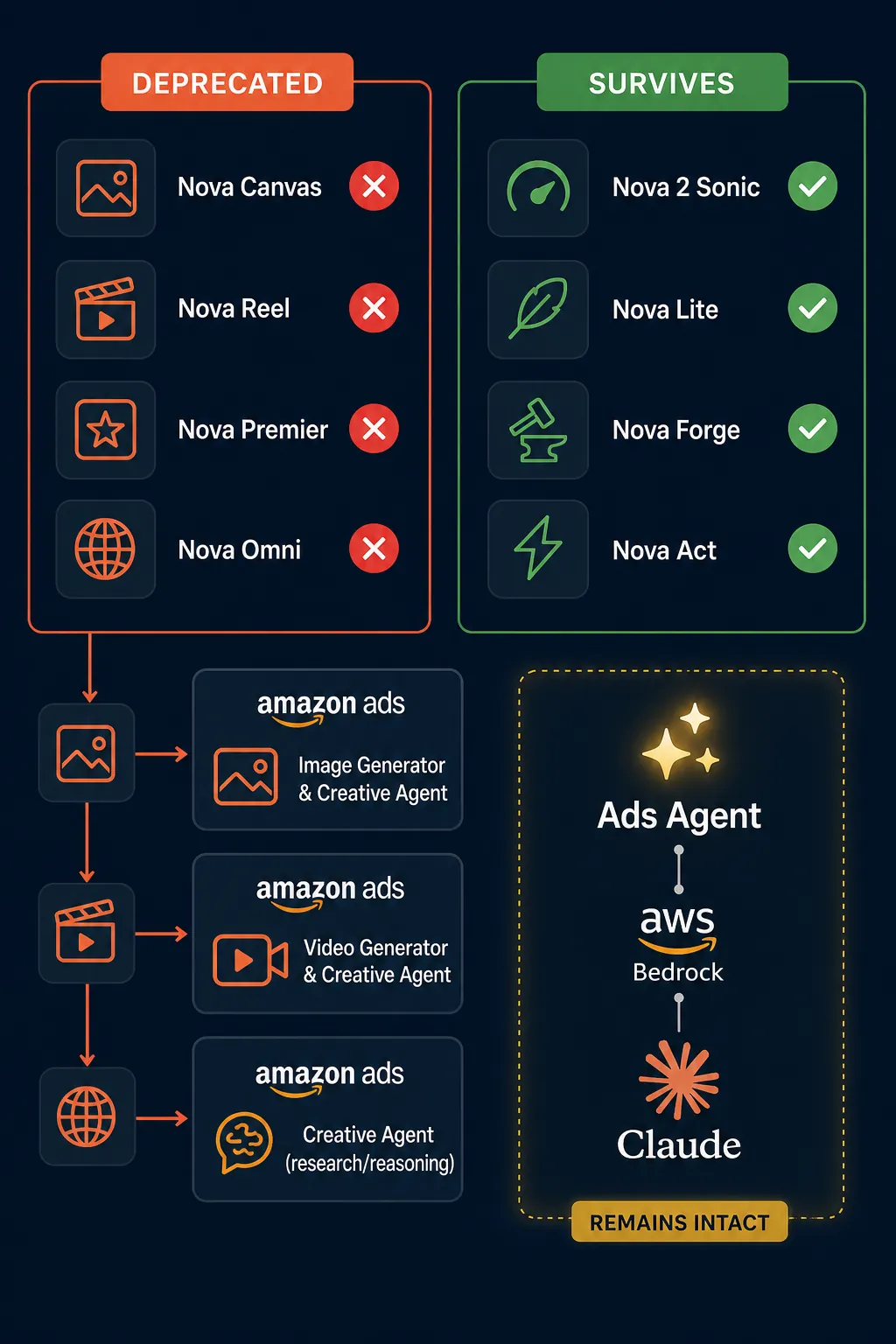
| Workflow or model | Current read as of July 30, 2026 | Q4 planning implication |
|---|---|---|
| Nova Canvas | Deprecated; image-generation model tied to Image Generator and Creative Agent image output | Do not assume image quality, prompt handling, or format coverage will keep improving |
| Nova Reel | Deprecated; video-generation model tied to Video Generator and Creative Agent video output | Build a fallback for video variants before Streaming TV or DSP creative deadlines |
| Nova Omni | Deprecated; multimodal/reasoning layer relevant to Creative Agent's research and planning behavior | Treat Creative Agent as useful but not safe as the only planning or production path |
| Nova Premier | Deprecated as part of the flagship-model wind-down | Watch for downstream dependencies Amazon has not yet publicly mapped |
| Nova 2 Sonic, Lite, Forge, Act | Reported as surviving models | Not every Amazon AI workflow is being shut down |
| Ads Agent | Partly insulated because Claude via Bedrock remains in the stack | Lower immediate exposure than the native image and video generators, but still monitor guidance |
What changed on July 28
Business Insider reported on July 28, 2026 that Amazon is winding down most of its flagship Nova models, including Premier, Omni, Reel, and Canvas, while keeping models such as Nova 2 Sonic, Lite, Forge, and Act alive. Reuters picked up the report the same day.[1][2] The practical ad-platform issue is not whether Amazon still has an AI strategy. It is whether the specific model layer attached to ad creative generation is still a place where advertisers should expect improvement.
For Amazon Ads teams, Canvas is the obvious exposure because it sits under image generation. Reel is the obvious exposure for video. Omni is more awkward because it is tied to the broader multimodal and reasoning work that makes an agentic creative tool feel less like a single-asset generator and more like a workflow assistant. That is why Creative Agent deserves more scrutiny than a simple "image tool affected" label.
The status described by unnamed Amazon employees to Business Insider is KTLO, short for "keep the lights on": existing support, no active development, and teams shifting focus elsewhere.[1] That is a very different risk profile from a hard shutdown. A tool can remain available in the UI while the model behind it stops receiving the improvement cycles that advertisers quietly rely on before holiday season.
The ad tools most exposed
Image Generator is the cleanest case. If a workflow depends on Amazon-native AI images for Sponsored Brands, Sponsored Display, or brand-store-adjacent creative, the relevant question is no longer just whether the current output is acceptable. It is whether the tool will keep adapting to new placements, policy friction, prompt behavior, product-category edge cases, and seasonal creative needs while its underlying image model is deprecated.
Video Generator has the same structural problem through Nova Reel. That matters for teams that were using Amazon's generator to reduce the lag between campaign planning and video asset delivery, especially where Streaming TV or DSP planning depends on getting rough variants into review before the usual Q4 congestion. A deprecated video model may still produce output today, but it is no longer a comfortable single point of dependency.
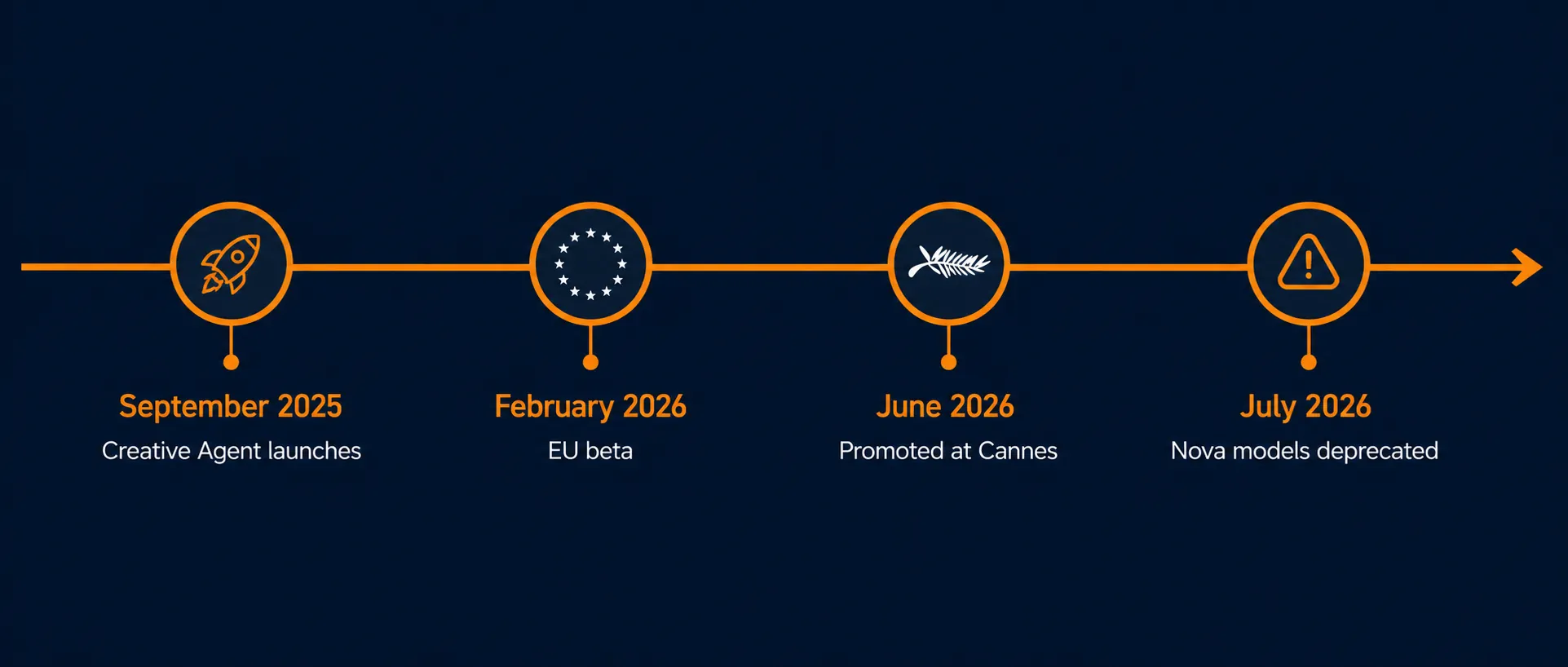
Creative Agent is the bigger operational headache because it was positioned as more than a one-off generator. AdExchanger covered Amazon Ads' introduction of agentic functions to its generative AI Creative Studio in September 2025, and Amazon later announced a Creative Agent beta in Europe in February 2026.[3][4] The product promise was not merely "make an image." It was to use product detail pages and brand assets to help assemble campaign-ready creative paths.
That makes the July 2026 model cut feel especially sloppy from an account-operations view. A buyer could reasonably have watched Creative Agent launch in September 2025, seen the February 2026 EU beta, noticed the continued Cannes promotion in June 2026, and assumed the tool was moving toward deeper production dependency. Six weeks later, the native model layer behind major parts of that workflow is reported as deprecated.
Deprecated does not mean broken, but it does change the planning standard
A maintenance-only model can still be useful. It can still save a junior designer from resizing work, give a media buyer a first visual direction, or help a brand manager see what a product-detail-page-led concept might look like. The risk is not that every generated asset becomes unusable immediately. The risk is that the tool remains visible while the quality curve flattens.
That flattening shows up in unglamorous places: more time spent regenerating near-identical assets, more compliance review rejections, less reliable product rendering, more copy-image mismatch, fewer usable video cuts, or a wider gap between what the platform generates and what a brand will actually approve. None of those failure modes needs a formal outage to cost time.
Business Insider also reported that Amazon promised "clear guidance and migration paths," while employees said they had received little direction.[1] As of this review date, Amazon has not published an advertiser-facing migration map that says Creative Agent, Image Generator, or Video Generator will move to a specific replacement model by a specific date.
That gap is the part advertisers should act on. If Amazon patches the workflow quietly before Q4, good. But a holiday creative calendar cannot be built on an unpublished migration path, especially when approvals, localization, retailer-specific policy review, and client signoff all sit downstream of the generated asset.
Why advertisers cared in the first place
It is worth remembering why these tools got attention. On its AWS advertising and marketing page, Amazon says brands using its AI creative tools averaged two times more images per advertised product and a 10.3% higher return on ad spend for Sponsored Brands campaigns, based on Amazon internal data from 2024 to 2025.[5] That is vendor-claimed, pre-deprecation data, not an independent guarantee of current performance.
Still, the claim describes the operational value proposition Amazon was selling: more variants per product, less waiting on creative queues, and a tighter loop between media planning and asset production. For a Sponsored Brands team trying to test category-seasonal imagery across a large catalog, even a modest improvement in asset throughput can change what gets launched on time.
The counterweight comes from Amazon itself. Jay Richman, Amazon's vice president of creative experiences, told AdExchanger in September 2025 that only 50% of generative creative assets produced in Creative Studio were actually used in campaigns.[3] That admission keeps the impact proportional. Some advertisers may be losing a real production shortcut. Others may find that the workflow looked impressive in demos but was already producing a high share of review-stage waste.
What still looks usable
Not every Amazon Ads AI workflow carries the same risk. Ads Agent is the most important distinction because its stack is not described as purely dependent on the deprecated Nova creative models. Feedvisor, a vendor source, describes Ads Agent as using Amazon Nova and Anthropic Claude through Bedrock.[6] Claude remaining available does not make Ads Agent risk-free, but it does make it less directly exposed than tools whose core output depends on Canvas or Reel.
Nova Forge and Nova Act also remain outside the cut described in the July 28 reporting.[1][2] Forge is relevant to enterprise fine-tuning discussions; Act is relevant to agentic web automation. Neither solves the immediate Sponsored Brands image-generation problem, but their survival is a reminder not to read the Nova cuts as a blanket Amazon AI shutdown.
The more careful account-level read is narrower: native Amazon image and video generation are the exposed areas; Ads Agent appears partially insulated; anything depending on an unpublished Creative Agent migration remains uncertain.
What to change before Q4 planning locks
The immediate job is not to abandon Amazon's tools. It is to stop treating them as the only production path for holiday creative. Teams that use Creative Agent, Image Generator, or Video Generator should separate three things this week: assets already approved, assets generated but not yet reviewed, and assets still expected from the platform before Q4.
- For approved assets, keep trafficking and documentation moving; the model change does not invalidate existing approvals by itself.
- For generated-but-unreviewed assets, move them through brand, legal, and marketplace-policy review earlier than usual so weak output does not surface at campaign-build time.
- For assets not yet created, assign a fallback owner now: internal design, agency studio, templated production, or another approved creative tool.
- For video, identify which placements truly need net-new generation and which can use edited, resized, or recombined existing footage.
- For client communication, explain the risk as model-maintenance uncertainty, not as a confirmed shutdown of the ad tools.
The review workflow is where many accounts will feel this first. If a buyer has been using Amazon-native generation to get three or four image directions into a Sponsored Brands build, the fallback is not just "ask design for images." Someone needs to decide which products get priority, which seasonal claims need substantiation, which marketplace-specific formats are required, and who approves the final asset if the AI option no longer produces a usable first pass.
For agencies, the cleanest client note is short and dated: Amazon has reportedly deprecated several Nova models used in creative generation; the tools may still function, but Amazon has not yet published a migration timeline; therefore Q4 plans that depend on Amazon-native image or video generation need a backup production lane. That is enough. No one needs a speculative lecture about Amazon's long-term AI ambitions to understand why a holiday asset plan needs redundancy.
The AGI Lab news is context, not the operating plan
The model deprecation landed alongside broader reporting that Amazon shut down its AGI Lab after 18 months, with layoffs occurring the same week.[1] That helps explain why the transition feels unsettled. It does not, by itself, tell an advertiser which campaign asset will pass review next month.
There is also a reported expectation that Amazon will introduce a new FMR, or Frontier Model Research, model at re:Invent in fall 2026.[1] The useful limit is important: there is no confirmed public timeline saying Creative Agent, Image Generator, or Video Generator will be moved to that model, no confirmed backward compatibility, and no advertiser-facing migration checklist as of July 30.
That leaves the current planning judgment fairly plain. Creative Agent and Amazon's creative generators are not dead. Ads Agent is less exposed because Claude remains part of the stack. But the native Amazon image and video generation layer is no longer safe to treat as improving production infrastructure until Amazon publishes a migration path. If those tools sit inside your Q4 workflow, build the fallback now and re-check the tracker when Amazon gives official guidance.
References
- Amazon overhauls its AI strategy, winding down most flagship models, Business Insider, July 28, 2026
- Amazon winds down most flagship AI models in strategy overhaul, Reuters, July 28, 2026
- Amazon Ads introduces agentic functions to its generative AI Creative Studio, AdExchanger, September 2025
- Amazon Ads launches 'Creative Agent', Amazon About Amazon, February 2026
- Amazon Nova for Advertising & Marketing, AWS Advertising & Marketing
- What is Amazon Ads Agent? Agentic AI for sellers in 2026, Feedvisor
Built on this evidence
No Bidding tactic or Creative record currently cites this case file. Compare it against other results in Benchmarks.
Related benchmark reading
Report a corroborating or contradicting result
Seeing something different in your own account? Feed the data-integrity loop instead of leaving an open comment.