
When AI Movie Ads Work and When They Don't
Nine real brand campaigns show that AI-generated cinematic marketing succeeds when solving a real production constraint — speed, cost, or impossibility — and fails when it tries to replace emotionally anchored brand storytelling. This article breaks the pattern down with sourced outcomes and a decision framework for marketers.
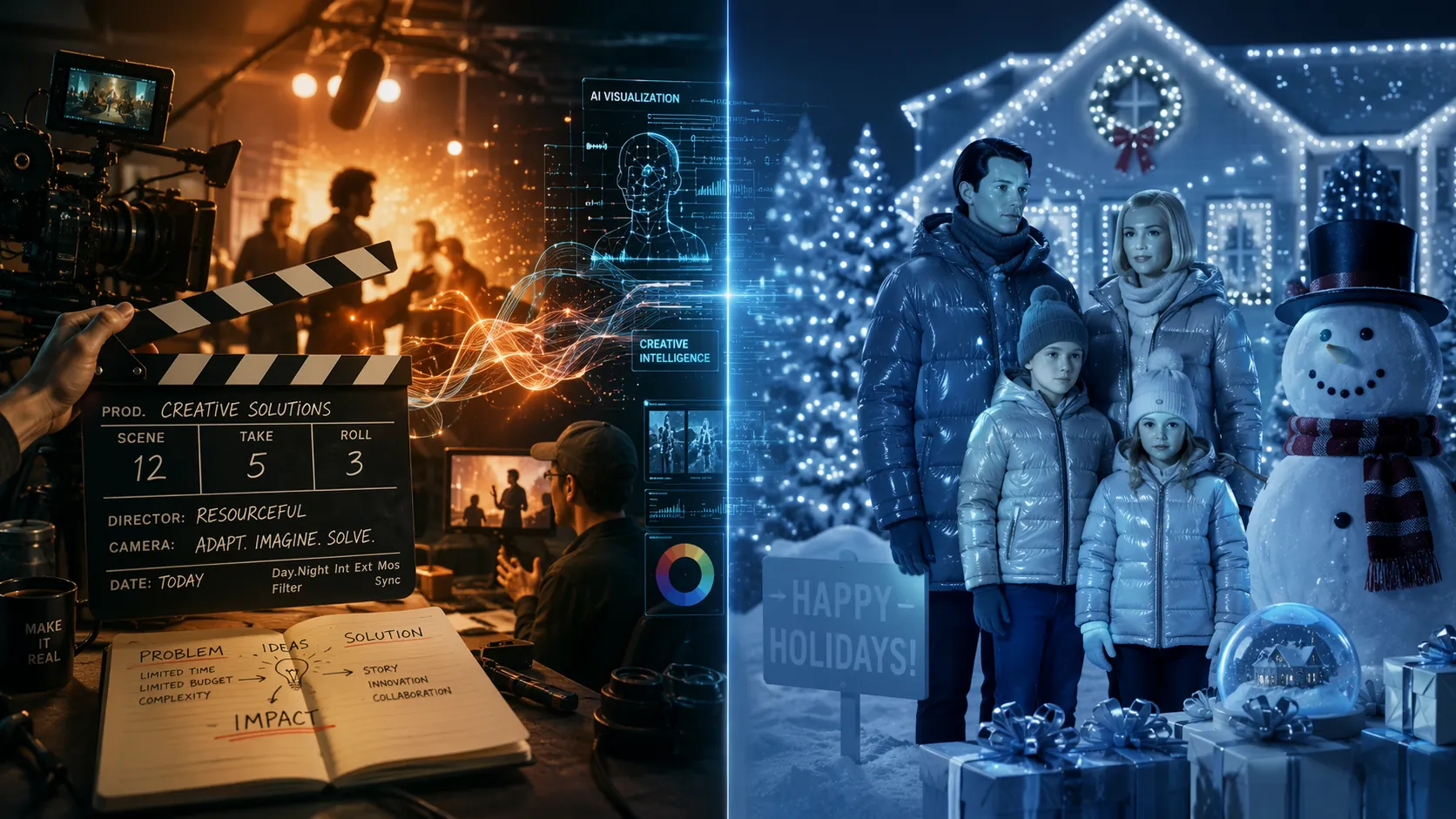
The useful question in AI-generated movie marketing is not whether the ad looks expensive. It is whether AI solved a production problem the audience can understand. A national NBA Finals spot made for about $2,000 in three days has a different permission structure than a synthetic holiday film trying to borrow decades of brand memory. One reads as resourceful. The other can read as a shortcut taken in the one place a brand should not be cheap.
That pattern shows up across nine recent campaigns. Kalshi, Popeyes, Under Armour, Nike, and Starburst used AI video to answer a hard constraint: money, timing, unavailable talent, impossible footage, or asset volume. Coca-Cola and Toys “R” Us ran into a colder audience reaction when AI appeared to stand in for inherited emotional material. Zevia and BodyArmor sit off to the side, using AI or AI-like visual language partly to comment on the technology itself rather than simply to make a cheaper film.
The Permission Comes From the Constraint
Kalshi’s NBA Finals ad is the cleanest cost-and-speed case because the constraint was visible. The prediction-market company reportedly produced a national prime-time spot using Google Veo for about $2,000 in three days, described as more than a 90% reduction versus traditional production costs.[1] That kind of number can become a lazy headline, but here it matters because the media moment itself was expensive and perishable. A small brand buying national attention needed a way to make the creative catch up with the placement.
The ad did not ask viewers to admire AI as an aesthetic movement. It used AI as a compression tool: fewer vendors, fewer shoot logistics, less time between decision and air. That is a legitimate production argument. It does not prove that every brand should replace film crews with generative video, and the reported cost figure comes from secondary coverage rather than a fully audited brand case study. Still, the campaign shows a useful boundary: AI can earn tolerance when the audience can see why normal production would have been disproportionate to the job.
Popeyes’ “Wrap Battle” worked for a related reason. The brand responded to a McDonald’s announcement with a script, music generated through Suno, and video generated through Veo 3 in under three days.[2] The important part is not that the workflow sounds modern. It is that the creative act was reactive. A long production cycle would have sanded down the point of the work before the work arrived.
Fast reactive advertising has always carried rough edges. Social teams, newsroom-style brand studios, and scrappy agency war rooms have lived with that trade-off for years. AI video changes the ceiling on what those teams can render in a tiny window. It does not remove the need for taste. In a reactive spot, a slightly strange image may read as the mark of speed. In a heritage film, the same flaw may read as carelessness.
Marketers Are More Comfortable With AI Ads Than Consumers Are
The industry’s confidence is running ahead of the audience. In IAB’s 2026 “AI Ad Gap” report, 82% of ad executives said they thought consumers felt positive about AI ads, while only 45% of consumers actually did, creating a 37-point perception gap.[3] That gap is not a verdict against AI video. It is a warning against treating internal excitement as market permission.
The gap matters most when AI is attached to emotionally loaded brand assets. A consumer may accept an AI-generated response ad because the format carries a sense of improvisation. The same consumer may reject an AI-generated holiday film because the brand is touching a memory structure built by older campaigns, family rituals, and repetition. The technology has not changed; the assignment has.
High-visibility AI ads also attract a different kind of scrutiny. Meltwater analysis reported by MediaPost found that 50% of social comments about Super Bowl LX AI ads were sharply negative.[4] Social comments are not the same as sales impact, and they overrepresent people motivated enough to post. But for brands putting AI-generated cinematic work into mass cultural moments, the reputational downside is not imaginary.
When AI Expands What Production Can Depict
Under Armour’s “Forever Is Made Now” is a stronger argument for AI video than most cost-saving examples because the problem was not simply budget. Anthony Joshua was physically unavailable for a traditional shoot, so the team used AI to build a film around a performance that could not be captured in the normal way.[5] That is a different creative bargain. AI is not replacing the emotional center of the brand; it is solving access.
This is where AI-generated cinematic marketing starts to feel less like a procurement tactic and more like a production method. Sports brands often need bodies, motion, weather, competition, arenas, and timing to align. If one element is unavailable, the whole concept can collapse into a simpler execution. AI gives the team another route, provided the brand still treats likeness, rights, and performance integrity as serious governance questions.
Nike’s AI-assisted reconstruction of 130,000 match points from real game footage pushes the same idea further.[6] No traditional crew could go back in time and capture every needed angle with cinematic control. The value is not that AI made something cheaper; it made a film grammar possible around a volume of real sports material that would otherwise resist production.
That distinction should guide creative reviews. If AI lets the team visualize an inaccessible athlete, compress a live cultural window, or transform a dataset into film, the audience has a reason to grant the experiment some room. If AI is only being used because the brand wanted the emotional effect of a major film without paying for the craft, the work starts the meeting in debt.
Scale Is a Real Use Case, but It Can Flatten the Idea
Starburst’s “Different Every Time” campaign is a useful scale case because the production model matched the brand idea. The campaign reportedly used more than 20 AI-generated worlds and more than 300 modular assets, and it went on to win a Clio Award.[7] The modularity was not hidden in the back office. It connected to a product truth: variety.
That is the difference between personalization and content mulch. Many brands say they need hundreds of assets when what they really have is one average idea stretched across placements. Starburst had a premise elastic enough to support variation. AI helped build the asset system around that premise.
| Campaign type | What AI solved | Audience risk |
|---|---|---|
| Kalshi-style low-budget national spot | Production cost and turnaround | Output may feel thin if the media buy overpromises the creative |
| Popeyes-style reactive ad | Speed against a live competitor moment | Roughness can be forgiven only if the timing is genuinely relevant |
| Under Armour or Nike-style sports film | Unavailable talent or impossible reconstruction | Rights, likeness, and authenticity need stronger review |
| Starburst-style modular campaign | Asset volume and variation | The idea can collapse if every variation feels interchangeable |
| Coca-Cola or Toys “R” Us-style nostalgia film | Cheaper recreation of emotional heritage | Viewers may see substitution where the brand expects warmth |
Cadbury’s Diwali work points to the same scale logic in a more localized form. The brand created hyperlocal AI video ads for more than 2,000 stores using Shah Rukh Khan’s AI likeness.[8] The useful lesson is not that every brand needs a celebrity deepfake. It is that personalization at that level has to give the viewer something recognizably relevant, not just a name, location, or face pasted into a template.
For broader planning context, the adoption landscape around AI marketing is bigger than cinematic video. A campaign team weighing AI film against other applications should compare it with adjacent use cases in content operations, media, analytics, and lifecycle marketing rather than treating video as the inevitable first experiment. The broader 2026 use-case map is a better starting point for that budget conversation than a demo reel alone: How Marketers Are Using AI in 2026.
The Backlash Boundary: Nostalgia, Childhood, and Holiday Memory
Coca-Cola’s AI holiday work sits on the other side of the line. Its 2024 AI holiday ad drew criticism in press coverage, including the phrase “creepy dystopian nightmare.” Its 2025 follow-up reportedly generated 70,000 AI clips and was criticized by The Verge as a “sloppy eyesore.”[9] The specifics matter because this was not an obscure experiment. Coca-Cola’s holiday advertising carries unusually heavy memory. Trucks, lights, polar bears, Santa imagery, and music do not behave like ordinary production assets.
A brand can use AI to make more images of snow, bottles, and festive streets. That does not mean it has recreated the emotional contract attached to those images. In holiday advertising, viewers are not only watching a spot; they are checking whether the brand still understands the feeling it has trained them to expect. Synthetic polish can become evidence against the brand if the audience senses that memory has been rendered rather than cared for.
Toys “R” Us faced a similar problem with its Sora-generated brand film. Carma reported a measurable decline in positive sentiment after the film’s release.[10] The case is especially instructive because childhood sentiment gives a brand less room for technical weirdness. A toy retailer can experiment with style, but when it reaches for origin-story emotion and family memory, viewers bring a more protective standard.
This is the same predictable pattern that shows up when AI touches merchandise, mascots, fan objects, or identity-heavy brand symbols: people react less to the existence of AI than to the feeling that something emotionally owned by the audience has been cheaply simulated. The backlash pattern is worth reviewing before a team puts AI near a heritage asset: Why AI Merchandise Backlash Follows a Predictable Pattern.

Not Every AI-Looking Ad Is Trying to Hide the Machine
Zevia and BodyArmor are useful outliers because their value is more rhetorical than performance-proven from the available material. They used AI or AI-like aesthetics to make a point about the technology itself. That can be a legitimate creative stance when the brand is openly playing with the cultural conversation instead of hoping viewers will mistake synthetic footage for conventional craft.
The risk is that self-awareness can become a thin shield. An ad cannot simply wink at AI and assume the audience will reward it. If the joke, critique, or visual system is sharp enough, the artificiality becomes part of the idea. If it is not, the brand has merely disclosed the weakness before viewers point it out.
Consumer Data Is Mixed, Not Hopeless
The backlash cases should not be misread as proof that consumers reject all AI-generated advertising. VML and WPP reported in 2026 that 73% of Gen Z and Millennial consumers said knowing an ad was AI-created would either increase or not change their purchase likelihood.[11] That is an attitude measure, not a guaranteed behavior outcome, but it does puncture the easy assumption that disclosure alone ruins an ad.
MIT’s 2026 experiment with 21,000 consumers found that AI-personalized video had a 9.4% higher click-through rate than personalized image ads.[12] The study was conducted with an Indian e-commerce retailer, so it should not be generalized too casually to Western brand films, CPG nostalgia campaigns, or mass-market TV. Still, it supports a narrower and useful conclusion: when AI video increases relevance in a performance context, consumers may respond with behavior, not just tolerance.
That is why the decision should not be “Will people hate AI?” The better question is “What value does the viewer receive because AI was used?” Faster cultural participation, more relevant local creative, impossible footage, or a more varied campaign system can be real value. A cheaper imitation of a beloved brand memory is usually value for the company, not for the audience.
A Practical Review Framework Before You Greenlight the Film
The most useful AI video review is not a tool review. It is a production, brand, and audience review. Before a team signs off on an AI-generated cinematic campaign, the work should survive five questions.
- Is there a real constraint? Speed, cost, scale, unavailable talent, and technical impossibility are stronger reasons than novelty.
- Is the asset emotionally sensitive? Holiday memory, childhood nostalgia, mascots, founders, and heritage imagery need a higher bar.
- How will imperfections read? In a reactive ad, roughness may signal speed; in a sentimental film, it may signal disrespect.
- Has governance happened early enough? Likeness rights, disclosure, brand safety, legal review, and provenance cannot be bolted on after the render.
- Do the savings justify the reputational risk? A cheaper film is not a better investment if it spends down brand trust.
Governance is where many promising AI video ideas either become usable or fall apart. A governed workflow gives creative teams room to experiment without letting every test become a public-facing brand decision. The handoff from concept to legal, model selection, training-data policy, rights review, disclosure, QA, and measurement needs to be designed before the campaign is moving at crisis speed. A fuller operating model is covered in The AI Creative Advertising Playbook.
Budget discipline matters too. AI video can be impressive and still be the wrong first dollar. If the goal is near-term payback, teams should compare cinematic AI against use cases with clearer performance loops, such as lifecycle testing, creative versioning, media optimization, or content operations. The ROI question belongs before the sizzle reel, not after it; the broader prioritization lens is laid out in The AI Marketing ROI Stack.
Where the Line Lands
AI-generated cinematic marketing is strongest when the production problem is honest. Kalshi needed national creative on a tiny budget and short clock. Popeyes needed to move while the competitive moment was still alive. Under Armour had an athlete access problem. Nike had a reconstruction problem. Starburst had a modular variation problem. In those cases, AI did a job the audience could understand even if viewers did not know every tool in the stack.
It is weakest when the brand asks synthetic imagery to carry emotional trust that was built elsewhere. Coca-Cola holiday nostalgia and Toys “R” Us childhood sentiment are not just visual territories. They are inherited relationships. AI can help produce the film around those relationships, but it cannot be treated as a cheap replacement for stewarding them.
The operational judgment is simple enough to use in a review room: use AI video when the constraint is real, the audience benefit is visible, and the brand asset can withstand experimentation. Do not use it to imitate the emotional labor your brand has already taught people to value.
References
- Kalshi NBA Finals AI ad coverage, ThatWorksMedia and The Verge
- Popeyes “Wrap Battle” AI campaign coverage, Creatify and TechRadar
- AI Ad Gap report, IAB and Sonata Insights, January 2026
- Super Bowl LX AI ad sentiment coverage, MediaPost, February 2026
- Under Armour “Forever Is Made Now” campaign coverage, Kapwing
- Nike AI match-point reconstruction campaign coverage, ThatWorksMedia
- Starburst “Different Every Time” campaign coverage, Kapwing and ThatWorksMedia
- Cadbury hyperlocal Diwali AI video campaign coverage, Pragmatic Digital
- Coca-Cola AI holiday ad coverage, NY Post and The Verge
- Toys “R” Us Sora-generated brand film sentiment analysis, Carma
- Gen Z and Millennial AI-created ad purchase-likelihood research, VML and WPP, 2026
- AI-personalized video consumer experiment, MIT IDE, 2026
Built on this evidence
No Bidding tactic or Creative record currently cites this case file. Compare it against other results in Benchmarks.
Related benchmark reading
Report a corroborating or contradicting result
Seeing something different in your own account? Feed the data-integrity loop instead of leaving an open comment.