
Why platform AI labels don't make synthetic ads compliant
Meta's AI Info tag and Google's July 2026 AI label setting live behind menus and metadata, while New York's synthetic-performer law and the EU AI Act require disclosure perceivable inside the ad itself. Media buyers get a plain read on what the platform labels actually cover — and why the advertiser, not the platform, still owns the legal labeling duty.
- Platform
- Meta and Google
- Creative type
- synthetic performer
- Disclosure status
- Does not meet NY or EU in-ad disclosure norms
- Failure type
- Disclosure gap: platform label not visible in ad
- Last reviewed
- 0-08-26
A buyer sees Meta’s AI Info tag, or Google’s July 2026 AI label setting, and the next question in trafficking becomes deceptively small: can this synthetic ad now ship as compliant?
For New York and the EU, the practical answer is no. Platform AI labels are useful transparency signals, but they are not compliance coverage when the law expects the disclosure to be perceivable inside the ad experience. Google says this plainly: its AI label setting “doesn’t guarantee compliance with specific regulations.” [1] That sentence should be printed on the trafficking checklist, not buried in the launch announcement.
For ad operations, the regulatory impact on synthetic ad creative is less about whether a platform can detect AI and more about what the viewer sees at first exposure. If the synthetic nature of the ad is disclosed only after a user opens a menu, inspects metadata, or lands in a platform transparency panel, the advertiser still has a legal-labeling problem.

| Signal or rule | Where the user sees it | What powers it | What it does not solve |
|---|---|---|---|
| Google AI label setting | Google’s ad transparency experience, including the “How this ad was made” panel in My Ad Center | A July 9, 2026 rollout across Google Ads, Display & Video 360, Campaign Manager 360, Merchant Center, and Ads Editor [2] | Google states the setting does not guarantee compliance with specific regulations [1] |
| Meta AI Info / About this ad path | The ad’s platform information flow, reached through the ad’s disclosure or menu surface | Reported mechanics include updated AI-generated ad disclosure tags and C2PA-based detection of third-party generative AI tool signals | A platform-side information panel is not the same thing as visible or audible disclosure inside the ad creative |
| New York synthetic-performer rule | Inside the advertisement itself | GBL §396-b, effective June 9, 2026, for synthetic performers in advertising | A hidden or menu-only platform label does not meet the “conspicuous” in-ad disclosure yardstick [3] |
| EU AI Act Article 50 transparency rule | Visible or audible to the user without technical tools or dedicated actions | Deployer-side disclosure duties for covered synthetic or manipulated content | Machine-readable marking and detector output are not enough when the viewer cannot perceive the disclosure at first exposure [4] |
The platform label is a product feature, not the legal label
The uncomfortable part is that the platform features are not useless. They can help preserve provenance, reduce ambiguity in review, and give users more context. A clean C2PA chain is better than a folder full of flattened exports and Slack messages. A consistent Google label is better than every advertiser inventing its own hidden notation. But usefulness is not the same as satisfying the disclosure obligation imposed on the advertiser or deployer.
Meta’s AI Info route matters because it shows the exact handoff gap. The ad platform may surface AI context through an “About this ad” style panel, and the reported mechanics point to C2PA-based detection of signals from third-party generative tools. That can be helpful for verification and triage. It tells the reviewer that a tool signal may exist. It does not tell the user, at the moment the ad is first seen, that the performer, product scene, voice, or likeness is synthetic.
That distinction is where screenshots of platform announcements become dangerous. A QA reviewer cannot approve an ad because a platform can classify it somewhere else in the interface. The publish/no-publish question is narrower: does the actual served ad carry the disclosure the relevant rule requires?
Google’s commercial AI label setting creates the same risk in cleaner documentation. Google introduced new AI labels for ads on July 9, 2026, spanning Google Ads, Display & Video 360, Campaign Manager 360, Merchant Center, and Ads Editor, with additional information appearing through the “How this ad was made” panel in My Ad Center. [2] That is a broad platform implementation. It is not a promise that a synthetic performer ad running in New York, or a covered deep fake ad in the EU, now has the legal disclosure it needs.
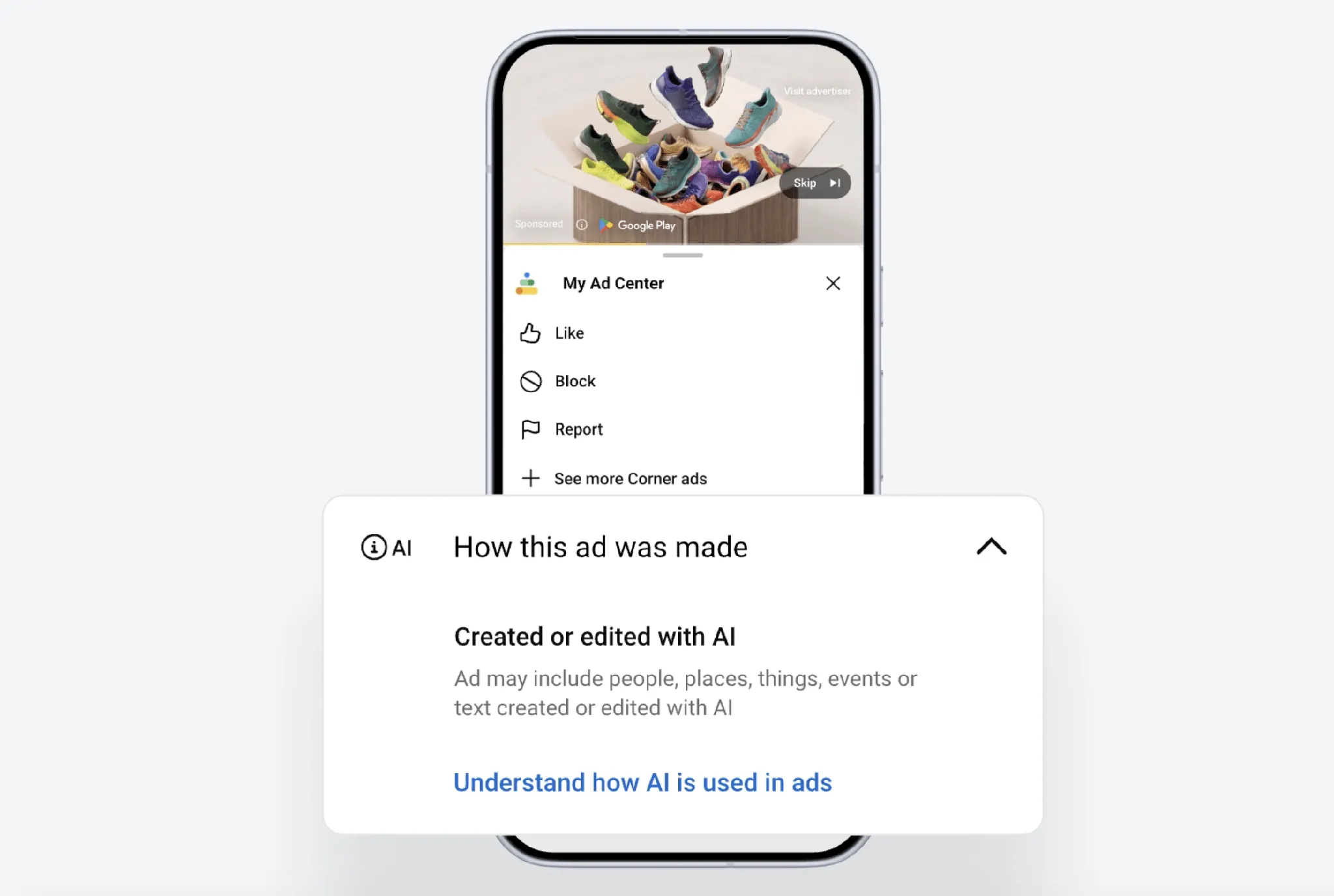
Google’s own warning is the clean operating instruction: the setting “doesn’t guarantee compliance with specific regulations.” [1] In a review queue, that means the setting can support the file history, but it cannot replace the in-creative label decision.
One other Google distinction is worth keeping separate. The commercial AI labeling change is not the same thing as Google’s separate altered or synthetic content checkbox for election ads. Treating those as interchangeable creates another false signoff path: a political-ad disclosure workflow does not automatically solve a commercial synthetic-ad disclosure rule.
New York’s yardstick is the ad itself
New York is the easier yardstick to apply because the operational question is direct: does the advertisement use a synthetic performer, and if so, is the disclosure conspicuous in the ad?
GBL §396-b became effective on June 9, 2026, and requires conspicuous in-ad disclosure of synthetic performers in advertising. The cited civil penalties are $1,000 for a first violation and $5,000 for subsequent violations, enforced by the New York Attorney General, with no private right of action. [3] For a trafficking decision, the important part is not the enforcement architecture. It is the placement of the disclosure.
A synthetic performer disclosure that lives only in a platform panel is poorly matched to that requirement. “About this ad” may be relevant background. A metadata flag may be relevant evidence. Neither is the same as a conspicuous disclosure inside the ad the user is watching, hearing, or seeing in-feed.
So the New York QA check should not start with “Did Meta or Google label it?” It should start with “Is there a synthetic performer?” If yes, the creative needs a conspicuous disclosure before upload. The platform label can sit alongside that decision, not instead of it.
The EU problem is broader than a face-swap warning
The EU AI Act’s transparency approach is a sharper test for hidden labels because the Commission’s FAQ draws a line between machine-readable marking and disclosure a person can actually perceive. It says deployers cannot rely solely on a provider’s machine-readable marking, and that disclosure must be perceivable without technical tools or dedicated actions. [4]
That maps almost perfectly onto the ad-ops failure mode: the system knows something, but the viewer does not. If a disclosure is stored in metadata, inferred by a detector, or available only after a user taps through a menu, the platform may have more context than before. The user still has not received the visible or audible disclosure the EU standard is concerned with.
The EU “deep fake” discussion is also wider than many creative teams assume. Guidance discussed for advertisers and PR teams treats covered AI-generated or manipulated depictions as potentially reaching products, objects, places, animals, and non-identifiable avatars, not only human faces. A photorealistic AI product scene, a synthetic celebrity-influencer execution, or an AI-generated voiceover can raise a different disclosure question than a clearly cartoonish spot. [5]
There are boundaries. The Commission’s interpretation of territorial reach and carve-out limits is guidance, not yet settled court precedent. The research record here also does not support claims about click-through rate, CPA, or ROAS effects from AI labels. That belongs in campaign testing later, not in the compliance signoff.

The QA decision belongs before upload
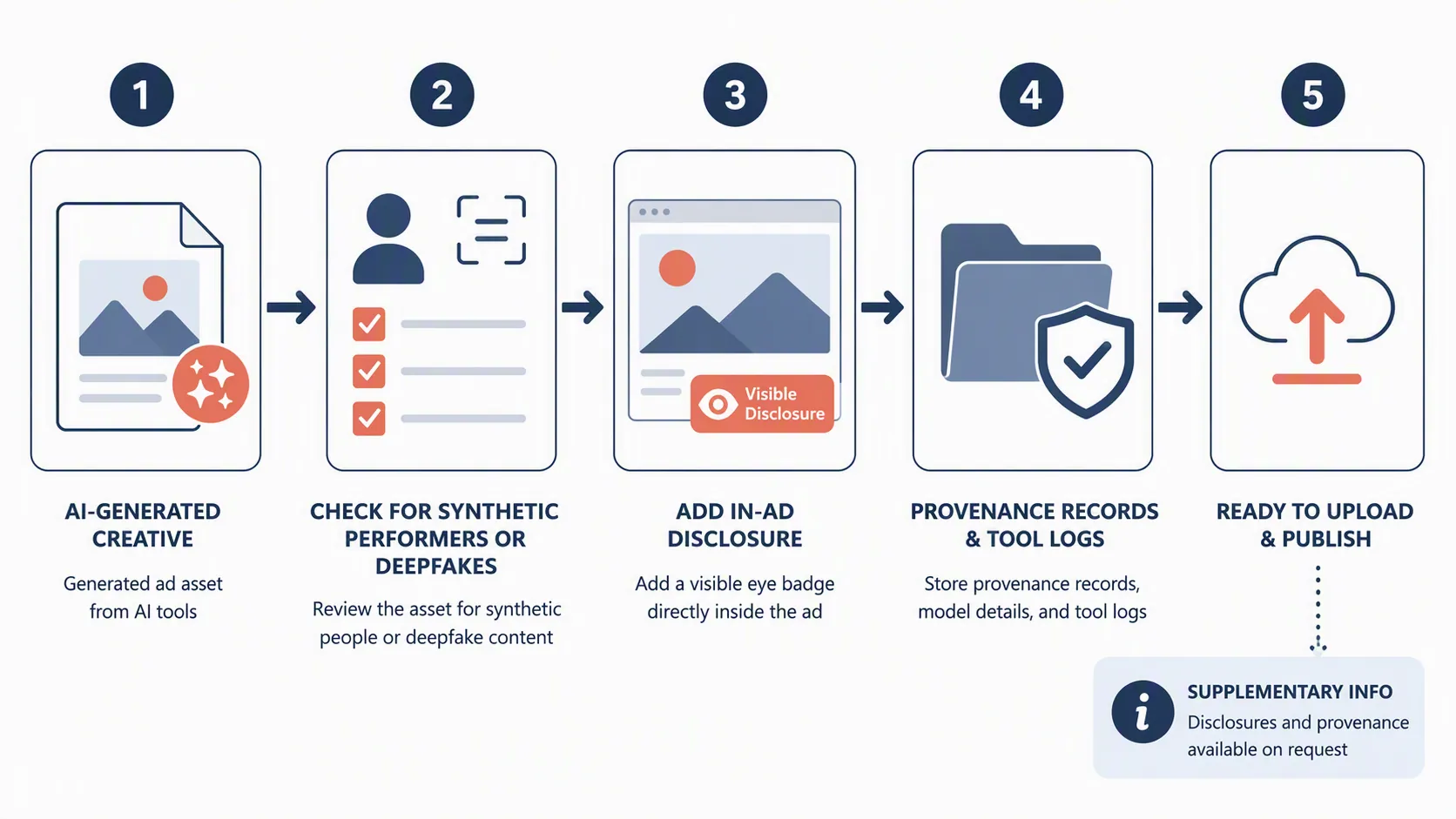
Once the gap is clear, the workflow is not complicated. It is just earlier than many teams want it to be. The disclosure decision belongs in creative QA and provenance review before the asset is uploaded to Meta, Google, or a retail media platform.
- Classify the asset: decide whether the file includes a synthetic performer, a synthetic voice, a manipulated likeness, or EU-relevant deep fake content.
- Decide the legal yardstick: use the broader synthetic ad creative law map and the dated deepfake laws tracker for jurisdiction coverage, instead of reusing a platform announcement as the legal source.
- Add the disclosure inside the creative when required: visible for visual placements, audible for audio-only placements, and clear enough that the viewer does not need to open a platform panel.
- Retain provenance: keep tool records, edit history, C2PA or metadata signals where available, and approval notes. These support review, but they do not replace the viewer-facing label.
- Upload with platform settings completed: use Meta and Google AI labeling fields as supplementary signals, not as the disclosure of record.
Teams that need a standing policy can put this into a three-tier disclosure rule: creative label required, provenance record required, platform label completed where available. The internal owner should be the person who can block upload, not the person who reads the platform announcement after the campaign is already built. A fuller operational template belongs in the AI disclosure policy tracker for marketing teams.
Detector and metadata outputs still have a place. They can help reviewers identify files that need closer inspection, especially when assets move through generative image, video, and audio pipelines. The mistake is treating detector output as if the legal communication has already happened. For that distinction, the same logic used in AI-generated video detection and brand safety and AI image detection for ad verification applies here: detection is triage, not disclosure.
Audio needs the same discipline. If a campaign includes synthetic voice or music for EU-targeted placements, provenance and licensing checks should sit next to the audible-label review. The adjacent audio-rights implications are tracked separately in the GEMA/Suno ruling impact tracker, but the disclosure principle is the same: the listener cannot be expected to inspect metadata.
A defensible rule of thumb is simple enough for the upload queue: if the viewer has to open a menu, inspect metadata, or rely on platform-side detection to learn the ad is synthetic, the advertiser has not solved the legal disclosure problem.
References
- Updates to AI labeling requirements (July 2026), Google Ads Help.
- Google introduces new AI labels for Ads, Google.
- NY Senate bill text.
- Transparency obligations under Article 50 of the AI Act, European Commission.
- EU AI Act Guidance Expands AI Disclosure Rules for Advertisers and PR Teams, Davis+Gilbert.
This is a record of what happened and what was tested, not legal advice. Compliance determinations require qualified counsel.