
Which deepfake laws apply to AI-generated ads?
AI-ad disclosure stopped being voluntary as of Q3 2026: New York's synthetic-performer law, the EU AI Act, Google's AI-label rollout, and state political-ad deepfake rules are all in force or imminent. This dated tracker log maps which requirements apply to AI-generated ads — effective dates, penalties, exemptions, and the per-asset checks to run before launch.
- Platform
- Regulators
- Change category
- policy
- Effective date
- 2026-08-02
- Change type
- policy or regulatory shift
- Impact level
- High
Last reviewed: August 4, 2026. As of Q3 2026, disclosure for AI-generated ads is no longer a voluntary brand-safety preference. It is also not one universal “deepfake law.” The same AI video can be treated differently depending on whether it uses a human-like synthetic performer, runs in New York, serves into the EU, includes a testimonial-style claim, appears in election inventory, or relies on a platform’s own generative-AI tools.
For a media buyer, the practical question is not “Is this AI?” It is: which market, which asset, which disclosure, which upload field, and which penalty if the team gets it wrong?

Q3 2026 AI-generated ad disclosure tracker
| Effective date / status | Jurisdiction or platform | Requirement | Affected ad assets | Penalty or enforcement consequence | Exemptions / carve-outs / notes | Primary source |
|---|---|---|---|---|---|---|
| June 9, 2026 | New York | Advertisers must disclose when an ad uses a synthetic performer that appears human-like. | Digital, social, streaming, and sponsored ads using human-like AI performers. | $1,000 for a first violation and $5,000 for subsequent violations. | Reported carve-outs include expressive works, audio-only content, translation, and publisher exemptions. Treat this as an ad-specific rule, not a general AI-content rule. | New York Gen. Bus. Law § 396-b analysis and advertiser summary [1][2] |
| August 2, 2026 | European Union | AI Act Article 50(4) requires disclosure for deepfakes, with the definition reaching realistic AI-generated or manipulated depictions that falsely appear authentic. | AI-generated or manipulated ads served in the EU, including content from non-EU advertisers when delivered into the EU. | Transparency-rule penalties can reach up to €15 million or 3% of worldwide annual revenue. | Guidance examples matter at asset level: a celebrity-influencer-style AI video can be a deepfake; AI mice arguing over cheese are not; a real car on an AI background may not be if not misleading; an AI product image that misleads about appearance may be. Guidance is newly finalized and interpretive. | EU AI Act Article 50 guidance summaries [3][4] |
| July 9, 2026 rollout | Google Ads, Display & Video 360, Campaign Manager 360, Merchant Center, Ads Editor | Google expanded AI transparency labels, including auto-labeling for some ads made with Google tools and support for in-creative labels. | Ads using Google generative-AI tools and other synthetic or altered content that falls within Google’s policy workflow. | Platform enforcement can include labeling, disapproval, or account-level consequences under Google policy; legal compliance remains advertiser-side. | Google explicitly cited EU, India, and New York requirements. Platform labeling helps the upload flow but does not replace statutory review. | Google policy page and Google Ads blog [5][6] |
| October 21, 2024 | United States / FTC | The FTC Consumer Reviews and Testimonials Rule bans fake reviews and testimonials, including AI-generated fake reviews. | AI-generated testimonials, review claims, ratings, endorsements, or testimonial-style ad copy presented as authentic consumer experience. | Civil-penalty authority applies; do not confuse this with New York’s fixed fine tiers or EU revenue-based caps. | Most relevant when an AI ad uses a fake customer, fake expert, fabricated review, or testimonial voiceover. | FTC final rule announcement [7] |
| May 19, 2026 enforcement start | United States / platform takedown duties | The Take It Down Act created platform duties around nonconsensual intimate imagery, including AI-generated intimate imagery. | Ads or platform content involving nonconsensual intimate imagery; generally a platform-duty and takedown issue rather than a routine product-ad disclosure rule. | FTC penalties reported up to $53,088 per violation; FTC warning letters went to more than 12 platforms including Meta, Apple, Microsoft, TikTok, Reddit, Snapchat, and X. | Relevant if creative, landing pages, user uploads, or influencer materials contain nonconsensual intimate imagery. Not a general synthetic-performer disclosure law. | Benesch enforcement summary [8] |
| In force in multiple states; counts vary by source and date | U.S. state political-ad laws | Many states regulate AI-generated or materially deceptive deepfakes in political advertising, often through disclaimer, consent, timing, or ban provisions. | Election ads, candidate ads, ballot-measure ads, PAC creative, and other political or election-related synthetic media. | Penalties vary by state; do not apply a single national fine. November 2026 midterm creative needs state-by-state review. | Counts are not stable: one source reported 30 states as of May 2026; another said more than 30 in June 2026. A Ballotpedia search snippet showed 33 as of July 23, 2026, but that page was not verified here and should not be treated as controlling. | Stackcyber and Wiley dated counts [9][10] |
| Since 2022; broader background count | U.S. states / deepfake statutes generally | State deepfake laws have expanded beyond political ads into areas such as impersonation, sexual imagery, elections, and fraud. | Not every statute applies to commercial AI ads; use this only as background for why a state-by-state filter is now necessary. | Depends on the statute. | MultiState reported 175 state deepfake laws enacted since 2022. That is a broad deepfake-law count, not a political-ad-only count. | MultiState state-law tracker analysis [11] |
| Pending; not law as of this review | United States / federal | NO FAKES Act would create federal protections around unauthorized AI replicas of voice and likeness if enacted. | Synthetic voice and likeness uses, potentially including ads and endorsements. | No current ad-compliance penalty to apply because the bill is pending. | Senate Judiciary Committee passage was reported in June 2026. GovTrack listed S.4591 with a low enactment prognosis; treat as a watch item, not a launch-blocking rule. | Holland & Knight and GovTrack bill-status summaries [12][13] |
Where New York bites first: the synthetic performer
New York is the cleanest new ad-specific rule in the stack because the affected object is recognizable in the asset folder: a human-like synthetic performer in an ad. If the creative team generated a person to present the product, demonstrate the service, or appear as the on-camera face of the spot, the New York question has to be asked before upload, not after the campaign is already live.
The rule is also newly effective. New York’s synthetic-performer disclosure law took effect June 9, 2026, with fines reported as $1,000 for a first violation and $5,000 for later violations [1][2]. Those amounts belong to New York. They should not be blended with FTC per-violation numbers or EU revenue-based caps in a launch note.
The carve-outs are just as operational as the requirement. Reported exemptions include expressive works, audio-only content, translation, and publisher exemptions [1]. That means the reviewer has to know what is actually in the file: a synthetic presenter in a paid social ad is a different review than an audio-only translated spot, and both are different from a publisher’s handling of third-party material.
The launch problem is not usually that someone hides the AI source. It is that one asset gets renamed six times, resized into four placements, and added to a New York geo split after the disclosure decision was made for a national test. The New York check belongs at the variant level: each video, cutdown, thumbnail, and sponsored post should carry its own disclosure decision in the trafficking notes.
The EU test is broader than “does this look like a fake person?”
The EU AI Act Article 50 row deserves more than a checkbox because the definition of “deep fake” is wider than many U.S. campaign teams expect. The guidance described by Davis+Gilbert and DuckDuckGoose treats realistic AI-generated or manipulated depictions of people, objects, places, and events as potentially covered when they falsely appear authentic [3][4]. A synthetic human is only one route into the rule.

The Commission example pairs are useful because they sound like creative-review questions, not theory. A celebrity-influencer-style AI video can qualify as a deepfake; two AI mice arguing over cheese do not. A real car placed on an AI-generated background may not be a deepfake if the overall image is not misleading. An AI-generated product image that misleads viewers about what the product actually looks like may be treated differently [3][4].
That is the part that changes QA. An EU review cannot stop at “human replica: yes/no.” It has to ask whether the ad presents a realistic depiction as authentic. A product render, a showroom scene, an event image, or a place-based claim can become the harder call even when no synthetic spokesperson appears in the frame.
Article 50 obligations are enforceable from August 2, 2026, and the reported transparency-rule penalty ceiling is up to €15 million or 3% of worldwide annual revenue [3][4]. That penalty tier should stay attached to the EU transparency obligation. It is not the New York fine, and it is not the separate higher EU banned-AI tier that begins later under a different part of the Act.
Non-EU advertisers should not treat the EU row as somebody else’s localization issue. The reported guidance reaches AI content served in the EU, including by advertisers outside the EU [3]. If the campaign has an EU geo, language expansion, retargeting pool, or “Europe too?” last-minute budget line, the Article 50 decision has to be made before the platform upload goes live.
For milestone context on Article 50 inside the site’s broader AI-ad benchmark record, see the EU AI Act compliance milestone log.
Google’s labels help the workflow; they do not close the legal file
Google’s July 9, 2026 AI-labeling update matters because it lands inside the buying tools: Google Ads, DV360, Campaign Manager 360, Merchant Center, and Ads Editor [5][6]. That is where disclosure decisions either become part of the campaign record or disappear into a Slack thread.
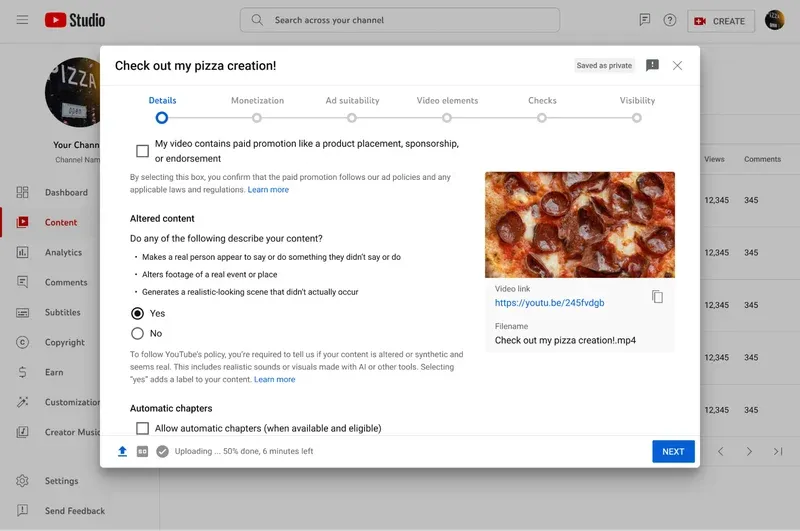
Google says some ads created with its own AI tools can be auto-labeled, and its materials permit in-creative labels in relevant workflows [5][6]. That can reduce the chance that the label gets lost between creative export and platform trafficking. It does not answer whether the asset also needs a New York synthetic-performer disclosure, an EU Article 50 disclosure, or a state political-ad disclaimer.
The useful way to treat the platform label is as evidence in the account record: which tool generated the asset, which label appeared, which policy field was completed, and which market-specific law was checked separately. For a fuller map of platform-burden mechanics, including where platforms auto-label and where advertisers still carry the compliance obligation, use the AI-generated ad liability tracker.
Political-ad counts are a dated-source problem
There is no clean national number to paste into a political-ad launch checklist and forget. One source reported 30 states with political deepfake laws as of May 2026 [9]. Wiley described the count as “more than 30” in June 2026 [10]. A Ballotpedia search snippet showed 33 as of July 23, 2026, but the underlying page was not verified for this review, so it should remain a verification note, not a controlling source.
That spread is not a rounding error for November 2026 midterm creative. Political-ad laws can differ on timing windows, disclaimer language, consent rules, candidate references, materially deceptive content, and whether the remedy is a ban, a label, or another enforcement route. A national paid-social buy that uses one AI-generated candidate depiction may need different treatment by state.
The broader state-law picture is even wider. MultiState reported 175 state deepfake laws enacted since 2022 [11]. That number is useful background, but it should not be misread as 175 commercial AI-ad disclosure rules. A political-ad reviewer should start with the state and election context, then work down to the actual asset: candidate likeness, voice simulation, event depiction, ballot-measure claim, or synthetic supporter testimonial.
FTC and Take It Down are narrower, but they can still hit an ad folder
The FTC fake-review rule is not a general deepfake-labeling requirement. It becomes relevant when the AI ad includes a review, rating, endorsement, testimonial, or customer-like statement that is presented as real. The FTC announced the final Consumer Reviews and Testimonials Rule in August 2024, with an October 21, 2024 effective date, and described it as banning fake reviews and testimonials, including AI-generated fake reviews [7].
That means a synthetic performer saying “I used this for two weeks” creates a different review path than a synthetic performer simply reading product features. The first may raise testimonial substantiation and authenticity issues; the second may be primarily a synthetic-performer or deepfake-disclosure issue depending on market.
The Take It Down Act is also not a normal product-ad disclosure rule. It matters if AI-generated or manipulated intimate imagery appears in content, platform uploads, landing-page material, or user-generated material attached to a campaign. Benesch reported a May 19, 2026 enforcement start, FTC penalties up to $53,088 per violation, warning letters to more than 12 major platforms, and an April 2026 first criminal conviction in Ohio [8]. For most routine commercial campaigns, it is a boundary check; for any campaign touching intimate imagery, creator misuse, revenge-porn themes, or user submissions, it becomes a hard escalation.
Pre-upload QA for one AI ad variant
Run this pass per asset and per jurisdiction. It is not a compliance guarantee; it is the minimum source trail a campaign record should have before the asset is approved.

- Open the exact exported asset, not the concept deck. Check whether a human-like synthetic performer appears in the video, thumbnail, carousel card, sponsored post, or landing-page hero.
- Mark the delivery markets. If New York is included, test the asset against the New York synthetic-performer disclosure row. If the EU is included, test the asset against Article 50, including realistic depictions of products, places, objects, and events.
- Separate “AI-made” from “deepfake-like.” A stylized abstract animation may be AI-generated without being a realistic depiction that falsely appears authentic. A realistic synthetic influencer, product image, or event scene needs a closer read.
- Flag testimonial behavior. If a synthetic voice, avatar, or text block claims experience, preference, results, ratings, or customer opinion, route it through FTC review/testimonial substantiation before launch.
- Identify election or political content early. Candidate likeness, simulated candidate voice, ballot-measure messaging, PAC creative, and synthetic event footage should go into a state-by-state political-ad review, especially for November 2026 placements.
- Record platform provenance. Note whether the asset was generated by Google’s own tools, a third-party AI system, an agency tool, or an influencer/creator workflow. Platform auto-labeling may only cover part of the legal question.
- Save the label decision beside the asset. The useful record is not “AI checked.” It is: asset filename, date reviewed, markets, platform, applicable rule, disclosure used or exemption relied on, reviewer, and source row.
- Recheck when anything changes: new cutdown, new market, new placement, new platform, new political context, new landing page, or new creator version.
Consumer reaction to AI-ad disclosure is a separate question from whether the label is required. If the team is weighing disclosure language, trust, or backlash, use the AI ad creative backlash brief for that layer rather than mixing sentiment into the legal tracker.
The working rule for Q3 2026 is simple enough to put in the trafficking doc: no single AI label decision now covers a campaign. Every AI creative variant needs a dated source trail before launch, and the tracker should be revisited whenever the asset, market, platform, or political context changes.
References
- New York’s Synthetic Performer Disclosure Law: What Advertisers Need to Know, McDermott Will & Emery
- Using AI in an Ad? You’ve Got to Disclose It Starting This Month in New York, Transparency Coalition
- EU AI Act Guidance Expands AI Disclosure Rules for Advertisers and PR Teams, Davis+Gilbert
- Deepfake Regulation 2026: What’s Changing, DuckDuckGoose
- Political content, Google Ads Policies Help
- New AI transparency labels in Google Ads, Google
- Federal Trade Commission Announces Final Rule Banning Fake Reviews and Testimonials, Federal Trade Commission, August 2024
- One Year In: FTC’s Operation AI Comply Continues Under New Administration, Signaling Enduring Enforcement Focus, Benesch
- AI Deepfake Laws, Stackcyber
- AI Restrictions in Political Ads: What to Know About Deepfake Disclaimers and Bans, Wiley
- How AI-Generated Content Laws Are Changing Across the Country, MultiState, February 12, 2026
- Senate Judiciary Committee Advances Legislation to Protect Name, Image, Likeness from AI, Holland & Knight, June 2026
- S.4591 — NO FAKES Act, GovTrack
Primary source: https://eur-lex.europa.eu/eli/reg/2024/1689/oj