
Who is liable when AI-generated ad content gets flagged?
A platform-by-platform map of who carries the risk when AI-generated ad creative triggers policy or brand-safety flags: Google auto-labels but disclaims compliance, Meta only labels its own tool-made assets, Amazon pushes New York synthetic-performer disclosure onto sellers, and TikTok requires creator disclosure. The advertiser carries the burden on every major platform, and the sharp differences in mechanics make compliance a per-platform workflow problem.
- Platform
- Google, Meta, Amazon0 TikTok
- Creative type
- AI image, AI video0 synthetic performer
- Disclosure status
- Advertiser owns compliance; no safe harbor
- Failure type
- Disclosure and provenance gap; brand-safety flagging
- Last reviewed
- 0-08-03
As of Q3 2026, if AI-generated ad content gets flagged for disclosure, policy, or brand-safety reasons on Google, Meta, Amazon, or TikTok, the practical burden sits with the advertiser or uploader. That does not mean every platform uses the same rule, or that any of them has published a clean sentence saying “the advertiser is liable for everything.” They mostly do something more operationally annoying: they give you labels, toggles, review paths, or disclosure fields, then leave compliance with the account owner.

Google says this most plainly. Its AI label setting for ads can help show that an ad was made with AI, but Google’s own policy help page says using that setting “does not guarantee compliance with specific regulations.”[1] That sentence captures the platform-brand safety problem in miniature: the platform offers the disclosure mechanism; the advertiser still owns the miss.
| Platform | What changes the workflow | Where the burden lands in practice |
|---|---|---|
| Auto-labels ads made with Google AI and offers a manual AI label setting for ads created elsewhere. | Advertiser must decide when to use the setting and cannot treat the label as regulatory compliance. | |
| Meta | “AI info” labels apply to ads fully created or significantly edited with Meta’s own generative AI features. | Third-party AI creative does not automatically move through the same Meta label path. |
| Amazon | For New York-served ads, advertisers must select “Contains synthetic performers” where applicable and embed required disclosure in supplied creative. | The advertiser has to identify the synthetic performer issue before submission. |
| TikTok | Creators must disclose realistic synthetic media. | Disclosure can attach to the uploader or creator side, not just to an automated ad-system label. |
The important distinction is not whether AI creative is allowed. It usually is, subject to the same deception, impersonation, political, restricted-category, and platform-specific rules that already applied. The sharper question is what happens when the asset looks synthetic enough, realistic enough, or human enough to trigger a review flag. On that question, the platform map matters more than a generic AI policy memo.
Google: the cleanest label mechanism, and the clearest non-guarantee
Google’s July 9, 2026 update is the most important current document because it connects product behavior to advertiser exposure. Google announced that people can open My Ad Center and see a “How this ad was made” panel for certain ads. Ads created with Google’s own generative AI tools can be labeled automatically, while advertisers can use a control to label ads made with AI tools outside Google.[2]

That sounds tidy until it hits trafficking. If the asset was generated or significantly altered inside Google’s tools, the account may benefit from Google’s automatic labeling path. If the same concept was made in Midjourney, Runway, Firefly, an agency production stack, or an internal image model, the buyer has to know that and decide whether the Google AI label setting should be applied. The workflow therefore depends on creative provenance, not just final-file review.
Google’s support page then draws the boundary that matters for liability. The AI label setting is not a safe harbor. Google says use of the setting “does not guarantee compliance with specific regulations,” and advertisers remain responsible for understanding and satisfying applicable legal requirements.[1] In plain upload-room terms: the label may reduce ambiguity for the viewer, but it does not turn a questionable asset into a compliant one.
That affects brand-safety handling too. A synthetic spokesperson, AI-edited testimonial, or realistic generated scene may be labeled, but the label does not answer whether the claim is substantiated, whether a person’s likeness has been used with permission, whether the disclosure is prominent enough for a state-specific rule, or whether the ad creates a misleading impression. Those are still account-side review questions before the asset reaches Google Ads.
Meta: the gap is third-party AI creative
Meta’s current AI label path is narrower than many advertisers assume. Meta says “AI info” labels can appear on ads fully created or significantly edited using Meta’s own generative AI features, including labels shown beside “Sponsored” or in the three-dot menu.[3]
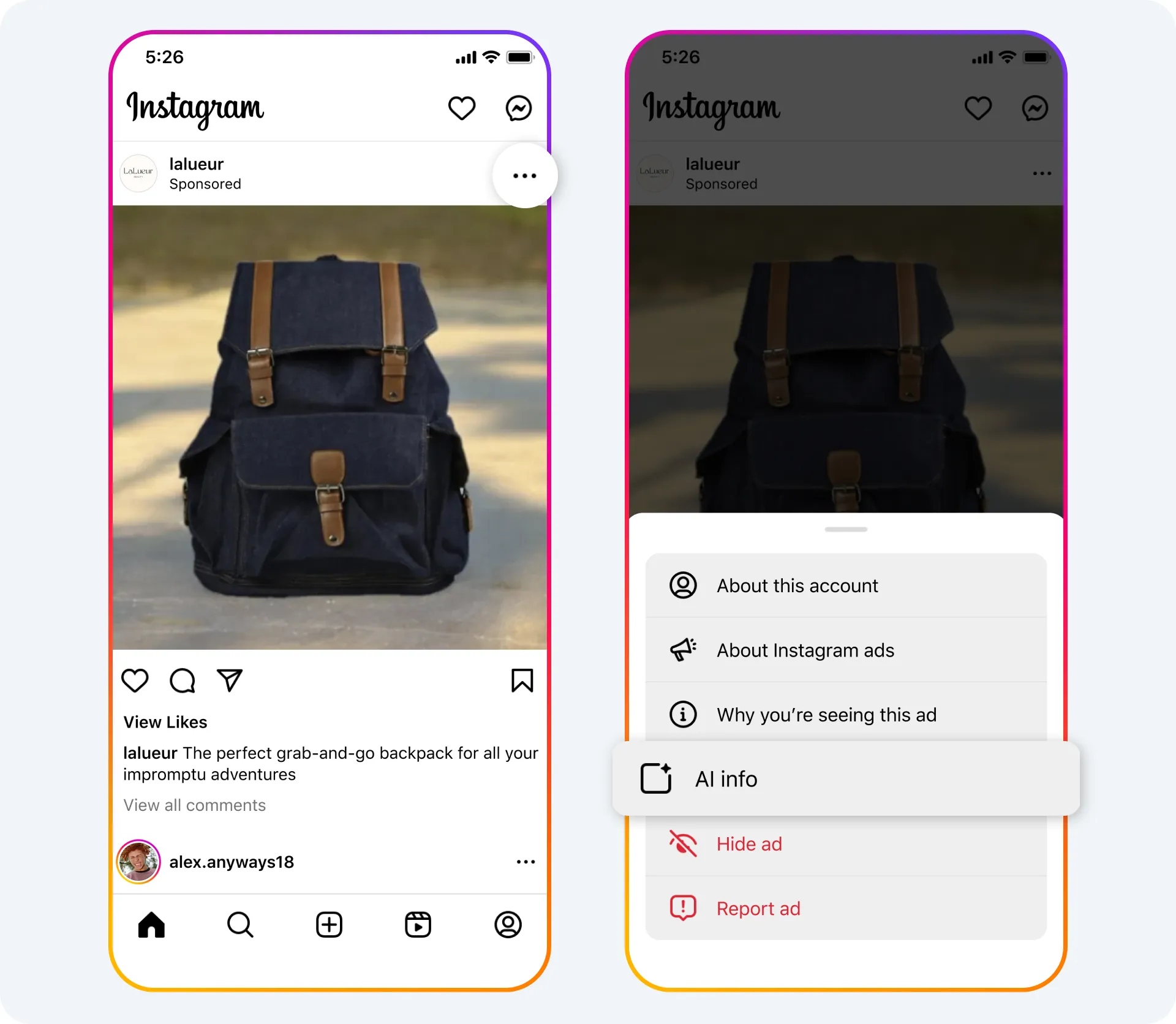
That matters because it is not a universal AI-content scanner for every ad an agency uploads. If an image was made or materially altered in a third-party system before it entered Meta Ads Manager, the same Meta-owned-tool labeling path does not necessarily apply. The label mechanic is tied to Meta’s own AI features, not to the advertiser’s entire creative supply chain.
For a media buyer, the practical consequence is boring but important: the trafficking checklist cannot stop at “will Meta label this?” It has to ask how the asset was made before upload. Meta may provide an AI info surface for its own generative edits, but that does not resolve disclosure, permission, or substantiation issues created elsewhere.
One caveat: the Meta help material in the source set is not a full liability allocation document, and the help page was reviewed through translated material with corroborating coverage. It explains label behavior for Meta AI-created or significantly edited ads. The advertiser-burden conclusion comes from that mechanics gap, not from a Meta sentence expressly admitting where legal liability sits.
Amazon: New York synthetic-performer flags make the advertiser identify the problem
Amazon is the most concrete example of AI disclosure becoming a pre-flight field. Its Amazon Ads help page says advertisers are responsible for complying with applicable laws and regulations, including New York’s law on synthetic performers. For ads served in New York, advertisers must select “Contains synthetic performers” if the ad includes a synthetic performer, and if the advertiser supplies the creative, the required disclosure must be embedded directly in that creative.[4]
That is a very different workflow from waiting for a platform-side label. Someone on the advertiser side has to look at the asset and decide whether the person on screen, in the image, or in the generated performance meets the synthetic-performer condition. If the answer is yes, the campaign setup needs the Amazon flag, and the creative file itself may need disclosure before it is uploaded.
The embedded-disclosure point is easy to miss. A platform label can sit around the ad unit. Amazon’s instruction for supplied creative means the disclosure may have to travel with the asset itself. That changes production handoff: the edit, export, QA, and trafficking steps all need to know whether the ad will run in New York and whether the synthetic-performer rule is implicated.
Amazon’s documentation should not be overstated. The research record does not support a precise claim about every visibility trigger or enforcement criterion for every Amazon placement. What it does support is narrower and still operationally meaningful: for New York-served ads involving synthetic performers, Amazon makes the advertiser select the relevant flag and, for supplied creative, carry the compliant disclosure in the creative itself.[4]
TikTok: disclosure attaches to realistic synthetic media
TikTok’s key contribution to the map is simpler: it requires creators to disclose realistic AI-generated content. In its September 19, 2023 announcement, TikTok said creators must label realistic AI-generated images, audio, or video, and the platform introduced a tool to help creators disclose that content.[5]
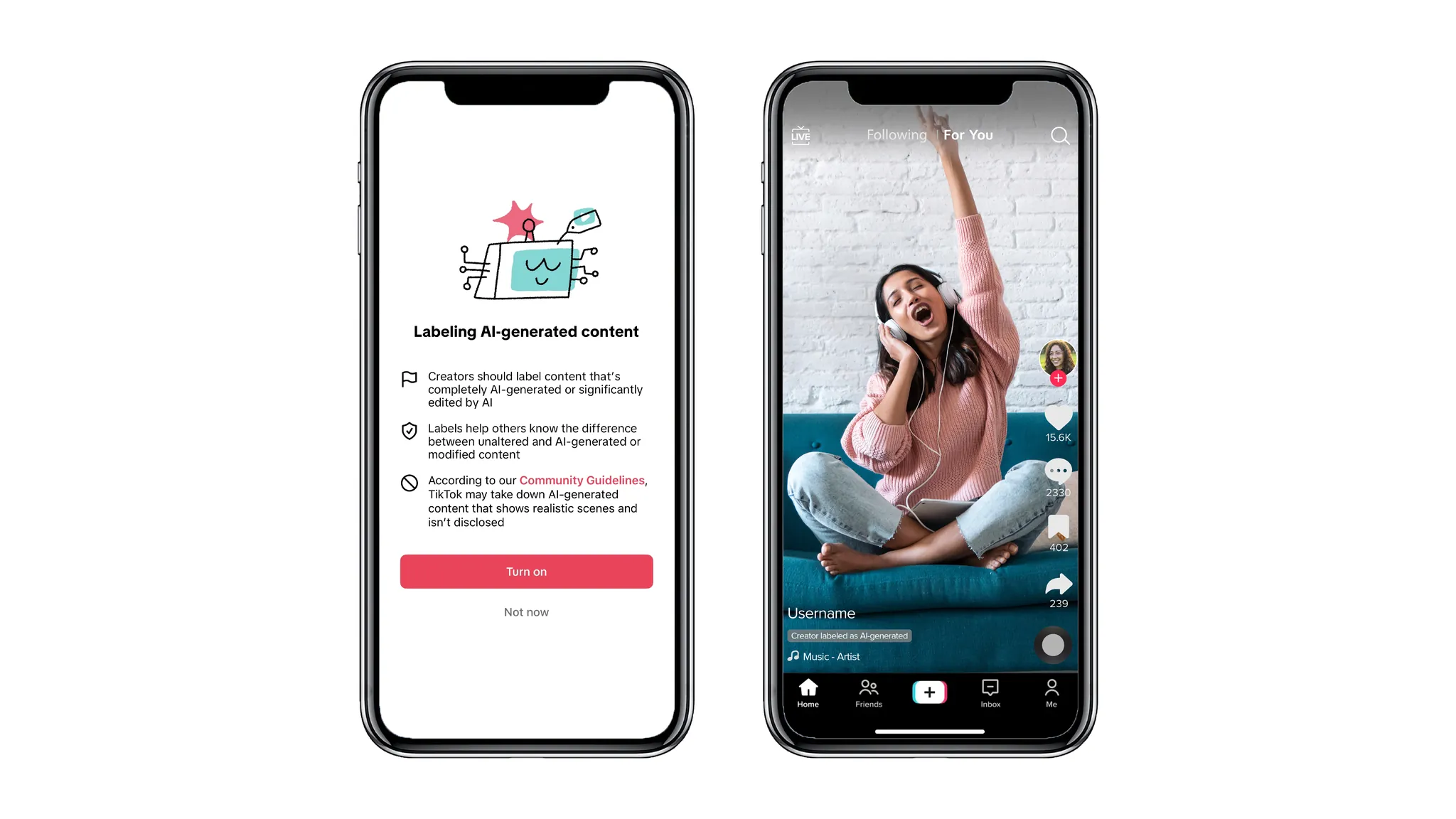
For advertisers, the lesson is not that TikTok has the same AI ad workflow as Google or Amazon. It does not. The useful comparison is that disclosure can attach to the person or account uploading realistic synthetic media, rather than being solved entirely by an ad-platform auto-label. If a paid campaign uses creator-style synthetic content, the disclosure obligation may be sitting upstream in the creator workflow before the media plan ever sees the file.
The legal backdrop is real, but it is not one federal AI-ad label rule
There is no single federal U.S. rule that simply says every AI-generated ad must carry an AI disclosure. The federal baseline is broader and older: advertising cannot be deceptive, and marketers do not get an AI exception from truth-in-advertising principles. The FTC’s Operation AI Comply announcement framed enforcement around deceptive AI claims and schemes, not a universal ad-label mandate.[6]
The FTC’s business guidance likewise keeps the focus on ordinary advertising obligations: claims must be truthful, evidence must support objective claims, and disclosures must be clear enough not to leave consumers with a misleading impression.[7] An AI label can be relevant to that analysis, but it is not the same thing as claim substantiation, likeness clearance, endorsement compliance, or platform approval.
The reason platform workflows are changing anyway is the patchwork around the edges: New York’s synthetic-performer law, state-level political-ad synthetic media rules, California provenance and watermarking developments, and EU AI Act transparency obligations. For a dated companion record on that regulatory calendar, see Palantir CEO's AI regulation warning hits home for adtech this week. The operating point for U.S. ad teams is still narrower: do not treat “AI disclosure” as one national checkbox that travels cleanly across platforms.
What to document before an AI ad goes live
A workable AI creative review process should be platform-specific. It does not need to be theatrical. It needs to leave a record that can survive the moment an asset is rejected, labeled unexpectedly, paused after review, or questioned by a client.
- Record how the asset was made: platform-native AI tool, third-party AI tool, manual edit, stock asset, creator submission, or mixed production.
- Identify whether a realistic synthetic person, voice, likeness, performer, testimonial, or scene appears.
- Check whether the platform auto-labels only its own AI-generated assets or requires advertiser self-declaration for outside tools.
- For Amazon New York delivery, decide before upload whether “Contains synthetic performers” applies and whether the supplied creative itself needs embedded disclosure.
- For TikTok creator-style assets, confirm whether realistic synthetic media disclosure was handled by the creator or uploader.
- Keep screenshots or export notes showing which disclosure setting was selected, who approved it, and what version of the creative was trafficked.
- Separate disclosure review from claim review. An AI label does not substantiate a product claim or clear a person’s likeness.
The failure mode is usually not that a team “used AI.” It is that nobody can reconstruct what changed between the initial generation, the edit, the export, the platform upload, and the disclosure choice. When the flag lands, that missing chain becomes the advertiser’s problem to explain.
So the answer is deliberately uneven. Google may label and still disclaim compliance. Meta may label assets made with its own tools while leaving third-party AI provenance outside that same path. Amazon may require advertiser-side synthetic-performer selection and embedded disclosure for certain New York-served supplied creative. TikTok may put disclosure duties on realistic synthetic media creators. None of that gives advertisers one portable AI-ad liability rule. It gives them four upload workflows to control.
References
- About AI labels in ads — Google Ads Help.
- Expanding AI transparency in advertising — Google, July 9, 2026.
- About AI info on ads — Meta Help Center.
- Synthetic performers in ads — Amazon Ads Help, updated July 6, 2026.
- New labels for AI-generated content — TikTok Newsroom, September 19, 2023.
- FTC Announces Crackdown on Deceptive AI Claims and Schemes — Federal Trade Commission, September 25, 2024.
- Advertising and Marketing — Federal Trade Commission.
This is a record of what happened and what was tested, not legal advice. Compliance determinations require qualified counsel.