
Can AI image detectors verify your ad creative?
Advertised accuracy numbers from AI image detectors don't survive independent testing. This guide walks media buyers through the 2026 evidence — NewsGuard audits, generator compliance gaps, and FTC actions — and lays out a verification stack that treats detection as triage, not proof.
- Platform
- Meta, Google
- Creative type
- AI image
- Disclosure status
- Advertiser-declared, not independently verified
- Failure type
- Detection tool inaccuracy
- Last reviewed
- 2026-08-26
The short answer for Q3 2026: detectors can triage, not verify
If the question is whether AI-generated image detection can verify ad creative, the responsible answer is no. A detector score can help a media team decide which files deserve a closer look. It should not become the sentence a client sees, the evidence a compliance lead signs off on, or the basis for accusing a creative vendor of submitting AI-generated work.
The reason is not philosophical. It is operational. In NewsGuard’s May 8, 2026 audit of five leading AI image detection tools, the tools collectively marked authentic images as AI-generated 13.33% of the time. One tool, ScamAI, flagged 6 of 15 real photos as fake. Sightengine detected only 5 of 15 heavily manipulated images. Across the 45-image test set, the tools disagreed on 35 images.[1]
That is the part that matters before launch. By the time an ad image has been resized, compressed, exported from a design tool, uploaded into an asset library, renamed by an agency, and ingested by Meta or Google, a clean yes-or-no detector verdict is already weaker than it sounds. The file has a history. The detector only sees the current artifact.
The FTC is also circling the same issue from the accuracy-claim side. In its proposed order against Workado, the agency described a product marketed at about 98% accuracy that allegedly measured around 53%; on July 1, 2026, the FTC also sought comment on a proposed policy statement addressing AI accuracy claims.[2] For a media buyer, that is a useful warning: a landing-page accuracy number is not a verification standard.
| Evidence layer | Responsible use in ad creative QA | Client-facing strength |
|---|---|---|
| Single AI image detector | Internal triage only | Too weak for a verification claim |
| Multiple detectors agreeing | Prioritize review, request source files, check disclosure settings | Still not proof |
| Provenance metadata or watermark signal | Support chain-of-custody review when preserved | Stronger, if the signal survives the workflow |
| Platform AI disclosure settings and labels | Confirm what Meta or Google will show users | Useful, but often depends on advertiser or tool compliance |
| Source-file records, vendor attestations, edit logs | Complete the audit trail | Most defensible when combined with provenance and platform evidence |
Why one detector score is not evidence
The NewsGuard audit is uncomfortable because it breaks the neat vendor story from both directions. False positives put real images at risk. False negatives let manipulated images pass. Tool disagreement means the answer can change depending on which detector lands in the QA spreadsheet.
For creative QA, the false positive is not a harmless mistake. If an in-house team tells a client that a real product photo is AI-generated because a detector said so, the team now owns that accusation. If an agency rejects a freelancer’s image on the same basis, it may be making a personnel or vendor decision on a weak signal. If a brand keeps the image but adds an AI disclosure “just to be safe,” it may be creating a misleading disclosure problem in the other direction.
The false negative is just as practical. A heavily manipulated image that escapes a detector can still trigger platform labeling, client policy, or regulatory review later. In NewsGuard’s test, Sightengine caught only 33% of heavily manipulated images, and the detector set disagreed on most of the images tested.[1] That is not a foundation for an approval note that says, “Verified non-AI.”
There is also a plain evidentiary difference between “the vendor says it is accurate” and “an independent test measured how it behaves on a defined sample.” A product page can report a favorable accuracy claim without telling you enough about the test set, perturbations, resizing, compression, or threshold. An independent audit may still be limited, but at least it tells you what was tested and where the tool failed.
That distinction matters when the result is going into an approval workflow. A detector result can justify opening a ticket, asking for the original layered file, checking a generator account, or escalating to compliance. It does not justify closing the file as proven.
The verification stack that can actually survive review
A useful workflow starts with the evidence that travels with the asset or can be checked against platform behavior. Detectors sit in the middle of that workflow, not at the end.
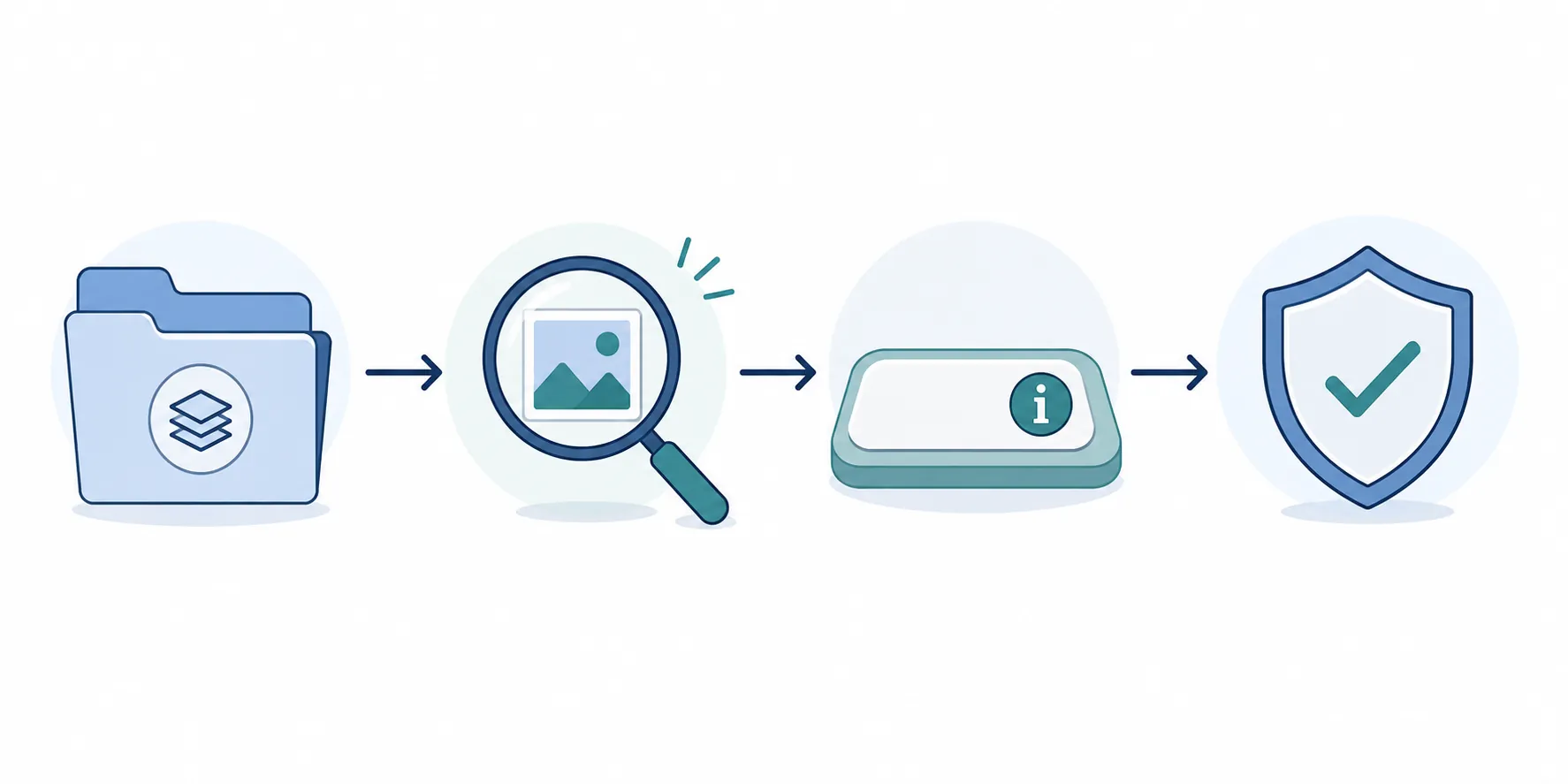
- Start with provenance: source files, edit history, content credentials, watermark signals, export records, and vendor attestations.
- Use detectors to sort the messy folder: run more than one tool when the result affects approval, and treat disagreement as a reason to inspect, not a reason to decide.
- Check platform disclosure requirements before upload: what the platform asks the advertiser to declare is often more important than what an outside detector thinks.
- Write the approval note around evidence actually reviewed: “source file and platform disclosure checked” is stronger than “AI detector passed.”
Watermark and provenance systems are stronger than passive detection because they attach or preserve a signal instead of trying to infer origin from pixels alone. ImageDetectBench, an arXiv benchmark, found that watermark-based detectors outperformed passive detectors across 8 common perturbation types and 3 adversarial perturbation types.[3] Google DeepMind describes SynthID as a system for embedding a digital watermark into AI-generated images so the content can later be identified by a detector designed for that signal.[4]
That does not make watermarking magic. A provenance signal can be stripped, broken, or never attached in the first place. The point is narrower and more useful: if a preserved credential or watermark can be inspected, it is a better compliance artifact than a passive detector’s probability score.
How platform labels fit into the stack
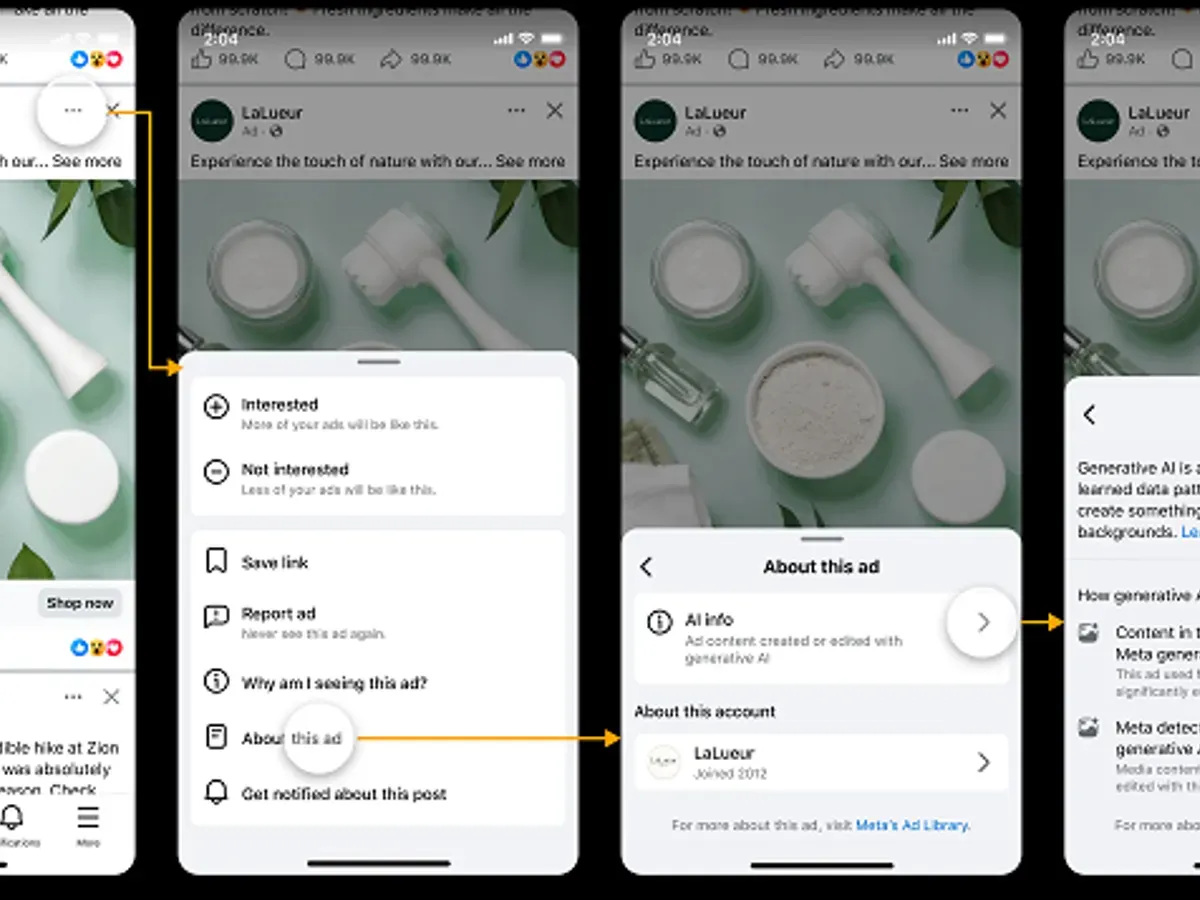
Meta says ads may receive “AI info” labels when they are created or significantly edited with Meta generative AI features or third-party AI tools, while minor edits are treated differently.[5] That is a platform-facing disclosure layer. It is not the same as an independent forensic finding, but it affects what users may see and what the advertiser has to manage.
Google’s July 9, 2026 announcement introduced a “How this ad was made” panel for AI transparency in ads.[6] Google’s Ads policy update says advertisers must indicate when certain ads use synthetic or digitally altered content, but the mechanism is still partly an advertiser disclosure workflow.[7] TechCrunch reported the uncomfortable operational detail: Google will not independently verify the checkbox.[8]
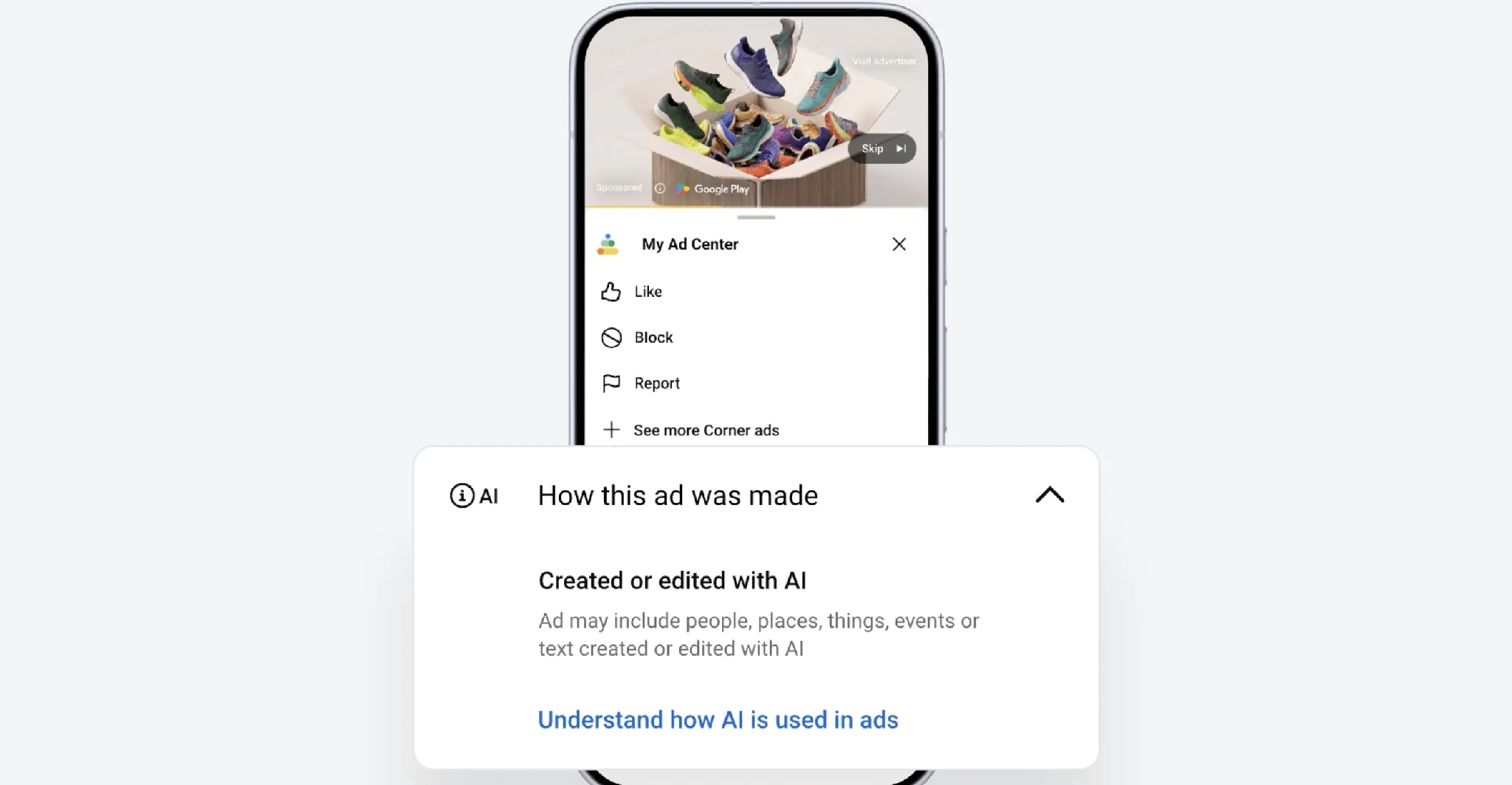
That checkbox dependency is exactly why platform labels should be treated as a disclosure control, not as independent proof of origin. The media buyer still needs a record of who checked the box, what evidence they reviewed, and whether the uploaded asset matches the file that was approved.
The generator-detector fallback is incomplete
A tempting workaround is to ask the generator’s own detector. In 2026, that is not a complete fallback either. KQED’s August 17, 2026 summary of Indicator/WITNESS testing reported that only 7 of 13 major AI image generators had published legally required public detection tools after the August 2 deadline, and only Google and OpenAI could identify their own edited output.[9][10]
That finding narrows what a buyer can safely say. If the generator’s public detector exists and identifies the file, that is useful evidence. If it does not exist, cannot handle edited output, or only detects untouched generations, the absence of a match is not a clean bill of health.
Edited output is the ordinary ad case, not the edge case. A campaign image may start in a generator, move into Photoshop or Figma, pick up brand text, get cropped into platform ratios, and then be compressed on export. The farther the asset moves from the original generation, the more dangerous it is to treat a detector miss as evidence that no AI system was involved.
The dates belong in the QA record
The compliance calendar is now close enough to media operations that it should sit beside the upload checklist. The 2026 map includes New York’s synthetic-performer law on June 9, Google’s AI ad transparency launch on July 9, and both California SB 942 and EU AI Act Article 50 becoming operative or applicable on August 2.[6][11]
Those dates do not create one universal AI-ad label rule in the United States. The FTC has not adopted a blanket “label every AI ad twice” requirement. The safer habit is more boring: record which rule, platform policy, or client standard applied on the date the creative was approved, and avoid importing penalties or disclosure mechanics from vendor blogs unless the primary source supports them.
Put dated changes in the planned Tracker, while any real performance evidence for labeled AI creative belongs in future Benchmarks case files. Until there is spend-backed evidence, do not turn “AI disclosed” or “AI not disclosed” into a performance claim. Keep broader creative workflow notes in the AI creative category.
What to write in the approval note
The approval note should not say “AI detector verified this image.” It can say what was actually checked.
- “Source layered file received and matched to exported ad variants.”
- “Provenance or watermark signal checked where available.”
- “Two detector tools were used for triage; no detector result was treated as proof.”
- “Meta and Google AI disclosure settings reviewed before upload.”
- “Client policy reviewed against the approval date and placement market.”
That language is less flashy than a 98% accuracy claim. It is also easier to defend when a platform label appears, a client asks for the audit trail, or a detector changes its mind after the image has already gone live.
The working rule for 2026 is simple enough to put in the QA template: use AI image detectors to decide what to inspect next, not what to tell a client, regulator, or platform.
References
- Leading AI Image Detection Tools Mislead Online Users, Often Declaring Authentic Content Fake, NewsGuard, May 8, 2026
- FTC Seeks Public Comment on Policy Statement Addressing AI Accuracy, Federal Trade Commission, July 1, 2026
- arXiv:2411.13553, arXiv
- Identifying AI-generated images with SynthID, Google DeepMind
- Meta Help Center, Meta
- Expanding AI transparency in ads, Google, July 9, 2026
- Updates to AI labeling requirements (July 2026), Google Ads Policies Help
- Google will now disclose which ads are made with AI, TechCrunch, July 9, 2026
- New California law requires AI companies to publish detection tools. Are they complying?, KQED, August 17, 2026
- AI generators are now required to offer detection tools. We tested them and they need work, Indicator
- Artificial Intelligence, All About Advertising Law
This is a record of what happened and what was tested, not legal advice. Compliance determinations require qualified counsel.