
Can You Trust AI Video Detection for Paid Ad Brand Safety?
AI-generated video detection is now live inside paid-ad brand-safety stacks, but detector output is a decision input, not ground truth: independent audits show false positives, and the accuracy figures vendors publish are self-claims. Media buyers get the verification checklist — what to ask, what to configure pre-bid, and what to log — for treating detection as auditable rather than trusted.
- Platform
- Meta/TikTok
- Creative type
- AI video ads
- Failure type
- False-positive over-blocking
- Last reviewed
- 0-08-26
AI-generated video detection now has a direct impact on paid ad brand safety because it is no longer sitting in a demo tab. In 2026, a buyer can run into it as an open-web pre-bid avoidance segment, a walled-garden media-quality product, or a platform disclosure label. IAS put Low-Quality GenAI Avoidance live on May 29, 2026; DoubleVerify expanded DV Authentic AdVantage to Meta and TikTok on June 22, 2026; and Meta began adding updated disclosure tags for AI-generated ads using C2PA-based detection in July 2026.[1][2][3]
That makes the practical answer fairly narrow: use the tools, but do not treat a detector score as proof. The strongest independent warning available this year comes from NewsGuard, which tested image-detection tools rather than video detectors. That distinction matters. Still, its May 2026 audit is hard to ignore for anyone wiring detection into spend decisions: five leading tools flagged authentic images as AI-generated 13.33% of the time overall, one tool did so 40% of the time, and the tools disagreed on 35 of 45 test images.[4]

For paid media, the expensive failure is not usually a public debate over whether a viral clip is fake. It is the quieter version: a detector label becomes a pre-bid exclusion, inventory disappears, delivery shifts, and the buyer later has to explain whether the campaign avoided genuine adjacency risk or simply bought less media.
The detection surface now changes the buying decision
AI-video detection does not enter the stack in one clean place. The same campaign can be affected by an open-web exclusion, a platform-side media-quality model, and an ad disclosure label. Those surfaces have different purposes, different proof problems, and different reporting gaps.
| Where the signal appears | What it can change | What the buyer still has to verify |
|---|---|---|
| Open-web pre-bid avoidance, such as IAS Low-Quality GenAI Avoidance, launched May 29, 2026 | Whether the bid is eligible before the impression is bought | Coverage boundary, segment definition, whether the product is text-, page-, video-, or multimodal-aware, and what blocked inventory is later visible in logs[1] |
| Walled-garden media-quality products, such as DV Authentic AdVantage on Meta and TikTok from June 22, 2026 | How delivery is optimized or filtered inside platform inventory | Whether the buyer receives placement-level evidence, only aggregate reporting, or a platform/vendor score with limited replayability[2] |
| Platform disclosure labels, such as Meta’s July 2026 AI-ad labels based on C2PA detection and other signals | How the ad is labeled to users and reviewers, and potentially how brand-safety rationale is documented | Whether the label explains the detected signal, whether it arrived before trafficking, and whether it applies to creation, significant editing, or both[3] |
A platform label is not the same thing as a third-party brand-safety block. A pre-bid segment is not the same thing as post-campaign verification. A C2PA credential is not the same thing as a model’s judgment about visual artifacts. Mixing those into one “AI detected” bucket is how a useful signal becomes an unreviewable buying rule.

What detectors are actually checking
Most commercial detection stacks are not relying on a single magic test. In the AI-video context, vendors and platforms look across a mix of signals: frame-level visual artifacts, lip-sync and audio mismatches, metadata, watermarking, C2PA-style provenance, and classifier output. Digiday’s reporting on marketers confronting AI-video brand-safety risk described signal stacks that include frame analysis, lip-sync and audio cues, and metadata checks.[5]
C2PA matters because it gives the market something more structured than a model hunch. The IAB’s January 2026 AI Transparency and Disclosure Framework points to machine-readable metadata, including C2PA, as part of the shared infrastructure for disclosure and provenance in advertising.[6] That is useful. It is also incomplete. Metadata can be missing, stripped, incorrectly attached, or irrelevant to the specific brand-safety question a buyer is trying to answer.
The better way to read these systems is as layered evidence. A watermark can support a disclosure workflow. Frame-level analysis can help identify suspicious synthetic traits. Audio-visual checks can catch some manipulations that still look plausible frame by frame. Platform classifiers can enforce the platform’s own rules. None of those signals, by themselves, should automatically become a final verdict that a placement is unsafe or that an ad creative is noncompliant.
The reliability gap is not theoretical
NewsGuard’s audit is not a video-detector benchmark, and it should not be cited as if it measured paid-video brand-safety tools directly. Its value is narrower and still important: it shows how leading AI-detection tools can produce false positives and tool-to-tool disagreement when asked to classify authentic visual content. The audit found an overall 13.33% false-positive rate on authentic images, one tool reaching 40%, and disagreement on 35 of 45 images.[4]
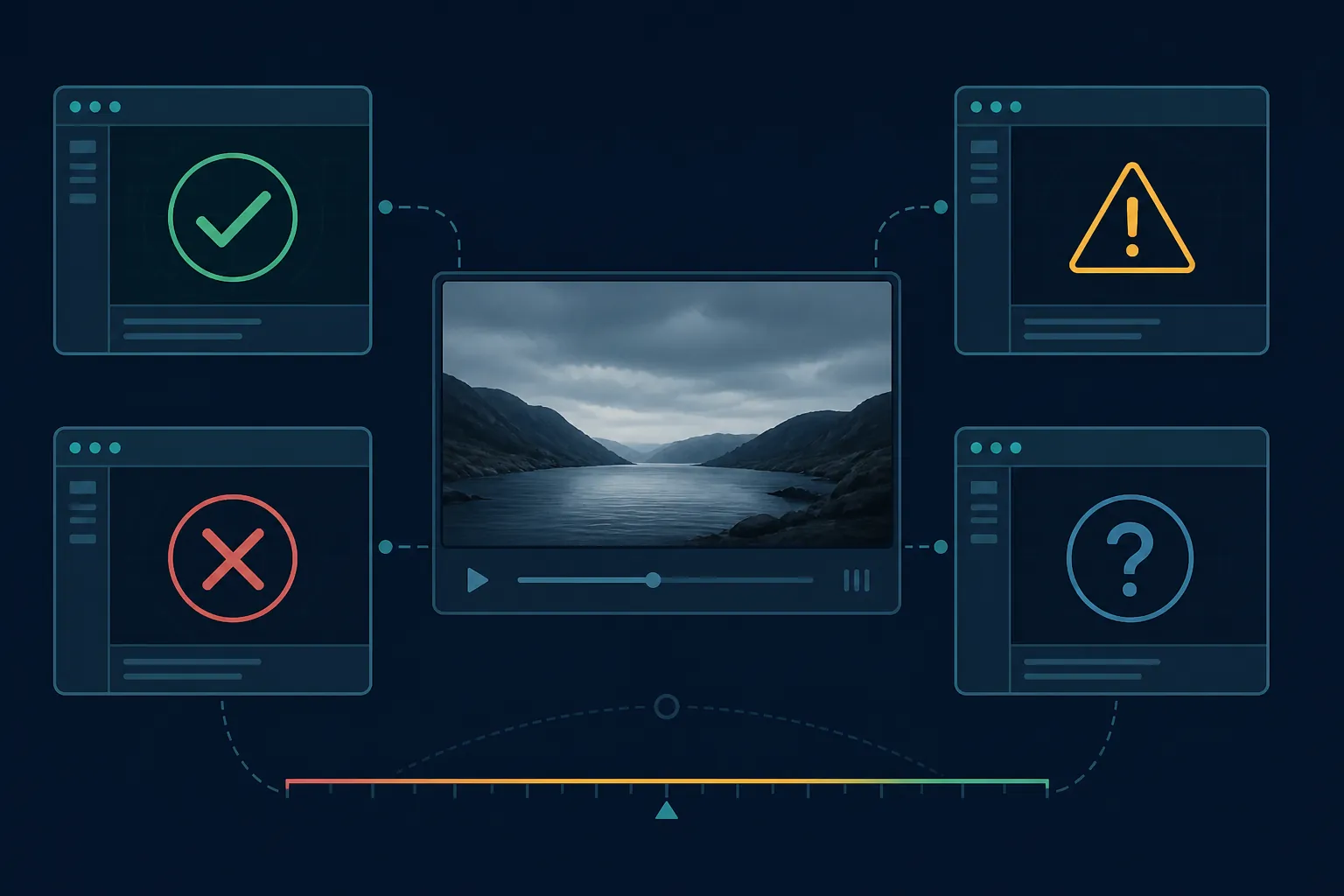
That is enough to reject the easiest procurement shortcut: “The vendor says it detects AI, so we can exclude detected AI.” If image tools can disagree so sharply on authentic material, then video tools deserve scrutiny before their outputs are allowed to block supply, suppress delivery, or justify a brand-safety decision after the fact.
The contrast with vendor claims is the real issue. Vendor-published accuracy and performance figures can be directionally useful, but they are still vendor claims unless the methodology, test set, and evaluation are independently available. IAS has cited campaign-performance findings from a 1 billion-impression analysis, including a 49% higher success rate and 24% lower cost per success when avoiding low-quality AI inventory; that is useful vendor data, not independent proof that every detector decision is correct.[1]
Accreditation helps, but only if the buyer reads the boundary. Zefr’s March 2026 MRC accreditation was important because it was described as content-level brand-safety accreditation rather than the older domain-level approach.[7] That matters in a feed and video environment where the page, channel, or creator name may be less relevant than the exact item adjacent to the ad. It still does not mean every AI-video detection product in the market has been independently validated, or that accreditation for one measurement scope transfers to another vendor’s classifier.
| Evidence type | What it supports | What it does not prove |
|---|---|---|
| Independent visual-detection audit | False positives and cross-tool disagreement are real risks in AI-content classification[4] | The exact error rate of any specific paid-video brand-safety detector |
| Product launch announcement | The control is operationally available in a buying surface[1][2][3] | That the control improves outcomes for every campaign or format |
| Vendor campaign-performance analysis | The vendor has observed a performance pattern in its own data[1] | Independent causal proof, or a guarantee that excluded supply was actually unsafe |
| Content-level accreditation | The measurement scope may be closer to the placement or asset than domain-level screening[7] | Universal coverage across platforms, languages, formats, and AI-video techniques |
Open web, walled gardens, and labels each fail differently
Open-web pre-bid controls
Open-web controls are attractive because they can act before money is spent. They are also where over-blocking can become invisible fastest. If a segment excludes inventory before the auction, the buyer needs more than a post-campaign line saying “AI content avoided.” The useful questions are operational: which URLs, apps, videos, channels, or content objects were eligible; which were excluded; what threshold applied; and whether the blocked supply can be reviewed later.
This is especially important when the product’s coverage boundary is narrower than the buyer’s mental model. A “GenAI avoidance” segment may be useful for low-quality AI pages or text-heavy inventory while saying less about video-level synthetic manipulation. If the campaign problem is AI-generated video adjacency, the buyer should make the vendor state whether the control evaluates the video asset, the page context, the channel, metadata, or some combination.
Walled-garden products
Walled-garden availability is a step forward because a large share of paid social video buying happens where the buyer cannot simply bring open-web verification logic. DV’s June 2026 expansion of Authentic AdVantage to Meta and TikTok shows that AI-powered media-quality controls are moving deeper into social environments.[2]
The audit problem changes there. The buyer may not get the same placement-level or content-object-level evidence available in other channels. If the platform and verification partner return an aggregate quality score or optimized delivery result, the campaign team still needs a log of what changed: which settings were enabled, which inventory pools were affected, what categories were avoided, and whether the optimization reduced reach, CPM efficiency, or conversion volume.
Platform disclosure labels
Platform labels solve a different problem. Meta’s July 2026 update addressed ads created or significantly edited with generative AI features or third-party tools, with C2PA detection part of the labeling approach.[3] That can help with disclosure and user-facing transparency. It does not automatically tell the media buyer whether the adjacent content was low quality, whether the creative was brand-safe, or whether the campaign should have excluded the impression.
The timing also matters. A label that appears after upload, review, or delivery may be too late for trafficking decisions. If a platform label becomes part of the brand-safety rationale, the team should preserve the date, the label text, the policy basis, and whether the label was advertiser-disclosed, platform-detected, or metadata-driven.
What to ask before a detector can affect spend
A media team does not need a research lab. It does need procurement-grade answers before detector output becomes a blocking rule.
- What is the unit of classification: page, domain, channel, creator, video, frame, audio track, ad creative, or placement?
- Which signals are used: visual artifacts, frame-by-frame analysis, lip-sync mismatch, audio cues, watermarking, C2PA metadata, platform classifier output, or publisher declarations?
- Is the product detecting synthetic content, low-quality AI content, undisclosed AI use, impersonation, deepfake manipulation, or unsafe adjacency? Those are not interchangeable.
- What content types, languages, geographies, platforms, and formats are covered right now, not on the roadmap?
- Are the accuracy, false-positive, and false-negative figures independently tested, MRC-accredited for the relevant scope, or self-published by the vendor?
- What was in the training and test set, and was the test set separated from model development?
- How does the system handle lightly edited human-made content, AI-assisted editing, stock footage, subtitles, dubbing, filters, and compression artifacts?
- Can the buyer review examples of false positives and appeals, or only aggregate pass/fail rates?
- What threshold triggers exclusion, warning, disclosure, or report-only classification?
- What log is available after the campaign: blocked bid requests, avoided placements, labeled creatives, category codes, timestamps, confidence scores, policy reasons, and spend impact?
The key distinction is not whether the vendor has AI detection. It is whether the buyer can reconstruct what the detector changed. Without that reconstruction, the tool may still be valuable for hygiene, but it is weak as a defensible brand-safety control.

Use different outputs for different decisions
A detector output can support several decisions, but they should not all use the same threshold. A high-confidence match from a product with clear content-level coverage may justify pre-bid avoidance for a conservative brand. A weaker classifier score may belong in reporting or manual review. A C2PA-based label may satisfy a disclosure workflow while doing little to answer whether the surrounding content is suitable for a financial-services or children’s brand campaign.
| Decision | Reasonable use of detection | Evidence needed before automation |
|---|---|---|
| Pre-bid exclusion | Avoid clearly defined low-quality AI inventory or synthetic-video categories before spend | Coverage boundary, threshold logic, false-positive process, and post-campaign blocked-supply log |
| Bid optimization | Shift delivery away from lower-quality or higher-risk media without a hard block | Reporting that shows reach, cost, conversion, and quality trade-offs |
| Creative disclosure | Apply or validate AI-use labels for ads created or significantly edited with AI | Disclosure policy, C2PA or metadata handling, advertiser declaration path, and label timing |
| Manual review | Escalate ambiguous cases, especially when the content is high-spend, high-risk, or reputationally sensitive | The underlying signal, confidence level, sample asset, and reviewer decision trail |
| Post-campaign reporting | Document exposure avoided, labels applied, and inventory affected | Exportable logs that connect settings to delivery changes |
This is also where consumer concern has a practical role. DoubleVerify’s July 2026 global study reported that 56% of consumers cannot consistently identify AI-generated content, and Zefr and OM Media Trials reported in February 2026 that 81% of consumers named at least one AI-content type inappropriate for brand adjacency.[8][9] Those figures explain why buyers are asking for controls. They do not validate any particular detector.
Compliance raises the cost of vague labels
Regulation does not turn detection into truth either, but it raises the cost of sloppy process. EU AI Act Article 50 obligations became enforceable on August 2, 2026, with transparency duties for certain AI-generated or manipulated content and penalties described as up to €15 million or 3% of global turnover. New York’s Synthetic Performers Disclosure Law became effective June 9, 2026, with civil penalties described as $1,000 for a first violation and $5,000 for later violations.[10]
For ad operations, the lesson is not to make the media buyer a legal interpreter. It is to separate compliance evidence from media-quality evidence. A label can show that a synthetic element was disclosed. A detector can suggest that content is AI-generated. A brand-safety control can avoid certain inventory. The campaign record should say which one happened.
A defensible campaign workflow
Before launch, decide which AI-content outcomes actually matter for the brand. Low-quality AI video adjacency, undisclosed synthetic performers, deepfake impersonation, AI-assisted creative production, and synthetic UGC are different risks. If the brief collapses them into “avoid AI,” the setup will probably over-block some legitimate supply and miss some real risk.
- Map each risk to a control: pre-bid exclusion for inventory risk, platform disclosure review for ad-creative transparency, manual review for ambiguous high-risk content, and reporting-only classification where confidence is lower.
- Record the exact product names, launch surfaces, segments, categories, thresholds, and platform settings used. A campaign should not depend on someone remembering that “the AI filter was on.”
- Ask the vendor or platform for the unit of analysis and coverage boundary in writing. If the tool evaluates pages rather than videos, say that in the plan.
- Run the strictest exclusions where the brand has low tolerance for adjacency risk, but keep a report-only or review tier for lower-confidence signals.
- After launch, compare delivery against the control: inventory lost, CPM movement, reach changes, conversion changes, labeled creatives, blocked categories, and any sampled false positives.
- Keep the post-campaign evidence with the media plan, not only inside the vendor dashboard. The record should survive a renewal meeting, an agency transition, or a brand-safety review.
The clean operating posture for 2026 is neither blind trust nor refusal. Configure the available controls. Demand the methodology, coverage, accreditation boundary, and false-positive process before detection affects spend. Then log what the detector actually changed in delivery. AI-generated video detection belongs in the paid-ad brand-safety stack, but only as an auditable input.
References
- Cut the AI Slop, Integral Ad Science, May 29, 2026.
- DoubleVerify Expands DV Authentic AdVantage to Meta and TikTok, an AI-Powered Solution to Optimize Media Quality and Performance, DoubleVerify, June 22, 2026.
- Sociable: Meta adds updated disclosure tags for AI-generated ads, Marketing Dive, July 9, 2026.
- Leading AI Image Detection Tools Mislead Online Users, Often Declaring Authentic Content Fake, NewsGuard, May 8, 2026.
- Future of Marketing Briefing: Marketers confront a new kind of brand safety problem in AI video, Digiday, October 24, 2025.
- IAB Releases Industry’s First AI Transparency and Disclosure Framework to Guide Responsible Advertising in a Generative AI Landscape, IAB, January 15, 2026.
- Brand safety is moving from fear to curiosity: Zefr’s Raddon on MRC’s new content-level accreditation and what it exposes about the industry, Digiday, March 9, 2026.
- Global Study: Quality Matters Most as AI Transforms Online Content and Advertising, DoubleVerify, July 29, 2026.
- Zefr and OM Media Trials Release First-of-Its-Kind Study on Brand Impact of Ad Adjacency to AI-Generated Content, Omnicom, February 2026.
- Synthetic Performers, Real Consequences: Implications of Trailblazing New York AI Ad Law, Crowell.
This is a record of what happened and what was tested, not legal advice. Compliance determinations require qualified counsel.