
ANA Chiikawa Jet Campaign Promises Assets, Not Results
ANA's Chiikawa Jet announcement is full of specific, checkable assets and completely silent on committed results. This campaign-claims audit separates the dated facts from the promotional framing and lays out the verification signals to watch once the jet enters service in late October 2026.
- Platform
- ANA
- Creative type
- aircraft livery
- Last reviewed
- 0-08-03
The ANA Chiikawa Jet collaboration is already easy to describe and still impossible to score. As of the Aug. 3, 2026 announcement, ANA has put unusually specific campaign assets on the record: the aircraft model and registration, the characters, the onboard items, the intended domestic route set, the schedule-period boundary, and a merch tease. What it has not put on the record is any committed outcome: no load-factor target, no revenue target, no merchandise-sales forecast, no KPI, and no exact first service date beyond late October 2026.
That makes the ANA Chiikawa Jet collaboration a cleaner audit case than most launch announcements. There is plenty to verify now. There is almost nothing to call performance yet.
| Checkable now | Not knowable yet |
|---|---|
| Boeing 767-300 special livery using aircraft registration JA609A | Whether the jet increases bookings, load factor, fare yield, or loyalty behavior |
| Eight Chiikawa characters with seasonal Japan motifs | Which routes it will actually operate on any given day |
| Economy-class non-removable headrest covers and one paper-cup design | Whether passengers will choose ANA because of the collaboration |
| Published candidate route list through the schedule period ending Oct. 24, 2026 | Exact first service date and post-launch operating cadence |
| ANA-uniform collaboration merchandise marked as coming soon | Merchandise sales, sellout speed, resale pressure, or incremental revenue |
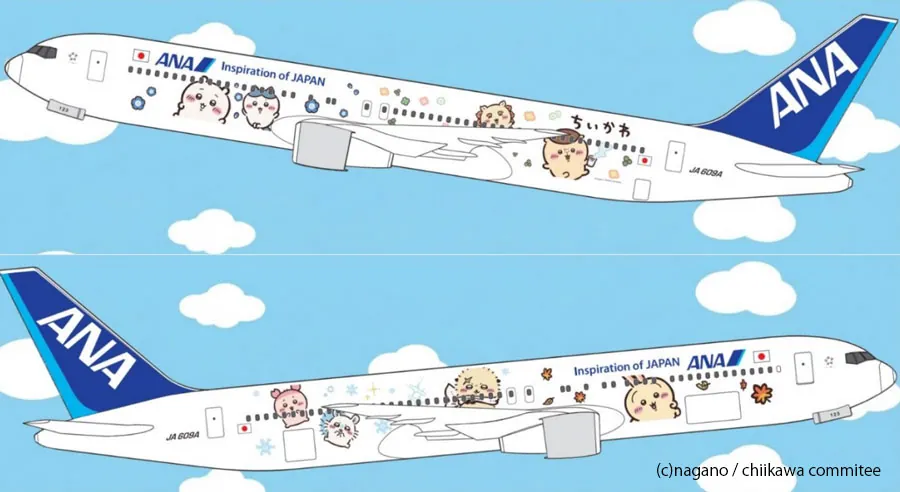
The asset layer is unusually auditable
ANA’s Japanese Chiikawa Jet theme page is the primary evidence record for this campaign. It identifies the aircraft as a Boeing 767-300, registration JA609A, and presents the livery around eight characters: Chiikawa, Hachiware, Usagi, Momonga, Kuri-Manju, Rakko, Shisa, and the Pochette no Yoroi-san character, each placed with seasonal Japan motifs such as cherry blossoms, fireworks, autumn leaves, snow, and hot springs.[1]
That specificity matters because it gives future verification somewhere to begin. If the jet enters service without the promised wrap, or with a materially different asset package, the gap is visible. If the same registration appears in flight records and passenger posts after launch, the campaign record can be matched back to the announcement rather than inferred from a generic “special livery” claim.
The onboard layer is also stated in concrete terms. ANA says economy-class seats will have Chiikawa headrest covers, and it explicitly says those covers cannot be taken home. It also shows a single paper-cup design for the collaboration.[1] Those are small details, but they are the kind of details that keep a campaign audit grounded. A passenger photo can verify the cup. Cabin shots can verify whether the headrest covers appeared. The non-removal rule prevents later social chatter about “limited goods” from being confused with an official giveaway.
The route layer is similarly useful, with one important caveat. ANA lists planned domestic routes including Haneda–Sapporo, Haneda–Itami, Haneda–Matsuyama, Haneda–Hiroshima, Haneda–Fukuoka, Haneda–Nagasaki, Haneda–Naha, Itami–Sapporo, Nagoya–Sapporo, and Nagoya–Naha, with the current schedule period running through Oct. 24, 2026.[1] That is a route universe, not a daily operating promise.
ANA’s own caveat is the guardrail: the operating routes are to be announced on the day of operation.[1] A route list therefore cannot be used as evidence that every listed market received exposure, or that a specific city pair benefited from the collaboration before the aircraft actually appears there. For a media buyer, this is the difference between booked inventory and delivered impressions.
The merchandise claim is the loosest part of the asset layer, but even that looseness is labeled. ANA previews collaboration goods featuring the characters in ANA uniforms and marks them as “coming soon,” without publishing the sales date, assortment detail, volume, price, or sales target on the theme page.[1] That supports a merch-intent claim. It does not support a merch-performance claim.
The announcement record is dated, but the English record is secondary
ORICON NEWS covered the Chiikawa Jet announcement on Aug. 3, 2026, as a dated Japanese media record of the launch.[2] Ikaros AIRLINE web also covered the announcement on Aug. 3, 2026, giving the campaign a second dated trade-press confirmation outside ANA’s own page.[3]
TravelWires has an English-language recap under the headline “ANA to Launch Special Chiikawa-Themed Boeing 767 on Domestic Flights.” It is useful for English readers, but it should be treated as secondary coverage unless ANA later publishes an English release for this specific jet.[4] For claim work, the source hierarchy is simple: ANA’s Japanese page first, dated Japanese press records second, English recap after that.
That hierarchy is not pedantry. In campaign reporting, small changes in translation or summarization can turn a planned asset into an implied result. “The jet will operate on domestic routes” is not the same as “the jet has driven domestic demand.” “Coming soon” merchandise is not the same as sold merchandise. A launch recap can be accurate and still be the wrong place to anchor a performance claim.
What the campaign does not claim
The cleanest part of ANA’s announcement may be what it leaves out. There is no published target for incremental passengers. No load-factor goal. No route-level demand forecast. No ticket-revenue ambition tied to Chiikawa. No loyalty-enrollment objective. No merchandise-sales target. No social-reach KPI. No stated measurement framework.
That silence is not a failure by itself. Brand collaborations often launch with asset detail first and performance disclosure later, if at all. The problem starts when the market fills the blank space with assumed lift because the plane looks compelling, the IP is loved, and the assets are photogenic.
This is the same category change that shows up in AI creative case studies: a launch video becomes “engagement,” a press cycle becomes “brand impact,” a spike in comments becomes “sales momentum.” The site has treated that distinction before in its audit of Dr Pepper Fansville’s AI creative claims, where brand-reported numbers and independently measured outcomes had to be separated rather than blended. The ANA case is not an AI campaign, and ANA is not making an AI claim. It belongs in this lane because the verification problem is identical.

Chiikawa context explains the temptation, not the result
It is reasonable to expect marketers to pay attention to a Chiikawa aviation collaboration. The characters have commercial pull, fans recognize the emotional register of the IP, and ANA has chosen assets that invite photographing: exterior wrap, seat details, cups, and uniformed-character merchandise. None of that should be flattened into a generic “IP asset” note. The affection is part of why the campaign has oxygen.
But adjacent Chiikawa commerce belongs in the context drawer, not the evidence drawer. MAY Planning’s consulting synthesis, which aggregates Japanese reporting, points to failure modes around scarcity and resale pressure, including a McDonald’s Japan 2025 Happy Set episode described with 15% food waste and resale up to 5x retail in China, as well as resale markups up to 380% and legitimate supply at 53% of demand in related Chiikawa-collaboration discussion.[5] Those figures help explain why operators might watch ANA’s merch cadence closely. They do not prove anything about ANA’s future ticket sales.
The same caution applies to retail benchmark chatter around prior Chiikawa collaborations. Reported lifts in store traffic, card applications, or same-store sales can show that Chiikawa has worked in other commercial environments. They cannot be imported into an airline campaign with different capacity constraints, route assignment rules, passenger decision cycles, and revenue mechanics.
A sushi chain promotion, a department-store pop-up, a fast-food toy run, and a domestic aircraft wrap all face different bottlenecks. One runs through store visits. One runs through limited-time retail inventory. One runs through children’s meal supply. ANA’s version runs through aircraft scheduling, route exposure, cabin experience, and possibly merchandise distribution. The shared IP does not make the measurement problem shared.
ANA’s company numbers are real context, not campaign proof
ANA’s investor materials show a large company entering this collaboration from a position of scale. The airline group reports FY2025 operating revenue of ¥2,539.2 billion, up 12.3% year over year, and separately reported record first-quarter FY2026 revenue of ¥672.7 billion on July 29, 2026.[6]
Those figures are useful because they prevent the campaign from being misread as a tiny stunt by a marginal operator. They are not evidence that the Chiikawa Jet has contributed revenue. The dates make that impossible: the Q1 FY2026 revenue report came before the Aug. 3, 2026 Chiikawa Jet announcement, and the aircraft is not scheduled to enter service until late October 2026.[1][6]
This is where a lot of campaign decks get slippery. A strong corporate revenue line can sit next to a new creative launch and imply momentum without measuring the campaign itself. The honest connection is narrower: ANA has the operating platform and brand scale to make the collaboration visible once it flies. The financials do not say whether this aircraft will move any commercial metric.

How to classify the claims before the jet flies
The useful move is not to dismiss the campaign as soft branding. It is to classify each claim by what it can currently support.
| Claim type | Supported wording | Unsupported leap |
|---|---|---|
| Aircraft asset | ANA has announced a Chiikawa-themed Boeing 767-300 using JA609A. | The livery is already generating incremental bookings. |
| Creative execution | The design features eight named characters and seasonal Japan motifs. | The creative will outperform other ANA domestic promotions. |
| Cabin experience | ANA says economy seats will have non-removable headrest covers and a single paper-cup design. | Passengers will choose flights because of these onboard items. |
| Route exposure | ANA has published a candidate domestic route list through the schedule period ending Oct. 24, 2026. | Every listed route will receive equal or predictable campaign exposure. |
| Merchandise | ANA has teased uniformed Chiikawa collaboration goods as coming soon. | Merchandise demand, sellout rate, or resale value is already measurable. |
| Performance | No campaign performance data exists before service begins. | Announcement coverage is evidence of business impact. |
The classification is deliberately conservative. It is also more useful than a premature verdict. Performance marketers do not need every campaign to arrive with a full incrementality readout on launch day. They do need the launch-day record to stay clean enough that later signals can be compared against it.
The same habit shows up in backlash and narrative-risk work. In AI ad creative backlash, the important split is between visible reaction and measurable damage. In the Tim Hortons brand-safety blind spot, the issue is how IP-backed creative can carry risk even when the surface idea feels familiar. ANA’s Chiikawa Jet has a more positive starting point, but the measurement discipline is the same: keep reaction, exposure, and outcome in separate columns.
The post-launch checks that will actually matter
Because ANA says service begins in late October 2026 and routes are assigned on the day of operation, the first real verification window opens only when the aircraft starts flying revenue service.[1] Until then, the campaign record is an asset record.
- First scheduled revenue service: identify the first passenger flight operated by JA609A after the Chiikawa wrap enters service, not just a ferry, test, media, or positioning movement.
- Day-of route appearances: compare actual operating routes against ANA’s listed route universe, because the announcement does not guarantee daily or equal exposure across markets.
- Onboard asset confirmation: look for passenger-visible evidence of the economy headrest covers and paper cups, while separating official assets from passenger-owned merchandise.
- Merchandise availability: record when the ANA-uniform Chiikawa goods become available, where they are sold, whether limits are imposed, and whether sellouts or restocks can be observed.
- Hashtag and UGC volume: treat social posts as attention signals unless they can be tied to booking behavior, merchandise purchase, or another defined action.
- ANA commentary: watch whether the collaboration appears later in earnings, investor Q&A, route commentary, domestic demand discussion, loyalty updates, or merchandising commentary.
The strongest future evidence would not be “people posted the plane.” It would be ANA tying the collaboration to a defined business metric, or independent data showing a measurable change that can plausibly be isolated from seasonality, route mix, fare changes, and broader domestic-travel demand. That standard is high, but lowering it is how launch optics become fake performance.
For attribution caution, the better comparison is not another character plane; it is the discipline used in evidence-scoring work such as the Indonesian brands global AI ads benchmark, where adoption, visibility, and effectiveness are not treated as interchangeable. The same dated-record habit appears in the Hugging Face OpenAI hack ad-platforms tracker, and the failure-analysis framing in AI content hallucination risks in marketing. The point is not to make ANA’s campaign sound like those cases. It is to keep the evidence record strong enough that a later update can say what changed.
For now, ANA has supplied assets, not results. The Chiikawa Jet is specific, charming, and easier to audit than most collaboration announcements. It is also pre-service. Until late October operations create observable signals, the honest read is limited to what can be checked now and what must wait.
References
- ちいかわ×ANA「ちいかわジェット」, ANA
- ANA、特別塗装機『ちいかわJET』就航へ, ORICON NEWS, Aug. 3, 2026
- ANA、国内線に「ちいかわジェット」就航へ, Ikaros AIRLINE web, Aug. 3, 2026
- ANA to Launch Special Chiikawa-Themed Boeing 767 on Domestic Flights, TravelWires
- Chiikawa Marketing Case Study, MAY Planning
- ANA Group Financial Highlights, ANA Holdings
This is a record of what happened and what was tested, not legal advice. Compliance determinations require qualified counsel.