
Why AI Marketing ROI Is Dropping Even as Adoption Surges
Despite 91% adoption, the share of marketers who can prove AI ROI fell from 49% to 41% in one year. This article examines why the measurement bar shifted and what the leaders who can demonstrate business-outcome ROI do differently — including the 10-20-70 resource allocation framework and a practical checklist for building credible measurement.
AI marketing has crossed the awkward line between experiment and operating expense. Jasper’s 2026 survey of 1,400 marketers says 91% of marketing teams now use AI, yet only 41% can prove ROI, down from 49% in 2025.[1] That is a vendor survey, so the exact percentages deserve caution. But the direction is hard to dismiss when BCG separately finds that 74% of companies have yet to show real ROI from AI initiatives.[2]
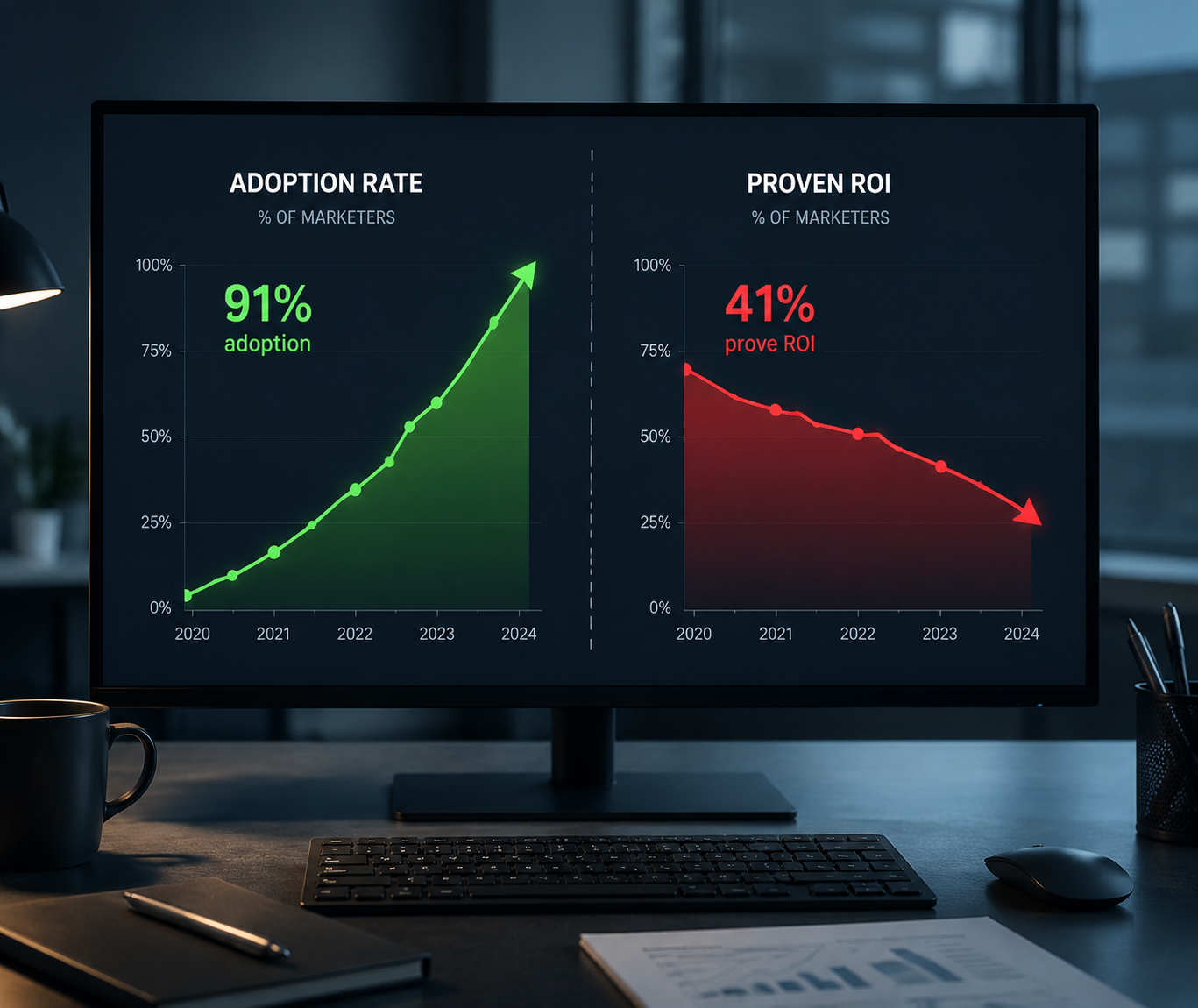
The lazy conclusion is that AI marketing is disappointing. The more useful conclusion is that proof got harder. In the early wave, “we saved time” often passed as a result. In 2026, a finance or executive team is more likely to ask what changed in pipeline, conversion, retention, media efficiency, customer acquisition cost, or headcount planning.
HubSpot’s 2026 State of Marketing data captures that split cleanly: 76% of marketers say AI helps their team be more productive, but only 31% say it has meaningfully improved performance metrics.[3] Those are not contradictory findings. They describe two different standards. Productivity asks whether work moved faster. Performance asks whether the business got a better result.
The ROI Bar Moved From Activity to Business Impact
A marketing team can publish more posts, generate more ad variants, summarize more calls, produce more email drafts, and still fail to improve the number leadership cares about. Faster production is useful, but it is not automatically ROI. It becomes ROI only when the saved time or improved output changes a business equation.
That distinction matters because many AI dashboards still measure the tool, not the business. Prompt volume, generated assets, usage frequency, and hours saved are adoption signals. They can help a manager see whether people are using the system. They do not show whether a sales cycle shortened, whether a lead source became more efficient, or whether the same team can support more revenue without more budget.
The 49% to 41% drop in proven ROI is therefore less alarming than it first looks. It may mean fewer teams can get away with a weak definition of proof. That is uncomfortable, especially for managers who already bought tools and promised efficiency gains. But it is also healthier. A measurement system that cannot survive a budget meeting was never going to protect the investment for long.
| Metric type | What it can prove | What it cannot prove by itself |
|---|---|---|
| AI adoption | The team is using the tool | The tool improved revenue, margin, or customer outcomes |
| Productivity | A task took less time or required fewer manual steps | The saved time was redeployed into higher-value work |
| Output volume | The team produced more assets or variants | The additional output improved conversion or efficiency |
| Performance metrics | A business result changed after the workflow changed | That AI alone caused the result without a baseline or control |
Most Teams Overfund the Tool and Underfund the Change
BCG’s 10-20-70 allocation is the most useful way to explain why AI marketing ROI is so often hard to prove: 10% of the effort goes to algorithms, 20% to technology and data infrastructure, and 70% to people, processes, and change management.[2] Treat it as a management pattern, not a magic formula. The point is that the visible purchase is the smallest part of the work.
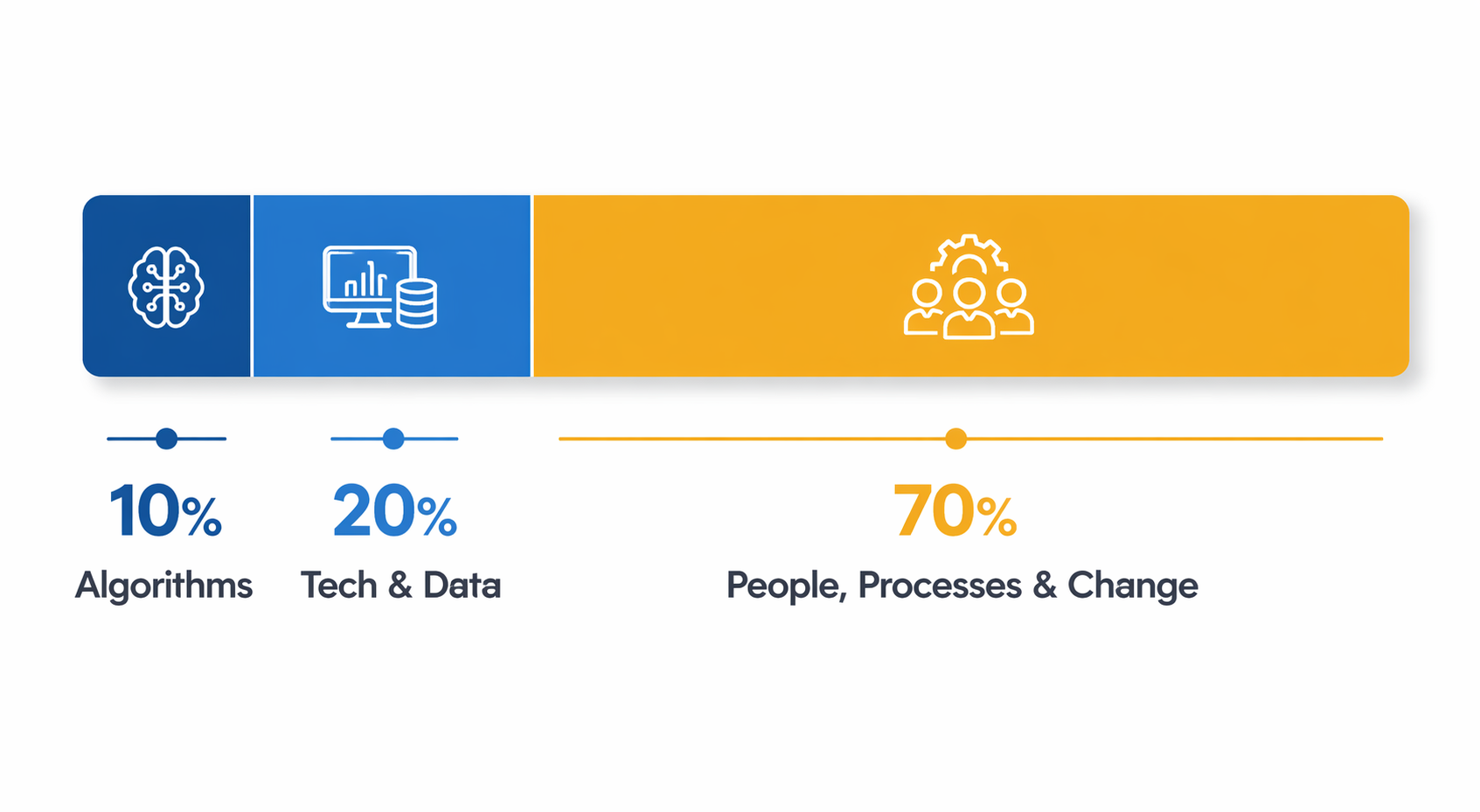
In practice, many marketing organizations invert the allocation. They spend weeks selecting tools, negotiating seats, and comparing features. Then they treat training as a launch webinar, data readiness as an IT dependency, and workflow redesign as something the team will “figure out” after adoption. Six months later, the activity dashboard looks busy and the ROI story is still thin.
The teams that can defend ROI usually do less theater. They decide where AI enters the workflow, which human review steps remain, which data fields must be clean, and which business metric should move. They also decide what will happen if the metric does not move. That last part is where many pilots quietly fail: nobody defines the evidence that would justify stopping.
Training Is Not a Soft Benefit
Training is often described as enablement, which makes it sound optional. It is closer to risk control. Organizations that trained employees in AI reported a 43% higher success rate in deploying AI projects, according to InformationWeek data cited by Iterable.[4] The number does not prove that training alone caused success across every context, but it points to a practical truth: people do not automatically know how to turn a model’s output into a better marketing process.
A marketer who uses AI to draft ten campaign concepts may save time. A trained marketer knows when to use the tool, how to brief it with audience and offer constraints, how to evaluate the output against brand and compliance rules, and how to connect the resulting test to a measurable business outcome. The second version is slower to set up and easier to defend.
Cross-Functional Work Is Where the ROI Math Gets Real
BCG reports that only 15% of AI initiatives at companies operate cross-functionally at scale.[2] That gap matters because marketing ROI rarely lives inside marketing systems alone. Revenue attribution may depend on CRM hygiene. Retention impact may depend on customer success tagging. Sales-cycle impact may depend on sales adoption. Cost reduction may depend on finance accepting the labor or vendor savings model.
This is why a content team can believe an AI pilot worked while the executive team remains unconvinced. The team sees faster briefs and more drafts. Finance sees no change in budget need. Sales sees no change in opportunity quality. Marketing operations sees attribution noise. Everyone may be describing the same pilot accurately; they are just measuring different consequences.
For a deeper diagnosis of these organizational failure modes, the related guide on why most AI marketing strategies fail is the better place to go. The short version here is that ROI proof gets much harder when the workflow crosses teams but the pilot charter does not.
Data Quality Turns Productivity Into Either Evidence or Noise
Data quality is the least glamorous part of AI marketing and one of the first things executives should ask about. CDO Times and Informatica data cited by TechnologyChecker says data quality issues consume 80% of AI project work and are the top reason AI projects fail.[5] That figure should not be casually blended with the marketing-only surveys; it comes from a different source base. But as a warning signal, it fits what marketing operations teams see every quarter.
If campaign names are inconsistent, lifecycle stages are disputed, lead source fields are overwritten, and CRM objects do not reflect the buyer journey, AI can still generate copy. It cannot rescue the ROI model. The output may be faster, but the measurement layer remains too weak to show whether the faster work mattered.
What the Better ROI Stories Have in Common
McKinsey data cited by Iterable says organizations investing deeply in AI see sales ROI improve by 10% to 20% on average.[4] That is the upside case, but “deeply” is doing a lot of work. It should not be read as proof that buying more AI tools produces a 10% to 20% lift. The more defensible reading is that stronger returns appear where AI investment includes the operating model around the tool.
Those operating models tend to share a few habits. They start with a business outcome, not a feature. They assign data ownership before the pilot. They train the people whose work will change. They connect marketing metrics to sales or customer outcomes when the use case requires it. They decide whether the result would justify continuing, expanding, or stopping the investment.
A demand generation example makes the difference clearer. A weak AI pilot asks whether the team can create more landing page variants. A stronger pilot asks whether AI-assisted variant development improves qualified conversion rate without increasing review time, compliance risk, or paid media waste. The first pilot can report activity within days. The second takes more setup, but it produces an answer a budget owner can use.
This is also where tool-specific ROI claims need careful handling. Jasper’s survey is useful because it surfaces the adoption-and-proof gap, and teams evaluating that platform may want a more focused look at whether marketing teams can prove ROI with Jasper AI. But a vendor’s ROI story should be mapped to the buyer’s workflow, data, governance, and outcome definition before it becomes a forecast.
A Measurement Checklist That Can Survive a Budget Review
The practical fix is not a bigger dashboard. It is a tighter measurement design before the pilot starts. A manager does not need a perfect attribution model to ask better questions. They need enough structure to separate usage from value and enough discipline to avoid declaring victory on convenience alone.
- Define the business outcome first: pipeline created, conversion rate, sales cycle movement, retention, cost avoidance, media efficiency, or another metric leadership already uses.
- Separate productivity metrics from performance metrics: hours saved, drafts produced, and cycle-time reduction belong in one column; revenue, margin, conversion, and cost outcomes belong in another.
- Establish the baseline before AI enters the workflow: current cycle time, cost, conversion rate, quality threshold, review load, or error rate.
- Identify the data owner: name the person or function responsible for CRM fields, campaign taxonomy, lifecycle stages, attribution rules, and reporting definitions.
- Document where AI enters the workflow: briefing, research, drafting, segmentation, scoring, personalization, testing, reporting, or handoff.
- Decide the investment rule in advance: what evidence would justify continuing, expanding, changing, or stopping the tool or workflow.
That checklist sounds basic because the basics are where many AI ROI stories break. If a team cannot say what the baseline was, who owned the data, or what decision the pilot was meant to inform, the final readout becomes a collection of anecdotes. Some may be true. Few will change budget.
How to Treat Productivity Without Dismissing It
Productivity still matters. It can reduce agency spend, shorten launch cycles, improve responsiveness, or let a team handle more work without adding headcount. The mistake is treating the productivity gain as self-evidently valuable without showing where the capacity went.
If AI saves campaign managers time, the ROI case should show whether that time was converted into more tests, faster launches, fewer contractors, better sales enablement, or lower operational burden. If the saved time simply disappears into more meetings and more revisions, it may still improve morale, but it is not yet a financial case.
For teams building the analytics layer behind this work, a more detailed practitioner reference on AI marketing analytics can help translate the measurement question into reporting architecture.
The Real Management Decision
The drop from 49% to 41% proven ROI is not a clean verdict on whether AI marketing works. It is a verdict on how poorly many organizations prepared to prove the value of something they adopted quickly. The standard moved from “the team is faster” to “the business is better off,” and that is a much harder test.
The teams most likely to pass that test are not necessarily the ones with the most tools. They are the ones willing to fund the unglamorous 70%: training, workflow redesign, cross-functional adoption, data quality, governance, and decision rules. AI ROI is not dropping as much as it is becoming harder to prove under better standards. That is exactly the kind of pressure marketing measurement needed.
References
- State of AI in Marketing 2026, Jasper.ai
- From Campaigns to Business Value: AI in Marketing, BCG
- State of Marketing Report, HubSpot
- 15 Stats That Prove the ROI of AI Marketing, Iterable
- AI in Marketing Statistics & Use Cases, TechnologyChecker.io
This is a record of what happened and what was tested, not legal advice. Compliance determinations require qualified counsel.