
Q3 2026: Independent Commission Ruling Reshapes Advertising Law
A consolidated tracker of the Slaughter Supreme Court ruling, July 2026 state privacy law amendments, FTC AI enforcement actions, and brand safety antitrust consent orders that simultaneously redefine paid-ad compliance in Q3 2026. Understand how these overlapping forces tighten targeting restrictions, data-use rules, and AI disclosure requirements.
- Platform
- FTC
- Change category
- policy
- Effective date
- 2026-06-29
- Change type
- policy shift
- Impact level
- low
As of July 24, 2026, the effect of the independent commission ruling on advertising law is not sitting in a clean legal lane. It is hitting the same paid-media workbench as July state privacy amendments, FTC AI claim enforcement, and brand-safety antitrust orders. The June 29 Slaughter decision was a 6-3 Supreme Court ruling in No. 25-332 that overruled Humphrey’s Executor and ended removal protections for FTC commissioners, while preserving a Federal Reserve carve-out through Trump v. Cook.[1] For ad teams, the first operational consequence is not that FTC rules disappeared. It is that FTC enforcement priorities are now less politically insulated, with only two Republican FTC commissioners remaining as of July 2026 and other independent agencies also pulled into the broader removal-authority shift.[2]
That would be enough for a tracker entry on its own. It is not the whole Q3 problem. On July 1, multiple state privacy changes moved directly into audience-building, geolocation, teen targeting, app-store age verification, and universal opt-out signal work.[3] The FTC’s Operation AI Comply remains active, with more than 12 actions since 2024 and a $48.6 million Growth Cave settlement in February 2026 over inflated AI capability claims.[4] New York’s synthetic-performer disclosure law became effective June 9, 2026.[5] And on April 15, the FTC announced consent orders against WPP, Publicis, and Dentsu in a brand-safety antitrust matter affecting how digital ad inventory judgments can be coordinated.[6]
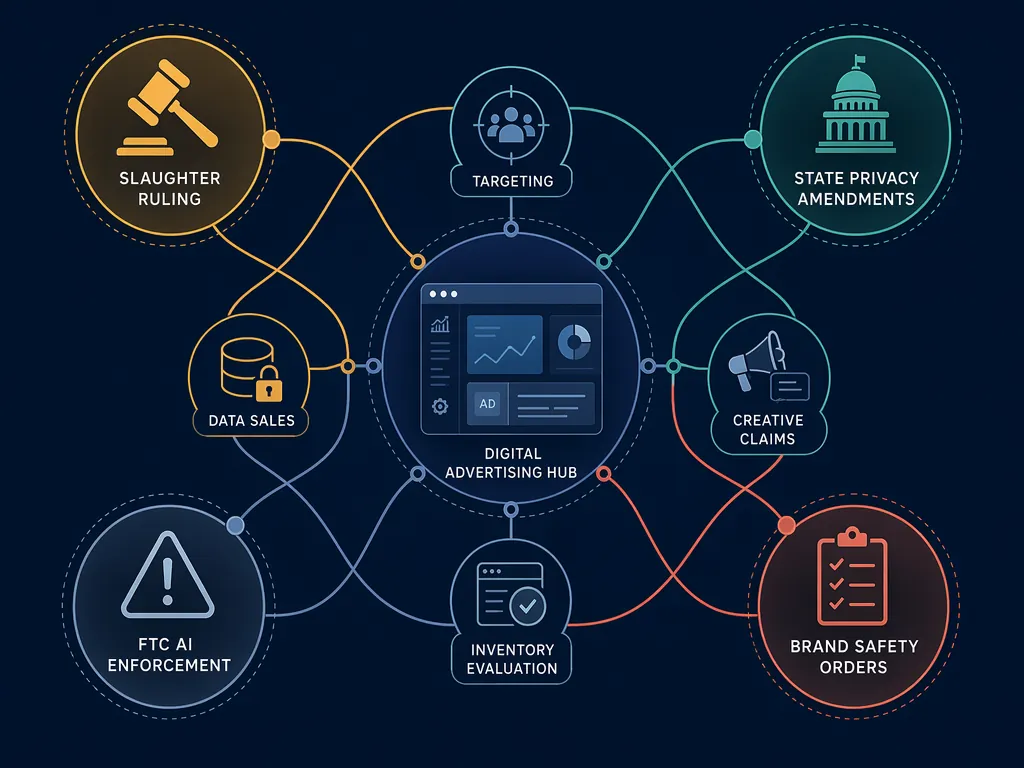
Q3 2026 tracker view
| Date | Source | Paid-ad area touched | Immediate operating consequence |
|---|---|---|---|
| June 29, 2026 | Supreme Court, Trump v. Slaughter | FTC enforcement stability | Treat FTC guidance and enforcement posture as more redirectable under a new commission, not void or irrelevant.[1][2] |
| July 1, 2026 | State privacy amendments | Audience targeting, geolocation data, minors, app age verification, universal opt-out signals | Recheck state-level segment eligibility, sale/share logic, teen exclusions, and GPC handling before reusing H1 audience rules in Q3.[3] |
| February 2026 and continuing | FTC Operation AI Comply | AI performance claims, automation claims, business-opportunity claims | Substantiate AI capability claims before they appear in ads, landing pages, sales webinars, case studies, or client reports.[4] |
| June 9, 2026 | New York synthetic-performer disclosure law | AI-generated or synthetic talent in creative | Add synthetic-performer disclosure checks to creative review when campaigns use AI-generated likeness, voice, or performance elements in covered contexts.[5] |
| April 15, 2026 | FTC brand-safety consent orders | Inventory evaluation and coordination | Separate an advertiser’s own brand-safety decisions from coordinated exclusion practices that may raise competition concerns.[6] |
The mistake is to file these under four different owners and move on: legal tracks Slaughter, privacy tracks state law, creative tracks AI, and media tracks inventory quality. That is how a campaign passes one review and fails another. A location-based teen campaign using AI-generated talent and a shared exclusion list does not experience these developments separately. It experiences them as one approval queue.
Slaughter changes the enforcement weather, not the campaign rules by itself
The Slaughter ruling deserves the top line because it changes how stable FTC priorities may feel from one commission to the next. But it should not consume the tracker. The ruling did not give advertisers a Q3 pass on unfair or deceptive acts, AI claims, endorsements, reviews, pricing disclosures, data use, or targeting. It changed the removal structure around commissioners and, with it, the predictability of enforcement leadership.
For a paid-media operator, the practical translation is boring and important: do not delete FTC-based guardrails because the commission’s independence changed. Instead, mark FTC-dependent risk areas as more volatile. If a client asks whether a current FTC priority might soften after a leadership change, the honest answer is yes, it might. If they ask whether that makes an unsupported AI claim safe this week, the answer is no.
That distinction matters inside workflows. A platform policy appeal, a claim-substantiation file, or a client-facing compliance deck should not say “FTC enforcement no longer applies.” It should say that federal enforcement direction may be easier to redirect, while existing rules, consent orders, state statutes, and private platform restrictions still have to be operated against. For a deeper legal tracker on the holding itself, see What the Supreme Court Ruling Means for FTC Ad Regulations and How the Humphrey's Executor Ruling Reshapes FTC Enforcement.
Audience targeting and data use are where July 1 lands first
The July 1 state-law wave is the most direct campaign-level pressure in this quarter’s stack. It touches the settings that buyers actually change: location radius, age range, custom audience source, sale/share classification, app eligibility, and opt-out handling.
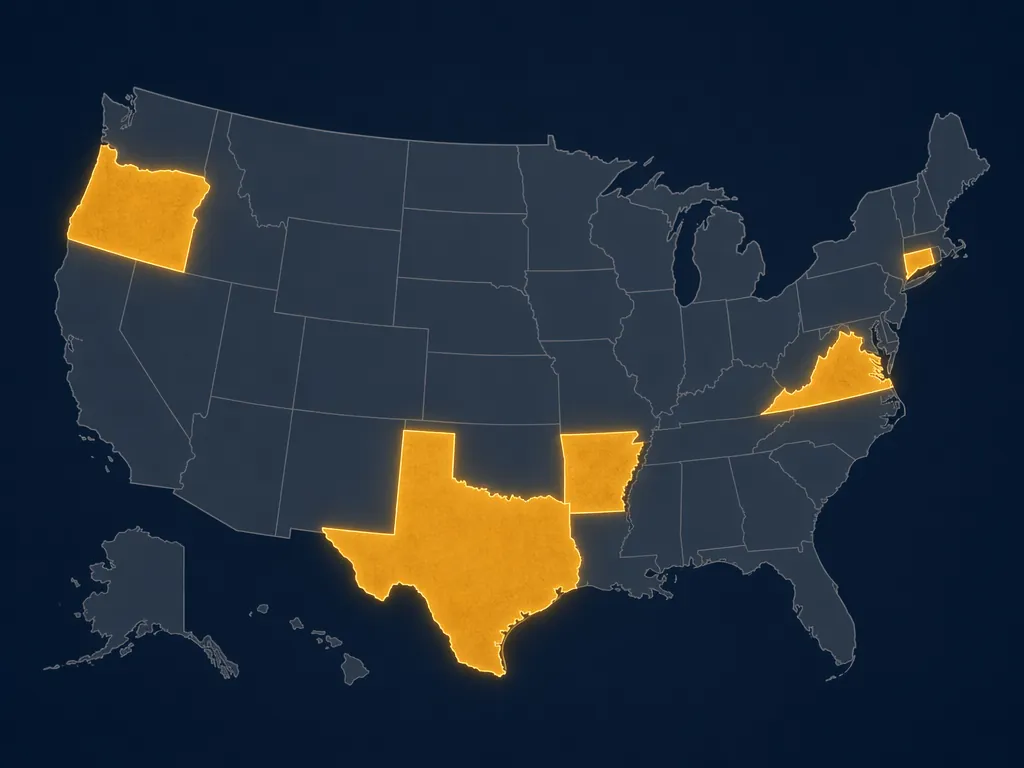
| State change effective July 1, 2026 | What it touches in paid media | What should be checked before launch |
|---|---|---|
| Connecticut expands sensitive data to include neural data.[3] | Segments, product data, wellness or device-derived signals, and any audience logic that could process covered neural data. | Sensitive-data classification, consent status, suppression logic, and whether the data is being used at all in activation. |
| Oregon bans the sale of precise geolocation data within a 1,750-foot radius and adds teen advertising restrictions.[3] | Location-derived audiences, foot-traffic vendors, conquesting, retail visitation products, and teen-facing media plans. | Whether a vendor’s geolocation product is a sale, whether radius-based audiences remain available, and whether teen exclusions are state-specific. |
| Virginia limits minors to one hour per day on social media without parental consent.[3] | Reach planning and availability for minor audiences on social platforms. | Whether campaign delivery assumptions, frequency expectations, and minor audience availability still match the platform’s current compliance posture. |
| Texas requires app stores to verify age.[3] | App-install campaigns, app-store flows, age-gated products, and teen acquisition funnels. | Whether the app-store path introduces age signals, consent checkpoints, or conversion drop-offs that need to be reflected in reporting. |
| Arkansas prohibits targeted advertising to minors up to age 16.[3] | Paid-social targeting, retargeting, lookalikes, interest segments, and custom audiences involving minors. | State-level age exclusions, retargeting suppression, and whether a supposedly broad campaign can still infer or reach covered minors. |
| Global Privacy Control obligations apply in California, Colorado, Connecticut, and Oregon.[3] | Universal opt-out signal handling, sale/share suppression, tags, pixels, clean rooms, and audience exports. | Whether opt-out signals are honored before data is exported to platforms, onboarders, analytics tools, or retail media networks. |
This is where “we already had privacy review” becomes dangerous. A campaign that cleared in Q2 because it avoided sensitive health data can still need a Q3 recheck if it uses neural signals now classified as sensitive in Connecticut. A retail conquesting campaign that previously used tight geolocation-derived audiences can become a different legal object in Oregon if the vendor is selling precise geolocation data within the covered radius. A teen campaign that looks broad nationally can still need Arkansas, Oregon, Virginia, and Texas handling because the restriction may sit in targeting, delivery, account access, app-store verification, or social-platform usage controls rather than in one obvious “age” toggle.
The operational fix is not to build one giant “minors” rule and assume it covers the map. The useful tracker field is more granular: state, age threshold, activity restricted, affected platform path, data source, opt-out handling, and launch owner. If the campaign uses platform automation, the review also needs to cover inputs into the automated system. Meta Advantage+, Google PMax, TikTok Symphony, or Amazon AI Max can optimize only from the audience, signal, feed, and exclusion logic handed to them.
Because these July 1 effective dates are close to publication, each state entry should also carry a verification field: in effect, delayed, enjoined, amended, or pending confirmation. That is not legal hedging for its own sake. It prevents a buyer from using a stale “effective soon” note as permission to run yesterday’s audience build after the date has already passed.
AI claims and synthetic creative need their own evidence trail
The AI compliance issue in Q3 is not limited to whether a brand used generative creative. It includes what the ad says the AI can do, whether the claim is measurable, whether a human review step exists, and whether the campaign uses a synthetic performer in a covered way. Operation AI Comply is already an enforcement program, not a speculative policy debate. The Growth Cave settlement is the ugly reminder: inflated AI capability claims can become a dollar figure, not just a creative note.[4]
The claim file should answer practical questions before the ad goes live: What exactly is automated? What evidence supports the promised outcome? Is the claim about the tool’s capability, the user’s expected result, or a past client performance number? Does the landing page narrow or expand the ad’s promise? If a sales webinar, testimonial, or case study repeats the same claim, does the substantiation travel with it?
New York’s synthetic-performer disclosure rule adds another review lane for AI-generated likeness, voice, or performance elements.[5] That belongs in creative approval, not in a separate “AI innovation” folder. A buyer swapping a human spokesperson for generated talent has changed more than production cost. The disclosure question now sits next to endorsement, review, testimonial, union/talent, and platform-policy checks.
There is also a state-versus-federal trap here. Even if federal AI policy messaging sounds more permissive in one channel, state disclosure rules and FTC consumer-protection theories can still make a campaign unsafe. For that split, see Why the Trump AI Action Plan Won't Ease Marketing Compliance. For campaigns using AI influencers or synthetic talent, the working review layer should look more like The Double Disclosure Playbook for AI Influencer Campaigns than a single approval checkbox.
Reviews belong in the same claim-control environment. If a campaign leans on star ratings, user quotes, before-and-after stories, or review volume, the Consumer Review Rule is not background noise. Review suppression, retaliation, fake reviews, and gated review flows can turn into ad-risk because the ad is often where the review claim gets monetized. Dealership teams facing review-retaliation issues can start with Protect Your Dealership from Google Ads Review Retaliation, but the same review-control logic applies beyond automotive.
Brand safety is now part of the same compliance dashboard
Brand safety used to be treated as the media team’s defensive corner: avoid unsuitable inventory, keep client screenshots out of bad placements, document exclusions when something breaks. The April 15 FTC consent orders against WPP, Publicis, and Dentsu pull that work into a different frame. The FTC described the action as an effort to restore competition in the digital advertising ecosystem.[6]
The narrow takeaway is enough for Q3 operations: an advertiser can still make its own brand-safety judgments, but coordination around inventory exclusion now deserves more careful documentation. A shared blocklist, industry initiative, agency-level exclusion practice, or cross-client inventory rule should not be handled as a purely reputational setting with no competition-law review.
That matters because inventory evaluation increasingly intersects with privacy and AI decisions. A campaign may exclude certain apps because of brand safety, restrict others because of teen-audience rules, and require disclosure review because the creative uses synthetic talent. If those decisions are written down as one vague “compliance block,” nobody can tell later whether the exclusion was based on suitability, age law, data restrictions, client policy, platform policy, or coordinated market pressure.
| Inventory decision | Better Q3 documentation |
|---|---|
| Excluding a publisher, app, channel, or placement category | State whether the reason is brand suitability, client policy, legal restriction, platform rule, fraud concern, age limitation, or another documented basis. |
| Using a shared blocklist or industry safety framework | Identify who created it, who updates it, whether adoption is optional, and whether the advertiser made an independent inventory decision. |
| Blocking inventory because minors may be reached | Tie the exclusion to the relevant state age rule, platform age controls, or campaign-specific audience design rather than a generic safety label. |
| Reporting avoided inventory to a client | Separate brand-safety avoidance from legal compliance avoidance so the client does not reuse the wrong rationale in another market. |
Where the four forces overlap in the actual campaign workflow
The point of the Q3 tracker is not to admire how many legal developments can fit in a deck. It is to catch the moments where one campaign decision is touched by more than one source of risk. Those are the places where teams tend to over-rely on an old approval.
| Campaign decision | Forces that may touch it | What should change in the tracker |
|---|---|---|
| Building a geolocation-derived audience | Oregon precise geolocation sale restriction; universal opt-out signals; platform data-sale/share logic; Slaughter-related FTC volatility.[1][2][3] | Add state, radius, vendor sale/share representation, opt-out signal handling, and whether the audience is reused from a prior quarter. |
| Running teen or minor-facing paid social | Oregon teen ad limits; Arkansas targeted-ad limits up to age 16; Virginia minor social-hour limits; Texas app-store age verification.[3] | Track age threshold by state, campaign objective, platform controls, retargeting exclusions, app-store flow, and whether inferred minor audiences are suppressed. |
| Using AI-generated talent or voice | New York synthetic-performer disclosure; FTC AI and endorsement scrutiny; platform creative policy.[4][5] | Require a creative-level AI use note, disclosure assessment, talent/likeness review, and substantiation for any performance or capability claim. |
| Claiming an AI tool improves results | Operation AI Comply; Growth Cave settlement; review and testimonial controls; Slaughter enforcement volatility.[1][2][4] | Attach evidence for the exact claim, define the measurement window, identify whether the result is typical, and prevent sales or reporting teams from expanding the claim. |
| Applying brand-safety exclusions | FTC brand-safety consent orders; client suitability policy; minor-audience restrictions; platform inventory controls.[3][6] | Record independent advertiser rationale, source of any shared list, legal basis if age or privacy drove the exclusion, and approval owner. |
| Exporting audiences from a CRM, clean room, or onboarder | State sensitive-data expansions; GPC obligations; geolocation sale limits; minor targeting restrictions.[3] | Confirm consent, opt-out suppression, sensitive-data classification, state carveouts, and whether the destination platform receives data for targeting, measurement, or both. |
A useful Q3 compliance note is therefore not “privacy reviewed” or “AI reviewed.” It is closer to: “Oregon geolocation sale checked; GPC suppression applied before export; Arkansas under-16 targeting suppressed; AI claim substantiated against current test file; synthetic voice disclosure reviewed for New York; brand-safety exclusion based on client policy, not coordinated industry direction.” That sentence is clunky. It is also the difference between a tracker and a vibe.
What to update before reusing Q2 campaigns
The highest-risk Q3 campaigns are not always the newest ones. They are often the Q2 winners being relaunched with fresh budget and a new date range. If the audience, creative, claim, or inventory logic was approved before June 29 or July 1, it should not be treated as automatically current.
- Add a Slaughter field to FTC-sensitive issues: current rule or guidance relied on, enforcement source, last reviewed date, and whether the client has been warned that FTC priorities may become more volatile.
- Reclassify audience data for July 1 state changes, especially neural data, precise geolocation, universal opt-out signals, and minor-related segments.
- Audit teen and minor campaigns by state rather than by one national age rule.
- Require substantiation for AI capability and performance claims before creative approval, not after legal asks for support.
- Add synthetic-performer disclosure review to creative workflows where AI-generated voice, likeness, or performance appears.
- Separate brand-safety rationale from coordinated inventory-exclusion rationale in media plans and client reporting.
- Verify July 1 state-law effective dates against any delay, amendment, or court action before relying on a tracker entry.
None of these updates requires predicting exactly what the FTC will do next. That is the point. Slaughter creates enforcement volatility; state privacy amendments create immediate targeting and data-use constraints; FTC AI enforcement keeps inflated AI claims expensive; brand-safety consent orders change how inventory judgments are handled. They do not cancel each other out, and none gives advertisers permission to relax another.
The day-to-day effect of Slaughter is still unfolding. The July 1 state-law entries should be checked against live statutory and litigation status. But the convergence is already real enough to justify updating tracker records, client claim review, audience rules, disclosure checks, and internal escalation paths now.
References
- Supreme Court Overturns Independent Agency Removal Protections — Mayer Brown.
- What the Trump v. Slaughter Decision Means for Independent Agency-Regulated Companies — Holland & Knight, July 2026.
- Data privacy laws: what to expect for 2026 — Ketch.
- FTC Enforcement Trends In 2026: What Businesses, Advertisers Should Be Watching Now — Benesch.
- Advertising Law Compliance in 2026: Five Developments Every Advertiser Should Know — ArentFox Schiff.
- FTC Takes Action to Restore Competition in the Digital Advertising Ecosystem — Federal Trade Commission, April 15, 2026.
Primary source: https://www.supremecourt.gov/opinions/25pdf/25-332.pdf