
Protect Your Dealership from Google Ads Review Retaliation
Google's April 2026 review policy rewrite and active FTC enforcement have created a new compliance risk for dealership Google Ads accounts. This article explains the specific changes and what dealerships must change to avoid account suspension and civil penalties.
- Platform
- Google Ads
- Creative type
- text
- Failure type
- review policy violation
- Last reviewed
- 2026-07-24
The review problem for dealerships changed shape in 2026. Google’s April review-policy rewrite named several showroom habits that many stores still treat as normal operating procedure: staff review quotas, requests that customers mention employees by name, review requests sent only to happy buyers, review stations on dealership devices, and incentives tied to review activity.[1] At almost the same time, the FTC was warning auto groups and enforcing its Consumer Review Rule, with civil penalties now reaching up to $53,088 per violation.[2]
That is why protecting a dealership from review retaliation in Google Ads cannot be limited to removing fake negative reviews from competitors or angry customers. That defensive work still matters, especially when a store sees a sudden burst of suspicious one-star reviews. But the more expensive exposure is often inside the dealership’s own workflow: the sales desk, BDC, service lane, CRM follow-up, and agency handoff that turn “ask every happy customer” into selective solicitation, pressure, or fake engagement.

The new risk map: review tactics, FTC penalties, and Ads account continuity
A dealership review process now has to be judged in three places at once. First, does it violate Google’s review rules for Business Profiles? Second, could it be treated as fake or misleading review activity under the FTC’s Consumer Review Rule? Third, if Google classifies the activity as fake engagement or deceptive business conduct, can that create a Google Ads suspension exposure under the broader Unacceptable Business Practices framework?
| Legacy dealership habit | Why it is now a compliance problem | Account-level consequence to plan around |
|---|---|---|
| Sales or service staff are told to collect a fixed number of reviews | Google’s April 2026 update identifies staff review quotas as prohibited solicitation behavior. | The Business Profile can attract review enforcement, and the same conduct can become part of a fake-engagement pattern. |
| Customers are asked to mention a salesperson, advisor, or manager by name | Requests for reviews containing specific content, including staff names, are called out in the policy summaries. | The request looks less like neutral feedback collection and more like scripted reputation manipulation. |
| Only satisfied customers receive review links | Review gating creates a filtered review stream rather than an open request process. | The store may preserve short-term rating quality while creating evidence of selective solicitation. |
| A tablet, kiosk, or showroom device is used to collect reviews on-site | On-premises capture devices are listed among the banned tactics in the April 2026 policy reporting. | Multiple reviews from the same location or device pattern can look engineered rather than organic. |
| Employees, customers, or vendors receive incentives tied to reviews | Incentivized review activity is a central concern for both Google and the FTC. | The issue can move from profile cleanliness into deceptive-review and fake-engagement territory. |
The Ads risk needs careful wording. Google does not publish a simple sentence saying every Google Business Profile review violation automatically suspends the connected Google Ads account. The documented path is broader: Google Ads can suspend accounts for Unacceptable Business Practices, and Google’s enforcement framework cross-references deceptive conduct and fake engagement signals.[3] In practice, that means review misconduct should be treated as an account-continuity risk, not just a local SEO cleanup item.
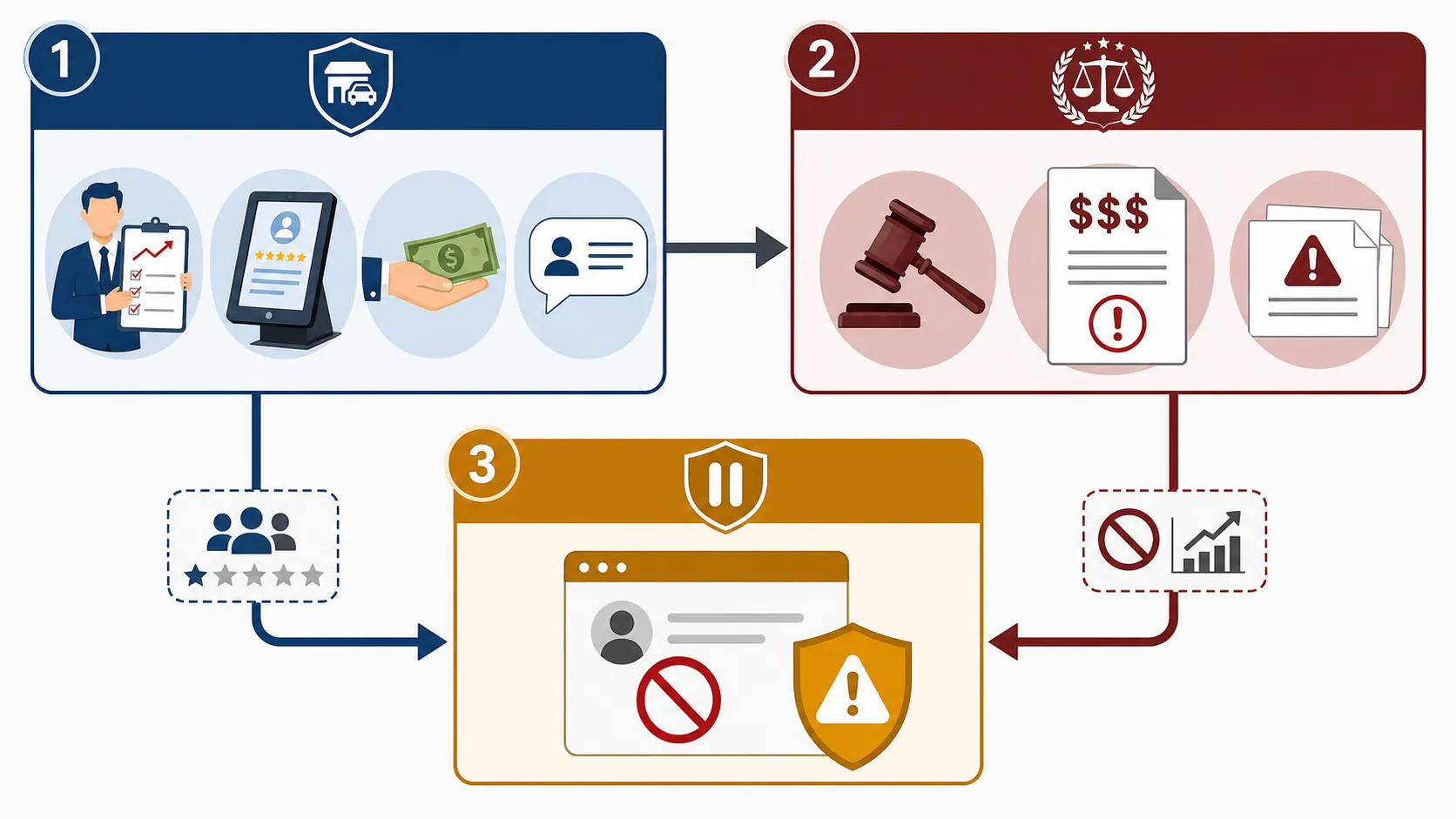
The dealership tactics that need to come out of the workflow
The easiest mistake is to read the April policy rewrite as a vendor-platform update and forward it to whoever owns the store’s reputation software. That misses where the problem usually lives. The risky instruction is often delivered in a Saturday sales meeting, written into a pay-plan note, built into a service-lane script, or buried inside a CRM automation that nobody has reviewed since the last website migration.
Review quotas
A quota sounds harmless until someone has to hit it near month-end. “Each salesperson needs five Google reviews” becomes pressure on customers, pressure on employees, and eventually pressure to find shortcuts. Google’s April 2026 policy reporting specifically identifies merchants requesting that staff solicit a certain number of reviews as banned behavior.[1]
The fix is not to rename the quota as a goal. Remove review counts from individual staff scorecards, bonus eligibility, sales-board competition, and manager one-on-ones. If the store wants to measure customer-feedback coverage, measure whether compliant requests were sent through the approved flow, not whether a named employee produced a certain number of public reviews.
Employee-name solicitation
Dealerships like name mentions because they turn reviews into public proof for specific salespeople and advisors. That is also why the practice is risky. Asking a customer to “mention Sarah in your review” is no longer just a coaching flourish; April 2026 policy summaries identify requests for specific review content, including staff names, as prohibited.[1]
A compliant request can still be personal in the normal customer-service sense. The employee can thank the customer and explain that feedback is welcome. What should come out is the instruction to include a name, describe a specific experience in a preferred way, mention a department, or use language that helps the store rank for a model, service, or location term.
On-premises tablets and kiosks
The tablet at the receptionist desk is one of those tactics that survived because it was visible, simple, and easy to explain to a GM. It is also exactly the kind of shortcut Google’s April 2026 update reporting warns against: on-premises kiosks and tablets used for review solicitation are listed among the banned practices.[1]
From an audit standpoint, remove dealership-owned devices from the review-capture process. Do not replace them with a manager’s phone. Do not have staff open the review form for the customer. Send the same neutral request through the approved channel after the interaction, and let the customer decide whether to respond on their own device, in their own time.
Review gating
Review gating is the habit that usually gets defended as good customer experience. The workflow asks a private satisfaction question first, then sends the Google review link only to customers who signal that they are happy. Unhappy customers get routed to a manager, a survey, or no public review path at all.
That filtered path is the problem. Google’s April 2026 policy reporting identifies selective review requests sent only to happy customers as prohibited review gating.[1] The store can still triage complaints. It cannot make public-review access depend on the customer giving a favorable private signal first.
Incentives and employee pressure
Incentives are not limited to “leave us a review and get a gift card.” In a dealership, the incentive may run through the employee instead of the customer: bonuses, spiffs, internal contests, public recognition, or manager pressure tied to review production. That distinction matters because the FTC’s Leader Auto Group action included allegations that employees were required to post fake reviews and that bonuses were withheld from employees who did not comply.[4]
The Leader Auto Group penalty is a serious signal, but it should not be misquoted. The $20 million FTC action was not a fake-review-only case. The matter also involved bait-and-switch pricing and undisclosed Canadian-manufactured vehicles, with fake-review conduct as one of the cited violations.[4] The lesson is still direct for dealerships: when review manipulation sits beside other consumer-deception issues, it can become part of a much larger enforcement file.
Why Google is catching more of this now
The volume of enforcement has changed. Google said it removed or blocked 292 million policy-violating reviews in 2025, a 21% year-over-year increase.[5] Search Engine Land reporting also described review deletion rates rising roughly 600% between January and July 2025 after Gemini was integrated into the moderation stack.[6]
Those numbers do not prove that every dealership using an old review script will lose its profile or Ads account. They do show that review moderation is no longer a mostly reactive complaint queue. Google is using automated detection at a scale where patterns matter: bursts, repeated language, device and location signals, staff-name clustering, sudden velocity changes, and solicitation systems that produce unnatural review behavior.
Google also began sending proactive email alerts to verified Business Profile owners about suspicious review activity in January 2026.[7] That is useful when a competitor or disgruntled party appears to be attacking a dealership with fake negative reviews. It is also a warning that the profile owner may now receive earlier signals when Google sees review patterns worth questioning.
The FTC side is no longer theoretical for auto groups
The FTC’s Consumer Review Rule took effect in October 2024 and prohibits several review-manipulation practices, including fake consumer reviews, buying positive or negative reviews, insider reviews without clear disclosure, and misrepresenting review independence.[2] The penalty range cited in the research brief runs from $51,744 to $53,088 per violation, depending on the applicable adjustment.[2]
Then the warnings became more pointed. The FTC sent warning letters to 10 companies in December 2025 and to 97 auto groups in March 2026, according to legal and industry reporting.[8][9] A warning letter is not a finding of liability. It is still the kind of dated enforcement marker that should make a dealer principal stop treating review compliance as an agency footnote.
For Google Ads operators, the important operational point is the overlap. A dealership does not need two separate bad systems to create two separate risks. The same workflow that filters unhappy customers away from Google, pressures employees to generate reviews, or scripts public review content can be relevant to platform enforcement and regulator review at the same time.
Where the Ads suspension exposure actually sits
Google Ads suspensions are expensive because they interrupt demand capture, not because they create a messy support ticket. A dealer can lose paid-search coverage on brand terms, model campaigns, service campaigns, inventory pushes, Performance Max, and remarketing while the team is trying to diagnose whether the trigger came from billing, policy, landing pages, misrepresentation, or business-practice signals.
The review-to-Ads path should be described as a documented risk path, not a guaranteed automatic pipeline. Google Ads policy allows suspension for Unacceptable Business Practices, including conduct that may be deceptive or harmful to users.[3] If review manipulation is treated as fake engagement or part of a broader deceptive-business pattern, the Ads account can become exposed through that enforcement category.
That distinction matters in a real dealership account. If a profile loses reviews, the local team may see it as a reputation problem. If the same conduct is reviewed as deceptive engagement tied to the advertiser, the media buyer now has an account-continuity problem. The appeal packet will need more than “we stopped asking for reviews this way.” It will need evidence that the underlying process was corrected.
What to audit before it becomes a suspension or enforcement file
Start where the request is actually made. Pull the CRM templates, BDC scripts, service follow-up messages, sales-manager notes, vendor automations, QR-code placements, showroom signage, and employee pay-plan language. If an agency runs the Google Ads account but the store controls review solicitation, the agency still needs to know whether the store is creating avoidable policy exposure around the same brand and Business Profile.
- Remove individual review quotas from sales, service, BDC, and management scorecards.
- Stop asking customers to mention employees, departments, vehicle models, locations, or preferred phrases.
- Send review requests through a neutral flow that does not depend on a private satisfaction score.
- Remove tablets, kiosks, shared devices, and employee-assisted review capture from the dealership floor.
- Separate review activity from employee compensation, contests, spiffs, and disciplinary pressure.
- Keep screenshots and change logs showing when templates, automations, and scripts were updated.
A clean replacement process is less dramatic than the old playbook. The store asks customers for honest feedback using the same approved request path. The request does not pre-screen for happiness. It does not prescribe content. It does not run through dealership-owned devices. It does not reward employees for public review production. Complaints can still be escalated internally, but escalation cannot be used to keep unhappy customers away from the public review option.
Handling fake negative reviews without creating a second problem
Competitor fake negative reviews and retaliatory review attacks are a separate defensive problem. Dealer Marketing coverage treats fake negative reviews from competitors as a real concern for dealers, and Google’s proactive suspicious-review alerts give verified profile owners another signal to watch.[7][10]
The response should stay boring and documented. Preserve screenshots, timestamps, reviewer names, profile links, and the suspected pattern. Use Google’s reporting process. Keep the response to the public review factual and restrained if a response is needed. Do not ask employees, vendors, friends, or loyal customers to “balance it out” with positive reviews. That turns a defensive problem into the same fake-engagement issue the store is trying to survive.
The operating standard for 2026
The practical standard is simple enough to enforce and strict enough to protect the Ads account. Every customer-facing review request should be neutral, non-selective, non-incentivized, and customer-controlled. Every internal process should make it clear that employees are not being paid, ranked, or pressured based on public review output.
For the paid-search team, review compliance belongs in account-protection work. It should sit beside billing controls, domain and landing-page checks, merchant and inventory-feed hygiene, advertiser verification, and suspension-response documentation. If Google or the FTC asks what changed, the dealership should be able to show the old workflow, the corrected workflow, the date of the change, and the people responsible for keeping it that way.
References
- Google Business Profile Review Policy 2026: What Changed — Three Chapter Media
- Complying with the FTC's New Rule on Customer Reviews: What Dealerships Need to Know — Bernstein Shur
- Google Ads account suspensions overview — Google Ads Help
- Breaking News: Massive FTC fine for fake reviews — SearchLab Digital
- Google 2025 Trust & Safety Report — Google
- Search Engine Land reporting on Gemini review moderation — Search Engine Land
- Google Business Profile Help suspicious review activity alerts — Google Business Profile Help
- What the FTC's warning letters mean for car dealers — CBT News
- Consumer Review Fairness Act: What Businesses Need to Know — Federal Trade Commission
- How Dealers Can Prevent Damage From Fake Negative Reviews by Competitors — Dealer Marketing
This is a record of what happened and what was tested, not legal advice. Compliance determinations require qualified counsel.