
Why the Trump AI Action Plan Won't Ease Marketing Compliance
Despite federal deregulation signals from the Trump AI Action Plan and 2026 Framework, state AI laws remain enforceable and FTC enforcement continues. This article explains why marketers must still comply with the strictest applicable state standard for national campaigns and what to prioritize today.
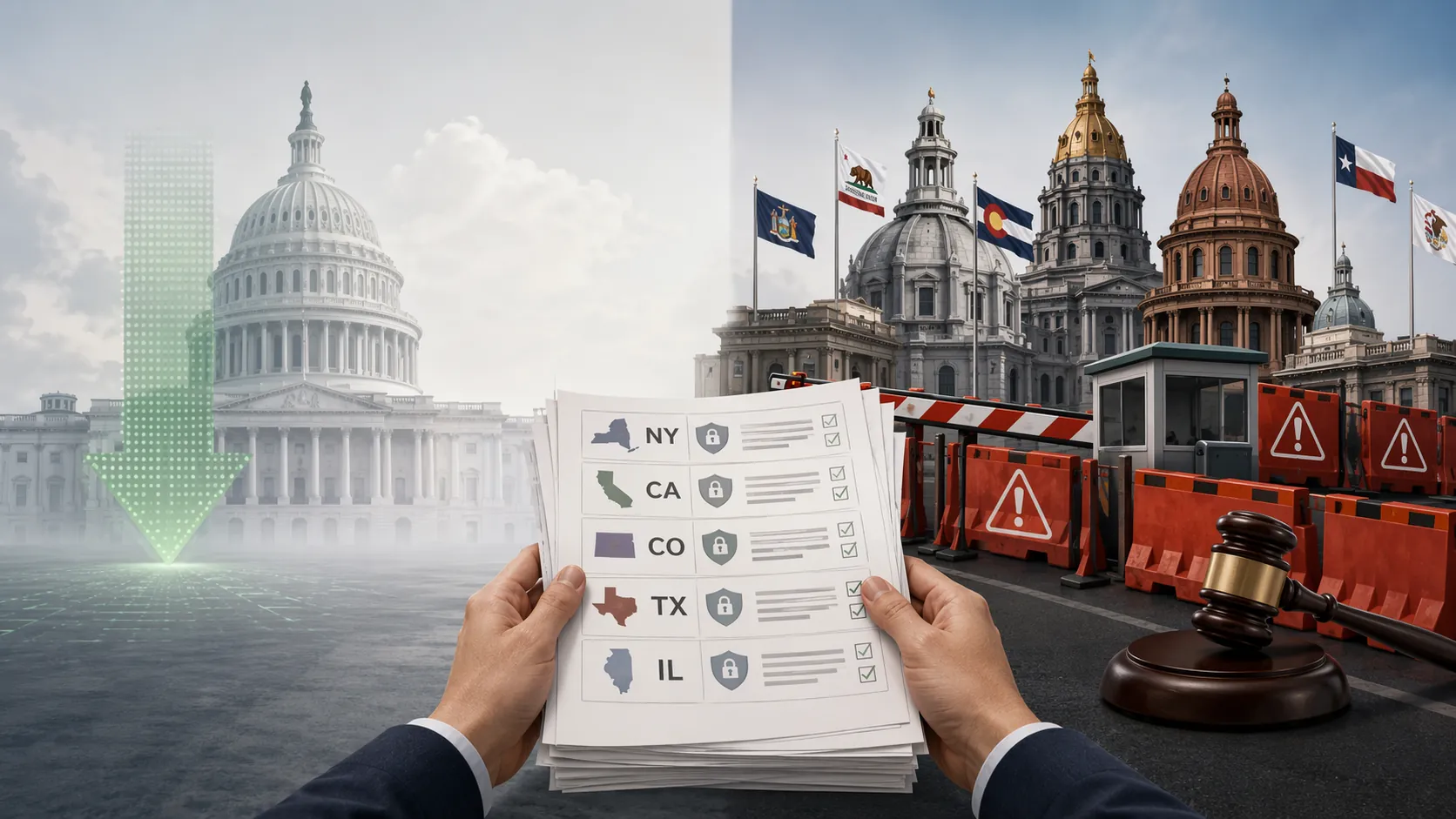
The short answer for teams asking about the Trump AI Action Plan’s 2026 marketing implications is less comforting than the headlines: no, the Trump administration’s AI deregulation push does not make state AI marketing rules disappear. The July 2025 AI Action Plan and the March 2026 National AI Policy Framework point toward federal preemption and a lighter federal regulatory posture, but they do not invalidate state laws by themselves.[1][2]
That distinction matters before a paid social team ships a national campaign with AI-generated testimonials, synthetic voiceover, automated targeting, or provider-supplied creative tools. A policy preference is not a court ruling. A federal framework is not a campaign approval memo. Until Congress, courts, or confirmed agency action changes what is enforceable, marketers still have to deal with state attorney general authority, consumer protection laws, synthetic media disclosures, AI claim substantiation, and the FTC’s Section 5 enforcement track.
What Changed Federally, and What Did Not
The federal shift is real. The Trump AI Action Plan, released on July 23, 2025, framed U.S. AI policy around acceleration, infrastructure, and reduced regulatory friction.[1] The March 2026 National AI Policy Framework formalized that posture by recommending federal preemption of state AI laws and favoring a deregulatory national approach.[2]
But for marketing compliance, the important word is recommending. Neither document is, on its own, a judicial decision that wipes out state obligations. Courts have not resolved whether federal AI policy preempts specific state AI laws. The December 2025 executive order that created an AI Litigation Task Force also carved out three areas from preemption arguments: child safety, AI compute and data infrastructure, and state government AI procurement.[3]
That leaves national advertisers in the least convenient position: federal policy may be moving one way, while state laws that touch real campaign workflows remain active unless and until they are successfully challenged. A brand cannot assume that a synthetic media disclosure requirement, an automated decision-making rule, or a state consumer protection claim becomes unenforceable because a federal policy document says a fragmented state regime is undesirable.
The practical question is not whether federal officials want fewer state AI rules. The practical question is whether the campaign team can explain, today, why it ignored a law that is still on the books in a state where the campaign ran. That is a very different approval standard.
Preemption Is a Legal Argument, Not a Launch Control
Preemption may eventually matter. It would be careless to write as if state AI laws are immune from federal challenge. The administration has clearly signaled that it wants a more centralized and less restrictive national AI policy, and legal commentators have treated that as a meaningful development for regulated businesses.[4]
But marketing teams do not operate in eventual outcomes. They operate against media buys, client approvals, influencer posting windows, landing page QA, and sales claims review. If a court has not enjoined a state law and no binding federal rule has displaced it, compliance teams still have to treat the state law as live. That is especially true where the state obligation is tied to consumer deception, disclosure, or unfair practices rather than a narrow technical AI governance requirement.
State attorneys general do not need a comprehensive AI code to bring enforcement. They can use existing consumer protection authority when an AI-enabled campaign misleads people, buries material information, exaggerates what automation does, or uses synthetic content in a way that affects consumer understanding. Federal deregulatory language does not remove that baseline.
The State Rules That Still Hit Marketing Workflows
The state-law problem is not abstract fragmentation. It shows up as different review questions for the same national creative package: does the campaign use a synthetic performer, does the AI provider need watermarking or detection tools, does the experience involve automated decisions, does the employment marketing flow include AI video screening, and who is responsible for disclosure downstream?
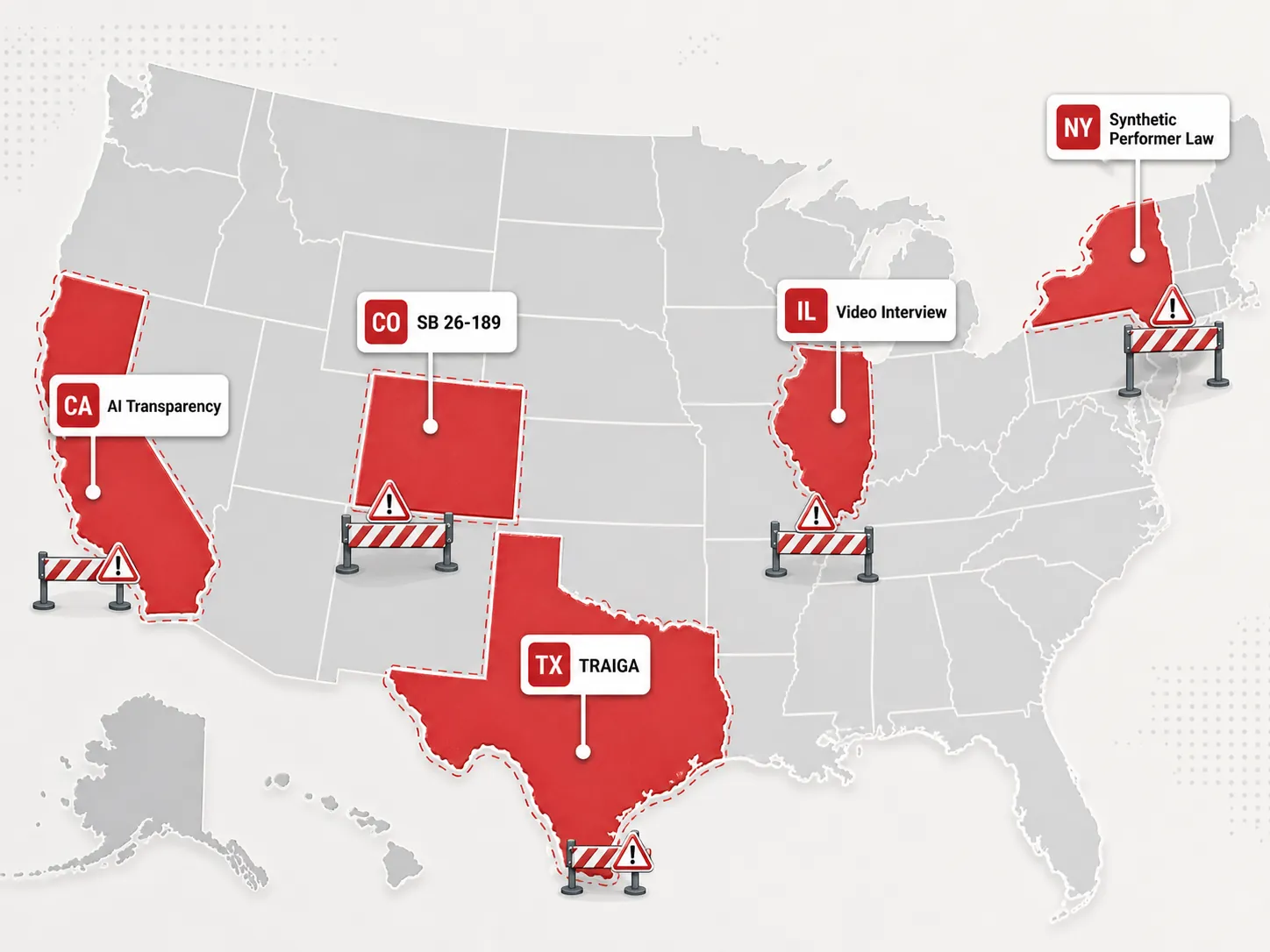
New York is the cleanest example for advertisers because its synthetic performer disclosure law, General Business Law §396-b, became effective on June 9, 2026, and imposes disclosure obligations directly on downstream advertisers. The penalties identified in compliance analyses are $1,000 for a first violation and $5,000 for subsequent violations.[5] For a national brand using AI-generated voiceover or a synthetic performance in paid media, that is not a vendor-side policy debate. It is a campaign trafficking question.
California creates a different kind of operational pressure. Its current and upcoming AI-related rules include SB 53 on AI safety, AB 2013 on training data transparency, SB 942 on AI transparency obligations such as watermarking and detection tools for covered providers, and CCPA automated decision-making regulations set to take effect in January 2027.[5] Not all of those rules apply to every advertiser in the same way. But if a campaign depends on a provider’s generative AI tool, automated profiling, or consumer-facing AI output, the California review usually cannot be skipped.
Colorado also needs current handling because older summaries may still point to the original Colorado AI Act. In May 2026, Colorado replaced that framework with SB 26-189, with an effective date of January 1, 2027.[5] For marketing teams, the immediate issue is not memorizing every provision months early; it is avoiding buildouts that assume the original law is the only Colorado reference point.
Texas and Illinois add still more practical edges. Texas TRAIGA appears in 2026 state-law tracking as part of the active AI compliance landscape, while Illinois’ AI Video Interview Act remains relevant for employers and agencies using AI-enabled video interview tools in recruiting or employment marketing flows.[5] A consumer acquisition campaign, a hiring campaign, and a lead-generation funnel may not trigger the same rules, but they often share the same marketing operations systems. That is where state-by-state nuance becomes a process risk.
| State example | Why marketers should care |
|---|---|
| New York synthetic performer disclosure law | Can require disclosure for synthetic performers in advertising, including downstream advertiser obligations. |
| California AI transparency, training data, safety, and ADM rules | Can affect provider due diligence, AI output transparency, automated decision review, and consumer-facing disclosures. |
| Colorado SB 26-189 | Replaces the original Colorado AI Act and changes the compliance reference point for 2027 planning. |
| Texas TRAIGA | Adds another major-state AI governance regime that national campaigns may need to screen against. |
| Illinois AI Video Interview Act | Matters where marketing, recruiting, and AI-enabled employment screening workflows overlap. |
This is why vendor complaints about state-law burdens often miss the operational center of the problem. Yes, fragmentation is burdensome. But the campaign owner still has to decide whether one national creative, one disclosure format, one approval checklist, and one vendor contract can survive review across the states where the media will run. If the answer is no, the burden has not vanished; it has simply moved to the person holding the launch calendar.
The FTC Track Has Not Gone Quiet
Even if a campaign never triggers a state-specific AI statute, the FTC problem remains. Operation AI Comply has continued into 2026 as a bipartisan Section 5 enforcement track focused on deceptive or unfair AI-related claims. The most useful recent anchor for marketers is Growth Cave: in January 2026, the company agreed to a $48.6 million settlement over claims that its AI-powered system could create online stores with “nearly 100%” automation, while users allegedly had to perform most tasks manually.[6]
That fact pattern belongs in every AI marketing review folder. It is not only about whether a product uses AI. It is about whether the ad overstates what AI does, whether the promised automation matches the customer experience, whether earnings or performance claims are substantiated, and whether the campaign leaves consumers with a misleading impression of effort, cost, or reliability.
The same pattern appears in earlier Operation AI Comply matters. Workado, also known as Content at Scale, advertised 98% AI detection accuracy, while testing reportedly showed about 53% accuracy.[6] DoNotPay reached a $1.5 million settlement over “robot lawyer” claims.[6] These are not identical cases, but they point in the same review direction: if the campaign says the AI can do something, legal and marketing need evidence that the claim is true in the way an ordinary buyer would understand it.
For a deeper channel-level review of this enforcement pattern, teams should keep FTC AI disclosure requirements for advertising and marketing close to the campaign approval process. The disclosure question is only one part of the issue; substantiation is often the part that breaks first.
Where AI Adoption Makes Compliance More Exposed
The compliance burden is increasing because AI is no longer a side experiment in many marketing teams. An IAB and Aymara report released in August 2025 found that 70% of marketers reported AI-related ad incidents, 40% had paused or pulled ads, and more than one-third had dealt with brand damage.[7] Those figures measure incidents and responses, not legal violations. Still, they explain why “we use AI now” is not a sufficient control.
The weak points are usually familiar before they become regulatory problems: a generative image changes a product attribute, a synthetic voice sounds like a real performer, a model-assisted claims workflow drops substantiation context, a vendor says its tool is compliant without saying where, or an automated targeting system becomes hard to explain once counsel asks who reviewed the inputs.
For product ads in particular, AI-generated visuals deserve their own review path. Teams working with synthetic product imagery should connect their state-law and FTC review to the practical risks covered in AI image generator risks for product ads, because the same creative asset can create a disclosure issue, a substantiation issue, and a product-representation issue at once.
A Defensible National-Campaign Posture
For national campaigns, the safest working rule is straightforward: apply the strictest applicable state standard across every jurisdiction where the campaign runs, unless counsel approves a narrower segmentation plan. This may feel inefficient, but it is usually less risky than letting each channel team improvise disclosures, vendor attestations, and AI claim review by state.
That posture does not mean treating every AI use as prohibited. It means building one approval route that can handle the highest-risk obligations before the media goes live. A national campaign using synthetic voiceover, for example, should not wait until the New York buy is separated from the rest of the plan to decide whether disclosure appears in the asset, the caption, the landing page, or the contract file. The team should decide the disclosure standard once, document it, and apply it consistently unless a local rule requires more.
- Screen AI-generated or AI-edited creative for synthetic performer, voice, image, and product-representation issues before trafficking.
- Require substantiation for AI capability claims, automation claims, accuracy claims, earnings claims, and performance claims.
- Map campaign states early enough to identify New York, California, Colorado, Texas, Illinois, and other state-specific triggers.
- Ask vendors which state laws their tools are designed to support, not just whether the tool is generally “AI compliant.”
- Keep FTC Section 5 review active even when no state AI statute clearly applies.
- Document why the team chose a disclosure, declined a disclosure, modified a claim, or segmented a campaign by jurisdiction.
A three-tier disclosure policy can help teams separate low-risk internal AI assistance from consumer-facing synthetic media or claims that need legal review. The operational value is not the label itself; it is that paid social, lifecycle, influencer, product marketing, and agency teams stop making the same disclosure decision five different ways. For implementation detail, see how to build a three-tier AI disclosure policy for marketing teams.
What Not to Overread From the Federal Shift
There are three assumptions that should not make it into a 2026 campaign approval memo.
- “Federal policy changed, so state laws no longer apply.” The available materials support a narrower conclusion: federal policy favors preemption, but enforceability has not been resolved by courts.
- “AI enforcement is over.” The January 2026 Growth Cave settlement confirms continued FTC activity into 2026, although later Q2 and Q3 enforcement posture should not be overstated without confirmed actions.
- “The vendor handles compliance.” Some laws and enforcement theories can reach downstream advertisers, and consumer-facing claims remain the advertiser’s problem.
There is also a softer mistake: assuming that uncertainty justifies delay. In practice, uncertainty usually requires a more conservative default, not a blank space in the checklist. Local counsel may still refine edge cases, especially for state-specific ADM, employment, child-safety, or synthetic media rules. But national marketing operations need a default that works before those edge cases appear.
The Rule for Q3 2026
As of July 23, 2026, the defensible posture is to treat applicable state AI laws as enforceable, keep FTC substantiation and disclosure review active, and apply the strictest applicable state standard across every jurisdiction where a national campaign runs. Revisit that posture only when courts, Congress, or confirmed agency action changes the enforceability picture.
References
- Trump AI Action Plan, AI.gov, July 23, 2025.
- March 2026 National AI Policy Framework, March 2026.
- December 2025 Executive Order creating the AI Litigation Task Force, December 2025.
- President Trump AI Action Plan Key Insights, Latham & Watkins.
- US AI Regulations 2026: The State Laws You Must Comply With, VerifyWise, May 2026.
- Advertising Law Compliance in 2026: Five Developments Every Advertiser Should Know, ArentFox Schiff, February 2026.
- AI Adoption Is Surging in Advertising, IAB/Aymara, August 2025.
This is a record of what happened and what was tested, not legal advice. Compliance determinations require qualified counsel.