
Perplexity's Nvidia-backed ad exit redirects AI search spend
Perplexity exited search advertising in February 2026, with Nvidia's investment making the pivot away from ads viable. The practical question for media buyers is where AI search ad spend and verification effort go now — and the answer is Google's AI Mode and OpenAI's ChatGPT ad test, not Perplexity.
- Platform
- Perplexity
- Change category
- policy
- Effective date
- 0-02
- Change type
- policy shift
- Impact level
- Medium
Perplexity fully exited advertising in February 2026, ending a short-lived attempt to turn its answer engine into paid media inventory.[1][2] For buyers assessing how Perplexity’s Nvidia backing affects AI search ads, that reversal is the decisive fact: Perplexity is no longer a channel to budget, launch, optimize, or measure.
“Nvidia-backed” does not mean Nvidia created a viable ad market. Nvidia is a confirmed Perplexity investor, but the available evidence does not establish the amount, terms, or timing of a specific Nvidia investment through retrievable primary coverage.[3] The safer conclusion is that Perplexity’s wider access to capital gave it room to pursue subscriptions and agent products without forcing an immature advertising business to become a dependable revenue source.
The practical question in H2 2026 is therefore not how to buy Perplexity ads. It is where AI-search testing budgets and the labor required to verify those tests should move next.
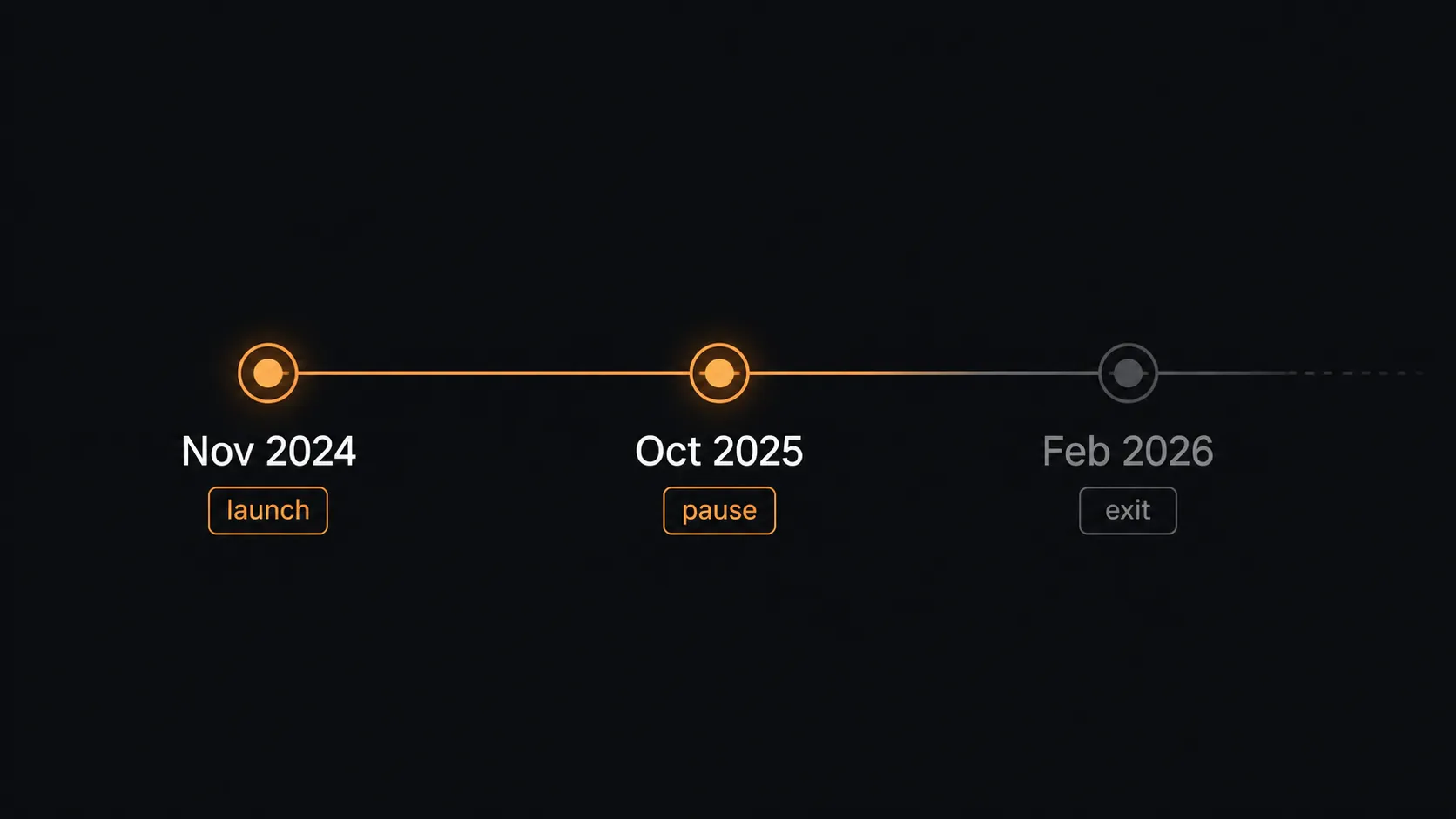
The ad channel lasted about 15 months
| Date | Platform change | Buyer implication |
|---|---|---|
| November 2024 | Perplexity began experimenting with sponsored follow-up questions in the US. | A limited pilot became available, rather than a mature, broadly accessible ad platform. |
| October 2025 | Perplexity paused new advertising deals while reassessing the business. | New access narrowed before the formal exit. |
| February 2026 | Perplexity stopped testing advertising. | The inventory ceased to be a current budget destination. |
Perplexity’s November 2024 launch post described advertising as an experiment and introduced sponsored follow-up questions alongside answers.[4] In October 2025, Adweek reported that the company had stopped accepting new advertising deals while it reconsidered its ambitions.[5] The February 2026 exit superseded both the original launch materials and any pre-exit instructions explaining how advertisers could participate.[1][2]
That sequence matters when reviewing old channel plans. A deck, agency guide, or platform announcement written during the pilot may accurately describe what existed then while being operationally useless now. No current Perplexity line item should survive a media plan merely because the product once had formats, pricing, and recognizable launch advertisers.
What advertisers could actually buy
The former product was more concrete than a speculative ad mockup, but much less complete than a performance marketer would expect from the phrase “search advertising.” Its signature format was a sponsored follow-up question: a paid prompt presented near an answer, designed to lead the user into another query or brand-related response. The pilot also included display and video placements.[4][6]
AdExchanger reported CPMs above $50 and fewer than a dozen advertisers as of March 2025. It also reported that Perplexity lacked both conversion tracking and self-serve buying.[6] Dataslayer described similar pilot mechanics, although its material should be used narrowly because its broader audience and date claims have known accuracy problems.[7]
| Buying stage | What the pilot offered | What the buyer still had to resolve |
|---|---|---|
| Access | A small, directly managed advertiser pilot | No self-serve interface for independently launching or changing campaigns |
| Placement | Sponsored follow-up questions plus display and video formats | Whether each placement matched the campaign objective and brand-safety requirements |
| Pricing | Reported CPM above $50 | Whether the price produced incremental reach or outcomes rather than premium-priced exposure alone |
| Delivery | Impression-based inventory around AI answers | How much reported platform usage was actually eligible, targetable, and available to the advertiser |
| Measurement | Basic campaign delivery without native conversion tracking | How to connect exposure with downstream leads, sales, or other business events |
| Optimization | A closely controlled test environment | How to make repeatable bid, audience, creative, or placement decisions without self-serve controls |
A high CPM was not, by itself, evidence that the product would fail. Premium contextual inventory can justify premium pricing when it delivers scarce attention or valuable audiences. The harder problem was the combination: a high reported price, a tiny advertiser pool, restricted access, and no native conversion trail.
A buyer could receive an impression report and still be unable to answer the client’s next questions. Which search interactions produced site visits? Which placements contributed to qualified actions? Could results be reproduced after changing creative or targeting? Was a lift visible against an untreated audience? Without those answers, verification shifted to manual tagging, analytics reconciliation, and assumptions about incrementality.
That distinction separates technically available inventory from a dependable performance channel. The pilot provided something to purchase, but it did not provide a complete loop from launch through conversion measurement and optimization.
Investment provided room to choose a different model
Nvidia belongs in this story as an investor, alongside other reported backers including SoftBank and Jeff Bezos.[3] That capital context helps explain why Perplexity could abandon an underdeveloped revenue line while building a subscription-plus-agent business around products such as Comet and Computer. It does not prove that Nvidia directed the exit, nor does investor participation demonstrate advertiser demand.
Reported company valuations and annual recurring revenue estimates also vary by source and date, so they should not be blended into a single settled profile. More importantly for media planning, company-level revenue or valuation would not reveal how many ad impressions were addressable, how much advertisers spent, or whether campaigns generated measurable outcomes.
Perplexity’s stated trust rationale is more relevant to the product decision. Reporting on the exit quoted the position that “a user needs to believe this is the best possible answer.”[1] Paid influence inside an answer engine creates an obvious tension: the commercial placement must remain distinguishable without weakening confidence that the underlying answer was selected for usefulness.
Scale did not remove the operational constraints. Wired cited Similarweb data estimating roughly 60 million monthly active Perplexity users in January 2026, while describing the user base as less than one-tenth the size of ChatGPT or Gemini. It also reported that weekly active users of the Comet agent had fallen from 7.8 million to 2.8 million.[2] Those are product-usage estimates, not counts of ad-eligible users, sellable impressions, or reachable campaign audiences.
For an advertiser, actionable scale begins after eligibility, geography, format availability, targeting, frequency controls, consent, and measurement requirements are applied. A platform can report a substantial audience while offering only a narrow slice that a buyer can purchase and defend.

The next verification burden sits with Google and OpenAI
With Perplexity unavailable, the two AI-search surfaces requiring the closest buyer attention in H2 2026 are Google’s AI Overviews and AI Mode, and OpenAI’s ChatGPT ad test. This is a concentration of testable inventory and verification work, not evidence that either platform has already produced a stable cross-advertiser benchmark.
Google: AI answers connected to an existing ad system
Google has placed ads in AI Overviews and developed conversational ad experiences for AI Mode. Buyers should follow the actual campaign eligibility, placement reporting, controls, and measurement behavior documented in the site’s Google AI Mode ads guidance, rather than assuming that every AI-generated answer represents separately buyable inventory.
Google’s advantage for testing is operational continuity: advertisers already have campaign accounts, conversion infrastructure, audiences, billing, and reporting workflows. The open issue is visibility. If AI placements are aggregated into broader campaign reports, a buyer may be able to run ads without being able to isolate how the AI surface performed.
OpenAI: a labeled test that still needs reporting detail
OpenAI began testing labeled ChatGPT ads for Free and Go users on February 9, 2026.[8] Labeling addresses one part of the trust problem, but it does not establish the buying model, the amount of available inventory, conversion access, placement controls, auction behavior, or the reporting granularity advertisers will receive.
The appropriate benchmark is therefore what an advertiser can verify, not ChatGPT’s total user base. The ChatGPT inventory benchmark should be updated as OpenAI discloses eligibility, buying access, pricing, delivery, and outcome reporting.
The broader spending pattern also argues against treating chatbot ads as the whole AI advertising market. A June 2026 eMarketer forecast said more than 80% of US AI advertising spend in 2026 would appear next to AI-created content rather than inside chatbots. It projected total US AI ad spend to more than double to $68.25 billion by 2030.[9] Forecast definitions and estimates should remain visible when those totals are used; the AI ad-budget conflict tracker is the better place to reconcile differing market numbers.
Strong referral growth can still come from a tiny base
AI-search referral traffic offers an early reason to test the category, but not a reason to skip scale checks. Brainlabs client data reported by eMarketer showed AI-referred sessions increasing 163% and AI-driven key events increasing 335%, while emphasizing that absolute traffic remained very small.[10]
Those percentages measure growth from the observed base; they do not establish that AI referrals can absorb a material share of budget. “Key events” also should not automatically be read as revenue, profit, or incremental conversions. Before treating the traffic as higher quality, a buyer needs the event definition, attribution window, sample composition, repeat-visit behavior, and absolute event count.
This is where AI-search tests can consume disproportionate analyst time. Small volumes produce unstable rates, referral strings may be incomplete, and platform-reported engagement can diverge from analytics or CRM outcomes. Testing remains reasonable, but the measurement plan should be sized for the likely volume rather than for the platform’s total reported audience.
Perplexity’s stance now extends beyond its own inventory
In August 2026, Perplexity blocked Time’s markdown-based ads intended for AI agents, calling the approach deceptive.[11] It is a single platform dispute, not proof of an industry-wide rule, but it is consistent with Perplexity’s resistance to paid influence that could be confused with independent content or system instructions.
What to verify next
- Google availability: Confirm whether ads continue to appear in AI Overviews and AI Mode for the relevant market, account type, campaign, query class, and device.
- Google measurement: Check whether AI placements can be identified separately in reporting and connected to conversion, value, and incrementality analysis.
- OpenAI labeling: Record how ChatGPT distinguishes an ad from an answer, recommendation, citation, or other commercial content.
- OpenAI buying and reporting: Track access, pricing, targeting, exclusions, placement detail, conversion support, and outcome disclosures through the OpenAI disclosure tracker.
- Referral quality: Test whether stronger AI-referred engagement persists when absolute traffic grows, and reconcile platform events with analytics, CRM records, and revenue.
- Usable scale: Ask for eligible impressions, delivered spend, advertiser participation, conversion volume, and outcome distributions—not only users, sessions, or percentage growth.
References
- Perplexity stops testing advertising, Search Engine Land, February 2026
- Perplexity Is Ditching Ads to Take On Google With AI, Wired, February 2026
- Perplexity Revenue, Valuation & Funding, Sacra
- Why We’re Experimenting With Advertising, Perplexity, November 2024
- Perplexity Pauses New Advertising Deals to Reassess Ambitions, Adweek, October 2025
- A Peek Behind the Curtain at Perplexity’s Nascent but Growing Ads Business, AdExchanger, March 2025
- Perplexity AI for Marketing: Should You Advertise on AI Search?, Dataslayer
- OpenAI starts testing ChatGPT ads, Search Engine Land, February 9, 2026
- US AI advertising forecast 2026, eMarketer, June 2026
- AI search referrals deliver higher-value visits—but at what cost?, eMarketer
- Perplexity blocks Time’s ads served to AI agents, calling them deceptive, Digiday, August 2026
Primary source: https://searchengineland.com/perplexity-stops-testing-advertising